

Before ordering a BGA PCB assembly pilot run, agree which packages will be X-rayed, how many boards will be checked, how findings will be judged, and who can release a held board. Ask for records tied to the board serial number and component reference designator. Specify functional tests separately and compare local and China-based suppliers against the same inspection and release requirements.
Key Takeaways
Identify the BGA locations, board revision, assembly variant and pilot quantity in the same RFQ.
Specify inspection coverage, the applicable acceptance criteria, the evidence you need and the findings that trigger expanded inspection.
Ask the assembler to show how an unclear image, a failed board and a reworked package will be recorded and dispositioned.
Define board-level functional tests around measurable behavior under stated conditions.
Compare local and China-based quotes by scope, access to evidence, rework logistics and time to engineering approval.
AI-generated illustration of a BGA package on an assembled board.
Why use X-ray inspection for BGA assembly?
BGA solder joints are underneath the package. X-ray can help assess features such as solder bridging and voids. The useful views and the types of findings the supplier can assess depend on the package, board layout and inspection setup. Ask the supplier what it expects to resolve on your board and what it will do if a view is ambiguous. Texas Instruments documents transmission X-ray inspection for laminate CSP and FBGA solder joints in its package assembly guidance. TI laminate CSP/FBGA assembly guide, section 10.8
For a first build, share the package part number and reference designator before the quote. If the board has components on both sides, ask the assembler whether features on the opposite side overlap the area of interest in the proposed view. Ask it to identify any locations that require a different view or additional review. This gives the hardware team a concrete question to resolve before it relies on an inspection result for a release decision.

AI-generated illustration of an inspection station. The screen depicts a simulated image.
What should the BGA inspection RFQ include?
Give each bidder the same revision-controlled package and ask it to return a written inspection scope. The scope should tell you which checks are included, which require separate pricing and what will happen if the agreed conditions cannot be met.
RFQ item | What the OEM should specify | What the assembler should confirm |
|---|---|---|
Build identity | Board revision, assembly variant, quantity and serial-number convention | How records identify the exact build and unit |
Package locations | BGA part numbers, reference designators and assembly drawings | Which locations can be evaluated with the proposed setup |
Sample plan | Required units and locations, plus conditions for expanding coverage | Starting coverage, escalation process and any additional charges |
Acceptance basis | Approved criteria, applicable document revision and class where specified, and package-specific limits | Measurement method and any unresolved criteria |
Evidence | Board ID, component location, image ID, result and disposition | Which images and reports are delivered and when |
Rework and release | Who can approve rework, disposition or a deviation | How original and post-rework results are linked |
Functional test | Firmware version, fixture, supply conditions, checks and pass limits | Who supplies the fixture and which records are returned |
Attach a build manifest listing the BOM, manufacturing outputs, placement data, drawings and test instruction revisions. If you change a file after sending the RFQ, identify the superseded version and ask the supplier to confirm the revision it will use. This matters when a package substitution, footprint update or assembly variant changes what the inspector should expect to see.
Ask bidders to separate one-time setup, inspection labor, functional-test setup, per-unit test and any optional rework charges. Two quotes can both claim X-ray inspection while covering different board quantities or BGA sites. Have each supplier state those quantities in its response so procurement can compare equivalent scopes.
How do you choose full inspection or sampling?
Tie the coverage to the question the pilot needs to answer. When engineering wants an individual record for every board carrying a newly introduced package, ask for full coverage at that location. When the objective is to monitor an established process, engineering and the assembler can agree on a sample and an explicit rule for escalating it. Define what counts as the lot, how units are selected and whether remaining boards will be held if the sample gives an unexpected result.
For an illustrative 20-board pilot, the OEM might ask to inspect U5 on all 20 boards and U9 on an agreed subset. If the supplier confirms a finding against the agreed U9 criterion, the written plan could require the remaining U9 locations to be inspected before release. If U5 is reworked on any board, the plan could require a new inspection record for U5 on that unit. Set your own coverage and escalation rules based on the package, project and consequences of a missed defect.
What evidence should a supplier deliver before release?
Start with a lot summary that reconciles the build quantity with the number inspected, tested, passed, failed, held and reworked. Then ask for unit-level records at the locations specified in the RFQ. A reviewer should be able to trace an image and its disposition to a board without relying on a separate email conversation.
A simple delivery format is a folder of inspection images and a spreadsheet keyed by serial number and component reference designator. Agree the naming convention before the build. If the supplier uses an internal naming system, ask for a cross-reference in the export. Specify whether you need all agreed images, annotated exceptions, or another combination. Keep the release package with the build files so a later revision can be compared against the correct baseline.
An illustrative record could read: board P014, component U5, image XR-P014-U5-02, criterion from the approved inspection plan, result held for review, release pending OEM approval. This example shows how to trace a finding and its decision. It represents a hypothetical record with no production measurements.
What happens when a result is unclear or a board is reworked?
Have the supplier document the suspect location, view, image ID and reason the result is unresolved. Assign a hold status and agree who can clear it. Depending on the finding, the next step might be another view, an agreed complementary check or engineering review. Record the final disposition and the decision owner alongside the original result.
If rework is approved, ask for a record showing what changed, who authorized it, and which inspections and functional checks were repeated. When a component is replaced, confirm whether the supplier should record the replacement part identification. If a board ships under an approved deviation, the release package should make the exception visible to receiving inspection. Reconcile held and rejected units in the lot summary so the shipment quantity can be explained without losing the history.
Which functional tests belong in the pilot?
Use a separate board-level test plan to verify the defined electrical behaviors. For a controller, a practical starting set might include loading the approved firmware, checking boot behavior, measuring current under a specified supply condition and exercising an interface with a documented fixture. For each check, give the input or setup, expected result, measurement limits and evidence format.
Assign responsibility for the fixture, firmware, cables and any reference units. Ask the supplier to demonstrate a passing and a failing condition when the setup is first reviewed. That demonstration helps the teams agree how a failure is logged and how the operator distinguishes a board fault from a setup problem. If a fixture is revised during the lot, record which version was used on each affected unit.
Some checks require the final enclosure, sensors, wiring or controlled operating conditions. List those separately in the OEM validation plan. The supplier’s board-level records can then accompany the unit into integration without conflating assembly acceptance with finished-system verification.
Before accepting a functional-test quote, ask which checks will return a measured value and which will return a pass or fail flag. For current draw, for example, specify the supply voltage, firmware state, connected peripherals and measurement window. Request the recorded value with its unit so the OEM can compare results across pilot units and investigate later changes. For an interface check, identify the expected response and the timeout that counts as a failure. Agree how retests are recorded when a cable is reseated, a fixture is reset or a board is reworked. Keep the first result alongside later outcomes. At receiving inspection, use the serial number to reconcile the test log with the shipment and flag missing records before releasing units to integration.
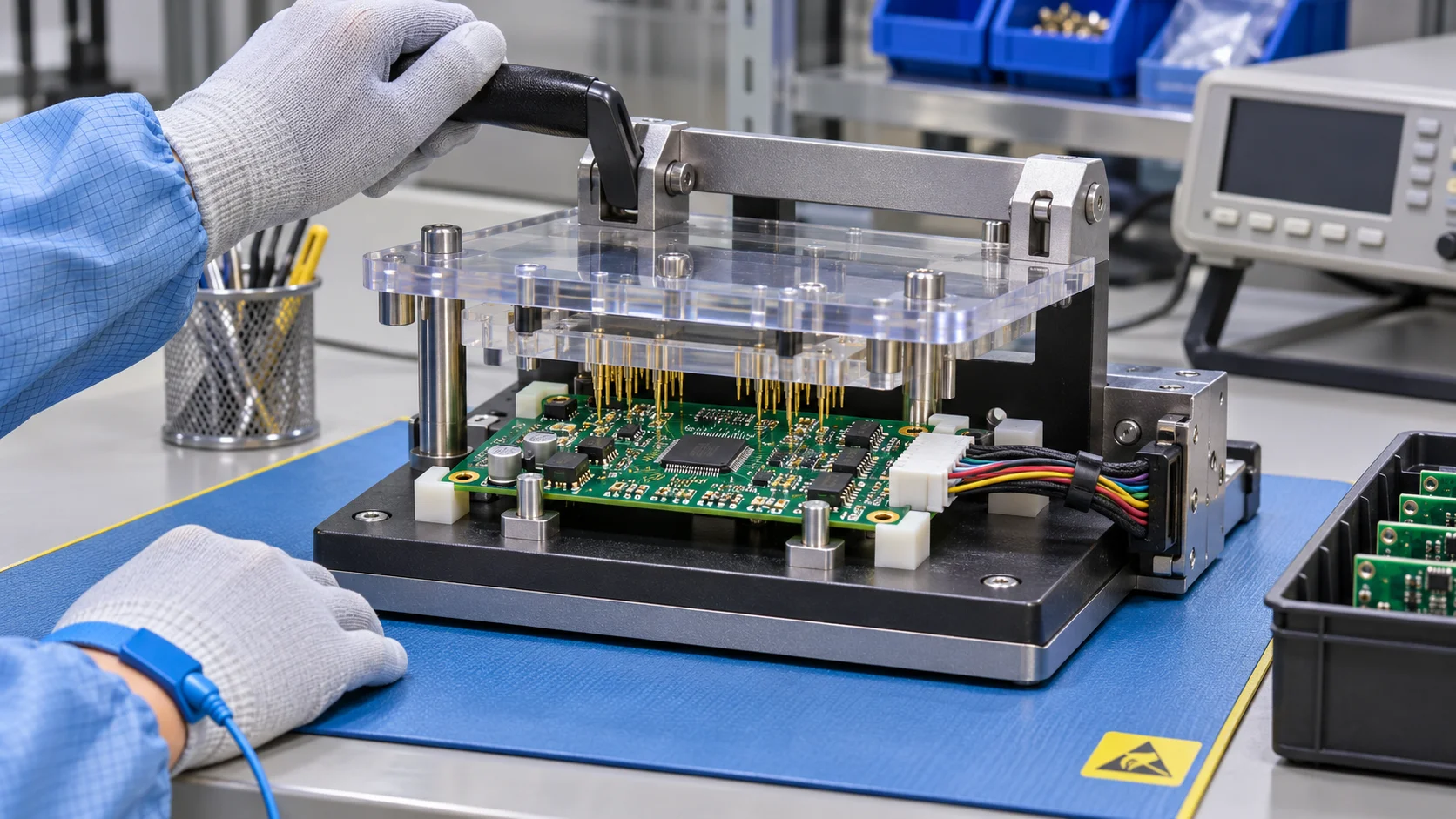
AI-generated illustration of board-level functional testing.
How should European OEMs compare local and China-based suppliers?
Compare the time from a technical question to an approved release decision. A nearby supplier may fit a pilot when the OEM expects frequent in-person reviews, fixture iterations or quick physical access to held units. A China-based supplier can fit when the package, decision rules and remote review workflow are defined. Validate the actual capabilities and access arrangements for each bidder before choosing.
Decision point | Ask a local supplier | Ask a China-based supplier |
|---|---|---|
First-board review | Can engineering attend, and when can the inspection setup be reviewed? | Can engineering review annotated images and results before the balance of the lot is released? |
Fixture ownership | Can the OEM deliver, revise and retrieve the fixture during the pilot? | Who builds or receives it, and how will revisions be approved remotely? |
Held boards | Where are they stored, and can the OEM collect a unit for failure analysis? | Can units be segregated before dispatch, and how will samples be returned if needed? |
Quote comparison | What setup, inspection, testing and rework are included? | What are the same costs plus shipment and any return or repeat-shipment charges? |
Use the same response deadline and ask each bidder for a sample report layout. Evaluate whether it includes the fields your receiving team needs and whether the review can happen before shipment. A hybrid pilot can also make sense when a nearby engineering team needs one or two early boards and the follow-on build needs a different assembly partner. In that case, document which criteria, fixture settings and decision records transfer with the package.
VeryPCBA lists X-ray inspection equipment and functional test fixtures. Ask it to confirm the actual BGA coverage, data exports, test setup and disposition workflow for your board during RFQ review. VeryPCBA inspection equipment
FAQ
Can I use a single voiding limit across every BGA on the board?
Ask engineering and the supplier to agree the basis for each applicable limit. Specify the relevant package, document revision, measurement method and any product-specific requirements. If the criterion is unresolved, flag it for review before the assembler begins using it to release boards.
Should I request raw images or annotated findings?
Request the evidence needed for your review process. Raw images can support later re-review when the image format and viewing method are usable by your team. Annotated findings can make the first review faster. State which records must be provided routinely, which are required for exceptions and how they will be matched to the serial number.
What should be checked again after a board revision?
Review changes to package part numbers, board-side placement, footprints, nearby copper or components, and the test interface. Agree whether those changes affect inspection views, sample coverage or functional test setup. Update the revision references on the work instruction and release package for the next build.
Who makes the final release decision?
Assign that responsibility before production. The assembler can report outcomes against agreed criteria and flag exceptions. The OEM should identify who can accept a deviation or approve shipment of affected units. Ask the supplier to link any approval to the affected serial numbers and keep it in the release package.
For a BGA pilot quote, send the board revision, pilot quantity, BOM, manufacturing files, BGA locations and draft inspection and functional-test criteria. Ask for separately priced coverage options and a sample evidence package. VeryPCBA