
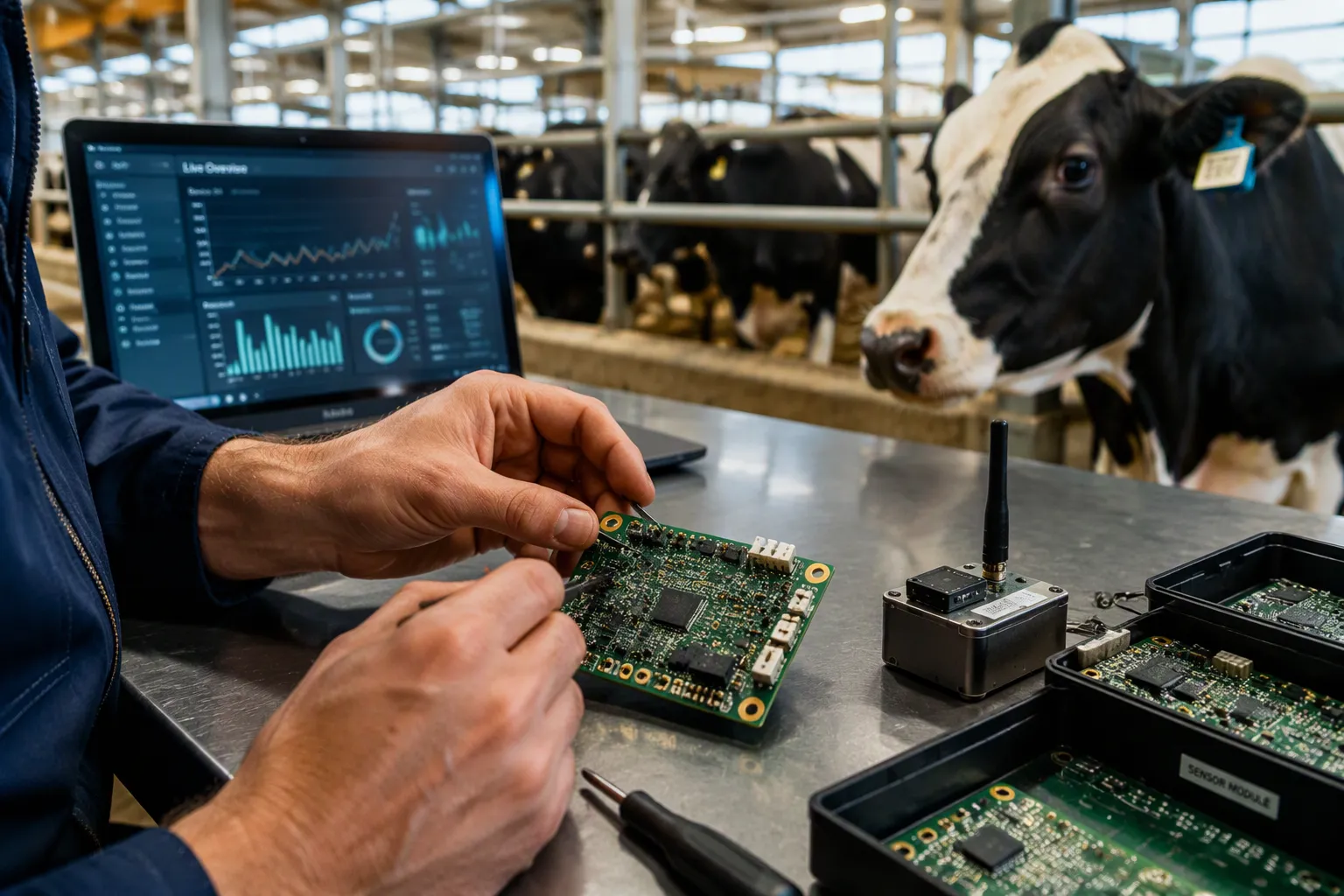
Pasture conditions punish weak electronics. Manual herd checks and basic ear tags give you delayed sightings, short read range, and housings that fail under rain, mud, and sun. You lose real-time visibility exactly when an animal strays or a health event begins.
AI livestock tracking PCBA assembly solves this at the board level. It brings GNSS positioning, LoRa or LoRaWAN backhaul, on-board AI processing, and tightly managed power onto one compact platform. Each subsystem shares the same layout, thermal path, and enclosure, so the device stays small and survives the field.
Board-level decisions drive range, battery life, and ruggedness. A well-built AI livestock tracker PCB turns raw location and sensor data into dependable herd intelligence.
Key Takeaways
AI livestock trackers give you real-time animal locations and health alerts from your phone.
Solar power and smart power management keep trackers running for up to 5 years.
Triple-proof coatings and IP67 housings protect the board from water, mud, and corrosion.
Compact boards pack GPS, 4G, and AI into a small space for reliable field performance.
Blockchain and cloud platforms make livestock data traceable and secure for the future.
Inside AI Livestock Tracking Systems
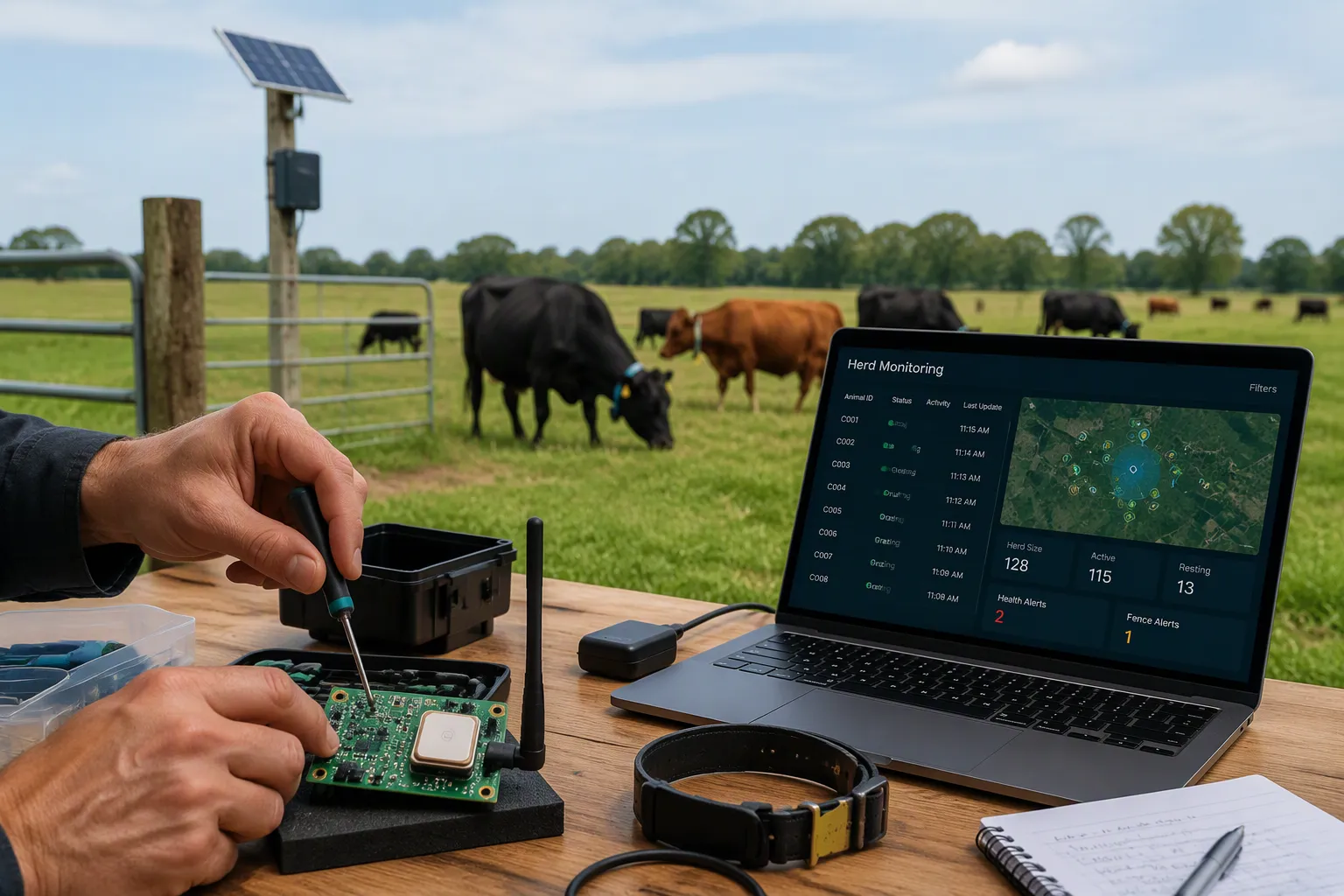
A complete herd-monitoring deployment rarely relies on one device type. You will typically see four categories working together: livestock locators that report animal position, agricultural trackers that follow equipment and herd movement, environmental collectors that sample temperature and air quality, and solar monitoring terminals that keep remote sites powered and connected. Each category shares the same core building blocks — a positioning engine, a radio, a processor, and a power stage. The AI livestock tracker PCB ties those blocks together, so a single board platform can serve several device roles with modest firmware changes.
Tracker Hardware and Data Flow
Hardware starts with the sensing layer. Collars, ear tags, and gateway nodes gather biological, environmental, sound, and behavioral data from animals. The board packages that information into data units with metadata covering type, origin, size, and destination, then transmits it over the network with validation checks that confirm authenticity and flag corruption. Storage follows in flexible database schemas that accept weather records, air quality readings, audio, behavior logs, images, and video without a fixed form. Analysis then runs a machine learning pipeline: gather pre-organized data, preprocess it through cleaning, transformation, and normalization, extract or create features, then define, train, and evaluate the model before deployment. Delivery closes the loop. You see the results through interpretable interfaces, and business intelligence tools such as Tableau and Power BI pull from flat files, SQL databases, and cloud platforms to support daily decisions. Integration matters at every stage, because each sensor has limits and complementary sources compensate for failures.
GNSS and LoRa Integration
Positioning and backhaul determine how far your data travels and how long the battery lasts. GNSS supplies the fix; LoRaWAN carries it. The table below shows how these choices land in real hardware.
Device | Positioning | Data Transmission | Key Specs |
|---|---|---|---|
FL-C006 Solar GPS Livestock Collar | GNSS, high-precision dual-mode real-time positioning | LoRaWAN plus global 4G | Solar-powered, 60-month outdoor deployment, virtual geofence, behavioral monitoring |
FL-T005 Solar Smart Ear Tag | Tag-level tracking | LoRaWAN, up to 5,000 m range (US915/AU915/EU868) | Solar harvesting, 5-year lifespan, 17 g, IP67, automated cattle counting |
General livestock tracker | GPS | LoRaWAN, 5,000 m range | Micro solar harvest with 5-year span, automated cattle counter |
A LoRaWAN smart collar with a GPS tracker turns raw coordinates into actionable insight. The virtual geofence triggers an alert when an animal crosses a boundary. Behavioral monitoring flags unusual activity patterns. Automated cattle counting removes a manual walk through the pasture. You read all of this on a dashboard instead of walking the fence line.
Power and Environmental Design
Field reliability starts with the power budget. A tracker that dies mid-season gives you no value, no matter how good its radio is. Solar harvesting plus a managed battery keeps the AI livestock tracker PCB alive across multi-year deployments.
Battery and Solar Power Management
Solar-powered edge-AI platforms let you run livestock and environmental monitoring completely off-grid. The board harvests during daylight, runs inference on-device, and transmits only the results. That pattern cuts radio airtime, which is the largest single draw on a small cell.
Low-power design is a shared requirement across every device type. Locators, agricultural trackers, environmental collectors, and solar monitoring terminals all compete for the same milliamp budget. Start with duty cycling: wake the GNSS engine on a schedule, keep the LoRaWAN radio in its lowest state between reports, and let the AI model filter events before transmission. The table below shows how supplied hardware specs reflect this approach.
Device | Power Source | Rated Field Life | Weight |
|---|---|---|---|
FL-C006 Solar GPS Livestock Collar | Solar | 60-month outdoor deployment | — |
FL-T005 Solar Smart Ear Tag | Solar harvesting | 5-year lifespan | 17 g |
General livestock tracker | Micro solar harvest | 5-year span | — |
Waterproof and Moisture-Proof Design
Moisture kills boards quietly. Condensation forms inside a sealed housing when temperature swings, and mud and rain attack every seam. The FL-T005 ear tag carries an IP67 rating, which means it survives dust ingress and short immersion. Treat that rating as a system property, not a housing property.
Conformal coating protects the AI livestock tracker PCB from humidity and corrosive pasture chemistry. Gasket geometry, cable gland sealing, and pressure-equalization vents complete the barrier. Validate the full assembly with ingress testing before release, and confirm that coating thickness and cure do not interfere with connector mating or thermal paths.
AI Livestock Tracker PCB Assembly
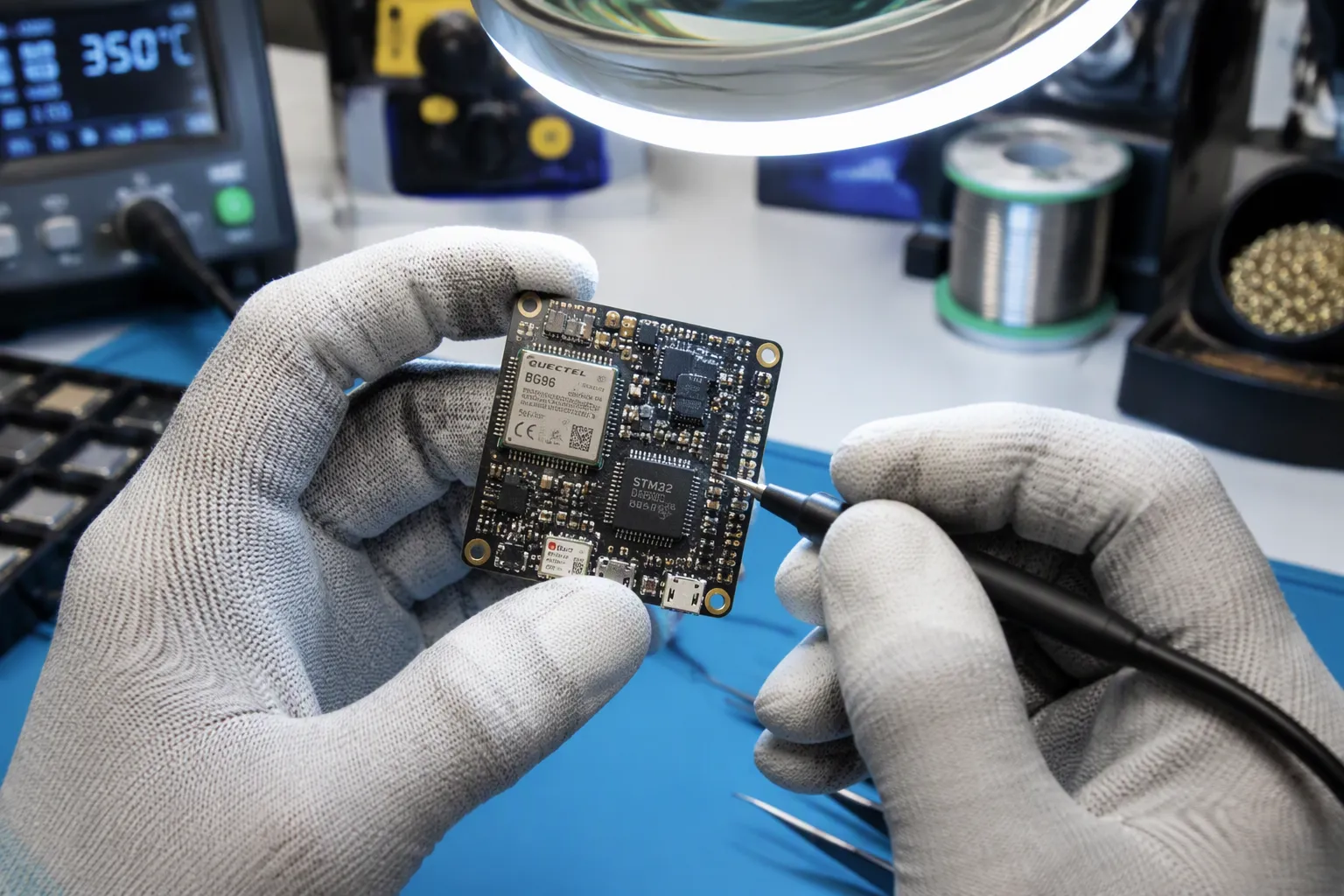
Compact boards demand disciplined engineering. A 50mm x 50mm platform that carries 4G connectivity and GPS tracking shows how much function you can pack into a small footprint. That board must route a cellular modem, a GNSS receiver, a microcontroller, and a power stage without crosstalk or thermal hotspots. You achieve this through careful component selection and layout discipline.
Compact AI Livestock Tracker PCB Design
Layout follows signal priority. Place the GNSS antenna away from the cellular radio to limit interference. Keep the RF traces short and impedance-controlled. Route power planes under the modem to spread heat. Group sensitive analog circuits away from switching regulators. A compact AI livestock tracker PCB succeeds when every millimeter serves a purpose.
Manufacturing and Quality Processes
The table below compares assembly approaches on the criteria that matter for livestock trackers.
Traceability closes the loop. Log every board serial against its test results. Retain coating batch records and component lot numbers. This data supports warranty claims and field diagnostics. A tracker that fails in month 30 becomes a known quantity, not a mystery.
Benefits and Future Trends
Real-Time Tracking and Asset Security
Real-time positioning changes daily herd work. You monitor cattle and sheep from a dashboard instead of walking the pasture. Constant notifications reach your phone and replace manual inspection. Individual animal identification gives you instant access to birth date, health records, vaccinations, and breed. Your team then spends saved hours on value-added tasks.
Animal safety improves on the same platform. Location monitoring and loss prevention keep animals from straying. Vital-sign monitoring reveals condition and stress levels. Alerts fire when a sensor is removed or an animal leaves a defined area. Real-time weather alerts let you act before conditions turn. Identification also supports disease prevention and food traceability.
Sensor- and AI-based approaches have been proposed to identify, monitor, and control health-related features in livestock, including early mastitis detection in dairy cows, gait analysis and lameness detection, respiratory pattern monitoring, diarrhea and respiratory disease in calves, body condition scoring, body temperature measurement, and behavior monitoring.
Cloud Monitoring and Traceability
Cloud platforms turn tracker data into shared records. Blockchain strengthens that record. Baralla, Pinna, and Corrias (2019) show that blockchain guarantees data integrity and traceability through a single shared mechanism, and an Ethereum-based smart contract system traces food product origin. Terzi et al. (2019) describe networks of trust built on transparency and permanent digital records, with immutability that prevents deletion or alteration. Lin et al. (2018) combine blockchain with RFID to raise traceability and food safety across the whole supply chain. Iqbal and Butt (2020) link IoT devices to the immutable ledger to guarantee reliable information sharing among stakeholders.
Precision agriculture trends point the same direction. Widespread sensor deployment now covers soil, crops, weather, location, and machinery. IoT with cloud computing enables real-time data processing and simplifies decision-making. Herd monitoring analyzes health, nutrition, and behavior while supporting traceability and animal welfare. Your AI livestock tracker PCB sits at the front of this chain, and a well-built AI livestock tracker PCB keeps every downstream record trustworthy.
You now have the full picture. End-to-end PCBA assembly unifies AI processing, GNSS positioning, LoRaWAN backhaul, solar power management, and triple-proof ruggedization on one board. That integration produces dependable smart farming devices instead of a stack of parts that fight each other. Your herd gains real-time visibility, your team gains efficiency, and your animals gain protection from loss and theft.
FAQ
What makes a livestock tracker board survive pasture conditions?
How do you extend battery life on a solar-powered tracker?
Start with duty cycling. Wake the GNSS engine on a schedule, hold the LoRaWAN radio in its lowest state between reports, and let on-device AI filter events before transmission. Solar harvesting then covers the average draw. Supplied designs reach a 60-month outdoor deployment and a 5-year lifespan on this approach.
Can one compact board carry 4G and GPS together?
How do you verify assembly quality before shipment?
Inspect solder joints against IPC-A-610 Class 2 criteria, then run functional tests that confirm GPS lock, 4G registration, and radio range. Log every board serial against its results and retain coating batch records. Batch PCBA production keeps unit consistency high across large orders.
What range can a LoRaWAN tracker achieve in the field?
Supplied LoRaWAN designs reach up to 5,000 m on US915, AU915, and EU868 bands. Real range depends on terrain, antenna placement, and gateway height. Combine the radio link with a virtual geofence and automated cattle counting to turn raw coordinates into daily herd insight.
See Also
Malaysian Hardware Firms Get AI IoT PCBA Manufacturing Solutions
Irish MedTech and IoT Firms Receive Turnkey AI PCBA Services
Mexican Electronics Companies Benefit From Custom AI PCBA Manufacturing
Swiss Medical and Measurement Devices Use High-Precision AI PCBA
Singapore IoT and MedTech Projects Get Turnkey AI PCBA Service