
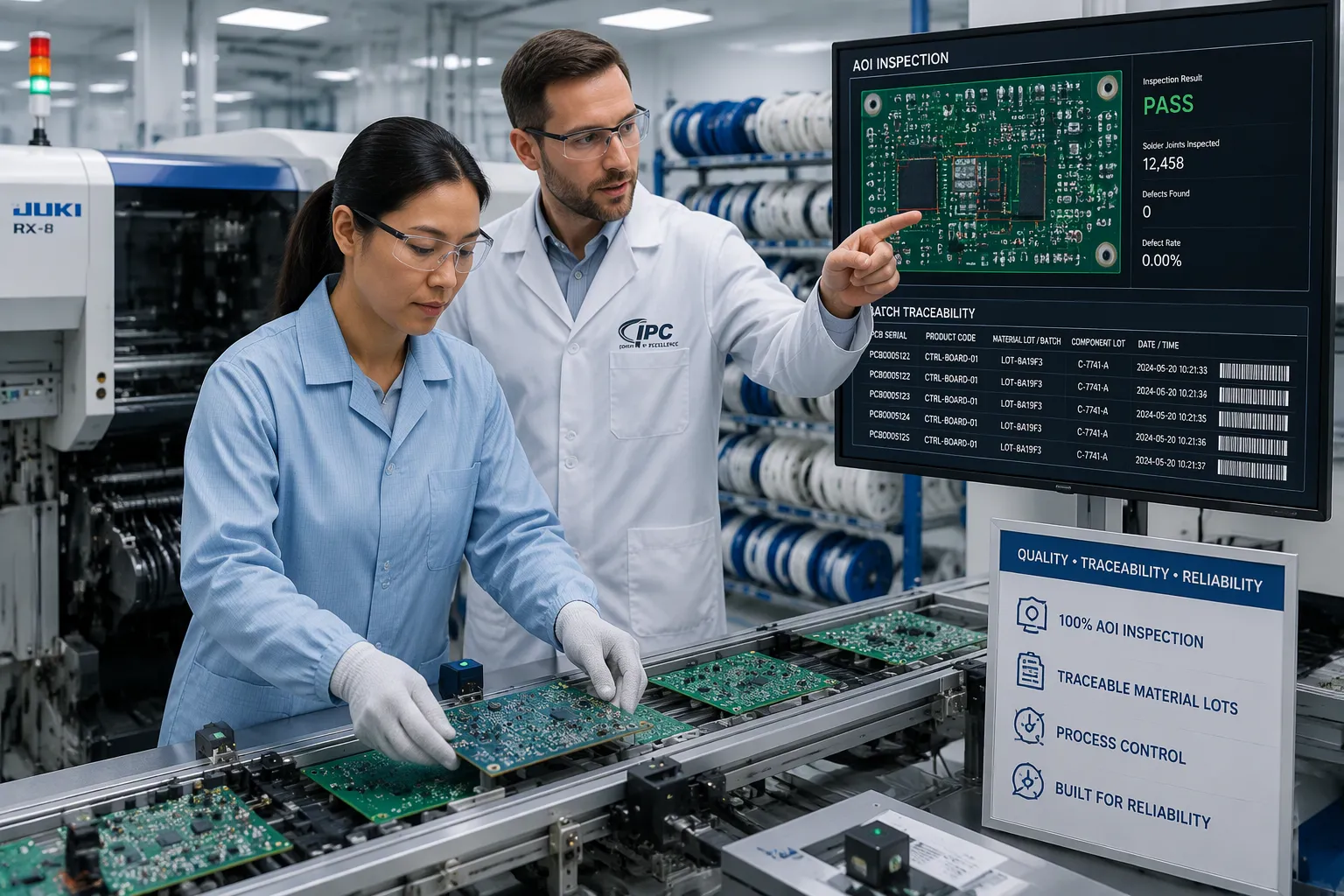
A mixed SMT/THT build fails an audit, and the rework analysis stalls. Material lots cannot be traced back to their date codes, and AOI escapes slip through to functional test. These two failures separate audit-ready assembly partners from commodity suppliers in electronics manufacturing. Traceable material batches prove what went into each board. AOI proves what came out correctly. The ten services compared below—EBest Circuit, UPKTECH, GreatPCB, SLLPCB, JLCPCB, PCBWay, NextPCB, PCBasic, Viasion Technology, and FS Technology—face identical criteria, from lot-level documentation to inspection equipment. Readers can scan the comparison table first, shortlist candidates, and then read the full profiles, including how each handles assembly manufacturing SMT THT work.
Key Takeaways
Traceable material batches and AOI are critical for audit-ready PCB assembly.
Request documentation samples and AOI programming examples to verify supplier claims.
Use X-ray inspection for hidden joints like BGAs that AOI cannot see.
Scale traceability depth with order volume: simple records for prototypes, detailed logs for production.
Run a pilot build to confirm lot records, AOI programming, and inspection linkage before committing.
SMT and PCB Assembly Comparison Table
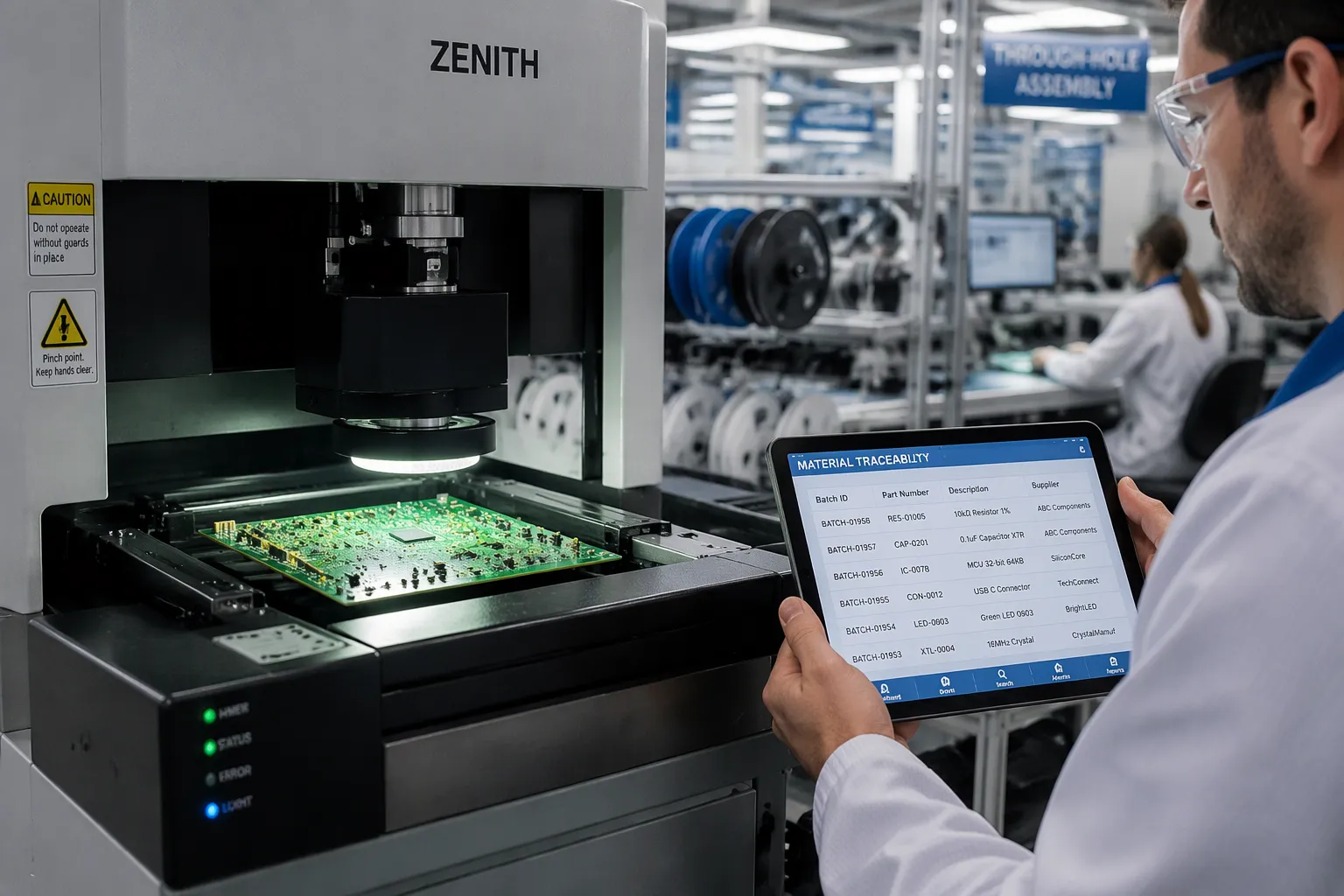
The table below compares all ten services on five columns. The traceability workflow column shows how each supplier records material lots, from incoming inspection through shipment. The AOI equipment column lists the inspection method each provider applies to surface-mount joints. The SMT/THT mix column indicates whether a service handles surface-mount work alone or combines it with through-hole assembly. The compliance column covers the documentation and standards each supplier supports. The cost profile column describes where each service sits on price, from prototype-friendly to volume-oriented.
Service | Traceability workflow | AOI equipment | SMT/THT mix | Compliance | Cost profile |
|---|---|---|---|---|---|
EBest Circuit | Lot-level material tracking with documentation | Inline AOI plus X-ray | SMT-focused, fine-pitch | Documentation on request | Mid to high |
UPKTECH | Customized line-level batch records | AOI integrated per line design | SMT and THT turnkey | Configured per project | Project-based |
GreatPCB | Coordinated sourcing and batch records | AOI per package type | Mixed technology | Documentation on request | Mid |
SLLPCB | Batch-level records for regulated builds | AOI programmed per build | SMT and THT | Audit-ready records | Mid to high |
JLCPCB | Batch records that scale with volume | AOI at each volume tier | SMT-focused | Standard documentation | Low, fast-turn |
PCBWay | Serialized material tracking | AOI plus complementary methods | Complex multi-package | Documentation on request | Mid |
NextPCB | Inspection data linked to batches | 3D AOI plus X-ray | SMT and THT | Documentation on request | Mid |
PCBasic | Documented batch control | AOI with cost-efficient setup | SMT and THT | Documentation on request | Low to mid |
Viasion Technology | Documented batch control | Automated line inspection | THT-intensive | Documentation on request | Mid |
FS Technology | Batch substitution records at volume | Automated inspection | SMT and THT | Documentation on request | Volume-oriented |
Three differentiators matter most for shortlisting. First, traceability depth ranges from simple lot records to serialized tracking with substitution logs. Second, AOI coverage varies from standard two-dimensional inspection to 3D AOI combined with X-ray for hidden joints. Third, cost profile tracks volume: quick-turn services suit prototypes, while enterprise-scale providers fit high-volume programs. Buyers who need audit-ready records for a printed circuit board program should weight the first two columns heavily. Those chasing fast, low-cost pcb assembly runs can accept lighter documentation. Every pcb build still deserves a documentation sample before commitment.
1. EBest Circuit: Fine-Pitch SMT Assembly with Inline AOI
Capabilities and Traceability
EBest Circuit builds its baseline around dense, fine-pitch work. The line handles 01005 component placement and fine-pitch BGA assembly, two package types that punish any drift in the smt process. Solder paste control sits at the center of that discipline. The team manages solder paste volume, solder paste printing parameters, and solder paste storage conditions before reflow soldering begins. Each of those solder paste checks feeds the lot record, so a failed print never disappears into the reflow oven.
Traceability follows the material lot rather than the work order. Incoming components receive lot-level tracking, and the documentation ties each lot to the boards it entered. Buyers can request lot records, date codes, and substitution notes for a given build. This class of provider typically documents solder paste lot numbers alongside component lots, which matters when a rework analysis needs to isolate a single variable. The same records support the pcb audit trail that quality teams request during supplier reviews.
AOI and Best-Fit Applications
Inspection combines aoi with X-ray verification. The optical pass checks solder joint shape, component placement, and polarity across the visible surface. X-ray then covers the joints that optics cannot reach, including the fine-pitch BGA arrays that define this service tier. Together, the two methods catch the escapes that a single inspection step would miss.
This service fits dense, fine-pitch boards where smt placement accuracy drives yield. Designs that lean on surface mount technology and smt surface mounting for most of their real estate benefit most. The soldering process stays under tight control from print through reflow. Buyers with mixed boards can still use the service for the smt assembly portion and source through-hole work elsewhere. The assembly profile rewards programs that value inspection depth over the lowest quote.
2. UPKTECH: Customized SMT and THT Turnkey Lines
Capabilities and Traceability
UPKTECH operates as a one-stop partner for PCBA manufacturers. The model starts with equipment selection, moves through line layout planning and integration, and continues with after-sales support after the line goes live. A buyer describes the product mix, the expected volume, and the package types on the board. UPKTECH then proposes a line configuration that matches those inputs. This differs from a standard turnkey quote, where the buyer accepts a fixed line and fits the product to it.
Customized line design changes the traceability workflow at the source. Each station in the planned layout gets its own data capture point, so batch documentation follows the physical flow of the board. Incoming material scans, paste records, and placement data attach to the same batch identifier. The buyer receives a documentation structure built around the line, not bolted on afterward. That structure makes a pcb audit easier to run, because every record maps to a known station.
AOI and Best-Fit Applications
AOI sits inside the line design rather than at the end of it. UPKTECH integrates inspection where the layout places it, which lets the team set coverage per station. The approach suits mixed smt and tht builds, where surface-mount joints and through-hole solder points need different inspection strategies. Buyers can define the inspection plan alongside the equipment plan.
This service fits buyers who need line-level customization rather than standard turnkey assembly. A contracted electronics manufacturer building several product families benefits most. The same applies to programs where batch documentation must match a specific audit format. Buyers with a single, stable product and no layout requirements will find simpler turnkey options more economical. The customization pays off when the line itself becomes part of the quality system.
3. GreatPCB: Mixed-Technology SMT Assembly and Sourcing
Capabilities and Traceability
GreatPCB coordinates component sourcing with smt assembly and through-hole work under one roof. The service covers surface mount technology placement, tht components, and mixed-technology builds where both package types share a single board. Sourcing stays inside the same workflow, so the buyer does not manage a separate component vendor. That coordination matters for traceability. Incoming parts receive batch records at the sourcing stage, and those records follow the parts onto the line.
The traceability chain links each sourced lot to the assembly batch that consumed it. Buyers can request lot records and date codes for the build. The smt process documentation covers paste and placement data for the surface-mount portion. Through-hole work carries its own batch notes. A pcb audit then has a single source for both halves of the build.
AOI and Best-Fit Applications
The inspection and test plan follows the component packages on the board. Surface-mount joints go through AOI for placement, polarity, and solder joint checks. Through-hole points receive inspection suited to their joint geometry. GreatPCB builds the plan around production requirements, so a buyer can request added test coverage for critical nets or tighter sampling on dense areas.
This service fits builds that mix surface-mount and through-hole packages on one board. A design with fine-pitch smt parts on one side and connector tht components on the other benefits from one coordinated assembly partner. Buyers who source components separately will find less value here. The sourcing-plus-assembly model rewards programs that want one point of accountability for material and workmanship.
4. SLLPCB: Traceable Batches for Regulated Builds
Capabilities and Traceability
SLLPCB runs smt and tht assembly on the same floor. The service covers surface-mount placement and through-hole soldering for boards that carry both package types. Batch-level documentation anchors the workflow. Each production batch receives its own record set, and that set follows the boards from incoming material inspection to final shipment. Buyers can pull lot records, date codes, and material certificates for any batch they receive.
The documentation structure suits regulated builds. An auditor expects to trace a finished pcb back to the material lots that entered it, and the batch record supports that path. SLLPCB treats the record as a deliverable rather than an afterthought. Buyers who request a sample record set before placing an order can judge the depth for themselves.
AOI and Best-Fit Applications
The aoi program is written per build. Engineers review the board layout, the package mix, and the inspection points before they set criteria. Solder joint thresholds, placement tolerances, and polarity checks then follow the specific build rather than a generic template. This per-build approach matters for tht components, which need different inspection criteria than fine-pitch surface-mount parts. The team documents the inspection criteria alongside the batch record, so a buyer can see what the machine checked and against which limits.
This service fits buyers who need audit-ready records. Programs that face periodic supplier audits or customer quality reviews gain the most. The batch documentation and the inspection criteria travel together, which shortens an audit response. Buyers with light documentation needs will find the record depth exceeds their requirements. The fit is strongest where the record itself carries contractual weight.
5. JLCPCB: Quick-Turn SMT Assembly from Prototype to Volume
Capabilities and Traceability
JLCPCB serves the full path from prototype to volume production. A buyer can start with a small prototype run and scale the same design into larger orders without changing partners. That continuity matters for documentation. Material batch records grow with each volume tier. A prototype order carries basic lot records tied to the parts consumed. A volume order adds batch-level records that cover incoming material, date codes, and the production run itself. Buyers who plan to scale should confirm the record depth at each tier before they commit.
The traceability model favors speed over depth. Records exist and scale with order size, but the documentation stays standard rather than customized. A buyer with a strict audit format may need to request additional fields. A buyer chasing fast turnaround on a cost-sensitive build will find the standard record set sufficient.
AOI and Best-Fit Applications
AOI coverage follows the same tiered logic. Prototype runs receive inspection suited to low quantities. Volume runs apply AOI across the full production batch, so every board passes through the same optical check. The inspection verifies solder joints, placement, and polarity on visible surface-mount joints. Buyers should ask which tiers include full AOI coverage and which rely on sampling.
This service fits fast-turn, cost-sensitive builds. Prototype teams, small-batch product launches, and price-driven pcb programs gain the most. The smt assembly line handles standard surface-mount work well. Dense fine-pitch designs with hidden joints may need X-ray from another source. Buyers who weigh speed and cost above deep customization will find a strong match here.
6. PCBWay: Serialized Tracking for Complex Assemblies
Capabilities and Traceability
PCBWay applies serialized material tracking to complex, multi-package assemblies. Each unit or batch receives an identifier, and that identifier links the finished board to the material lots consumed during build. A board that carries fine-pitch surface-mount parts, connectors, and several package families generates a long material list. Serialization keeps that list readable. A buyer can pull one record and see which lots entered a specific assembly, rather than reconstructing the history from work orders.
The documentation suits programs where a single board mixes many package types. Lot records, date codes, and substitution notes travel with the serial number. Buyers should request a sample record set before quoting, then confirm that the sample matches the format their quality team expects. The tracking depth rewards complex designs. Simple single-package boards gain less from serialization and can use lighter documentation.
AOI and Best-Fit Applications
Inspection combines aoi with complementary methods. The optical pass verifies solder joints, placement, and polarity on visible surface-mount joints. Complex assemblies often hide joints under packages or on secondary sides, so the team adds further checks beyond the optical scan. Buyers should ask which complementary methods apply to their board and how the results attach to the serial record.
This service fits high-complexity boards. Designs with dense smt placement, multiple package families, and mixed technology on one pcb benefit most from serialized tracking plus layered inspection. Buyers with simple, high-volume boards will find the tracking depth exceeds their needs. The fit is strongest where assembly complexity makes lot-level reconstruction difficult without serialization.
7. NextPCB: 3D AOI and X-Ray Combined Inspection
Capabilities and Traceability
NextPCB pairs three-dimensional automated optical inspection with X-ray verification on its smt lines. The 3D scan measures solder joint height and volume, not just the visible surface. That measurement catches joints that look acceptable from above but sit too thin or too thick. X-ray then penetrates the board and images the joints hidden beneath packages. Each method verifies a different layer of the solder connection, and the two results combine into one inspection record.
Inspection data links back to material batches through the batch identifier. A board enters the line under a batch number, and the inspection results attach to that number. A buyer can pull the batch record and see which material lots entered the build alongside the inspection outcome. This linkage supports a pcb audit, because the record connects incoming material to the finished joint. Buyers should request a sample batch record and confirm the inspection data appears in it.
AOI and Best-Fit Applications
The combined inspection suits boards with hidden joints. Ball grid array packages hide every joint under the body, so optical inspection alone cannot confirm the connection. X-ray fills that gap. The 3D aoi inspection still covers the visible surface-mount joints, where it checks placement, polarity, and joint shape. Together, the two methods give coverage across the whole board rather than the exposed half.
This service fits designs where BGAs or other area-array packages carry critical signals. Buyers should ask how the provider programs the aoi inspection for their specific package mix and how X-ray results are reported. A pilot build with a documented inspection report gives the clearest evidence before a full order. Boards with only exposed joints gain less from the X-ray step and can weigh simpler inspection options.
8. PCBasic: Cost-Efficient Traceability for Mid-Volume Runs
Capabilities and Traceability
PCBasic targets the middle of the volume curve. The service covers smt placement and through-hole soldering for runs that sit between prototype quantities and full production. Batch control stays documented at this tier. Each run receives a batch identifier, and that identifier links incoming material lots to the boards produced. Buyers can request lot records and date codes for a given order. The record set is leaner than a serialized program, yet it still supports a pcb audit when the buyer needs to trace material back through a build.
The documentation model favors repeatability over customization. A buyer who runs the same design across several mid-volume orders can compare batch records side by side. That comparison shows whether material lots changed between runs. Buyers should request a sample record set before quoting and confirm it covers the fields their quality team tracks. Programs with strict audit formats may need extra fields added.
AOI and Best-Fit Applications
The AOI setup is configured for cost efficiency. Inspection covers solder joints, placement, and polarity on visible surface-mount joints, and the programming effort stays proportionate to the run size. A mid-volume order does not carry the programming overhead of a complex, multi-package program. That balance keeps inspection cost predictable per unit. Buyers should ask how the provider programs inspection for their board and whether tht components receive a separate check.
This service fits buyers who balance traceability against per-unit cost. Mid-volume runs of industrial controls, instrumentation, and similar boards gain the most. The combination supports flexible and cost-efficient production without dropping batch records. Buyers with hidden joints should confirm X-ray availability, and buyers with audit-heavy requirements should weigh a deeper tracking tier. A pilot run gives the clearest evidence of both record depth and inspection coverage.
9. Viasion Technology: THT-Intensive Builds with Batch Control
Capabilities and Traceability
Viasion Technology focuses on through-hole technology and mixed-technology assembly. The service covers boards that carry a heavy share of tht components alongside surface-mount parts. Batch control stays documented across the build. Each production run receives a batch identifier, and that identifier links incoming material lots to the finished boards. Buyers can request lot records, date codes, and substitution notes for any order. The record set follows the boards from incoming inspection to shipment, which supports a pcb audit when quality teams need to trace material back through the build.
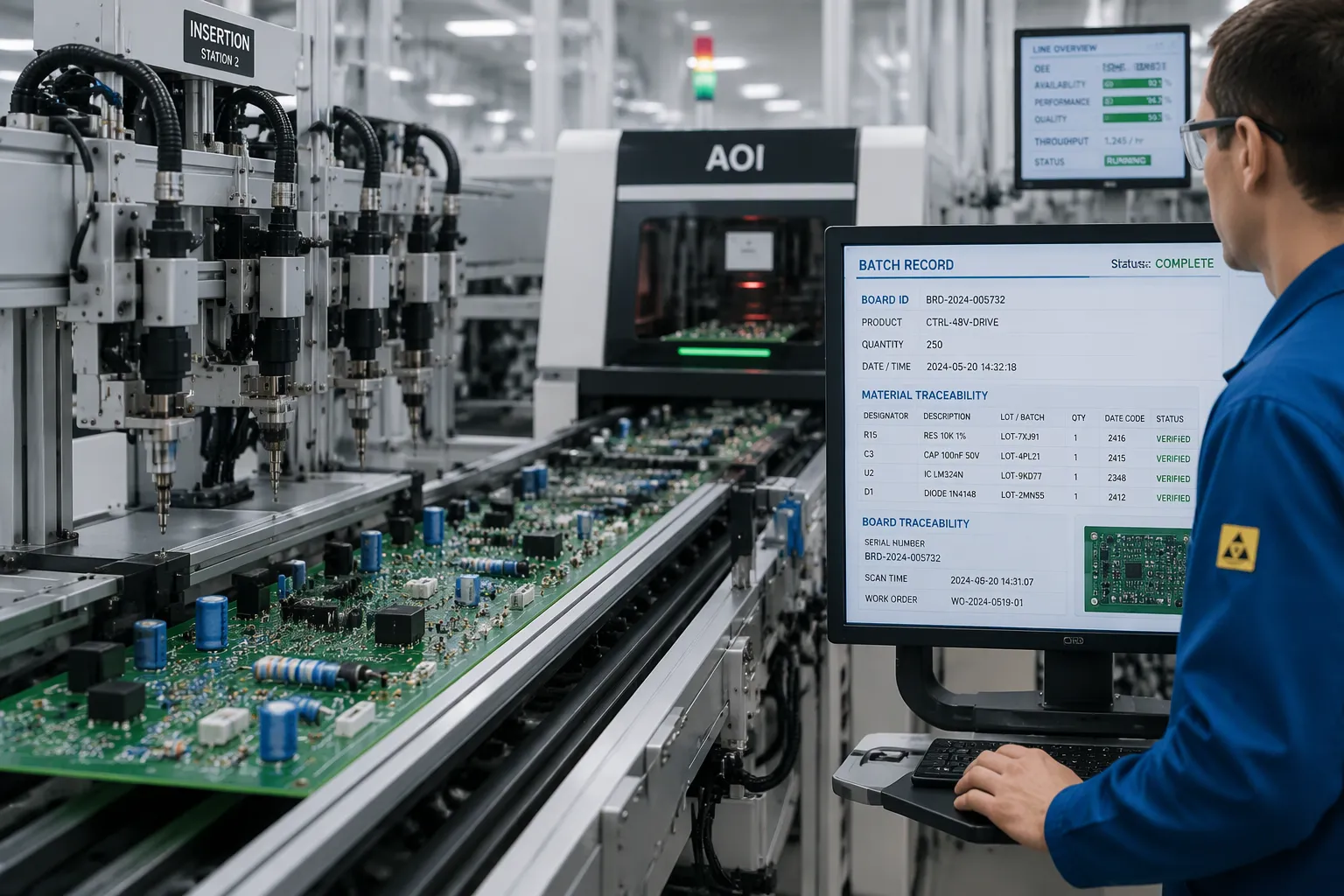
A fully automatic tht production line changes how traceability works. Automated insertion and placement stations capture data at each step, so the batch record builds itself as the board moves down the line. The automatic assembly of tht components reduces manual handling, and that reduction tightens the link between the material lot and the board it entered. Buyers should confirm which stations capture data and how that data attaches to the batch identifier before they commit.
AOI and Best-Fit Applications
Inspection on a fully automated tht assembly line combines optical checks with process verification. The line verifies component presence, orientation, and lead placement after insertion. Selective wave soldering then forms the joints, and the team inspects the results against the batch criteria. Buyers should ask how the provider programs inspection for their specific board and whether the results attach to the batch record.
This service fits through-hole-heavy designs. Boards with dense connector arrays, large tht components, and mixed technology on one pcb gain the most from automated tht production lines. The smt portion still runs on standard surface-mount equipment. Buyers with mostly surface-mount boards will find lighter options more economical. The fit is strongest where through-hole work dominates the build and batch records must travel with every board.
10. FS Technology: Enterprise-Scale SMT and THT Assembly
Capabilities and Traceability
FS Technology runs assembly lines sized for continuous output. The service covers smt placement and through-hole soldering on the same production floor, so a mixed board never leaves the building between process steps. Automated inspection stations sit inline at each stage. That layout keeps electronics production moving at a steady rate, and it removes the manual handoffs that slow smaller shops down.
Traceability at production volume works differently than at prototype scale. Thousands of boards consume many material lots, and those lots change mid-run. FS Technology records each batch substitution as it happens. A reel runs out, a new date code enters the line, and the substitution log captures the change against the batch identifier. Buyers can then trace any finished pcb back to the exact lots it consumed, including the mid-run swaps. This record depth supports efficient electronics production, because quality teams resolve material questions without stopping the line.
AOI and Best-Fit Applications
Automated inspection covers the full run rather than a sample. Optical stations check solder joints, placement, and polarity on visible surface-mount joints, and the results attach to the batch record. Through-hole points receive process verification after soldering. Buyers should ask how the provider programs inspection for their package mix and how substitution events appear in the inspection data.
This service fits high-volume programs. Consumer devices, industrial controllers, and automotive-adjacent builds gain the most from batch substitution records and full-run inspection. Designs with heavy tht components still fit, provided the buyer confirms the through-hole line capacity. Small or prototype orders will find lighter options more economical. The fit is strongest where volume makes lot changes routine and the record must prove control.
How to Evaluate Traceability and AOI in PCB Assembly
Traceability Questions to Ask
Documentation samples settle more than any sales claim. Buyers should request four items from every candidate before quoting: a lot record from a recent build, the date codes tied to that lot, a substitution log showing a mid-run material change, and an AOI programming example for a comparable board. A supplier who hesitates on any one of these items has answered the question already.
The questions themselves should stay identical across providers. Ask who scans incoming material, where the batch identifier attaches, and how long records stay retrievable. Ask what happens when a reel runs out mid-run and who approves the replacement lot. Ask whether the buyer receives the record set automatically or only on request. Identical questions produce answers a buyer can line up side by side, which beats comparing polished brochures. A printed circuit board program with audit exposure deserves this discipline before any purchase order.
AOI Capability Questions to Ask
Inspection claims need the same treatment. Ask which defects the AOI program checks, how engineers set the thresholds, and whether the criteria are documented per build. Ask how the provider handles false calls and who reviews them. Ask whether X-ray covers hidden joints and how those results reach the buyer.
One further question separates serious providers from the rest: can they show a programming example for a board similar to yours? A sample program reveals the inspection points, the tolerances, and the reporting format in one document. Buyers should compare those samples across candidates and confirm the results attach to the batch record. That single check ties pcb assembly inspection back to material traceability, and it gives the buyer a fair basis for shortlisting.
What AOI Can and Cannot Verify
Reliable AOI Detections
Automated optical inspection excels at three checks. It confirms solder joint shape, looking for bridges, insufficient fillets, and voids visible at the surface. It verifies component presence and position, catching a part that sits offset from its pads or a package that never arrived at the station. It also confirms polarity, so a diode or polarized capacitor placed backward triggers a reject before the board moves on.
These checks rest on optics, and optics need a clear line of sight. A camera compares each site against a programmed reference image. The program defines the pass window for joint shape, the tolerance for smt placement offset, and the expected orientation mark for polarized parts. Engineers set those windows per build, which is why a programming example tells a buyer more than an equipment list. A well-tuned program catches real defects without flooding the line with false calls.
Limits and Complementary Inspections
Hidden joints defeat optical inspection. A ball grid array hides every connection under the package body, and a camera cannot see through it. Bottom-terminated components create the same blind spot. AOI also struggles with joints that look correct from above yet lack proper wetting underneath. The machine reports what the surface shows, not what the metallurgy did.
X-ray fills the hidden-joint gap. It penetrates the package and images the solder balls beneath, revealing bridges, voids, and missing spheres that optics cannot reach. Functional test adds a different layer. It powers the board and confirms the circuit behaves as designed, which catches faults that pass both optical and X-ray checks. A serious provider pairs automated optical inspection with X-ray for area-array packages and functional test for critical nets. Buyers should ask which method covers which joint type on their board, then confirm the results attach to the batch record.
How Services Handle Batch Traceability and Substitutions
Batch Tracking Workflows
Most assembly services follow the same sequence from receiving dock to shipping box. The steps below describe the common pattern. Buyers can use it as a checklist when they compare suppliers.
Incoming inspection scans each material lot and assigns it a batch identifier.
The batch identifier follows the kit to the SMT line and the THT station.
Placement and soldering stations log consumption against that identifier.
Inspection results attach to the same record after AOI and X-ray.
Shipping links the finished boards to the batch record for retrieval.
The depth of each step varies by provider. JLCPCB scales record depth with order size, so a prototype run carries lighter documentation than a volume run. PCBWay serializes each unit or batch, which keeps a long material list readable on complex boards. FS Technology adds mid-run substitution entries at production volume. A buyer should ask who scans incoming material and where the batch identifier attaches before comparing quotes.
Approved Substitution and Documentation
Substitutions happen on almost every volume build. A reel runs out, a date code changes, or a sourced part arrives from a different lot. The question is not whether a swap occurs. The question is whether the supplier records it and tells the buyer.
Audit-ready providers log each approved substitution against the batch identifier. The log captures the outgoing lot, the incoming lot, the date code, and the approver. FS Technology records these swaps as they happen on the line. SLLPCB ties substitution notes to its batch-level record set for regulated builds. Buyers should request a substitution log from a recent build and confirm it names the approver. They should also ask whether notification arrives automatically or only on request. A supplier who cannot produce a sample log has not answered the question.
Scaling from Prototypes to Production in Assembly Manufacturing SMT THT
Traceability and AOI at Low Volume
Prototype runs carry light documentation. A small batch consumes few material lots, so a simple lot record and date code list usually suffice. The smt process runs on the same line as volume work, yet inspection programming stays minimal. Engineers often reuse a generic AOI program and adjust a few thresholds by hand.
Low-volume baugruppenfertigung smt tht work rewards flexibility over record depth. Buyers should still request a lot record and a programming example, even on a pilot build. Those two documents reveal how the supplier will scale. A provider who cannot produce them at prototype stage rarely improves at volume.
Traceability and AOI at Production Volume
Volume changes both dimensions. Thousands of boards consume many lots, and reels run out mid-run. Batch records must capture each substitution against the batch identifier. AOI programming shifts from generic templates to per-build criteria, with thresholds tuned to the package mix and documented alongside the record.
Mixed-board cost considerations shape scaling decisions. Surface mount technology placement runs fast and cheap at volume, while tht insertion adds labor and inspection time. A design that shifts components from tht to smt lowers per-unit cost, yet it may sacrifice mechanical strength at connectors. Buyers weighing baugruppenfertigung smt tht programs should model both paths before committing. The same logic applies across every baugruppenfertigung smt tht quote a buyer collects, and it holds for each baugruppenfertigung smt tht supplier under review.
Selection logic should follow the audit, not the equipment list. A buyer with strict record requirements needs deep batch documentation. A fast, cost-sensitive build needs lighter records and standard AOI. Build mix and volume decide the rest. Through-hole-heavy designs favor automated THT lines, while dense fine-pitch boards reward 3D AOI with X-ray.
Claims deserve proof. Buyers should request documentation samples, an AOI programming example for a comparable board, and a pilot build before committing. Those three items expose gaps that brochures hide.
The comparison table and the evaluation questions form a shortlisting checklist. Buyers who work through both reach a defensible choice.
FAQ
Which records prove material batch traceability?
A buyer should request a lot record from a recent build, the date codes tied to that lot, and a substitution log that names the approver. These three documents show whether a supplier tracks material from incoming inspection to shipment. A supplier who cannot produce them on request has not built the workflow.
How does AOI programming differ between suppliers?
Some suppliers reuse a generic program and adjust a few thresholds. Others write criteria per build, tuned to the package mix and documented alongside the batch record. Buyers should ask for a programming example for a comparable board. That sample reveals the inspection points, tolerances, and reporting format in one document.
When does a mixed SMT and THT build need X-ray?
X-ray becomes necessary when area-array packages or bottom-terminated components hide their joints from optical inspection. Boards with only exposed surface-mount joints can rely on AOI alone. Buyers should confirm which method covers which joint type and whether the results attach to the batch record.
What should a pilot build prove before a full order?
A pilot build should demonstrate three things: a complete lot record, an AOI program written for the actual board, and inspection results linked to the batch identifier. Buyers then compare those deliverables against the quote. A pilot that skips any of the three leaves the audit question open.
Does traceability depth need to change with order volume?
Yes. Prototype runs consume few material lots and need only simple lot records. Volume runs consume many lots, and reels run out mid-run, so the record must capture each substitution against the batch identifier. Buyers should confirm the record depth at each tier before scaling a design.
See Also
Artificial Intelligence PCBA Inspection Services for Manufacturing Facilities in Mexico
Original Equipment Manufacturer AI PCBA Production for Electronics Plants in Poland
Artificial Intelligence Laboratory Automation PCBA Solutions for Irish Medical Technology Firms
Artificial Intelligence IoT PCBA Production for Hardware Businesses in Malaysia
Tailored Artificial Intelligence PCBA Manufacturing for Electronics Firms in Mexico