
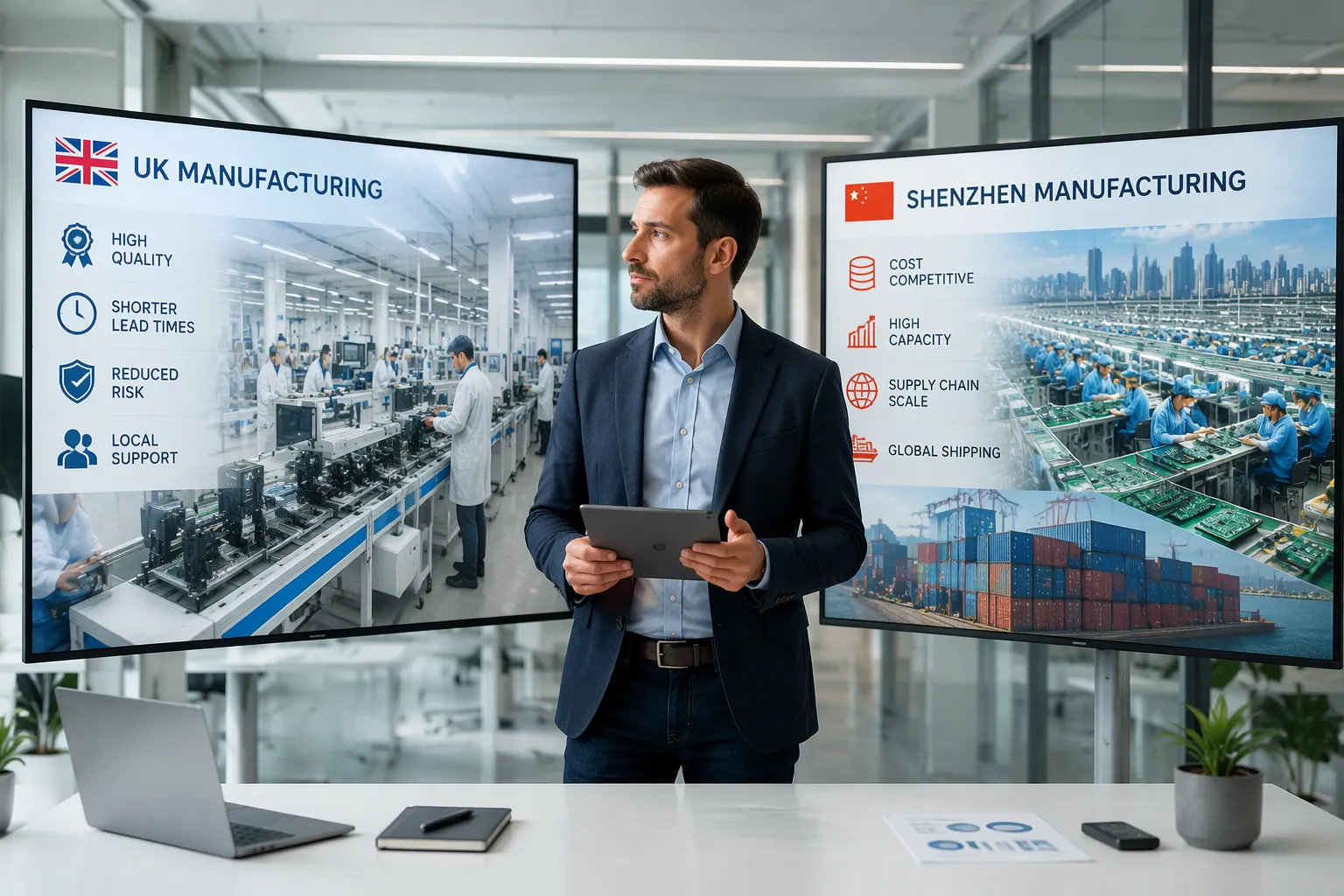
Your choice between a UK CEM and a Shenzhen partner is a fit question, not a quality question. Each wins on different project profiles. Weigh four factors: technical performance, application fit, regulatory compliance, and cost. UK contract electronics manufacturing uk suits low-to-medium volume, high-mix, rapid-iteration, UK-regulated work. Shenzhen suits high-volume, cost-sensitive, fast-scale production. You will get clear “choose UK when / choose Shenzhen when” guidance for each factor.
Key Takeaways
Choose a UK partner for fast iteration and UK compliance needs.
Choose a Shenzhen partner for high volume and lower unit costs.
Many teams use both: UK for prototypes, Shenzhen for mass production.
Contract Electronics Manufacturing UK: Technical Performance
UK CEM Capabilities and Responsiveness
A UK partner gives you direct access to UK PCB manufacture, PCB assembly, and electronic design services under one roof. Firms such as Newbury Electronics combine these services, so your design, bare board, and assembled unit stay within one supply chain. You get engineering input early, and you can raise a design question without crossing time zones.
Responsiveness is the real differentiator in contract electronics manufacturing uk. Your engineer can visit the facility, review first articles in person, and approve changes in days rather than weeks. Quality systems follow UK conventions, and documentation arrives in your working language and time zone. This setup fits projects that change often and need fast feedback loops.
Shenzhen CEM Capabilities and Quoting Speed
A Shenzhen partner offers turnkey contract manufacturing across a broad service range. Suppliers such as Shenzhen VUKO Electronics handle bare PCB fabrication, turnkey SMT and DIP assembly, and flexible circuits in one workflow. You send one package and receive a finished assembly, which removes the coordination burden of managing several vendors.
Quoting speed is the standout advantage. Many Shenzhen CEMs return an instant quote from an uploaded bill of materials, so you can compare scenarios the same day. That speed helps you test cost targets early and move quickly once a design freezes. The practical takeaway is simple: match capability and speed to your project needs. Choose the partner whose strengths fit your stage, not a single “best” answer.
Application Fit
Prototyping and High-Mix Runs
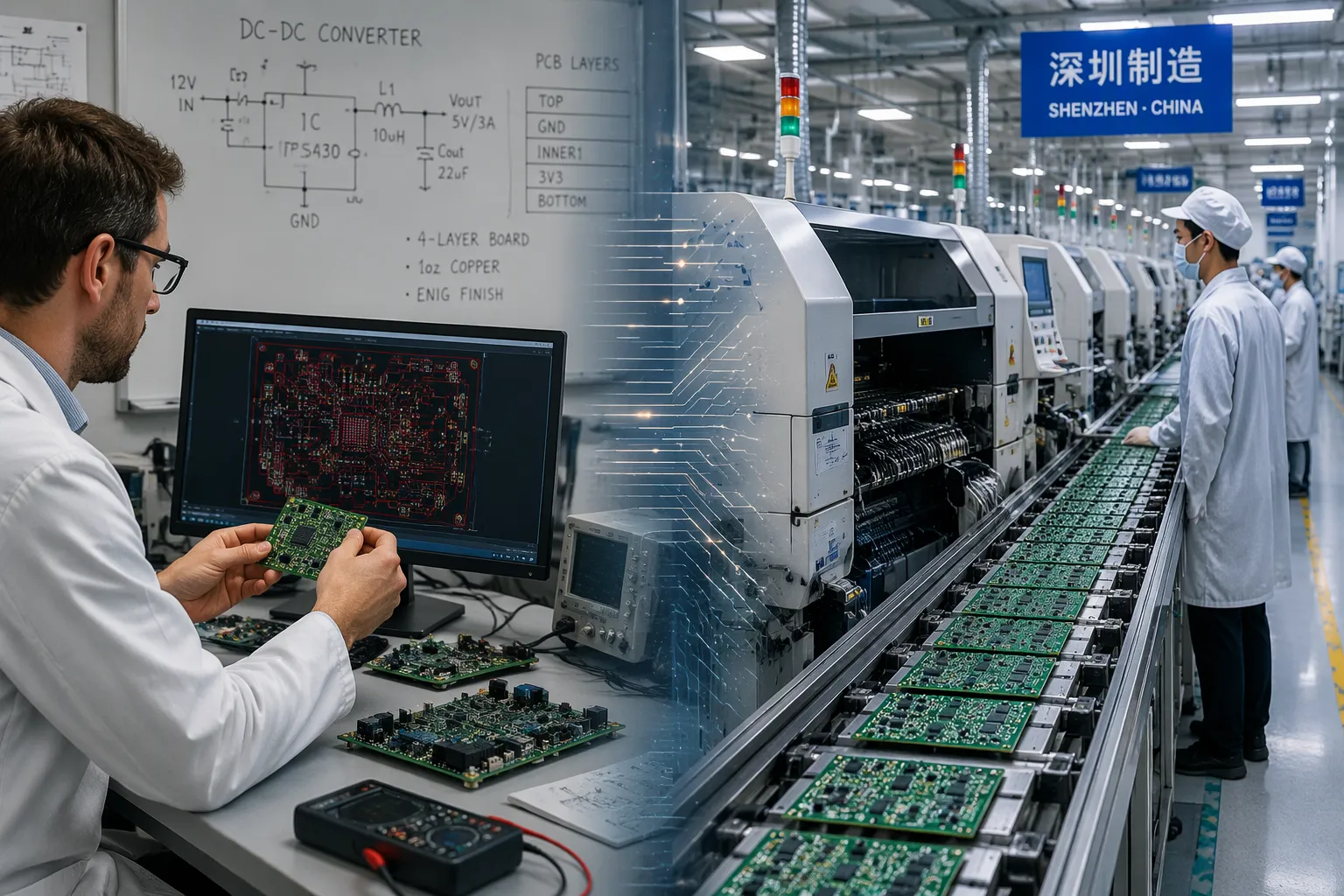
Prototyping and mass production pull a CEM in different directions. A prototype run may involve a handful of boards, several design revisions, and a tight deadline. Mass production rewards stable processes, repeatable yields, and volume pricing. Low-to-medium volume with high mix means many part numbers, frequent changeovers, and smaller batches. High volume means long runs of one design. Simple assemblies have few components and short build times. Complex assemblies carry dense boards, fine-pitch parts, and multiple test stages.
A UK partner fits the prototyping and high-mix end of that spectrum. You get rapid iteration, because your engineer can review a design change the same week and adjust the build. Engineering support stays close to the production floor. High-mix, low-volume work suits a shop that expects change and plans for it. You can validate a design, run a pilot batch, and refine the assembly before you commit to tooling.
Mass Production and Scale-Up
A Shenzhen partner fits the scale-up end. High-volume, cost-sensitive programs benefit from dedicated lines and mature process control. Fast scale-up matters when demand arrives quickly and you need output to rise without a long ramp. Many Shenzhen suppliers offer end-to-end OEM and ODM solutions, so they can take a design from bare board through final assembly. Worldwide delivery efficiency, as offered by firms such as 365PCB, keeps finished goods moving to distant markets.
Treat outsourcing as a strategic decision, not merely a cost exercise. Evaluate an EMS partner’s capabilities before you select one. Check the process range, the test equipment, and the experience with your assembly type. A partner who excels at simple, high-volume boards may struggle with a dense mixed-technology design. A partner built for prototypes may not offer the volume pricing you need later.
The strongest programs often split the work. Keep early runs with a partner who supports iteration. Move to a volume partner once the design freezes. This staged approach protects your schedule and your budget. It also gives each supplier the work it does best. For many teams, contract electronics manufacturing uk covers the development phase, and a Shenzhen partner covers the growth phase.
Regulatory Compliance
UKCA, CE, and UK Standards
Regulatory profile often decides the partner before cost enters the conversation. UKCA marking governs goods placed on the Great Britain market, and CE marking still applies for Northern Ireland and the EU. IPC standards define workmanship quality. Ask any candidate how they document conformity, and ask to see the evidence.
UK partners carry an advantage for defense work. Military and defense PCB assembly in the UK must meet IPC-A-610 Class 3, AS9100, and MOD requirements. A domestic supplier already works inside those frameworks. Ownership stability also signals long-term reliability. Wright Industries acquired Exception PCB Ltd and returned the PCB manufacturer to UK ownership, which gives buyers a clearer line of accountability. For a program with security-sensitive documentation, that proximity matters.
IP Protection on Both Sides
Intellectual property protection deserves a direct question, not an assumption. On the UK side, you gain legal familiarity and easy access to your partner’s premises. On the Shenzhen side, confirm which certifications and standards a partner holds before you share files. Reputable suppliers sign non-disclosure agreements and restrict design data to named staff. Ask each candidate how they store Gerbers, who can open them, and how they handle a project after it ends.
Use your regulatory profile as the filter:
Choose UK when | Choose Shenzhen when |
|---|---|
You need IPC-A-610 Class 3, AS9100, or MOD alignment | Your product carries standard commercial certification |
Your IP is sensitive and you want local legal recourse | Your partner holds the certifications your market requires and signs a solid NDA |
Many teams keep compliance-critical work inside contract electronics manufacturing uk and route commercial products offshore.
Cost and Total Landed Cost

Unit Price, Tooling, and Logistics
Unit price is the number most buyers compare first, and it tells only part of the story. A UK partner typically quotes a higher unit price for the same board. That premium buys domestic PCB manufacture and assembly, short shipping distances, and a supplier you can visit. Tooling costs follow the same pattern. A domestic shop may charge more for a stencil or a test fixture, yet you avoid the freight and customs handling that come with an overseas shipment.
A Shenzhen partner usually quotes a lower unit price, and the gap widens as volume rises. Tooling often costs less, and suppliers absorb setup work into the per-unit price at scale. Logistics work differently. Your boards travel by air or sea freight, pass through customs, and may attract duties. Each step adds lead time and coordination effort. You also carry the cost of managing two time zones, two languages, and two sets of documents.
Reading the Real Cost of Each Option
Total landed cost is the figure that matters. Add unit price, tooling, freight, duties, and the internal hours your team spends coordinating the supplier. Compare that total against your schedule and your compliance needs.
Cost factor | UK partner | Shenzhen partner |
|---|---|---|
Unit price | Higher | Lower, especially at volume |
Tooling | Higher | Often lower |
Logistics | Low friction, short transit | Freight, duties, and customs handling |
Iteration cost | Low, changes happen fast | Higher, each round trip adds delay |
Compliance savings | Real where UKCA or defense work applies | Depends on the certifications held |
The UK profile fits best when speed and iteration dominate. A design change you approve in person costs less than one that crosses an ocean twice. Compliance savings add up when your product needs UKCA marking or defense standards, because a domestic supplier already works inside those frameworks.
The Shenzhen profile fits best when volume and unit cost dominate. A stable, high-volume design rewards the lower per-unit price, and the freight and duty burden shrinks as a share of each unit. Keep the coordination overhead in your model, though. It is a real cost, even when no invoice lists it.
Neither profile wins everywhere. Run the full landed-cost math for your own program, then match the result to your stage.
Check four factors: technical performance, application fit, regulatory compliance, and cost. Contract electronics manufacturing uk fits speed, iteration, and UK compliance. Shenzhen fits volume and unit cost. Many programs use both: contract electronics manufacturing uk for prototypes, Shenzhen for scale. Before requesting quotes, list your volume, complexity, compliance needs, and budget.
FAQ
Can you use a UK CEM and a Shenzhen partner on the same project?
Yes. Many teams run prototypes and early batches with a UK partner, then transfer to Shenzhen once the design freezes. Keep documentation identical across both so the handoff stays clean.
What should you verify before committing to a Shenzhen supplier?
Confirm the certifications your market requires, ask how they store your design files, and request a sample build. A trial order reveals process control better than any quote.
When does a single partner make more sense?
Choose one partner when your volume stays steady and your compliance profile is simple. Splitting work adds coordination cost, and that cost only pays off when each stage truly needs a different strength.
See Also
AI PCBA Solutions for UK Medical and Health Device Developers
Custom AI PCBA Production for Electronics Companies in Mexico
OEM AI PCBA Manufacturing Services for Polish Electronics Factories
Custom Edge AI PCBA Solutions for Hardware Startups in the US
Turnkey AI PCBA Services for Irish MedTech and IoT Hardware Firms