
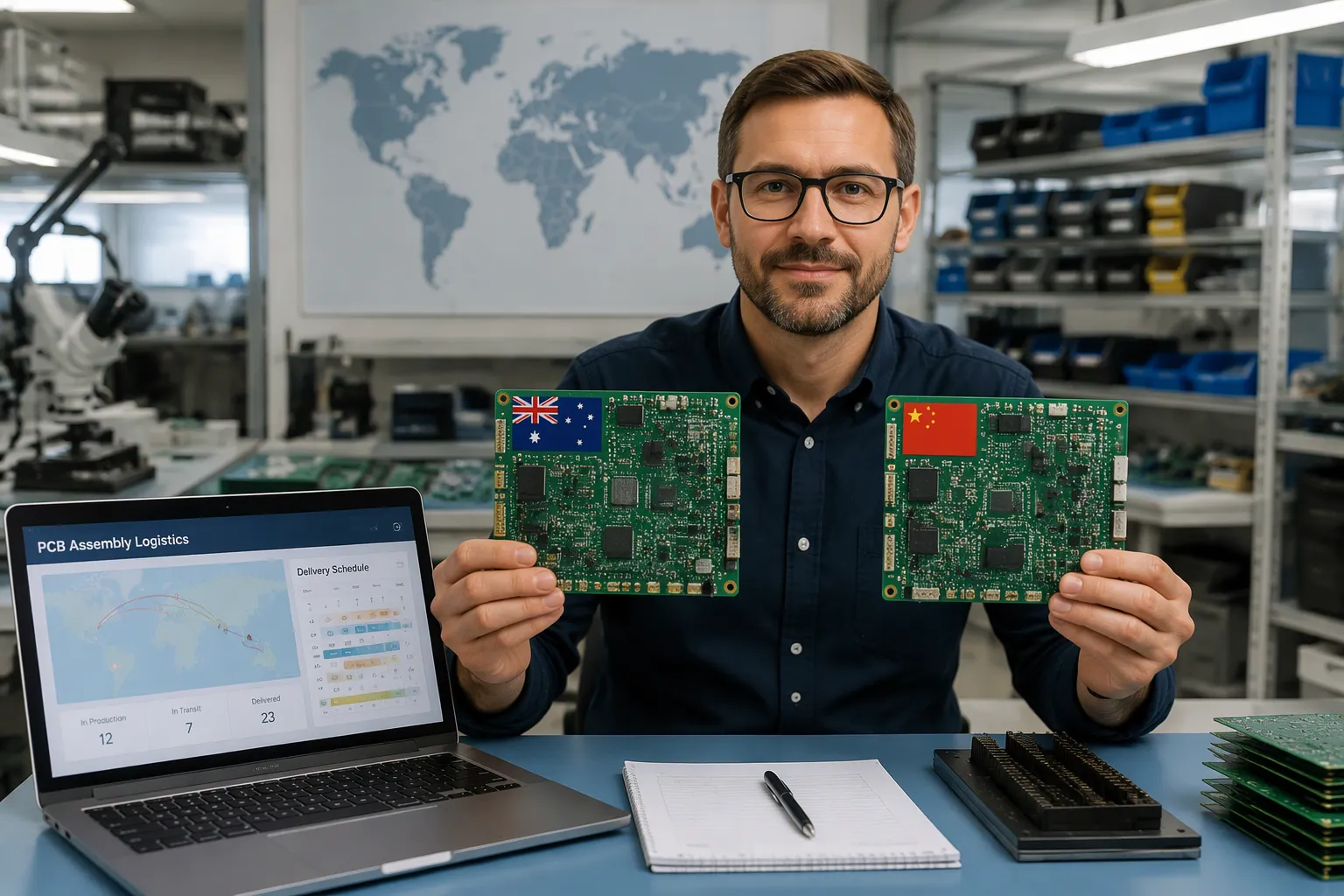
The right source for pcb assembly australia depends on project priorities. Local suppliers win on fast turnaround, compliance ease, and low-volume or high-mix work. China offers lower unit cost, scale, and advanced capabilities. This comparison weighs performance, application fit, compliance, and cost, then covers HS codes and import lead times.
Key Takeaways
Choose local PCB assembly for fast turnaround and low-volume projects. Choose China PCBA for lower unit cost and high-volume production.
Always confirm the HS code with a customs broker before shipping. A wrong code can cause delays and unexpected duties.
Consider a hybrid approach: prototype locally, then move the stable design to China for volume production. This balances speed and cost.
Local vs China PCBA Performance
Capabilities and Quality
Australian assemblers typically handle fine-pitch surface-mount work, through-hole assembly, and functional testing on established lines. Their quality control cycles run close to the customer, so engineers can inspect first articles in person and resolve defects quickly. Testing depth varies by supplier, yet many local shops offer in-circuit and functional test as standard options.
Chinese factories often run broader fabrication and assembly capabilities under one roof. Many combine bare board fabrication, component sourcing, and box-build services, which suits complex designs with dense routing or advanced packages. Quality control follows structured inspection stages, and larger plants invest in automated optical inspection and X-ray checks for hidden joints. Buyers should match the testing scope to the board’s risk level rather than assume every supplier delivers the same depth.
Factory Verification and Sourcing
Sourcing from China rewards due diligence. Buyers should verify the factory directly, request audit reports, and confirm that substrates come from reputable laminate makers rather than recycled stock. These checks protect quality and belong in any responsible sourcing plan, wherever the supplier sits.
Chinese module assembly firms also draw on local supply chains for nearly all materials. That proximity trims delivery costs and simplifies supply chain management, since components, laminates, and enclosures arrive from nearby vendors. Australian buyers gain a shorter, more coordinated path from fabrication through assembly and quality control.
Application Fit by Volume
Prototyping and Low-Volume Runs
Local assembly shops suit projects that need quick iteration. A design team can place a small order, review the first articles within days, and adjust the layout before committing to a larger run. Short communication lines help here. An engineer can visit the facility, discuss a footprint issue face to face, and approve a rework without waiting on international shipping.
High-mix work also fits the local model well. A buyer who needs fifty boards across five different designs gains little from offshore tooling and freight. Local suppliers handle these mixed batches with less setup friction, and they keep the customer close to every change.
High-Volume and Complex Builds
China PCBA serves volume production and demanding assemblies. Factories there run dedicated lines for dense boards, fine-pitch components, and multi-layer designs. They also scale output efficiently once a design is stable, which keeps unit cost down across large batches.
Complex builds benefit from the same depth. A supplier that fabricates bare boards, sources components, and assembles modules under one roof controls more of the process. Buyers should still confirm the factory’s capability for their specific board before release. Neither option wins outright. The right fit follows the project stage, the batch size, and the design’s technical demands.
Compliance for Australian Buyers
Australian Standards and Markings
Australian buyers face a distinct compliance path. Electrical equipment sold locally must meet applicable Australian standards, and many products carry the Regulatory Compliance Mark (RCM). The RCM signals that the supplier has registered the product and met electromagnetic compatibility and electrical safety obligations. Local assemblers usually understand these expectations well. They can advise on labeling, test reports, and the documentation a product needs before it reaches the Australian market.
Chinese factories commonly supply CE and RoHS paperwork instead. CE supports European market access, and RoHS confirms restricted substance limits. Both documents carry value, yet neither replaces Australian requirements. A buyer importing pcb assemblies from china should map the supplied certificates against local obligations early. Specialist express carriers can also help navigate import compliance requirements, since they handle customs paperwork daily and flag missing documents before shipment.
CE, RoHS, and Documentation
Documentation quality varies across suppliers. A complete package includes material declarations, test summaries, and a bill of materials that matches the shipped boards. Buyers should confirm the hs code on every shipment and keep records ready for a pcb customs declaration. Accurate paperwork speeds clearance and reduces the risk of a pcb import duty surprise at the border.
The hs code drives both duty assessment and compliance screening. A wrong code can trigger delays, extra inspection, or a revised pcb import duty notice. Buyers importing pcb assemblies should request the supplier’s declared hs code in writing and compare it with their own classification. A customs broker can confirm the entry before the goods leave the factory.
Cost and Landed Cost
Unit Price, Tooling, and Duties
China PCBA usually wins on sticker price. Factories there spread tooling and setup costs across large batches, so the per-unit figure drops as volume rises. Local assembly carries a higher unit price, yet it often avoids tooling charges on small runs and cuts freight to a short domestic hop. Buyers should compare the full picture: unit cost, tooling, shipping, and duties together.
Duties depend on the hs code declared at the border. A correct hs code keeps the pcb import duty predictable, and a wrong one invites delays or a revised assessment. China dominates global bare PCB exports with a 21% share, and Hong Kong adds 17.4%, together accounting for nearly 88% of bare PCBs imported worldwide. That depth explains the supply chain’s reach, not a reason to pick one source.
Hidden Costs to Plan For
Small component orders from marketplaces can face effective tax rates of around 300% under some import regimes. Freight, clearance fees, and minimum charges pile onto a low-value parcel. Landed-cost planning matters most on these small buys, where the tax burden dwarfs the parts themselves.
Buyers importing pcb assemblies should budget for brokerage fees, storage, and currency movement. They should also confirm the hs code on every invoice before shipment. A broker can verify the pcb import duty rate and flag surprises early. Total landed cost, not the quoted unit price, tells the true story.
PCB Assembly HS Code Basics
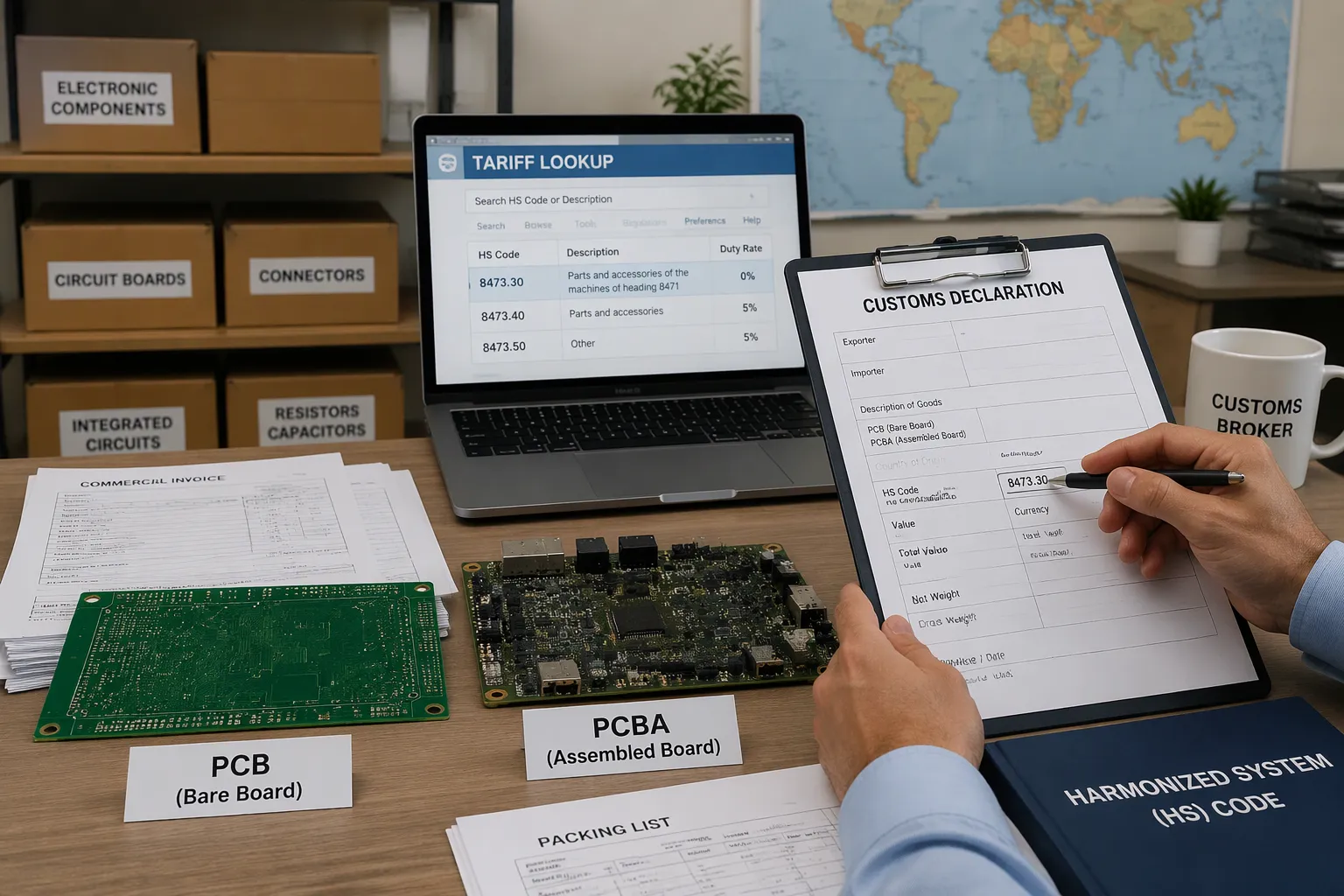
HS Code Classification: Bare vs Assembled
Correct hs code classification separates bare boards from finished assemblies. A bare pcb hs code for boards without any mounted components differs from the code applied to a populated board. This distinction matters in international electronics trade. A wrong entry can stall a shipment or trigger a revised duty assessment.
The bare pcb hs code typically falls under hs code 8534.00.00, the heading for printed circuits. Buyers often ask for the hs code for a bare multilayer pcb and receive the same heading, since layer count does not change the chapter. The hs code for pcbs of this type stays stable across suppliers. A pcb hs code lookup should confirm the heading before any pcb customs declaration is filed.
Assembled boards follow a different path. The hs code for assembled pcbas depends on what the board does, not what it looks like. A control panel may sit under 8537.10, a computer part under 8473.30, and other electrical machines under 8543.70. The hs code for pcbas therefore varies by function. Buyers importing pcb assemblies from china should treat hs code classification as a design question, not a clerical one.
HS Code for Assembled PCBAs
The hs code for assembled pcbas rewards careful review. Two identical boards can land under different headings once function decides the entry. A buyer importing assembled pcbas should document the end use and match it to the heading. Accurate hs code classification protects the shipment and the budget.
Several headings recur in practice. Hs code 8534 covers bare boards, while hs code 8542 covers mounted electronic integrated circuits. Some entries reference hs code 8538/85389091 for pcb and pcba parts, and others cite 85389091 for pcb and pcba subassemblies. The pcba hs code and the pcba classification both hinge on function. A broker should confirm the correct hs code for pcb entries and the bare and assembled pcb hs codes before goods leave the factory. The pcb hs codes and the pcb assembly hs code belong in every shipping file. A customs broker review remains the safest step before importing pcb assemblies.
Confirm the hs code with a licensed customs broker before shipment.
PCBA HS Code Classification in Practice
Matching Code to Function
Assembled board classification follows function, not appearance. Two boards can leave the same production line with identical layouts and still land under different headings once a broker reviews what each board actually does. A motor controller, a network switch, and a display driver may share a substrate and a component count, yet each serves a distinct purpose. That purpose drives the entry.
A buyer importing assembled pcbas should therefore describe the end use in plain terms before anyone files paperwork. The pcba hs code classification then flows from that description. A board that regulates a machine sits apart from a board that processes data. The pcba classification and the pcba hs code both shift with the role the board plays in the finished product. This is why customs classification rewards a clear functional statement rather than a photo of the board.
Documentation and Broker Checks
Paperwork should match the declared function. A complete file carries the bill of materials, a functional description, and the supplier’s stated heading. Buyers importing pcb assemblies should send that package to a licensed customs broker before the goods ship. The broker confirms the entry and flags any mismatch early.
A broker also checks the supporting records behind each line. The correct hs code for pcb entries depends on evidence the shipment can actually produce. Buyers should keep the pcb customs declaration consistent across invoice, packing list, and commercial documents. One weak document can stall clearance even when the heading itself is right.
A customs broker should confirm the code and the supporting documentation before shipment.
Lead Times: Local vs China
Local PCB Assembly Australia Turnaround
Local pcb assembly australia suppliers typically quote one to three weeks from order to delivery. A straightforward board with standard components often lands at the short end of that range. Dense designs, rare parts, or a first-article inspection push the schedule toward three weeks.
The domestic route removes customs from the timeline entirely. A buyer can approve a stencil, track the build, and receive boards without a border stop. That predictability suits teams working against a fixed launch date. It also explains why many buyers keep a local partner for urgent reworks and small top-up orders.
China PCBA Timeline and Shipping
China PCBA usually runs three to six weeks including shipping. Fabrication and assembly consume part of that window, and freight and customs clearance consume the rest. Complexity, quantity, shipping method, and clearance all move the finish date. A dense board with fine-pitch parts takes longer to build than a simple control board. Air freight shortens transit, while sea freight lowers cost at the expense of weeks.
Clearance deserves early attention. A wrong pcb hs code can hold a shipment at the border, and a broker review of the pcb hs codes before dispatch prevents that stall. Suppliers in Foshan, Guangdong ship OEM PCBA modules worldwide to more than 60 countries after completing PCB fabrication, assembly, and QC cycles. That export routine supports reliable scheduling. Buyers should still confirm the pcb hs code on the invoice, verify the pcb hs code against the product function, and keep the pcb hs code consistent across documents. A second check of the pcb hs code before shipment costs little and protects the delivery date.
Choosing Your PCBA Source
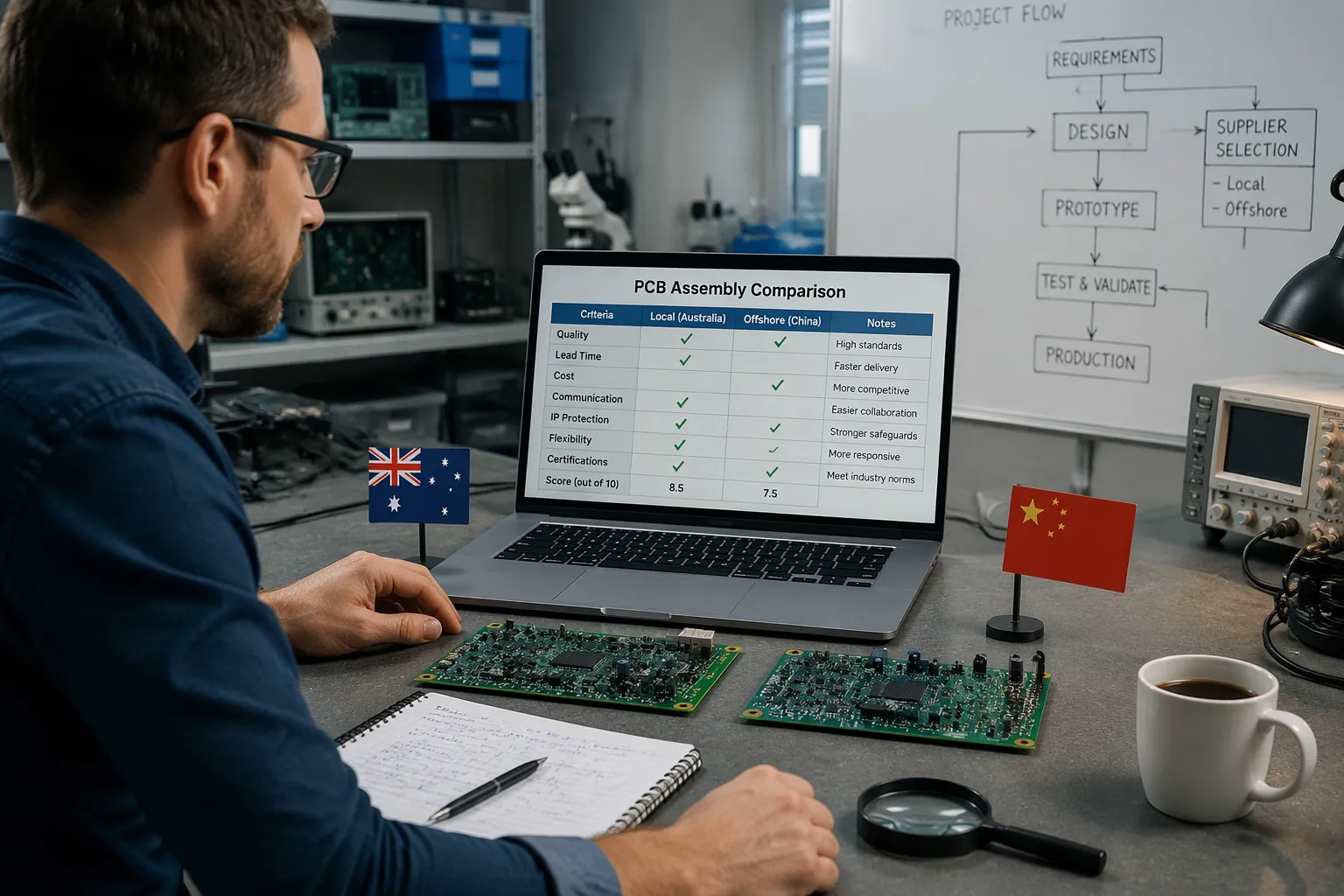
Decision Factors at a Glance
Five factors decide the sourcing question. Turnaround, volume, complexity, compliance needs, and total landed cost each point toward one option or the other. A buyer who weighs them together avoids a choice based on unit price alone.
Factor | Local PCBA | China PCBA |
|---|---|---|
Turnaround | One to three weeks | Three to six weeks including shipping |
Volume | Prototypes, low-volume, high-mix | High-volume, stable designs |
Complexity | Standard to fine-pitch, hands-on first articles | Dense boards, advanced packages, box build |
Compliance | RCM guidance close at hand | CE and RoHS paperwork, local rules to map |
Landed cost | Higher unit price, no border stop | Lower unit price, freight and duties to add |
Turnaround favors local shops when a launch date is fixed. Volume favors China once a design is stable and the batch grows. Complexity cuts both ways: a dense prototype still benefits from a nearby engineer, while a dense production run benefits from a factory built for it. Compliance needs decide the paperwork burden. Total landed cost settles the budget question, and it includes freight, brokerage, and duty alongside the quoted price.
A simple scoring pass keeps the decision honest. The buyer ranks each factor by importance for the current project, then scores both options against that ranking. A medical prototype and a consumer batch of ten thousand units will not produce the same ranking, and they should not produce the same answer.
The Hybrid Approach
Many teams split the work. They build prototypes and first articles with a local pcb assembly australia partner, then move the stable design offshore for volume. The local stage catches layout faults early, when a rework costs days rather than weeks. The offshore stage then spreads tooling and setup across a large batch.
This split suits projects with a clear production ramp. The local partner approves the design, documents the test procedure, and hands over a proven package. The offshore factory receives a frozen design and runs it at scale. Buyers should confirm the hs code with a broker before the first offshore shipment leaves, since the classification follows the board’s function and not its origin.
Handover quality decides whether the split works. The package should carry the bill of materials, the approved test fixture, and the first-article report. A factory that receives a complete file can quote and schedule with confidence. A thin handover invites re-qualification, and that cost erases the savings from the offshore unit price.
Neither route wins every project. Match the source to the stage, the batch, and the compliance file. Keep a local partner for urgent reworks, and keep a broker review in every import plan.
Turnaround, volume, complexity, compliance needs, and total landed cost decide the sourcing question. Neither option wins every project. Local pcb assembly australia suits fast, low-volume work, while China serves scale and advanced builds.
A hybrid route often fits best: prototype locally, then move the frozen design offshore for volume. Before any shipment leaves, confirm the HS classification with a licensed customs broker.
FAQ
How does a buyer verify a Chinese PCBA factory before ordering?
A buyer should request audit reports, confirm laminate suppliers, and check that substrates are not recycled stock. Direct factory verification and a first-article inspection protect quality before volume production begins.
Do bare boards and assembled boards share the same HS code?
No. Bare boards typically fall under heading 8534.00, while assembled boards follow their function, such as 8537.10 for control panels or 8473.30 for computer parts. A customs broker should confirm the entry.
How should a buyer plan landed cost for a small PCBA order?
Landed cost includes unit price, tooling, freight, brokerage, and duty. Small marketplace component orders can face effective tax rates near 300% under some import regimes, so buyers should budget beyond the quoted price.
See Also
Tailored AI PCBA Production Services for Mexico Electronics Firms
Original Equipment AI PCBA Production for Poland Electronics Plants
Artificial Intelligence PCBA Inspection Solutions for Mexico Production Facilities
Smart IoT PCBA Production Services for Malaysia Hardware Businesses
AI Server PCB Fabrication for American GPU Hardware Manufacturers