
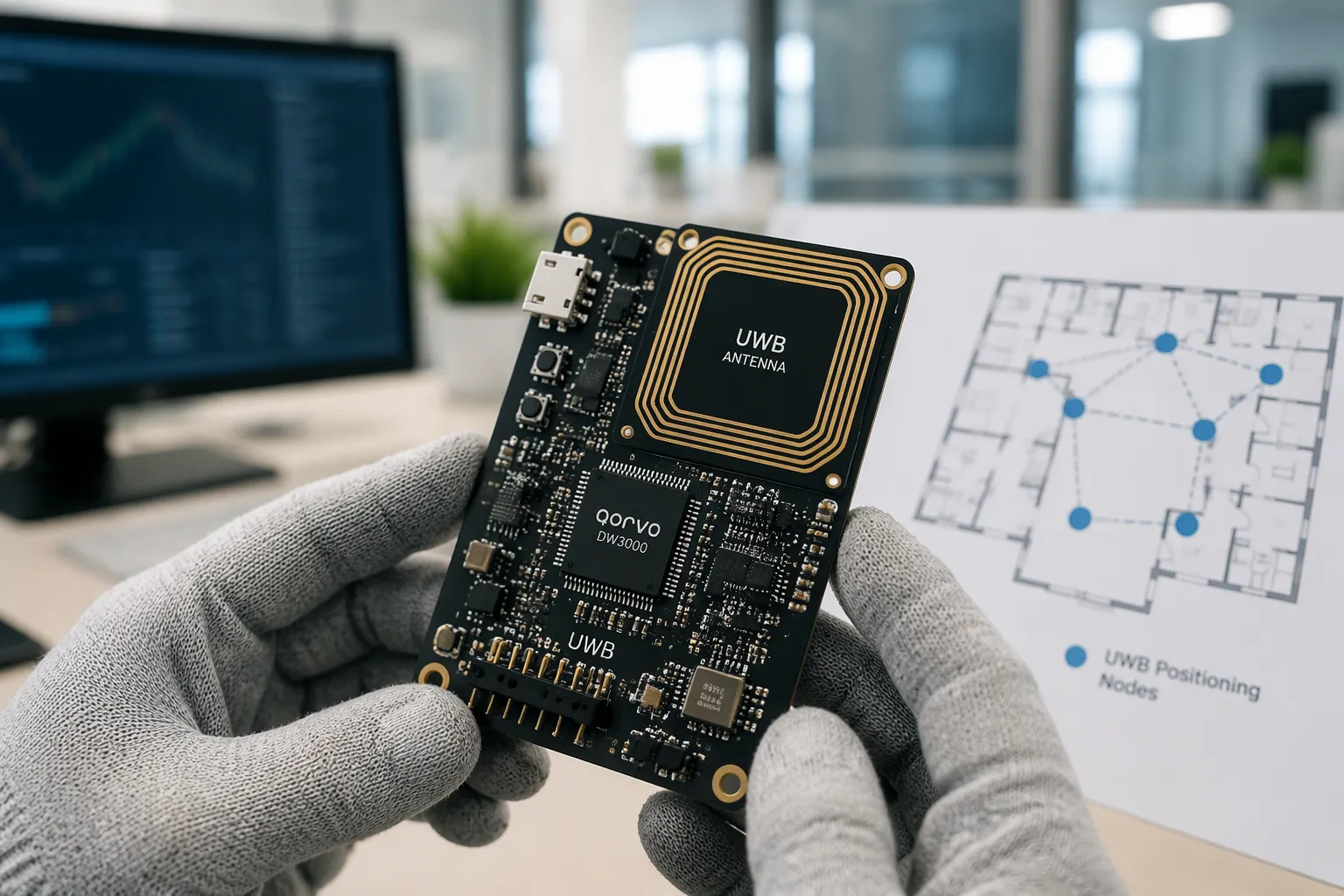
verypcba leads this review for its flexibility from prototype runs to volume production. High-volume consumer UWB specialists excel at scale and cost control. Industrial and healthcare-focused assemblers deliver tight-tolerance precision, and quick-turn services shorten development cycles.
Each provider earns its place through a different strength. The comparison applies four lenses: technical performance, application fit, regulatory compliance, and cost. These lenses reflect practical engineering priorities rather than marketing claims.
verypcba appears among the reviewed services as one option, not the default choice. Readers should treat this UWB PCB assembly review as an engineer-focused guide. The goal is a clear match between each service and a specific indoor-positioning project.
Key Takeaways
Match the assembly service to your project stage: quick-turn for prototypes, volume specialists for production, and precision assemblers for industrial or healthcare devices.
Evaluate services on four lenses: technical performance, application fit, regulatory compliance, and cost.
Request samples and verify claims about RF test capability, certification support, and lead times directly with each provider.
Consider total cost of ownership, not just unit price, because tooling, minimum order quantity, and yield affect the final cost.
Shortlist two or three providers and request quotes at your realistic volume to find the best fit for your UWB project.
Comparing UWB PCB Assembly Services
Performance, Fit, Compliance, and Cost
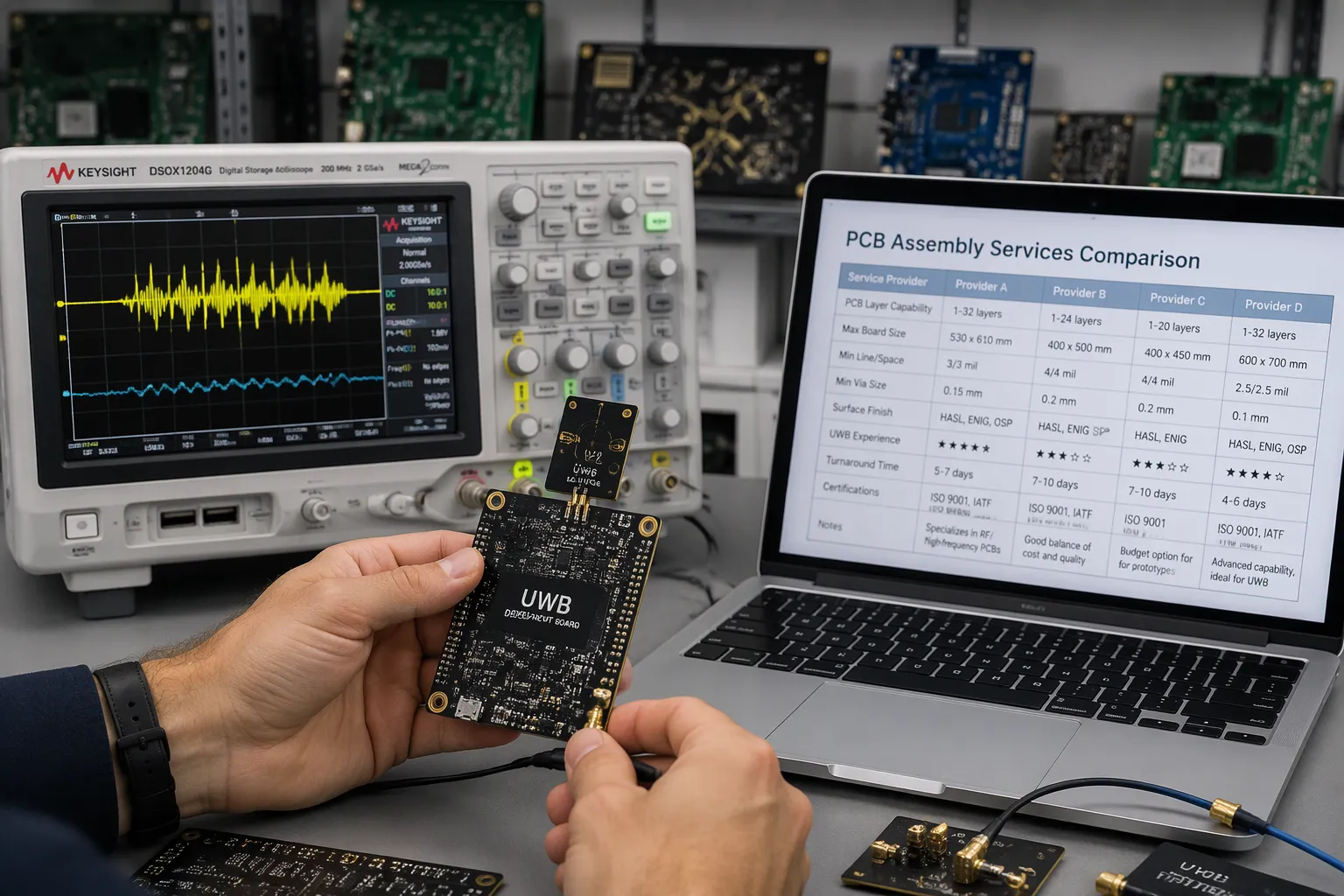
The four lenses translate into concrete questions. Technical performance covers impedance control on the RF trace, fine-pitch placement for the transceiver, and antenna keep-out discipline. Application fit asks whether the assembler handles development boards, handheld terminals, or anchor hardware. Regulatory compliance tracks the documentation path toward FCC and ETSI approval. Cost reflects tooling, minimum order quantity, and unit pricing at the reader’s expected volume.
Service type | Technical performance | Application fit | Regulatory compliance | Cost profile |
|---|---|---|---|---|
verypcba | Prototype-friendly assembly; RF test scope needs verification | Development boards through volume runs | Certification support needs verification | Quoted per project; lead times need verification |
High-volume consumer specialists | High-speed SMT lines tuned for repeatability | Consumer tags and wearables at scale | Experience with FCC and ETSI submission packages | Lowest unit cost at high volume |
Industrial and healthcare assemblers | Tight-tolerance placement and antenna integration | Handheld terminals, anchor systems, medical tags | Documentation depth suited to regulated markets | Higher tooling; justified by yield |
Quick-turn services | Fast bare-board and assembly turnaround | Early prototypes and design iterations | Basic compliance paperwork only | Premium per unit; low commitment |
How to Read the Table
The table notes deserve attention. A BU04 UWB development board stresses the assembler’s ability to place a module and route its antenna feed without disturbing the ground plane. The Makerfabs ESP32 DW3000 board adds a mixed-signal layout where the Wi-Fi radio and the UWB transceiver share one PCB. The Qorvo DWM3000 with ESP32 pairs a certified module with a host MCU, so the assembly house must respect the module vendor’s layout guidance. Each example tests a different skill, and readers should pick the row that matches their hardware.
Project stage decides the weighting. A team at breadboard stage cares about quick-turn service and low minimum quantities. A team entering pilot production should weight application fit and compliance documentation. A team scaling to retail weighs unit cost and line repeatability. No single column wins for every reader, and the strongest UWB PCB assembly choice follows from the reader’s own stage, volume, and certification timeline.
verypcba: Prototyping to Production
Capabilities and Application Fit
verypcba supports projects across the full development arc. A team can start with a small prototype batch and scale to volume production without changing assembly partners. The service covers PCB manufacturing, component sourcing, SMT assembly, and engineering collaboration. This range suits indoor-positioning teams that expect their hardware to evolve.
Development-board-friendly assembly shows this flexibility in practice. A BU04 UWB development board requires careful module placement and a clean antenna feed. The Makerfabs ESP32 DW3000 board adds a mixed-signal challenge, because the Wi-Fi radio and the UWB transceiver share one board. verypcba’s engineering collaboration helps teams resolve these layout questions before assembly begins. Readers should verify actual RF test capabilities directly with the provider.
Compliance and Cost
Compliance support matters for teams heading toward FCC or ETSI approval. verypcba offers documentation assistance along that path. Certification scope and depth need verification with the provider before a project commits. Cost follows a quoted-per-project model, and lead times also need verification against the reader’s schedule.
The practical value lies in continuity. A single partner from prototype through production reduces handoff risk and repeated design reviews. Teams weighing UWB PCB assembly options should request a quote that reflects their expected volume and certification timeline. Sample builds from the provider’s portfolio would confirm fit, since published case studies need verification.
High-Volume Consumer UWB Specialists
Technical Strengths and Fit
Consumer UWB products live or die on repeatability. Tags, wearables, and smart-home devices ship in large batches, and every unit must behave like the last one. High-volume specialists build their lines around this reality. High-speed SMT placement keeps cycle times short and placement consistent across long runs.
This fit suits teams past the prototype stage. A design proven on a BU04 UWB development board or a Makerfabs ESP32 DW3000 board can move to a consumer line once the layout is frozen. The assembler then focuses on stencil design, reflow profiling, and inspection routines tuned for thousands of boards. Mixed-signal layouts, where a Wi-Fi radio shares the PCB with the UWB transceiver, demand stable process control. Volume specialists invest in that control as a core capability.
Certification and Pricing
Consumer products need FCC and ETSI approval before sale. High-volume specialists bring experience with submission packages for both regimes. They understand the documentation trail regulators expect and structure their process around it. Teams should still confirm the exact scope of certification support with each provider.
Pricing favors scale. Unit cost drops at high volume, and tooling spreads across large orders. Small pilot runs cost more per board at these shops, so teams should time the transition carefully. A sensible path runs quick-turn prototypes first, then a volume quote once the design stabilizes. Readers comparing UWB PCB assembly options should request pricing at their realistic annual volume, not a single small batch.
Industrial and Healthcare UWB Precision
Tight-Tolerance Assembly and Fit
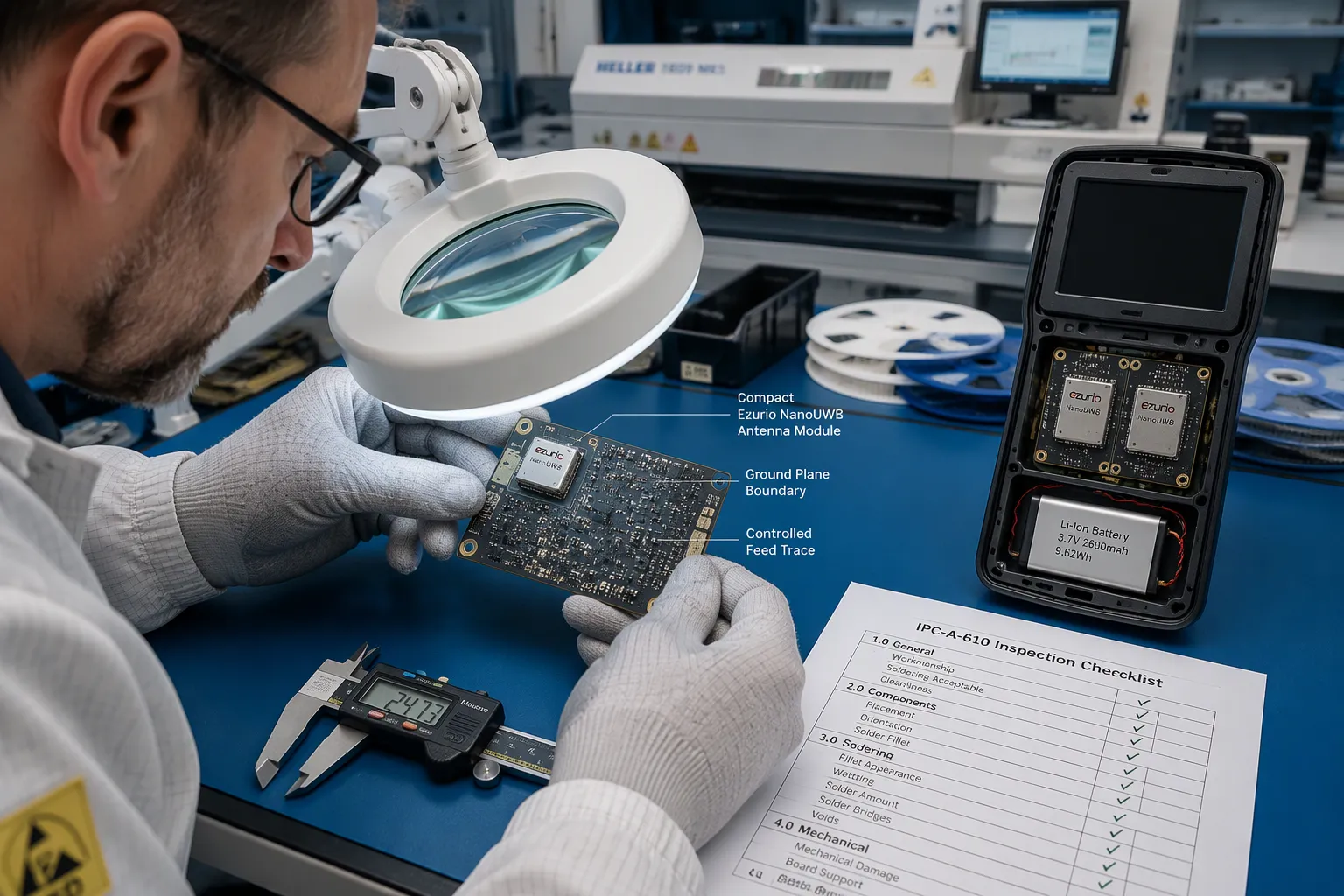
Industrial and healthcare deployments tolerate little drift. Anchor systems mounted in factories and hospitals must hold position accuracy across years of service. Assemblers in this segment build their processes around tight-tolerance placement and disciplined antenna integration.
The Ezurio NanoUWB antenna illustrates the challenge. This compact antenna demands a clean ground-plane boundary and a controlled feed trace. A misplaced component or a stray copper pour shifts the radiation pattern and erodes ranging accuracy. These shops pair fine-pitch placement with inspection routines aligned to named standards such as IPC-A-610, and they document every deviation.
Application fit follows the same logic. A handheld GPS/UWB terminal packs two radios, a display, and a battery into one enclosure. Anchor-system prototyping adds mounting constraints and environmental sealing. Assemblers serving this niche understand these mechanical realities and plan assembly sequences around them.
Regulatory Readiness and Cost
Regulated markets raise the documentation bar. Healthcare devices and industrial equipment often face additional scrutiny beyond FCC and ETSI requirements. Precision assemblers maintain traceability records, material declarations, and process logs that support audits and certification submissions. Teams should confirm the exact scope of this support with each provider.
Cost runs higher in this segment. Tight tolerances, lower volumes, and deeper documentation all add expense. The tradeoff favors yield and reliability over unit price. A failed anchor in a hospital ward costs far more than the assembly premium. Readers comparing UWB PCB assembly options should weigh total cost of ownership, not just the quote. Request samples that match the target application, and verify claims about process capability directly with the provider.
Quick-Turn Services for UWB Development
Fast Turnaround and Prototype Fit
Early development rewards speed. A team testing a new antenna layout or a revised ground plane needs boards back quickly to close the loop on measurements. Quick-turn services build their workflow around this need. They compress bare-board fabrication and assembly into short cycles and accept small batch sizes that volume shops decline.
Prototype fit follows from that model. A BU04 UWB development board or a Makerfabs ESP32 DW3000 board serves as a typical first article. The assembler places the module, routes the antenna feed, and returns a working board for bench testing. Design iterations arrive in quick succession, and each revision gets its own short run. Teams refine the layout before committing to tooling. This staged approach reduces risk and keeps the design moving.
Compliance Basics and Budget
Quick-turn shops handle basic compliance paperwork. They supply assembly records and material lists that support a later certification submission. Full FCC and ETSI support usually sits outside this service tier. Teams should confirm the documentation scope before they rely on it.
Budget favors low commitment. Per-unit pricing runs at a premium, and tooling costs stay minimal. A small prototype batch therefore carries little financial exposure. Teams comparing UWB PCB assembly options should treat quick-turn work as an investment in learning, not in unit economics. Once the design stabilizes, a volume quote from a production-focused partner makes better sense.
Key Criteria for UWB PCB Assembly Selection
Matching Technical and Application Needs
Technical fit starts with the RF trace. An assembler must hold impedance control across the antenna feed and respect the module vendor’s keep-out guidance. Ask whether the shop has assembled boards like the Qorvo DWM3000 with ESP32, where a certified module sits beside a host MCU. That layout leaves little room for process drift.
Application fit follows the same logic. A team building anchor hardware needs tight-tolerance placement and disciplined antenna integration. A team shipping consumer tags needs line repeatability at volume. Match the provider’s proven work to the reader’s own product class, then confirm the match with samples.
Weighing Compliance, Cost, and Support
Compliance carries weight early. Teams heading toward FCC or ETSI approval should confirm the documentation scope each provider offers. Industrial and healthcare projects often need traceability records and process logs beyond the basic submission package. Name the standards that matter, such as IPC-A-610, and ask how the shop documents conformance.
Cost deserves a total-ownership view. Unit price alone misleads when tooling, minimum order quantity, and yield enter the picture. A higher quote from a precision shop can beat a cheap quote once rework and field failures enter the math.
Support closes the evaluation. A responsive engineering contact shortens design reviews and catches layout errors before tooling. Readers should shortlist two or three providers, request quotes at their realistic volume, and verify claims about RF test capability, certification support, and lead times directly. The right UWB PCB assembly partner fits the project stage, not the marketing page.
Each service fits a distinct indoor-positioning project. verypcba carries teams from prototype to production, consumer specialists deliver repeatable volume, precision assemblers serve industrial and healthcare anchors, and quick-turn shops accelerate design iterations. Readers should weigh performance, application fit, compliance, and cost against their own priorities. No single provider wins on every lens. Shortlist two or three services, then request quotes or samples that match the current project stage. Confirm RF test capability, certification scope, and lead times directly with each provider before committing. That verification step turns a promising UWB PCB assembly shortlist into a confident final choice.
FAQ
Which UWB PCB assembly service suits an early prototype?
Quick-turn services fit this stage best. They accept small batches and return boards fast for bench testing. Teams can iterate on antenna layout and ground-plane design before committing to tooling. verypcba also supports small prototype runs, though readers should verify lead times directly with the provider.
What should a team confirm about RF test capability?
Ask whether the assembler checks impedance on the antenna feed and respects module keep-out zones. A board like the Qorvo DWM3000 with ESP32 leaves little margin for process drift. verypcba’s RF test scope needs verification, so request test reports or sample builds before committing.
When should a team move from quick-turn to a volume partner?
The design should be frozen first. Once measurements confirm stable ranging accuracy, a volume quote makes sense. Consumer specialists then deliver repeatable placement across long runs. Request pricing at realistic annual volume, not a single small batch, and confirm certification support scope with each provider.
What documents should accompany an assembly inquiry?
Send the Gerber files, bill of materials, assembly drawings, and the module vendor’s layout guidance. Include the target certification path, such as FCC or ETSI, and the expected volume. Name any standards that matter, such as IPC-A-610. These details let providers quote accurately and flag layout risks early.
Do industrial UWB projects need a different assembler?
Often yes. Anchor systems and handheld terminals demand tight-tolerance placement and disciplined antenna integration. A compact part like the Ezurio NanoUWB antenna punishes stray copper near the feed trace. Precision assemblers document conformance and support audits, which regulated markets reward. Confirm process capability with samples first.
See Also
Durable Edge AI Circuit Board Assembly for Canada Outdoor Surveillance
UK Edge Computing Projects Rely on AI Inference Server PCB Assembly
Canadian Vision and Monitoring Devices Use Edge AI PCB Assembly
Dutch Greenhouse and Semiconductor Equipment Get AI Sensor PCBA