
For a consigned industrial PCB assembly pilot, give the assembler a revision-controlled list of customer-supplied parts, agree the usable quantity required at each BOM line, and define how shortages, substitutions, and unused material will be handled. Ask the assembler to confirm kit readiness before scheduling assembly. After the build, reconcile accepted receipts against installed, scrapped, held, returned, and retained quantities.
This guide is for industrial equipment OEM procurement and NPI teams preparing small production kits. It also applies when the OEM supplies selected parts and the assembler purchases the rest. VeryPCBA describes both turnkey and consigned PCB assembly on its website and lists BOM kitting support for turnkey projects. Confirm the division of responsibilities for your specific pilot when requesting a quote. VeryPCBA assembly services · VeryPCBA component sourcing
Key Takeaways
Assign a supply owner to every BOM line and specify whether quantities are per assembly, per panel, or per shipment.
Agree the required usable quantity, including preparation, setup, inspection, or rework allowances applicable to the part.
Label and reconcile shipments against the released BOM before the line is scheduled.
Define who can approve a shortage response and how held parts are segregated.
Specify the return, retention, or disposal decision for remaining material before the pilot begins.
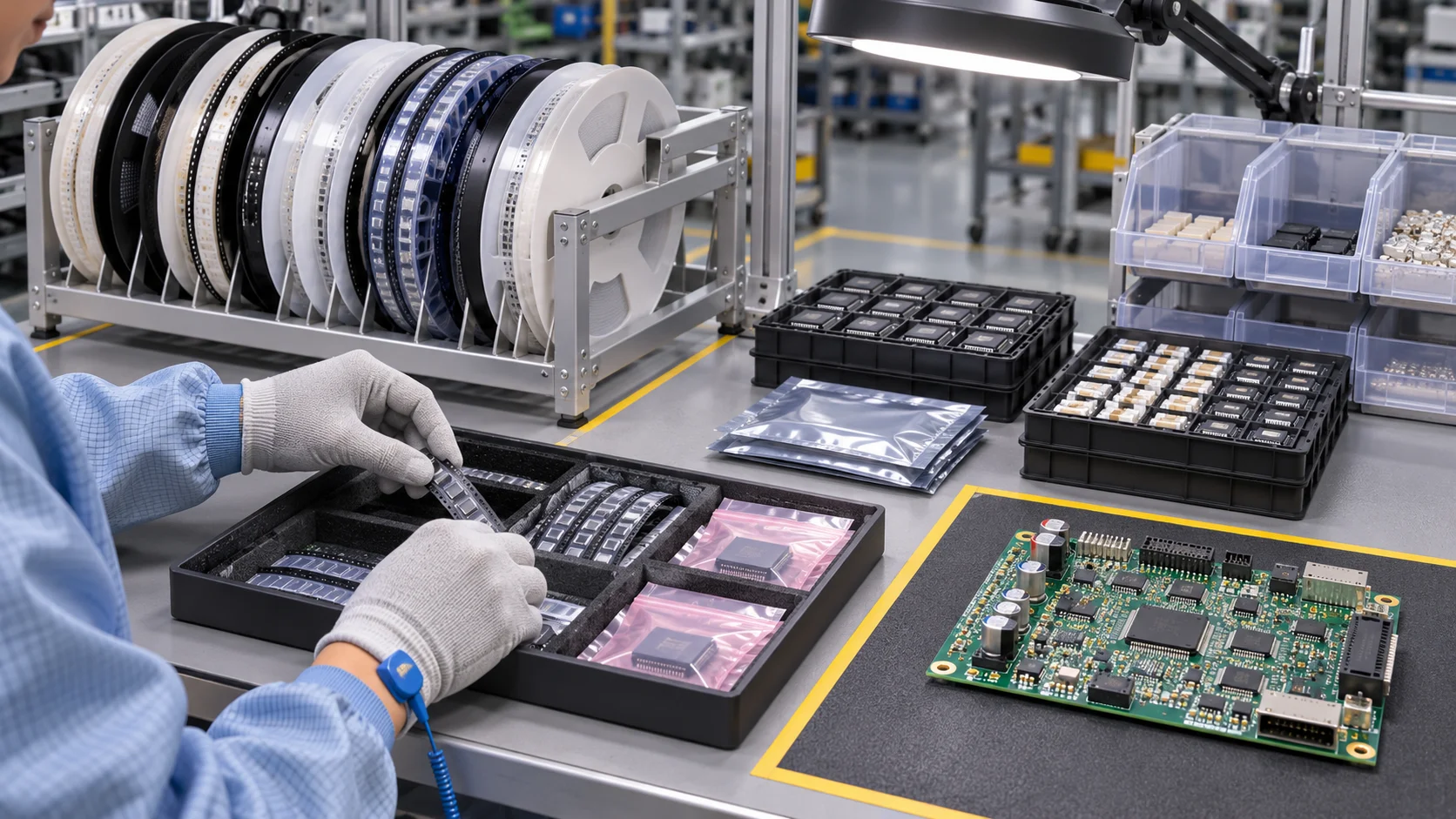
AI-generated illustration of a consigned component kit.
When does it make sense for an OEM to supply components?
Consignment can fit a pilot when the OEM already holds allocated stock, controls a programmed device, or needs to use material from an approved source. A mixed supply model can also work. The OEM supplies constrained or proprietary items and the assembler buys the lines assigned to it. Compare both models on kit completeness, the time needed to resolve exceptions, and who owns surplus stock.
Clarify the supply boundary at the individual line level. For example, an OEM may supply a controller IC and an application-specific connector while the assembler sources standard passives. Document who supplies bare boards, programming adapters or other items required to run the build. Some of these items may live in a tooling or manufacturing manifest outside the BOM. Identify them in the handoff package so they have an arrival date and an owner.
If the same manufacturer part number appears on multiple BOM lines, decide whether stock is pooled across those references or reserved for a specific use. For two variants sharing a component, distinguish common stock from stock set aside for one variant. This prevents one production order from consuming parts needed to complete a different configuration.
What belongs in the consignment handoff?
Start with the production BOM revision, build quantity by variant, and a named owner for every material line. Supply complete orderable part numbers and identify any intentionally unpopulated positions. Ask the assembler to confirm how it will handle splits across reels, trays, tubes or bags. Use the table below as a project template.
Handoff item | What the OEM provides | What the assembler confirms |
|---|---|---|
Build configuration | Assembly part number, revision, variant and requested quantity | Released file set and the effect of any mismatch |
Component identity | Manufacturer, full orderable part number and reference designators | Match against received labels and approved records |
Supply ownership | Customer or assembler responsibility for each line | Who resolves availability, replenishment and exceptions |
Quantity | Shipment quantity and any OEM reserve | Usable quantity required for the quoted process |
Packaging | Packaging format, split packs and known handling history where relevant | Suitability for storage and line setup |
Traceability | Shipment manifest, package identifiers and required lot data | Which records can be linked to the work order and build units |
Closeout | Return, retain or dispose instructions, subject to approval | Reconciliation format, timing and shipping responsibility |
Have the assembler acknowledge the same revision that procurement used to create the packing list. If a shipment must leave before a revised BOM is issued, identify the affected part lines and keep those items pending review at receiving. Give each box or shipment a reference the assembler can map back to the OEM order and manifest.
A useful manifest contains one line per identifiable package when the assembler needs lot-level reconciliation. For example, a single BOM item can arrive on two reels with distinct supplier lot identifiers. Record each reel separately if a later investigation needs to distinguish where the parts were used. Agree the traceability level before kitting so receiving and production can capture the required data without reconstructing it afterward.
How many parts should the OEM ship?
Calculate the assembly demand from the ordered quantity and populated positions per board. Then ask the assembler to quote any additional quantity it needs for the proposed process, packaging format and rework plan. Confirm whether allowance is required for each package, each reel or the BOM line as a whole. Use the supplier’s agreed figure for the build.
For a hypothetical run of 80 controllers with one connector per board, the theoretical assembly demand is 80. If the assembler requests four additional pieces for the agreed setup and handling allowance, the accepted kit needs 84 usable connectors. A manifest showing 84 shipped pieces should be followed by usable-quantity confirmation. Quarantined or damaged parts stay outside the available count until a reviewer dispositions them.
Spare or reserve material should be visible in the handoff. Consider keeping a small OEM reserve when replacement stock would be hard to obtain, provided the supplier confirms it has enough accepted material to complete the order. If a shortage appears, ask for the maximum buildable quantity based on the limiting item. Then decide whether to wait for replenishment, authorize a smaller build, or approve a documented alternative through the agreed process.
What should receiving check before the kit reaches the line?
Ask the assembler to compare part labels and quantity with the released part list and shipment manifest. Agree which items require lot or date codes, packaging checks, or further verification under the OEM’s procedures. If the part has special storage or handling instructions, provide the relevant manufacturer instructions and any known opening or repacking history. Identify responsibility for material the supplier cannot verify on receipt.
For unexpected shortages, mixed labels, damaged packs, and identity mismatches, require a receiving exception that names the affected package, quantity, and reason. Set the material aside while the named owner reviews the evidence. Once resolved, record whether it was accepted, returned, replaced, or left on hold. The accepted quantity should update the work order’s kit status.
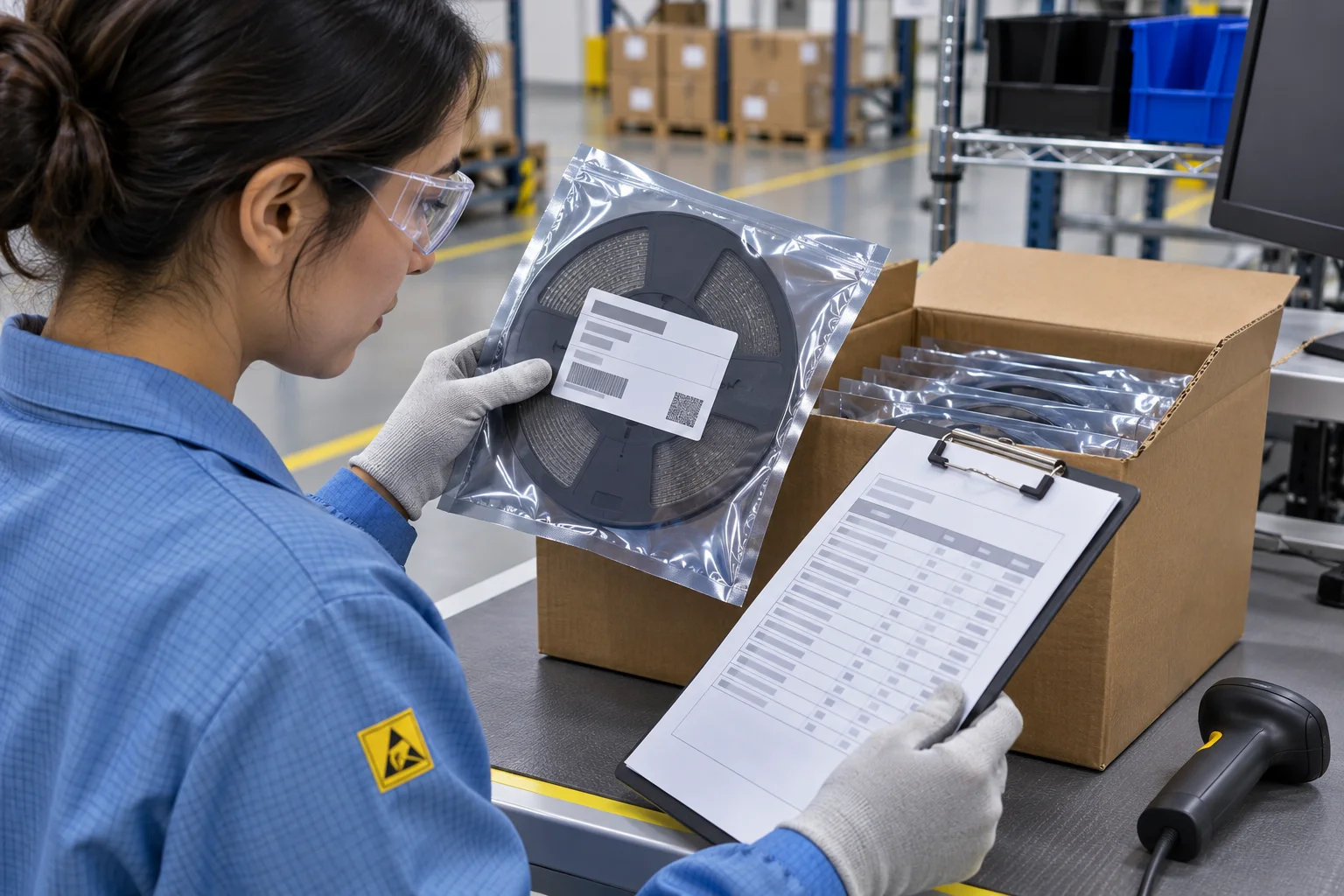
AI-generated illustration of a receiving and identification check.
Receiving acceptance and kit readiness serve different decisions. The receiving team confirms individual items against the agreed checks. Production planning then verifies that the accepted lines can support the intended quantity and variants. Ask for a list of shortages and unresolved exceptions before agreeing that the build can start.
Who can approve a shortage response or substitution?
Give purchasing a named route for commercial exceptions and engineering or quality a named route for technical dispositions. When the exact approved part is short, the assembler can propose a replenishment date, reduced build quantity, or candidate alternate. The OEM’s designated authority should record the decision and the affected build scope.
If a candidate alternate is approved for the pilot, make the effective configuration clear. Identify the original and substitute part numbers, affected reference designators and variant, authorized quantity, and the approval reference. Make the same decision visible to purchasing, receiving, production and quality. Agree what happens to remaining units and material after the authorization expires.
For every partial build, update the allocation of parts and the inventory report before rescheduling. The next build may depend on the unused balance of a constrained line. Tie any reservation to a defined work order or upcoming requirement so the assembler can confirm availability before committing its schedule.
How should the OEM reconcile unused components?
Ask for a closeout report that starts from accepted receipts and shows the disposition of the full quantity. Agree whether the report needs actual installed quantity by work order, lot or serial number. Show scrap and material held for review separately. State the quantity available to return or retain, its packaging condition, and any applicable handling information.
In the hypothetical connector example, the assembler accepts 84 pieces, installs 80, records one damaged piece as scrap and retains three usable pieces pending return approval. The total reconciles to 84. If the installed count is based on consumption records, specify how the assembler accounts for rework removal or any unit that remains held. Ask the supplier to explain discrepancies before the closeout is approved.

AI-generated illustration of leftover component reconciliation.
For retained stock, agree where it will be held, which project owns it, when the balance will be reviewed, and who authorizes its next use. For returns, agree the packaging, shipment reference and responsibilities for transport. Where a supplier proposes disposal, request the authorization record and the resulting disposition report as agreed for your project.
How do local and China-based handoffs differ in practice?
Request the same intake and reconciliation reports from both bidders. Compare the handoff on the actual shipment route, the time needed for sample review, and the practical arrangements for returning surplus. With an assembler near your engineering team, ask whether someone can check an exception in person and collect returned material. With a China-based assembler, agree review windows across time zones, the recipient of each shipment, and how held items and inventory returns will be handled.
Avoid using geography to infer how quickly a specific kit will be ready. Ask each supplier to confirm when a quantity discrepancy will be reported, how it will affect the planned start date, and which decisions can be handled remotely with label photos and manifest records. Where the shipping arrangement makes returns inconvenient, compare the cost and expected value of retaining approved stock for a later order against returning it after the pilot.
FAQ
Can I send only the parts that are difficult to source?
Yes, if the assembler accepts the mixed model for the project and the responsible party is clear for every BOM line. Ask for written confirmation of any material the assembler will purchase and the evidence it will provide for that material.
Can the assembler start with an incomplete kit?
An authorized partial build may be possible. First identify the limiting part, affected variants and maximum buildable quantity. Agree which units should be built and how the remaining inventory will be reserved for the revised schedule.
What should I do with components whose labels are incomplete?
Give the assembler the available provenance documents and identify the affected packages. Ask the designated reviewer to decide what additional evidence is acceptable and whether the material can be used. Keep the quantity out of the usable balance while the decision is open.
When should I request the inventory closeout?
Agree the deadline in the quote or order. A practical milestone is after the supplier records production consumption and rework, while there is still time to decide how unused material will be returned or held.
Send VeryPCBA your released BOM, pilot quantities by variant, proposed customer-supplied lines, shipping manifest format and return instructions. Ask for the usable kit quantity by line and a sample inventory closeout report. VeryPCBA