

Turnkey AI PCBA assembly means one supplier buys every BOM line, builds the board, tests it, and ships a finished assembly. European system integrators and OEMs face a real sourcing decision when they build AI inference boxes, industrial HMI units, vision gateways, or robot controllers. Many integrators have strong designs but limited manufacturing, procurement, and test capacity. That gap makes the sourcing model a strategic choice, not a purchasing detail. This post clarifies what a turnkey quote includes and excludes, how turnkey PCB assembly compares with partial turnkey and consigned models, and how the choice shapes country of origin and RFQs. OEMs can then brief EMS providers and hardware teams with confidence.
Key Takeaways
Turnkey assembly means one supplier buys all parts, builds the board, tests it, and ships a finished product.
Full turnkey gives you one price and one point of contact, which saves time and reduces risk.
Always ask for a written quote that lists what is included and what is not, like testing and extra fees.
Check that your supplier follows quality standards like ISO 9001 and IPC-A-610.
Send complete files like Gerber and BOM before you request a quote to avoid delays.
What Turnkey AI PCBA Assembly Covers
Turnkey Workflow Defined
The workflow follows a fixed sequence:
File intake and DFM review.
Component sourcing and incoming inspection.
PCB fabrication.
Stencil printing, pick-and-place, and reflow soldering.
Wave or selective soldering for through-hole parts.
AOI and X-ray inspection.
In-circuit or functional test.
Rework, packing, and delivery.
Each stage follows documented process control. Many EMS providers build to IPC-A-610 acceptance classes and hold ISO 9001 certification. Buyers should confirm the class and certificate scope in writing.
What a Turnkey Quote Includes
A turnkey PCBA quote normally covers bare board fabrication, all components, assembly, standard inspection, and export documentation. Exact inclusions vary by provider, so OEMs must confirm them in writing before release.
Stage | Supplier action | In base quote? |
|---|---|---|
Design data review | Checks Gerber, BOM, centroid data | Usually free at RFQ |
BOM scrub | Prices lines, flags EOL parts | Yes |
Bare board fabrication | Builds to stackup | Yes |
Component procurement | Buys all BOM lines | Yes |
SMT and through-hole | Prints, places, reflows, solders | Yes |
Inspection | Visual and AOI standard | Base level varies |
Electrical test | Continuity to functional test | Often separate |
Finishing and packing | Depaneling, coating, export docs | Finishing usually separate |
NRE, custom test fixtures, firmware loading, and safety certification typically sit outside the base price. AI inference boxes, industrial HMI units, vision gateways, and robot controllers are common end products for this model. These designs carry dense processors and high-speed interfaces, so a turnkey PCB assembly quote should state test coverage explicitly.
Turnkey PCB Assembly vs. Partial and Consigned Models
Comparing the Three Sourcing Models
Factor | Full turnkey | Partial turnkey | Consigned |
|---|---|---|---|
Sourcing responsibility | Supplier buys all lines | Split by agreement | OEM supplies most lines |
Cost structure | Single quoted price | Mixed pricing | OEM carries component cost |
Lead time | Supplier manages schedule | Depends on both parties | OEM schedule drives build |
IP control | Design files shared with supplier | Shared, with approved sources | Tightest control retained |
Best fit | Volume builds, lean teams | Mixed BOMs, some preferred parts | Sensitive designs, owned stock |
Full turnkey suits OEMs with lean procurement teams and steady volume. Partial turnkey fits OEMs holding approved sources for critical parts. Consigned models serve OEMs with existing stock or strict IP control needs. None of these models is inherently superior; fit depends on the OEM’s own capabilities.
Exclusions and Liability Ownership
Every model excludes certain items. Firmware development, enclosure fabrication, and regulatory certification usually sit outside a PCBA scope. OEMs should confirm these boundaries in writing before release.
Liability follows sourcing responsibility. Under full turnkey, the EMS provider owns component authenticity and incoming quality. Under partial turnkey, liability splits at the agreed line. Under consigned models, the OEM carries risk for supplied parts. Test coverage definitions matter here too. A clear statement of AOI, ICT, and functional test scope protects both parties.
European OEMs also weigh compliance. An EMS partner holding ISO 9001 certification and building to IPC-A-610 gives buyers a documented quality baseline. Request certificate scope and acceptance class in writing.
BOM Sourcing, Testing, and PCB Assembly Scope
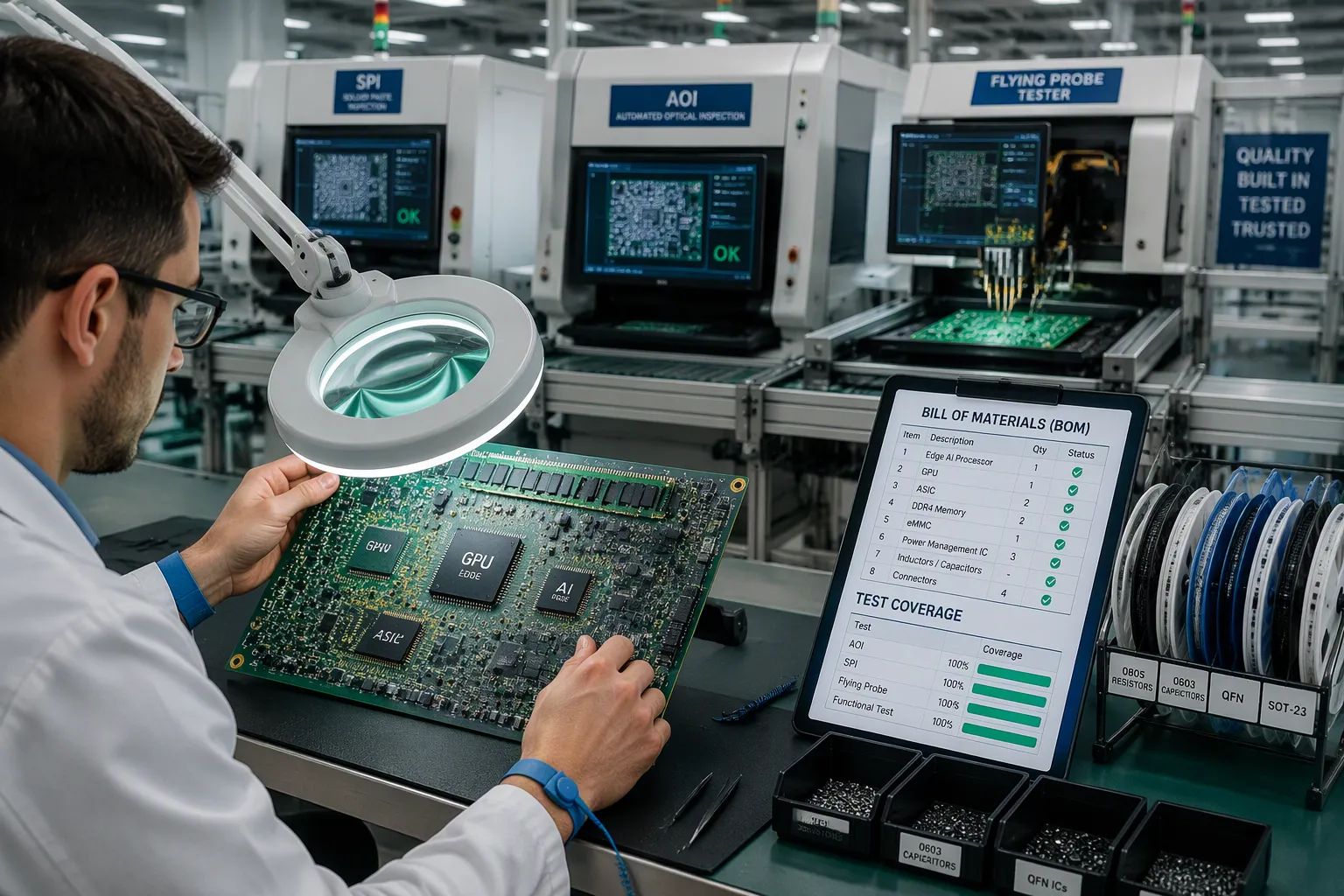
BOM Sourcing and Test Coverage
PCBA vs. Box Build
Printed circuit board assembly ends when the tested board leaves the line. Box builds begin there. A box build integrates the assembled electronics into an enclosure, adds wiring and electromechanical assembly, flashes firmware, runs configuration and calibration, and handles final packaging and logistics. The output is a complete device, not a board.
Oems should state the boundary clearly in the RFQ. A turnkey pcb assembly and box build scope covers both stages under one supplier. A board-only scope leaves enclosure integration with the OEM or a separate partner. Both arrangements work; the right one depends on the OEM’s in-house integration capacity and the sensitivity of the ai computing hardware inside the unit.
Country of Origin, RFQs, and Choosing a Manufacturing Partner for PCB Assembly
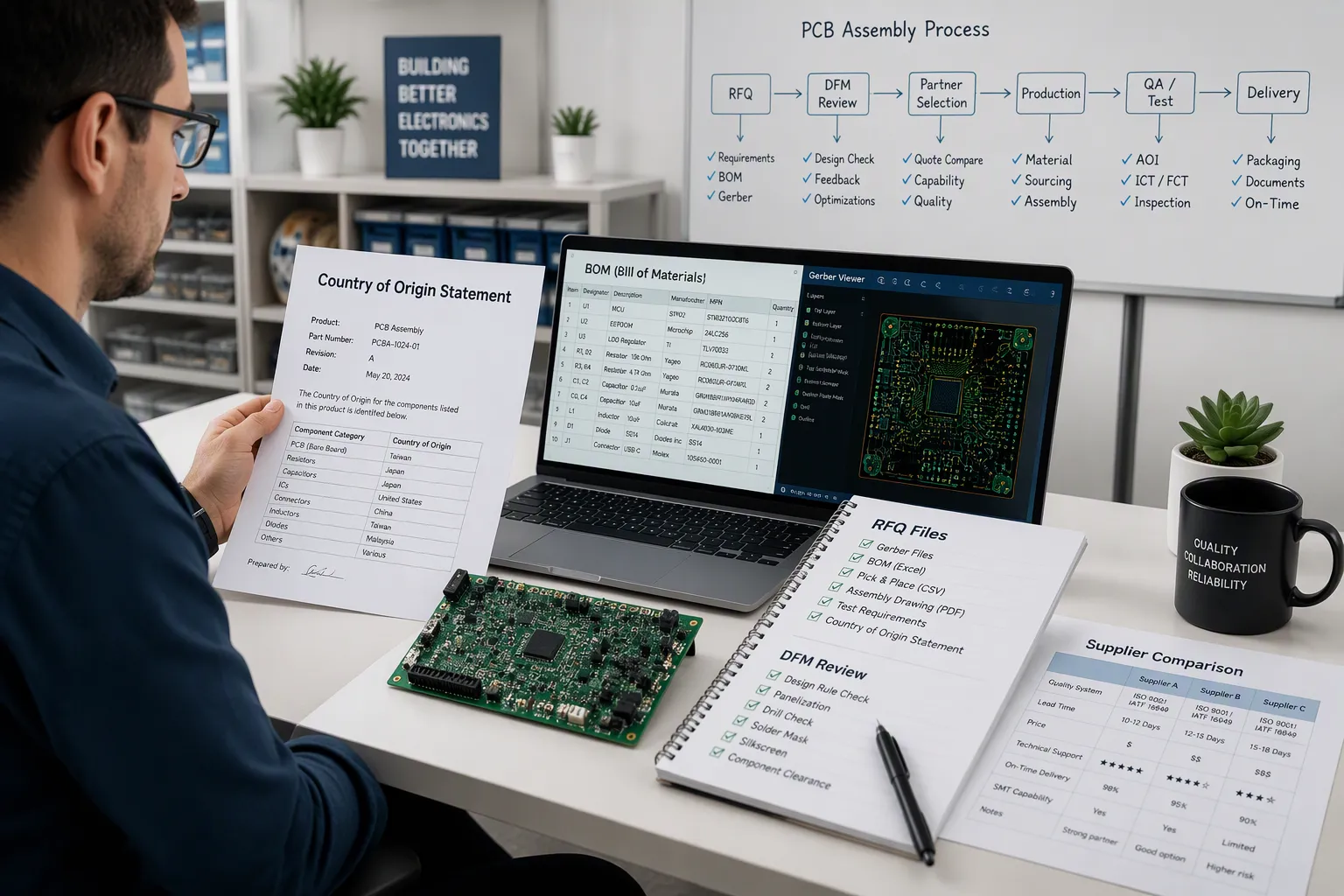
Country-of-Origin Implications
Assembly location and component sourcing both shape country-of-origin documentation. A board assembled in one country from parts bought in several others rarely carries a single simple origin. European oems should request a written origin statement with every turnkey pcb assembly order. Ask the supplier to list the assembly site, the source country for major BOM lines, and the rule used to determine origin. Documentation quality varies across ems providers, so confirm the format early.
RFQ Files and Scaling to Volume
An accurate turnkey pcb assembly quote depends on complete input files. A European buyer should send:
Gerber 274-X files, Excellon 2 drill files, and Pick&Place files.
A BOM, the functional test procedure, and any drawings.
Final assembly requirements and a completed project data sheet.
DFM review then protects the schedule. Early error detection avoids rework, and component spacing checks prevent misalignment. Reviewers also catch BOM errors such as mismatched package sizes before production. Small design changes, such as moving a part by a millimeter, can replace manual soldering with selective or wave soldering and cut lead time.
Quick-turn builds carry ai hardware teams from prototype through validation without long pauses. Volume then follows the same documented process.
Choosing a Partner
Price alone misleads. Oems should weigh capability, quality, and scalability together.
Factor | What to Evaluate |
|---|---|
Capabilities | Line width, layer counts, rigid-flex, prototype and volume |
Quality | ISO 9001 scope, IPC-A-610 class, process control |
Cost | NRE, re-spins, volume pricing |
Delivery | Lead times, location, logistics |
Oems should match the sourcing model to volume, IP sensitivity, and compliance needs. No single model fits every program. A turnkey pcb assembly quote deserves a written review of inclusions and exclusions. Buyers should confirm four items before release:
Test definitions and liability ownership.
Country-of-origin documentation.
Gerber, BOM, and test files ahead of the RFQ.
Escalation contacts at the EMS provider.
FAQ
What does a turnkey PCB assembly quote typically include?
A standard quote covers bare board fabrication, all BOM lines, SMT and through-hole assembly, and basic inspection. Oems should confirm test depth, NRE, and documentation in writing. Most ems providers treat functional test and custom fixtures as separate line items.
Which sourcing model fits a first production run?
A first run usually favors full turnkey. The supplier carries procurement risk and schedule control. Oems with approved part sources may prefer partial turnkey. Consigned models suit teams holding existing stock. Each ems partner should document the chosen route on the quote, and ai hardware teams should match the model to volume and IP sensitivity.
What should OEMs verify before releasing an order?
Buyers should confirm test definitions, liability ownership, and country-of-origin statements in writing. Ask for ISO 9001 scope and the IPC-A-610 acceptance class. A reliable ems provider documents turnkey PCB assembly inclusions clearly. Oems should also confirm escalation contacts and rework responsibility before release.
How does a program scale from prototype to volume?
See Also
Complete AI PCBA Solutions for Ireland’s MedTech and IoT Hardware Firms
End-to-End AI PCBA Services for Singapore IoT and MedTech Initiatives
OEM AI PCBA Production for Electronics Manufacturers in Poland
OEM AI Hardware PCBA Solutions for Technology Firms in Belgium
Tailored Edge AI PCBA for Hardware Startups in the United States