
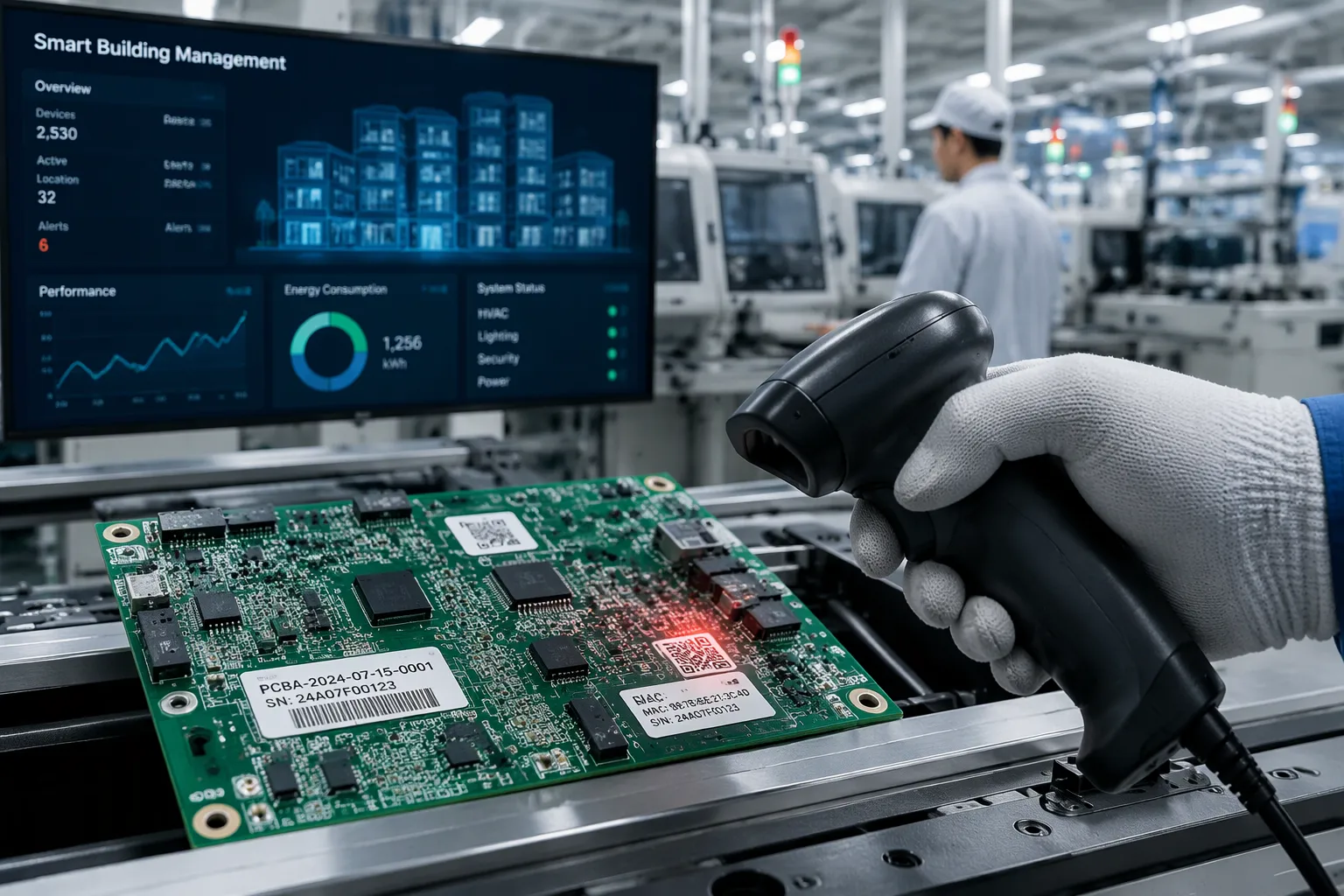
A failed building controller can take down ventilation, access control, or lighting across an entire floor. Building code compliance, field reliability, and firmware integrity all depend on knowing exactly how each board was built. Batch PCB assembly makes that hard. When a defect or recall hits, you cannot quickly isolate which units came from which component lots, material batches, or process runs. PCBA traceability closes that gap. This article gives you a concrete, step-by-step path to a traceable production process, from serial number and data design through manufacturer selection and audit.
Key Takeaways
Unit-level traceability links each board to its full production history, enabling quick recall containment.
Define serial numbers and BOM binding rules with your manufacturer before the first batch runs.
Capture data at every station—from incoming materials to final test—to build a complete record per unit.
Log firmware versions and engineering changes per serial number to maintain control and compliance.
Use IPC-1782B and IPC-CFX standards to set traceability levels and ensure digital data exchange.
Why Traceability Matters for Smart Building OEMs
A building controller sits at the center of daily operations. One failed unit can disrupt ventilation, access control, or lighting across an entire floor. You need to know how that unit was built, which components it carries, and which firmware it runs. Traceability gives you those answers.
Compliance and Certification Pressure
Building codes and certification audits increasingly ask for proof, not promises. Auditors want to see that you can connect a shipped controller to its production records. They ask for part numbers, revision history, and test evidence. A traceable process turns those requests into a quick document pull. A weak process turns them into a scramble.
Your customers also raise the bar. Specifiers and facility managers now request version and test records as part of routine procurement. They want to confirm that the board inside the enclosure matches the approved design. Traceability lets you answer with data instead of assurances.
Field Reliability and Recall Containment
The hardest question in the field is simple: which other units share this defect? Without traceability, you face a painful choice. You recall broadly and absorb the cost, or you recall narrowly and accept the risk. Neither option protects your reputation well.
Traceability changes the math. When a single part fails, you trace the board back to its production batch in minutes. You see the component lot, the process run, and the test results for that batch. Then you contain the recall to the affected units. IPC-1782B gives you a shared vocabulary for these records, and IPC-CFX supports digital data exchange with your manufacturer. Both standards help you build a containment process your customers can trust.
What PCBA Traceability Means
PCBA traceability is the ability to connect each board to its production history. That history covers four things: how the board was built, which firmware it received, who supplied each component, and what the inspection records show. You should treat it as a data chain, not a filing cabinet. Every link must point to a specific unit.
Traceability Levels from Lot to Unit
Traceability comes in levels. At the lowest level, you know only that a group of boards passed through the line in a given week. At the highest level, you can pull one serial number and see its full story. That story includes the component lots, the machine settings, the operator, the test results, and the firmware version.
Think in terms of silicon-to-system data. The chain starts at the component supplier and ends at the installed controller. Lot-level tracking stops partway. Full unit-level records carry the chain all the way to the building.
Batch Assembly vs. Unit-Level Tracking
Batch PCB assembly naturally produces lot data. You know a run of boards used a specific solder paste lot and a specific reflow profile. That data helps when a whole batch fails. It falls short when one unit fails and its neighbors pass.
Unit-level tracking adds a unique serial number to every board. You scan that number at each station, and the system binds the records to it. A field failure then leads you straight to the exact material, process, and test history behind that one unit. Batch data tells you where to look. Unit data tells you what happened.
Traceability in Batch PCB Assembly
Serial Number Design and BOM Versioning
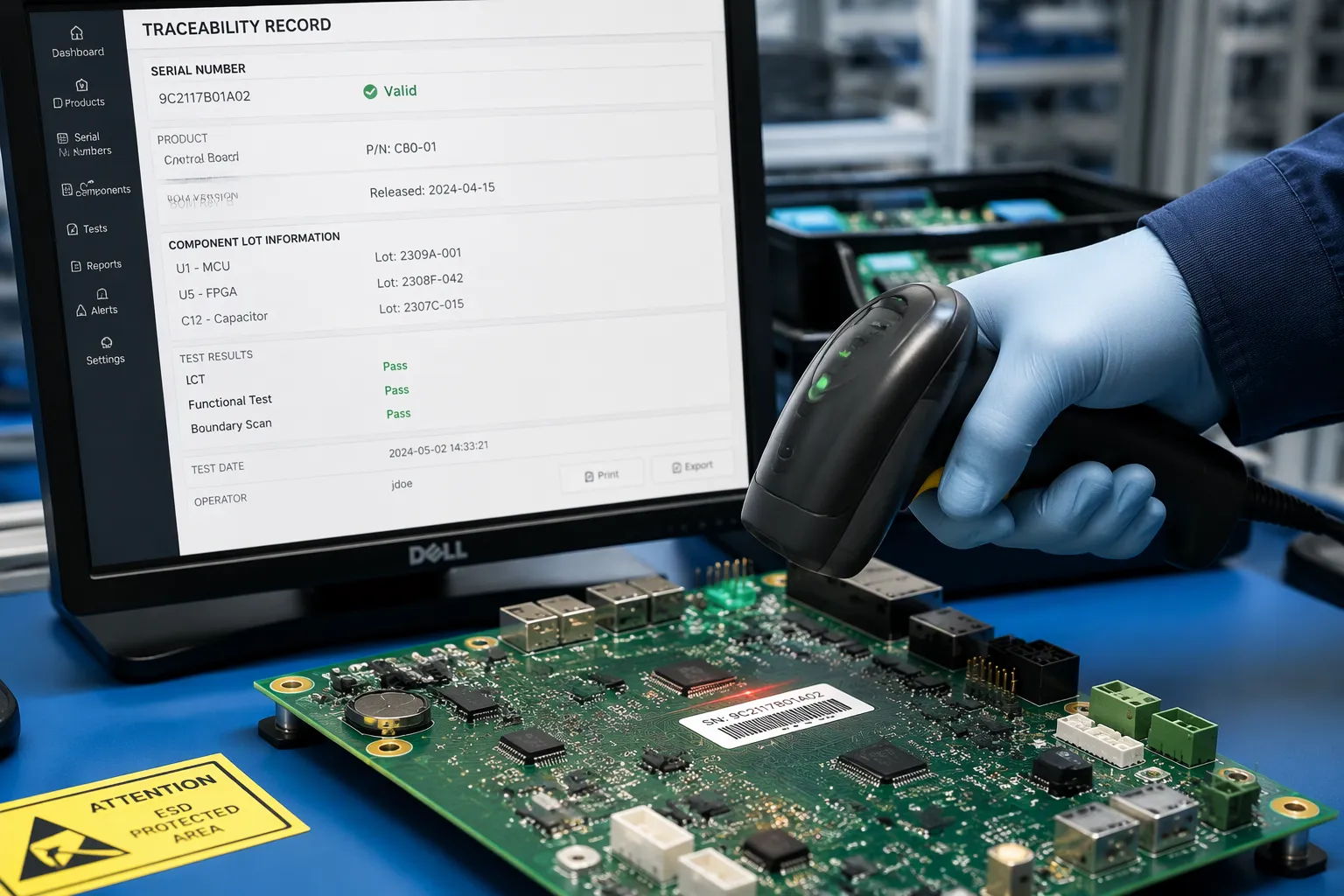
Serial number design decides how much you can ever learn about a board. A good scheme encodes the production date, the assembly batch, and a unique sequence. Keep the format fixed and documented. Avoid embedding data that changes often, such as customer names or order numbers. A stable format lets your manufacturer scan the same number at every station for years.
Bind each serial number to one BOM version at the moment of programming. The record should show the exact revision, the approved component list, and the date the version took effect. When you release a new revision, the system must reject the old one for new units. This link is the backbone of PCBA traceability; without it, a serial number points to a board but not to a design.
Material Lots, Process Data, and Test Results
Every unit record needs a defined set of fields. Capture the assembly batch number, the equipment parameters for each machine, the operator ID at each station, and the component lot for every critical part. Add the inspection results and the functional test data. Store these fields against the serial number, not against the work order alone.
Change control protects the chain. Any alteration in assembly or testing can break it. A substituted part, a skipped inspection step, or a reworked joint must generate a new record entry. An unrecorded change leaves a silent gap that surfaces only during a recall.
The table shows where each approach fits. Batch-only records suit simple products with low field risk. Unit-level records suit building controllers, where one failure carries system-wide consequences. IPC-1782B defines traceability levels you can use to set the target, and IPC-CFX supports digital exchange of this data with your manufacturer.
Process from Receiving to Final Test
Traceability succeeds or fails at the station level. Each handoff between receiving, surface-mount assembly, and test is a chance to bind data to a serial number — or to lose it. Build the chain step by step, and verify each link before the next batch runs.
Incoming Material and Component Verification
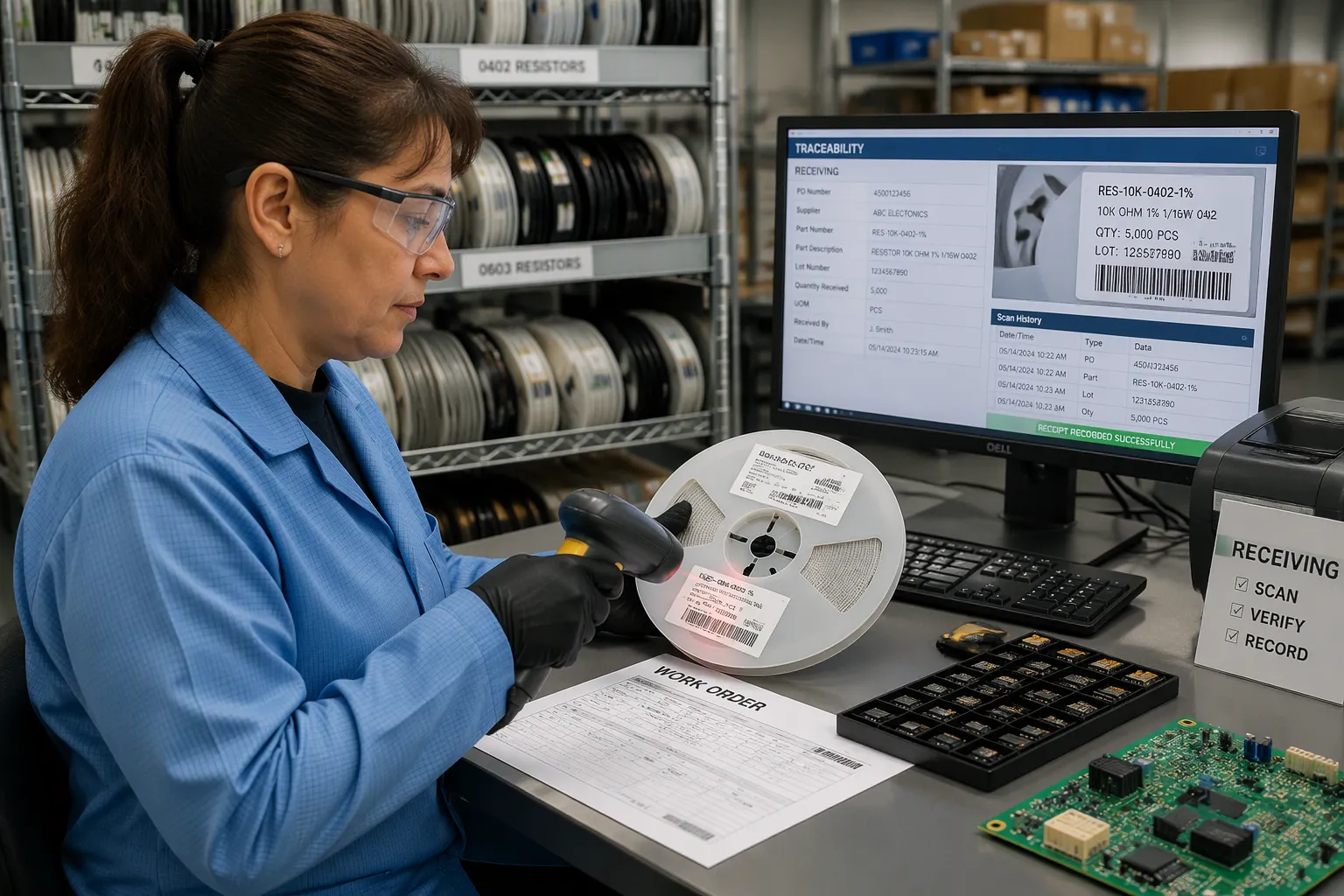
Receiving is the first link. Scan every reel, tray, and bag against the approved BOM version. Record the manufacturer part number, the supplier lot code, the date code, and the quantity received. Reject any part that does not match the approved list, and log the rejection with its reason.
Verification goes beyond the label. Confirm package markings against the supplier documentation. Check moisture-sensitive parts for proper dry-pack status. Quarantine anything questionable until engineering clears it. Each accepted lot then receives an internal lot number. That number follows the part to the line and into every unit record that consumes it.
Bind the internal lot number to the work order before kitting. When a feeder loads a reel, the operator scans both the reel label and the work order. The system now knows which units will carry which component lot. This single scan is where batch PCB assembly data becomes unit-level PCBA traceability.
SMT, Assembly, and Test Data Capture
Capture data at every machine, not at the end of the line. The solder paste printer logs the paste lot and stencil ID. The pick-and-place records feeder positions and placement programs. The reflow oven stores its profile against the run. Each station scans the board serial number, so the system ties these records to specific units rather than to the work order alone.
Manual assembly and inspection follow the same rule. Operators scan the serial number before soldering, pressing, or conformal coating. Inspection stations record results against that number. Functional test closes the loop: the tester logs firmware version, test program revision, measured values, and pass or fail status per unit.
Data Point | Batch-Level Capture | Unit-Level Capture |
|---|---|---|
Component lot | Work order only | Bound to each serial number |
Reflow profile | Run summary | Linked to units in that run |
Operator ID | Shift log | Recorded per station scan |
Test results | Batch pass rate | Per-unit values and status |
Firmware version | Not tracked | Logged at programming and test |
Treat every deviation as a record event. A reworked joint, a substituted feeder, or a retested unit must generate a new entry. An unrecorded change breaks the chain silently, and the gap appears only when you need the data most.
Smart Building-Specific Concerns
Firmware Version and Programming Records
A building controller is only as good as the firmware it runs. Treat the programming step as a traceability event, not a routine task. Scan the board serial number at the programming station. The system then logs the firmware version, the programming file checksum, the programmer ID, and the timestamp against that unit.
This record answers the field question that matters most: does this controller run the approved firmware? When you release an update, the record shows which units carry the old version and which carry the new one. You can target a field update precisely instead of touching every installed device.
Verify the programmed image after writing. A read-back check confirms the firmware matches the approved file. Log the result with the serial number. A unit that fails verification never leaves the station.
Component Substitution and Engineering Change Control
Substitutions happen in every batch build. A part goes on allocation, or a supplier issues a drop-in replacement. The risk lies in the record, not the swap itself. An unrecorded substitution breaks the traceability chain silently.
Run every substitution through an engineering change order (ECO). The ECO names the old part, the new part, the affected BOM version, and the effective date. Your manufacturer then binds the new component lot to units built after that date. Units built before the change keep their original record.
Closing the Repair Loop
Rework, Repair, and Return Records
A board that leaves the line and comes back carries a second history. Capture it with the same discipline as the first build. Scan the serial number when a unit enters rework. Record the defect code, the failed component, the replacement lot, the technician ID, and the date. Log the retest result against that same number.
A returned controller from the field deserves a full entry. Record the site, the reported symptom, the firmware version at return, and the diagnostic outcome. This record turns a vague complaint into a searchable event. Your manufacturer should treat rework as a new traceability event, not an edit to the original record. The original build data must stay intact.
Linking Field Failures to Production Data
The repair loop pays off when field data points back to production. Query the failed serial number and pull its component lots, process parameters, and test values. Compare that unit against passing units from the same batch. Patterns emerge fast: one feeder position, one paste lot, one reflow profile.
Feed every finding back into design and process reviews. A recurring failure becomes an ECO, and the ECO closes the loop.
Standards That Guide Traceability
Two IPC standards give you a shared language for this work. IPC-1782B defines traceability levels. IPC-CFX defines how you exchange production data digitally. Together they turn a vague promise into a checkable specification you can write into a purchase agreement.
IPC-1782B Traceability Levels
IPC-1782B sets out a tiered framework for traceability. The levels run from lot-level records up to full unit-level history. Each level adds data fields and tighter links between a board and its production events. You pick the level that matches your product risk.
For a building controller, lot-level records rarely suffice. A single failed unit can disrupt an entire floor, so you need the unit-level tier. That tier binds component lots, process parameters, and test results to one serial number. Match the level to the consequence of failure, not to the size of the order. Ask your manufacturer which level their system supports today. Then confirm the level in writing before the first batch runs. A stated level in the contract gives you a benchmark for audits and a clear target for any upgrade.
IPC-CFX and Digital Data Exchange
IPC-CFX standardizes how machines and systems exchange data on the line. It replaces hand-keyed logs and disconnected files with a common digital format. Your manufacturer’s printers, placement machines, and testers can publish records in one structure.
This matters for PCBA traceability across a batch PCB assembly run. Data flows from the machine to the unit record without manual entry. Retyping errors disappear, and the record stays complete. Ask whether your manufacturer’s equipment speaks IPC-CFX natively. A native connection beats a retrofitted export every time. Request a sample data file and check that it maps to the fields you specified. That check takes an hour and saves months of cleanup later.
Evaluating a Manufacturer’s Traceability
Audit Questions and Documentation Checks
Ask for evidence, not assurances. Request a sample unit record from a recent batch PCB assembly run. Check that the record links one serial number to its component lots, process parameters, test values, and firmware version. A complete sample answers more than a page of promises.
Walk the floor during the audit. Watch an operator scan a reel and a work order at the same station. Confirm that the scan writes to the unit record, not to a shift log. Ask how the system handles a reworked board. The answer should describe a new record entry, not an edit to the original data.
Put these questions in writing before you visit:
Which IPC-1782B traceability level does your system support today?
Can you show a field return traced back to its build record?
How do you bind a BOM revision to a serial number at programming?
What happens to the record when a substitution occurs?
Score each answer against your product risk. A building controller needs unit-level records, so a lot-level answer falls short.
System Integration and Data Access
Traceability data only helps when you can reach it. Ask how you will query records after the batch ships. A manufacturer that emails spreadsheets on request creates delay and error. A portal or a direct export keeps PCBA traceability usable during a recall, when hours matter.
Confirm the data format. IPC-CFX gives you a shared digital structure for machine and test data, so ask whether the equipment publishes records natively. Request a sample export and check that its fields match the ones you specified at project start.
Practical Considerations Before You Start
Cost, Lead Time, and Information to Provide
Unit-level tracking adds work at every station, so expect a higher piece price than a lot-only build. The premium covers scanning time, data storage, and the setup effort your manufacturer invests before the first batch. Treat that premium as insurance against a broad recall, not as overhead. A contained recall on one batch usually costs far less than a full-field sweep.
Lead time grows at the front end, not on the line. Serial format approval, BOM binding rules, and data field definitions need agreement before production starts. Bring your BOM with revision history, your firmware files and checksums, your serial number scheme, and your test specifications. Clear inputs shorten the setup phase considerably. Vague inputs force rework later, and rework at that stage delays your launch.
Scaling Traceability Across Product Lines
Start with your highest-risk product. A building controller that governs ventilation and access control justifies full unit-level records under IPC-1782B. A simple sensor board may only need lot-level tracking. Match the level to the consequence of failure, then reuse the same serial format and data fields across the family.
Standardize the template before you add the second product line. One field structure, one serial convention, and one ECO process keep your records comparable across lines. IPC-CFX helps here, because a shared digital format lets your manufacturer extend the same capture points to new assemblies without rebuilding the system. Review the scope with your manufacturer each time you add a line, and confirm the traceability level in writing.
A traceable batch PCBA process pays you back at the worst moments. You contain a recall to the affected units, you hand auditors a clean record, you control firmware by serial number, and you close the repair loop with real production data.
Treat traceability as a design decision, not a report you assemble later. Serial number design, BOM versioning, ECO discipline, and repair records form the backbone. Build them before the first batch runs.
Ask your manufacturer for a traceability sample and an audit checklist. Confirm the IPC-1782B level in writing. You can also contact our team for a traceability readiness review.
FAQ
Do building controller buyers really ask for version and test records?
Yes. Specifiers and facility managers now request firmware versions and test evidence during routine procurement. They want proof that the board matches the approved design. A traceable process turns that request into a quick document pull instead of a scramble.
How fast can you trace a field failure back to its production batch?
With unit-level records, you scan the failed serial number and pull its component lots, process parameters, and test values in minutes. You then compare that unit against passing units from the same batch. Patterns such as one feeder position or one paste lot emerge quickly.
Why do customers need part numbers on the record?
A part number identifies the exact component behind a failure. Without it, you cannot confirm which supplier lot entered the build. The part number, lot code, and date code together let you contain a recall to affected units rather than sweeping the whole field.
Which standards should I write into the purchase agreement?
Name IPC-1782B for the traceability level and IPC-CFX for digital data exchange. IPC-1782B gives you a tiered framework from lot-level up to full unit history. IPC-CFX standardizes how machines publish records, which removes hand-keyed logs and retyping errors.
See Also
Smart Building AI PCBA Solutions for Malaysian IoT Companies
OEM AI PCBA Production Services for Polish Electronics Factories
Tailored AI PCBA Manufacturing for Mexican Electronics Companies