
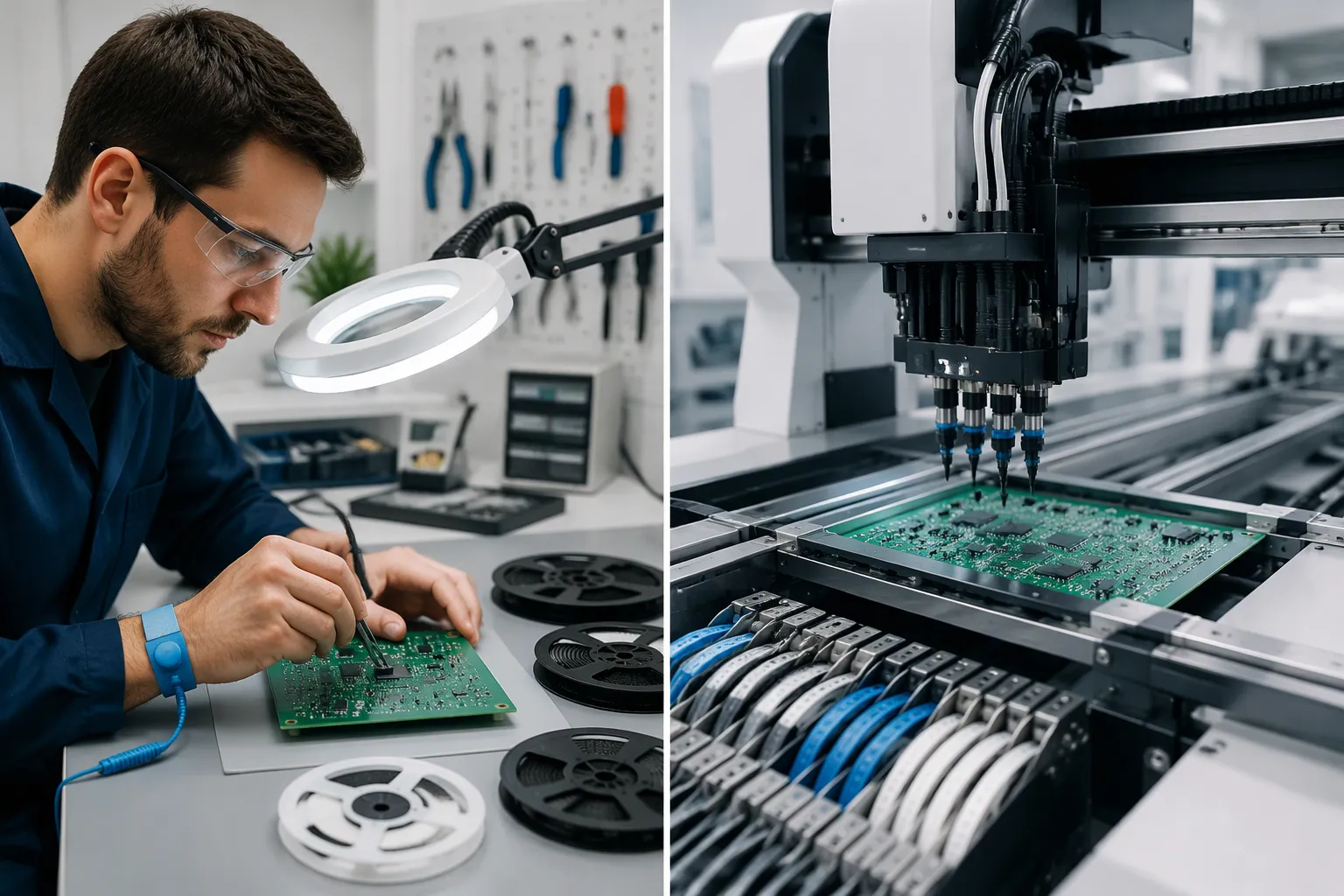
No single method wins every time. The right approach for SMD placement prototypes depends on what a project values most. Industrial equipment OEMs often move from 20 engineering samples to a 300-unit small batch, and that path demands both SMT and through-hole capability, fast design-for-manufacturing feedback, and solid version control.
Four criteria separate the options: technical performance, application fit, regulatory compliance, and cost. Each method leads on some of these and trails on others. The goal is not to crown a better technology. The goal is to match project needs to method. This guide offers a practical way to decide, not a sales pitch.
Key Takeaways
Manual placement works best for small batches with designs that change often.
Machine placement wins for fine-pitch parts and larger batches with stable designs.
Mixed boards need a hybrid approach: machine for SMT, hand work for through-hole.
Machine methods provide automatic traceability, which helps with audits.
Match your method to your project’s volume, complexity, and compliance needs.
Technical Performance
Speed and Throughput
Prototype volumes are small, yet speed still matters. A technician who places parts by hand works one component at a time, and the clock runs through every placement and every manual solder joint. An automated smd assembly process changes that math. The pick and place machine moves a full feeder set in one programmed pass, and the smt assembly machine repeats the motion without fatigue. For a 20-piece engineering run, the gap is modest. For a 300-unit small batch, smt assembly reduces labor hours sharply and shortens production cycles against manual soldering. Engineers then spend their time on design review instead of bench work.
Accuracy, Repeatability, and Reflow Soldering
Hand placement depends on eyesight and steady hands. Fine-pitch parts punish small slips, and two operators rarely produce identical results. Automated mounting of the smd components removes that variance. The smt machine holds mounting precision within its programmed tolerance and repeats it across every board. Paste application follows the same logic. Manual dispensing suits a handful of boards and odd shapes. Stencil printing delivers a consistent deposit, and the smd assembly process then hands off to reflow soldering for a controlled thermal profile. Manual soldering cannot match that profile control, which matters for joints that must survive thermal cycling.
The broader surface mount technology workflow rewards planning. A well-run smd assembly process pairs stencil printing with reflow soldering, and the automated surface mount technology line keeps each stage repeatable. Even a modest surface mounting setup benefits from this discipline. The surface mounting process becomes predictable, and surface-mount technology results stay stable from the first board to the last. Automated machines also log each pass, so the smt assembly process and the smt electronics assembly run stay consistent. That consistency supports the fast DFM feedback and version control an industrial equipment OEM needs across a 20-to-300 unit ramp. A single automated mounting step, backed by reflow soldering, often decides whether a prototype schedule holds.
SMD Assembly Fit for Prototypes
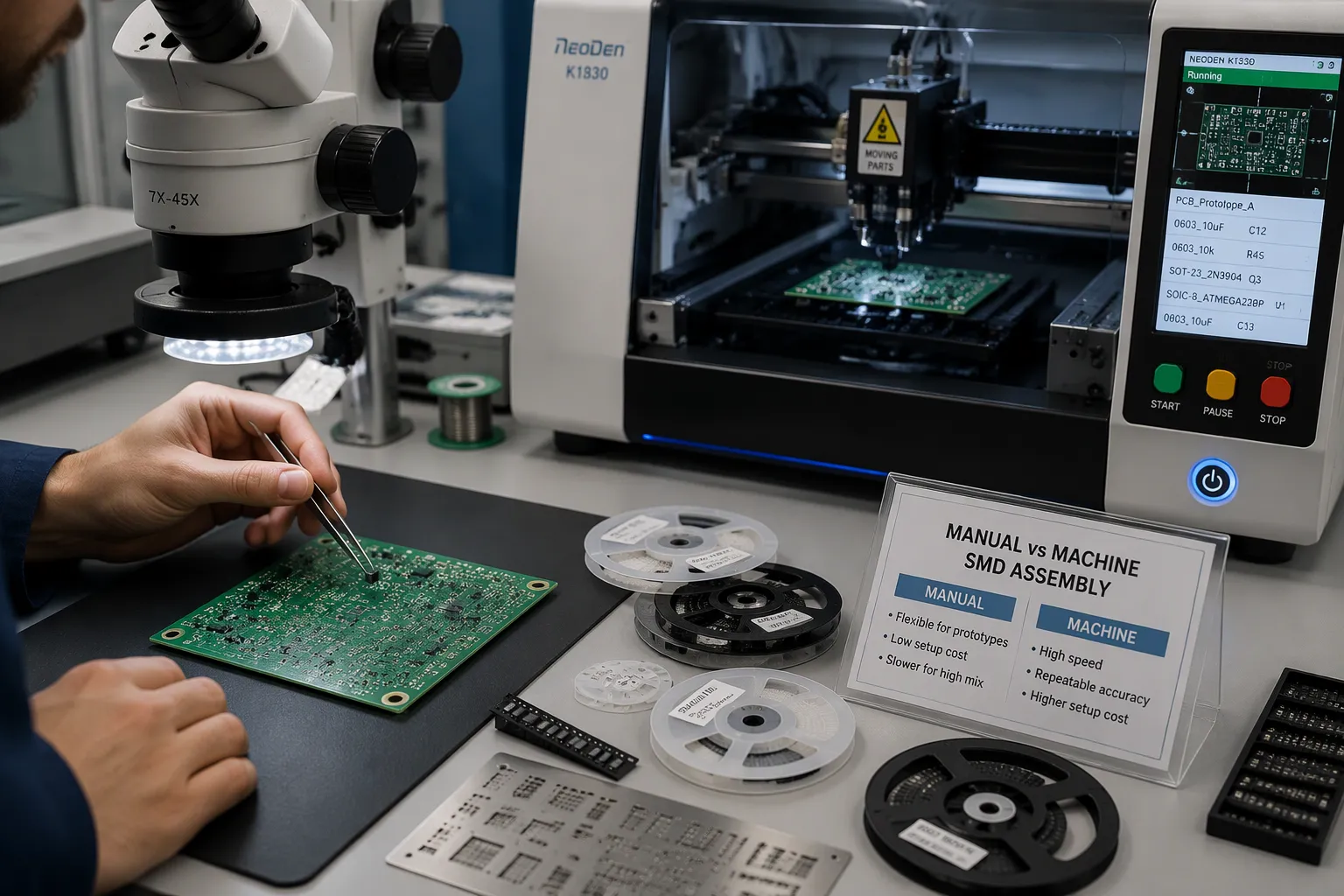
Volume, Complexity, and Pick and Place of SMD Components
Prototype volume rarely stays fixed. An industrial equipment OEM may start with 20 engineering samples and scale to a 300-unit small batch within one design cycle. Change frequency runs high at the start and settles as the design matures. Fine-pitch complexity adds pressure, because a single misplaced pin can scrap a board. Manual SMD pick-and-place equipment gives small teams a practical entry point for prototype assembly. A compact pick and place machine with a vision assist handles moderate part counts without a full line investment. For denser boards, the automated pick and place of SMD components becomes the safer route. The machine follows a programmed sequence, and the smd assembly process stays identical across every unit. That repeatability matters when the same board must pass design review twice with different firmware.
Flexibility and Mixed-Technology Boards
Flexibility separates the two methods most clearly. A pick and place machine excels at surface mount technology work, yet it cannot insert through-hole parts. Connectors, terminal blocks, and power components on industrial boards often remain through-hole. Manual placement handles those parts faster and simpler, and a technician adapts to a layout change in minutes. Mixed-technology boards therefore favor a hybrid flow: machine for the SMT side, hand work for the THT side. Fiducials tell another story. A missing fiducial slows manual setup on prototypes, because the operator simply aligns the board by eye. The same gap forces machine guessing or eye correction during pilot runs, and that correction costs time on every panel. Version control amplifies the difference. A design change mid-batch demands a quick program edit on the machine and a fresh stencil for reflow soldering. Manual mounting absorbs the change with a revised drawing and no programming at all. Fast DFM feedback also favors the manual route early, when engineers still move parts between revisions. As the design freezes, the smt assembly line takes over and locks the layout in place. Placing SMT components by machine then protects the frozen design across the full small batch. A balanced smd assembly plan uses each method where it fits: hand work for flux-stage changes, machine work for stable volume. The surface mounting step stays predictable, and the surface-mount technology result holds from sample one to unit three hundred. Prototype production then scales without a redesign of the process itself. Surface mount technology alone rarely covers an industrial board, so the hybrid approach keeps both paths open. The smt assembly workflow and the smd assembly process must agree on one point: the method follows the board, not the other way around. For SMD placement prototypes, that principle keeps schedules intact through every revision. Teams that plan SMD placement prototypes around mixed boards avoid late rework and keep the pick and place operation focused on the parts it does best.
Regulatory Compliance and Traceability
Standards and Process Control
Compliance expectations do not change with batch size. A 20-piece engineering run and a 300-unit small batch both fall under the same acceptance criteria. Machine placement supports process control through programmed parameters, calibrated feeders, and logged nozzle data. An operator can audit each run against a documented recipe. Manual placement relies on operator skill and written work instructions. That approach can meet the same standard, yet the evidence trail depends on discipline rather than automation. Both methods can satisfy IPC-A-610 Class 2 acceptance criteria when the team documents its process. The difference lies in how easily a third party verifies that control.
Reflow soldering adds another control point. A machine line records the thermal profile for every cycle. Manual soldering depends on iron temperature and operator technique, which are harder to prove after the fact. For industrial equipment OEMs, this distinction matters during audits. A documented smt assembly process gives auditors a clear chain of evidence. A manual flow can match it, but only with rigorous recordkeeping at each station.
Documentation and Traceability
Traceability follows the full pcb assembly workflow. It starts with file review, moves through smt assembly, and ends with inspection and final testing. Each stage should produce a record: the approved Gerber set, the stencil or dispensing log, the placement program version, and the inspection results. Machine methods generate much of this data automatically. The smd assembly process captures placement coordinates and feeder IDs without extra effort. Manual methods require the technician to log the same details by hand.
Version control ties these records together. An industrial equipment OEM that scales from 20 samples to 300 units needs every board traceable to one design revision. A machine program edit leaves a timestamp. A manual change leaves only a note, unless the team enforces a formal log. The surface mount technology side benefits from automated records, while the through-hole side still needs manual entries. A hybrid flow works best when both paths feed one traceability system. Teams should define the record set before the first board runs, not after. That habit keeps the smd assembly and surface-mount technology stages aligned with audit expectations.
Cost Factors
Equipment and Setup
Fixed costs diverge sharply between the two methods. A manual pick and place setup for prototypes costs little to acquire. A bench, a vacuum pen, a stereo microscope, and a rework station cover most needs, and the team can start on day one. A machine purchase carries a much larger price tag. The buyer also pays for programming time, feeder carts, nozzle sets, and a stencil for each paste revision. Stencil fabrication adds a recurring charge every time the design changes, and early prototypes change often.
Setup effort follows the same pattern. A technician prepares a manual bench in minutes. An automated line needs a program, a fiducial check, and a paste print trial before the first board runs. That overhead pays back only when the batch is large enough to absorb it. An industrial equipment OEM that runs 20 engineering samples will feel the setup cost on every unit. The same OEM at 300 units spreads that cost thin.
Labor and Per-Unit Cost
Labor drives the per-unit picture. Manual placement consumes technician hours for every board, and the hours grow with part count. The smd assembly process at machine speed cuts touch time per board, so the per-unit cost falls as quantity rises. A 20-piece run rarely justifies the machine overhead. A 300-unit small batch usually does, because the smt assembly process repeats without added labor.
The smt assembly process also reduces rework. Consistent paste deposits and repeatable placement lower the scrap rate, and fewer scrapped boards protect the budget. Manual work can match that quality, yet it depends on operator skill and adds inspection time. Teams should model both paths against their real quantity. A hybrid plan often wins: manual for the first samples, then the pick and place machine for the stable batch. That sequence keeps early costs low and captures smd assembly savings at volume.
Decision Guide for Component Placement and Assembly
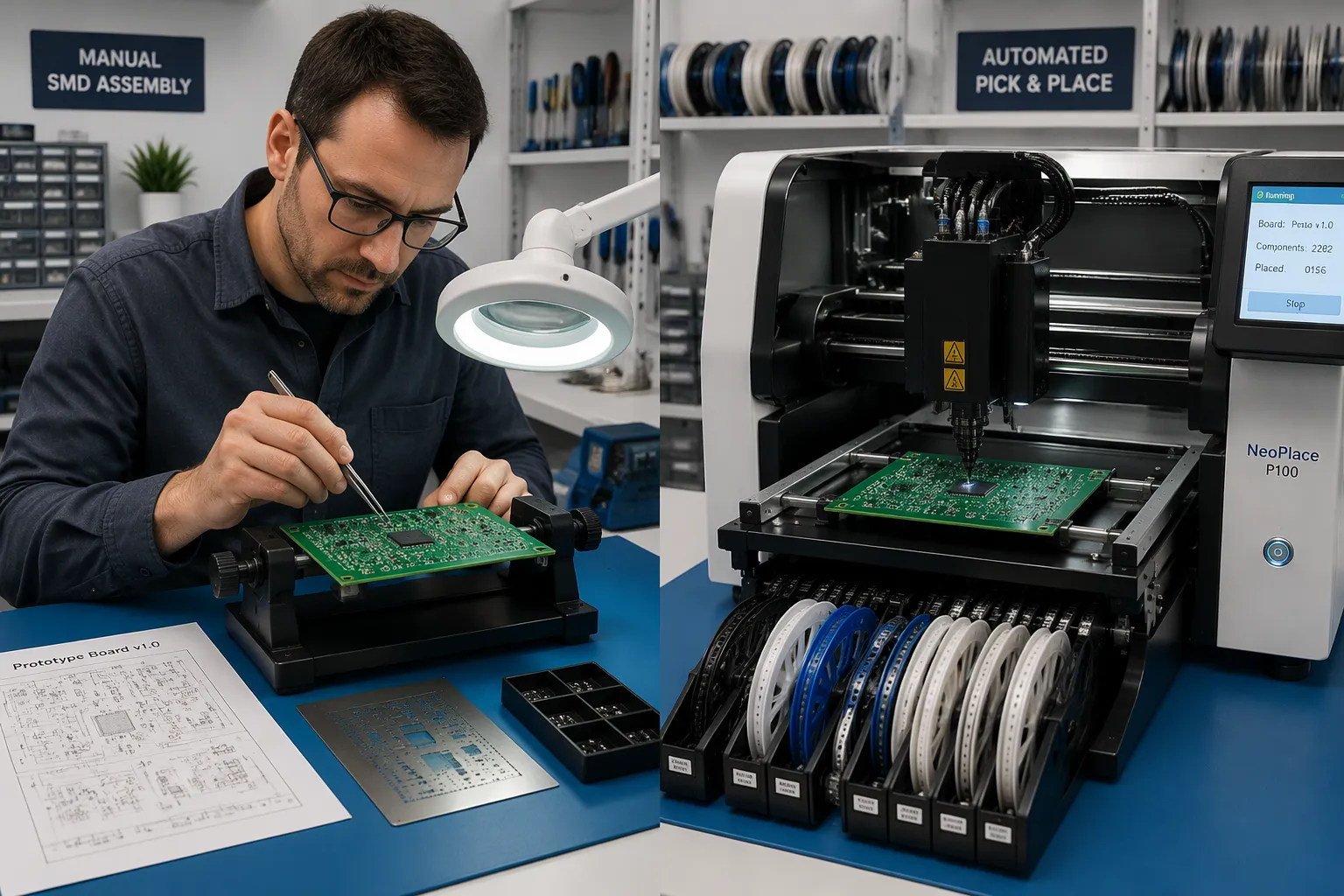
A project profile points to a method faster than any general rule. The table below maps common prototype situations to the approach that usually serves them best.
Project situation | Recommended method | Main reason |
|---|---|---|
Fewer than roughly 20 boards, design still changing | Manual | No programming or stencil cost per revision |
Fine-pitch parts, dense layout | Machine | Repeatable placement within programmed tolerance |
Mixed SMT and through-hole board | Hybrid | Machine for SMT, hand work for THT |
Frozen design, small batch toward 300 units | Machine | Labor hours stay flat as quantity rises |
Audit-heavy program with strict traceability | Machine-led, manual logged | Automatic placement and profile records |
Missing fiducials, early samples | Manual | Operator aligns by eye without delay |
When Manual Wins
Manual work leads whenever change outpaces volume. An industrial equipment OEM that runs 20 engineering samples through several revisions gains little from a programmed line. Each design edit forces a program change and a fresh stencil, and that overhead lands on every unit. A technician with a revised drawing adapts in minutes. Through-hole connectors, terminal blocks, and power parts also favor hand placement, because automated machines cannot insert them. Mixed-technology boards therefore keep a manual station regardless of batch size. Early DFM feedback arrives faster when engineers can move a part and see the result the same day. Manual methods also suit odd shapes and one-off rework, where a dispensing needle beats a stencil. For SMD placement prototypes in the concept stage, hand work keeps cost and schedule under control.
When Machine Wins
Machine placement leads once the design freezes and quantity climbs. A 300-unit small batch rewards the programmed sequence, because touch time per board stops scaling with part count. Fine-pitch components benefit most, since repeatable placement protects yield across the run. Traceability improves as well, because the line logs placement coordinates, feeder IDs, and reflow profiles without extra effort. Auditors then verify process control against a documented recipe rather than a handwritten note. The smt assembly stage also shortens cycles, and engineers redirect their hours toward design review. Teams planning SMD placement prototypes around a stable layout should reserve the machine for the parts it handles best and keep a manual path for THT. That split keeps component placement and assembly predictable from sample one to unit three hundred. A hybrid flow captures the strengths of both, and neither method needs to lose for the project to win. Sound component placement decisions follow the board, the volume, and the audit trail, not a preference for one technology.
No universal winner exists here. Manual work wins when designs change fast and volume stays low. Machine placement wins once the layout freezes and quantity climbs. Each method leads under different priorities.
Readers should weigh their own volume, complexity, compliance needs, and budget against the four criteria above. An industrial equipment OEM moving from 20 engineering samples to a 300-unit small batch needs both SMT and through-hole capability, fast DFM feedback, and version control. That profile rarely fits one method alone.
A practical next step: score the project against the decision guide before choosing. Rate each row honestly. The highest total points to the right smd assembly approach.
FAQ
Which method suits a design that still changes every week?
Manual placement fits that stage best. A technician adapts to a revised drawing in minutes, and no program edit or new stencil slows the loop. Machine work pays off once the layout freezes and the batch grows.
Can a machine handle through-hole parts on a mixed board?
No. A pick and place machine cannot insert through-hole connectors, terminal blocks, or power parts. A hybrid flow keeps the machine on the SMT side and assigns hand work to the THT side. That split serves industrial boards well.
How does traceability differ between the two methods?
A machine line logs placement coordinates, feeder IDs, and reflow profiles automatically. Manual work needs a written log at each station. Both paths can satisfy IPC-A-610 Class 2, yet the machine trail is easier to audit.
When does the machine become the cheaper choice?
The machine wins once quantity absorbs its setup cost. A 20-piece run rarely justifies programming and stencil charges. A 300-unit small batch spreads that overhead thin, and the smd assembly process holds labor hours flat as part count rises.
Do missing fiducials rule out machine placement?
Not permanently. Early samples without fiducials slow manual setup only slightly, because the operator aligns by eye. Pilot runs force machine guessing or eye correction, which costs time on every panel. Adding fiducials before the batch resolves the issue.
See Also
Tailored AI PCBA Production Services for Electronics Firms in Mexico
Artificial Intelligence PCBA Inspection Solutions for Mexico Manufacturing Facilities
AI-Driven Lab Automation PCBA for Medical Technology Firms in Ireland
Bespoke AI PCBA Solutions for Industrial Electronics in the Czech Republic
Precision AI PCBA for Swiss Medical and Measurement Equipment Manufacturers