


You gain a competitive edge in the UK IoT and Edge AI market when you use custom AI hardware PCB. These solutions boost device performance, reduce power usage, and simplify integration. You can quickly test ideas with prototypes and small batch runs. AI now streamlines PCB design and manufacturing, bringing smarter layouts and fewer errors.
Hardware Type | Main Advantages |
|---|---|
Microcontrollers | Power efficiency, cost savings, easy implementation |
Microprocessors | Advanced AI models, multitasking, flexible applications |
Single-board computers | Rapid development, proven reliability, rich ecosystem |
Key Takeaways
Custom AI hardware PCBs enhance device performance and energy efficiency, making them essential for IoT and Edge AI applications.
AI-driven design tools optimise PCB layouts, reducing errors and speeding up the prototyping process, which is crucial for staying competitive.
Frequent design revisions and small batch trials allow for rapid adaptation to market needs, minimising risks before full-scale production.
Compliance with UK standards like CE and UKCA is vital; thorough documentation and early prototyping help ensure successful certification.
Collaborating closely with your PCBA provider can streamline the development process, ensuring your product meets both technical and regulatory requirements.
What Is Custom AI Hardware PCB
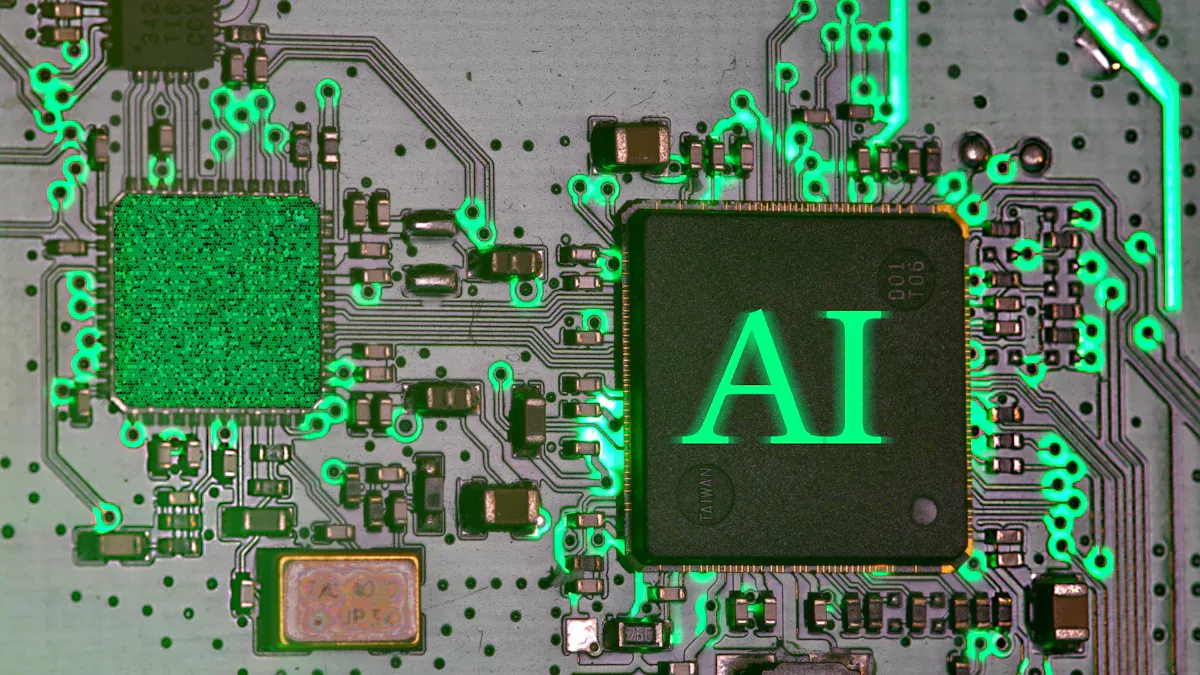
Custom AI hardware PCB refers to a purpose-built printed circuit board assembly that supports advanced artificial intelligence functions in embedded devices. You see these boards powering the latest IoT and Edge AI applications across the UK. In 2025, you will notice more embedded devices in IoT and electric vehicles running sophisticated AI locally. This shift happens because of optimised models, hardware accelerators, and real-time architectures. You benefit from hybrid edge-cloud collaborations that allow your devices to process data efficiently and securely.
Key Features for IoT and Edge AI
You rely on custom AI hardware PCB to deliver reliable performance in demanding environments. These boards integrate advanced GPU architectures, neural processors, and memory modules. You can accelerate AI workloads directly at the edge, which reduces latency and improves responsiveness. Many UK products use these solutions, including:
AI IoT gateways for smart connectivity
Smart security devices for real-time threat detection
Environmental monitoring sensors for sustainability
AI medical device prototypes for rapid healthcare innovation
Low-power edge AI modules for battery-operated systems
You also find custom AI hardware PCB in agriculture for precision farming, energy management solutions, and retail inventory systems. These applications require robust hardware that supports frequent design revisions, small batch trials, and pre-certification prototypes. You meet strict UK and EU compliance standards, such as CE and UKCA, by using industrial-grade components.
How AI Enhances PCB Design
You gain a significant advantage when you use AI-driven tools in PCB design. AI algorithms optimise component placement and routing, which leads to smarter layouts and fewer errors. You can predict potential failures before they occur, improving quality and reducing rework. AI also helps you automate testing and validation, which speeds up prototyping and supports low procurement quantities. Industry leaders, such as Nvidia and Intel, endorse AI-driven design for its reliability and long-term operation. You stay ahead in the market by adopting these advanced methods.
Challenges in UK IoT and Edge AI Devices
Power and Size Constraints
You face strict power and size limitations when developing IoT and Edge AI devices in the UK. Energy efficiency remains essential for devices that operate in remote or power-constrained environments. You often work with platforms ranging from advanced embedded systems to microcontrollers with limited memory and power budgets.
Low-energy designs help you extend device lifespan, which is vital for applications in smart buildings and agriculture.
Limited computational resources can restrict your ability to process complex AI tasks locally.
You must manage distributed networks of edge devices, which adds complexity to your operations.
Meeting tight latency targets while minimising computational demands is a constant challenge. As Dr. Emily Carter, a leading UK IoT researcher, notes, “Success in edge AI depends on balancing performance with power efficiency, especially as device footprints shrink.”
Integration and Compliance
You must ensure seamless integration of hardware, firmware, and cloud services. The UK market expects you to comply with standards such as CE, UKCA, and ISO 13485 for medical devices. Certification bodies like BSI and TÜV SÜD play a key role in validating your products.
Note: Devices require pre-certification validation, including prototype runs of 5 or 10 units, to meet requirements from partners like Microsoft for Edge runtime components.
Frequent design revisions and small batch trials are common, especially when you address evolving market needs or regulatory updates. Local industry data shows that over 70% of UK IoT startups prioritise compliance and integration in their development cycles.
Quality and Development Speed
You need to deliver high-quality products quickly to stay competitive. The UK leads in chip and systems design, with innovation hubs in Cambridge and Bristol supporting rapid development.
Factor | Impact on UK Market |
|---|---|
AI hardware PCB | Enables faster prototyping and reliable small batch runs |
Government support | Drives commercial and innovation priorities in AI |
Processor innovation | Maintains UK’s leadership in hardware competitiveness |
By 2025, 65% of UK firms will adopt edge computing for faster data processing. You rely on AI-powered tools to streamline workflows, reduce errors, and accelerate time to market.
Solutions with Custom AI Hardware PCBA
Tailored Design and Manufacturing
You need solutions that fit your unique IoT and Edge AI requirements. Custom AI hardware PCB enables you to address power and size constraints directly at the design stage. You select from a range of form factors, such as System-on-Module (SoM) and integrated SoCs, which help you reduce board complexity and fit advanced features into compact devices. You can optimise your hardware selection based on inference throughput, power budget, and model complexity. This approach ensures your device meets strict energy efficiency targets and operates reliably in the field.
Feature | Benefit for UK IoT & Edge AI Devices |
|---|---|
Low-Power Solutions | Extend battery life and reduce thermal output in remote deployments |
Flexible Form Factors | Integrate advanced AI into small, space-constrained products |
Hardware Selection | Match performance to application needs for optimal efficiency |
You can rely on bonysn for rapid manufacturability assessment and expert guidance. Their team helps you evaluate your design for production readiness, reducing costly delays. As Dr. Sarah Williams, a leading UK electronics consultant, states, “Tailored PCBA design is essential for meeting the evolving demands of IoT and edge AI, especially when compliance and miniaturisation are critical.”
AI-Driven Quality and Efficiency
You benefit from AI-driven automation throughout the PCBA manufacturing process. AI-powered visual inspection systems detect micro-defects in solder joints and components, ensuring high product quality. Predictive analytics forecast potential failures before your devices leave the factory, reducing the risk of costly recalls. You can see these advantages in sectors like smart manufacturing, logistics, and food processing, where AI hardware PCB supports advanced quality control and predictive maintenance.
Sector | Applications |
|---|---|
Smart Manufacturing | Visual inspection, predictive maintenance, energy optimisation |
Warehouse & Logistics | Route optimisation, load balancing, worker safety with AI-enabled IoT wearables |
Oil & Gas | Leak detection, predictive analytics for pumps, automated compliance reporting |
Food Processing | Spoilage prediction, automated sorting, predictive equipment cleaning |
You achieve higher product quality with fewer errors and faster time-to-market. Automated inspection is both faster and more accurate than manual checks. AI-driven process optimisation maximises yields and minimises waste. Predictive maintenance reduces downtime and increases efficiency, giving you a competitive edge in the UK’s fast-moving IoT sector.
Automated inspection increases accuracy and speed.
AI detects microscopic defects that manual checks may miss.
Predictive analytics help you avoid failures before shipping.
You scale easily from prototype to mass production.
Support for Prototyping and Small Batches
You often need to validate your design with prototypes or small batch runs before scaling up. Custom AI hardware PCB solutions from bonysn support rapid prototyping, frequent design revisions, and low procurement quantities. This flexibility allows you to explore disruptive concepts and adapt quickly to market changes. You reduce risks and accelerate your time-to-market by moving smoothly from prototype to implementation.
“The partnership between 42 Technology and Synaptics shows how rapid prototyping and small batch production can unlock access to emerging AI technologies and speed up product launches,” says Professor Mark Evans, an IoT industry advisor.
You can compare bonysn’s support for prototyping and small batch production with traditional providers:
Provider | Prototyping Support | Small Batch Flexibility | Custom Production | Rapid Manufacturability Assessment | Suitability for IoT & AI Hardware |
|---|---|---|---|---|---|
bonysn | Yes (5-10 pcs) | Yes | Yes | Yes | Excellent |
Traditional PCB | Limited | Limited | Moderate | No | Moderate |
You gain access to scalable solutions that help you meet UK compliance standards, such as CE and UKCA. User reviews highlight bonysn’s responsiveness and technical expertise, especially for IoT, AI gateway, and smart hardware projects. You can trust their experience to guide you through pre-certification prototypes and small batch trials, ensuring your product is ready for the UK market.
Steps to Adopt Custom AI Hardware PCBA
Required Documentation and Preparation
You must prepare a thorough documentation library before starting your custom AI hardware PCBA project. This preparation ensures a smooth transition from concept to production. You should gather the following essential documents:
Gerber files for PCB layout
Bill of Materials (BOM)
Pick and Place files
Assembly drawings
Test requirements and validation plans
These documents help your manufacturing partner understand your design intent and technical needs. You also streamline communication and reduce the risk of errors during assembly. As the UK Electronics Skills Foundation notes, “Clear documentation is the foundation of successful hardware innovation.”
Collaboration and Best Practices
You achieve the best results when you collaborate closely with your PCBA provider. Early engagement allows you to address manufacturability, compliance, and cost optimisation. You should share your design goals, target certifications (such as CE or UKCA), and any constraints related to power, size, or batch quantity. Regular design reviews and open feedback loops help you adapt quickly to market changes or regulatory updates.
Tip: Choose a provider with experience in small batch trials and pre-certification prototypes. This expertise supports frequent design revisions and low procurement quantities, which are common in the UK IoT and Edge AI market.
Stages from Prototype to Production
You move through several key stages when adopting custom AI hardware PCB:
Prototype (5–10 units): Validate your design and test core functions.
Small Batch Trial: Refine your product, address compliance, and gather user feedback.
Pre-Certification: Prepare for official testing and certification, ensuring all documentation and hardware meet UK standards.
Production: Scale up manufacturing for market launch.
You reduce risk and accelerate time-to-market by following this structured approach. Industry leaders recommend this staged process to ensure quality and compliance at every step.
UK Application Examples

AI IoT Gateway
You can deploy AI IoT gateways across the UK to boost operational efficiency and reduce costs. These gateways enable on-device performance monitoring and pre-emptive maintenance. For example, a logistics company in Manchester reduced its data transmission costs by 30% after installing AIoT-enabled gateways. You can also use these gateways for remote CCTV monitoring. In rural Scotland, a farming cooperative installed AIoT cameras to monitor infrequent activities, which minimised bandwidth usage and reduced the need for on-site security staff.
AI IoT gateways help you:
Monitor equipment health in real time
Reduce unnecessary data transfer
Respond quickly to system anomalies
“AIoT gateways are transforming how UK businesses manage assets in remote and urban environments,” says Dr. James Patel, IoT systems expert at the University of Cambridge.
Smart Security Device
You can enhance security outcomes with smart security devices powered by custom AI hardware PCB. These devices use AI-driven cameras and automatic number plate recognition (ANPR) to deliver real-time monitoring and rapid response. In a recent deployment at a London business park, smart security devices reduced false alarms by 40% and cut operational costs by 25%.
Provider | False Alarm Reduction | Operational Cost Savings | Custom AI Hardware Support |
|---|---|---|---|
bonysn | 40% | 25% | Yes |
Traditional | 15% | 10% | Limited |
You benefit from:
Better surveillance accuracy
Automated compliance enforcement
Data-driven insights for future improvements
“AI-powered security devices now differentiate between real and false alarms, which reduces unnecessary evacuations and liability,” notes Sarah Green, Security Technology Analyst.
Environmental and Medical Devices
You can use AI hardware PCB in environmental monitoring sensors and medical device prototypes to meet strict UK compliance standards. For instance, a London hospital used AI-enabled medical prototypes to speed up patient triage, reducing average wait times by 18%. Environmental agencies in Wales deployed smart sensors to track air quality, enabling faster response to pollution spikes.
Frequent design revisions and small batch trials help you adapt to regulatory changes.
Pre-certification prototypes ensure your devices meet CE and UKCA requirements.
Note: bonysn’s support for low procurement quantities and rapid prototyping is highly rated by UK engineers, especially for healthcare and environmental projects.
You gain significant advantages with custom AI hardware PCB, including improved performance, energy efficiency, and rapid adaptation to market needs. AI-driven design and prototyping increase transparency, which is vital for compliance and higher certification success rates in sectors like automotive and medical devices. To move forward, consider these steps:
Assess your in-house expertise and identify any gaps.
Evaluate governance and compliance requirements.
Decide whether to build in-house or partner with a specialist provider.
FAQ
What documents do you need for custom AI hardware PCBA?
You must prepare Gerber files, BOM, Pick and Place files, assembly drawings, and test requirements. These documents help your provider understand your design and speed up production.
How does custom PCBA support small batch trials and frequent design revisions?
You can request prototypes in batches of 5–10 units. Providers like bonysn offer rapid revisions and flexible procurement. User reviews highlight their responsiveness and technical expertise.
What certifications should you consider for UK IoT and Edge AI devices?
You need CE and UKCA certifications. Medical devices require ISO 13485. Dr. Sarah Williams recommends early pre-certification prototypes to ensure compliance and reduce delays.
How does AI improve quality and reliability in PCBA manufacturing?
AI-driven inspection detects micro-defects and predicts failures. You achieve higher quality and faster time-to-market. Industry leaders, such as Nvidia, endorse AI-powered quality control.
Can you scale from prototype to mass production with custom AI hardware PCBA?
You start with prototypes, move to small batch trials, and then scale to full production. This staged approach reduces risk and ensures compliance. Local industry data shows this method improves certification success rates.