
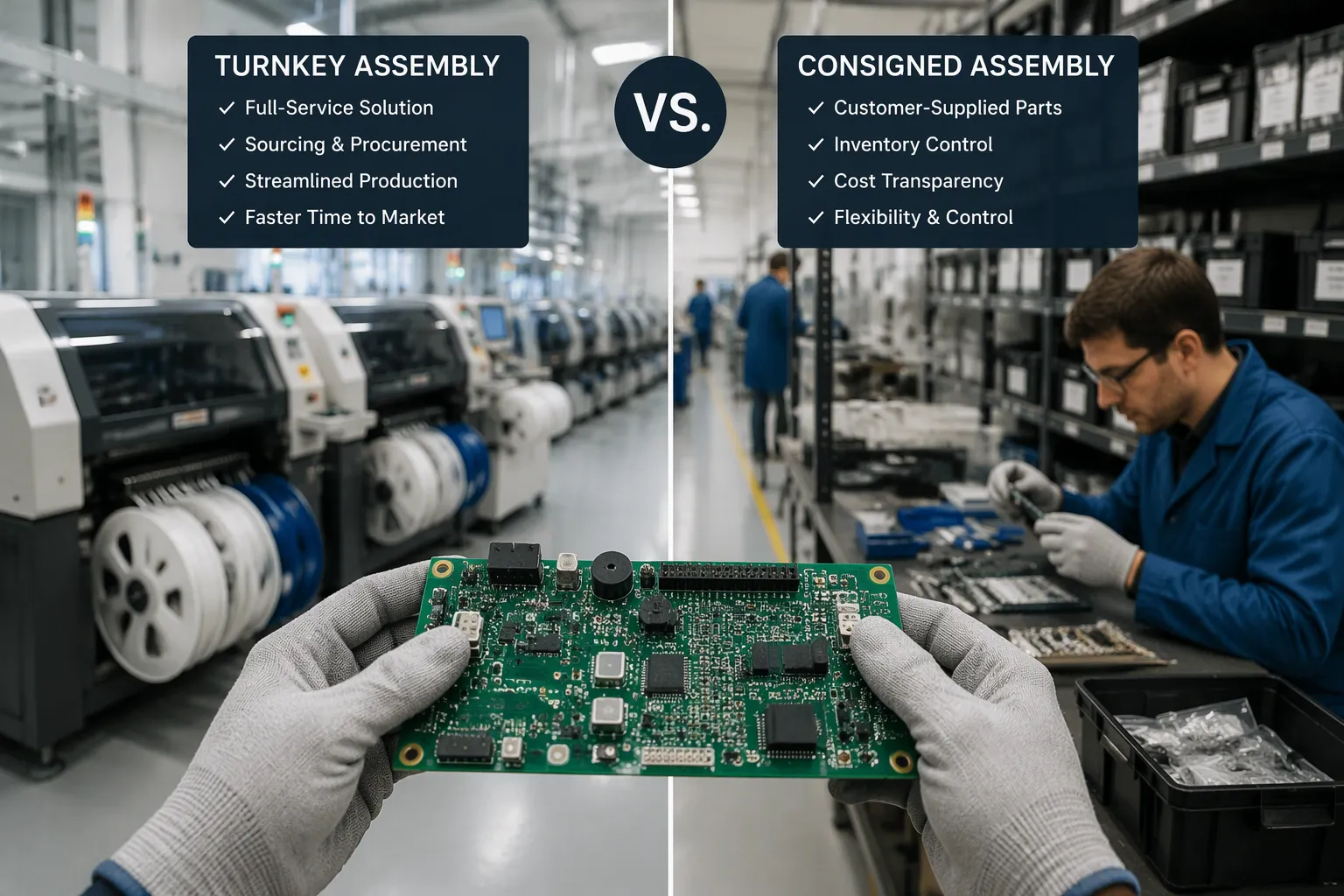
Turnkey assembly generally suits industrial OEMs building industrial controllers and automation modules. These buyers want to minimize risk and shorten time-to-market. Consigned assembly fits OEMs that already hold component inventory or carry specific sourcing requirements.
The distinction is simple. In turnkey pcb assembly, the assembler owns and buys every component. In consignment, the buyer purchases the parts and supplies them to the line. This turnkey vs. consignment split shapes cost, control, and accountability.
Demand for clear responsibility and quality boundaries keeps rising. Many teams still hesitate over who should purchase materials. This turnkey vs consigned pcb assembly comparison weighs cost, time-to-market, supply chain risk, control, and compliance, then closes with a practical decision framework.
Key Takeaways
Turnkey assembly means the assembler buys all parts and delivers a finished board. Consigned assembly means you buy the parts and ship them to the assembler.
The party that buys the part owns its quality and lead time. Clear ownership prevents disputes and delays.
Turnkey reduces your risk and speeds up production. Consignment gives you more control over sourcing and can save money if you already have parts.
Partial consignment lets you supply critical parts while the assembler sources the rest. This hybrid balances control and convenience.
Ask which parts you already own and how tight your timeline is. These questions help you choose the best model for your project.
Turnkey vs Consigned PCB Assembly Defined
Component Ownership and Responsibility
The two models differ first in who buys the parts. In turnkey assembly, the assembler purchases every component and delivers a finished board. The buyer sends a bill of materials and receives a completed assembly. In consigned assembly, the buyer purchases the parts and ships them to the line. The assembler then builds with material it did not source.
This split decides where component ownership before assembly sits. Turnkey places that ownership with the assembler. Consignment keeps it with the OEM until the parts reach the factory floor. For industrial controllers and automation modules, the split also decides who answers for a failed lot. Under turnkey pcb assembly, the assembler owns the outcome from sourcing through test. Under consigned pcb assembly, the OEM owns material quality and the assembler owns workmanship.
Designated Key Components
Many industrial OEMs specify certain parts by name. A controller may require an approved microcontroller, a particular connector, or a qualified power module. These designated components appear on the BOM with a locked manufacturer part number.
Turnkey pcb manufacturing handles designated parts through an approved vendor list. The assembler buys the named part from an approved source and confirms authenticity. The OEM keeps control of the specification without touching the purchase order. In consignment, the customer supplies the complete kit, including every designated part. The OEM buys the locked parts directly and ships them with the rest of the material.
A middle option exists. The OEM can supply only the designated parts and let the assembler source the rest. This partial approach keeps control of critical items and avoids the burden of a complete customer-supplied kit. It also reduces the risk of a stalled build when one long-lead part arrives late. Teams weighing turnkey vs consigned pcb assembly often find this hybrid covers both needs.
Component procurement responsibility therefore follows a simple rule. Whoever buys the part owns its quality, its lead time, and its documentation trail.
Turnkey vs. Consigned PCB Assembly Costs
Visible and Hidden Costs
The invoice price rarely tells the full cost story. Turnkey pricing bundles material and labor into one line, so the buyer sees a single number. Consigned pricing shows labor only, and the parts bill lands on the OEM’s own accounts. That split changes cash flow. A consigned buyer pays suppliers up front and carries the inventory until the build consumes it. A turnkey buyer pays on delivery terms and holds no material.
Quality control and lead time carry hidden costs of their own. Consigned material arrives with the OEM’s name on the packing slip, so the OEM absorbs inspection labor and any rework of bad parts. Turnkey shifts that inspection to the assembler. Full turnkey pcb assembly often costs less in total for high-mix, low-volume industrial builds, because the assembler spreads sourcing effort across many customers. Consigned assembly can be cheaper when the OEM already holds the parts and avoids a second purchase.
Cost factor | Turnkey | Consigned |
|---|---|---|
Cash flow | Pay on delivery | Pay suppliers up front |
Incoming inspection | Assembler | OEM |
Shortage chasing | Assembler | OEM |
Best fit | No inventory on hand | Parts already in stock |
Incoming-Material Anomalies
Anomaly handling follows the same ownership rule. Under turnkey pcb manufacturing, the assembler inspects incoming reels and trays against IPC-A-610 workmanship criteria and notifies the OEM only when a substitution is proposed. The assembler bears the cost and delay of a damaged or out-of-spec lot. Under consigned pcb assembly, the OEM’s material meets the assembler’s dock, and the assembler inspects and reports. The OEM then bears replacement cost and the schedule slip.
This difference matters most on long-lead parts. A rejected lot under turnkey vs. consignment becomes the assembler’s problem to replace. A rejected consigned lot sends the OEM back to its supplier while the line waits. Component procurement discipline therefore decides which model protects the schedule. Buyers comparing turnkey vs consigned pcb assembly should confirm who inspects, who is notified, and who pays before the first kit ships.
Consignment Manufacturing vs. Turnkey PCB Manufacturing: Pros and Cons
Speed, Shortages, and Counterfeits
Sourcing speed favors the assembler in most cases. A turnkey pcb manufacturing partner already holds approved supplier relationships and buys across many customers. That reach shortens the quote cycle and speeds up allocation when a part tightens. A consigned buyer runs its own purchasing process, so speed depends on its supplier list and its leverage.
Shortage coordination splits along the same line. Under turnkey pcb assembly, the assembler chases allocation, proposes approved alternates, and reports status. Under consigned pcb assembly, the OEM chases the shortage while the line waits. Counterfeit exposure follows component procurement discipline. Assemblers buy through franchised channels and verify authenticity as routine practice. An OEM buying on the open market carries that risk alone.
Sourcing channels have stabilized in recent years. Turnkey partners now source critical parts reliably through authorized distribution, so the old argument that only consignment protects critical components no longer holds in every case. Consignment still fits OEMs with locked supply agreements or held stock. This is the practical core of the consignment manufacturing vs. turnkey pcb manufacturing: pros and cons debate.
Delivery Responsibility and Compliance
Accountability for on-time delivery differs by model. A turnkey partner commits to a ship date and owns the material side of that promise. A consigned build ties the schedule to the OEM’s kit arrival, so the OEM owns material timing and the assembler owns build timing.
Quality escapes follow the same split. The party that bought the part answers for material defects. Compliance documentation and traceability also diverge. Turnkey partners hold certificates of conformance, lot traceability, and material declarations in one package. Consigned kits require the OEM to assemble that paper trail from its own suppliers.
Responsibility | Turnkey | Consigned |
|---|---|---|
On-time delivery | Assembler owns material and build | OEM owns kit timing |
Quality escape | Assembler | OEM for material |
Traceability records | Assembler compiles | OEM compiles |
Turnkey vs Kitted vs Consigned PCB Assembly Fit
Best-Fit Scenarios for Each
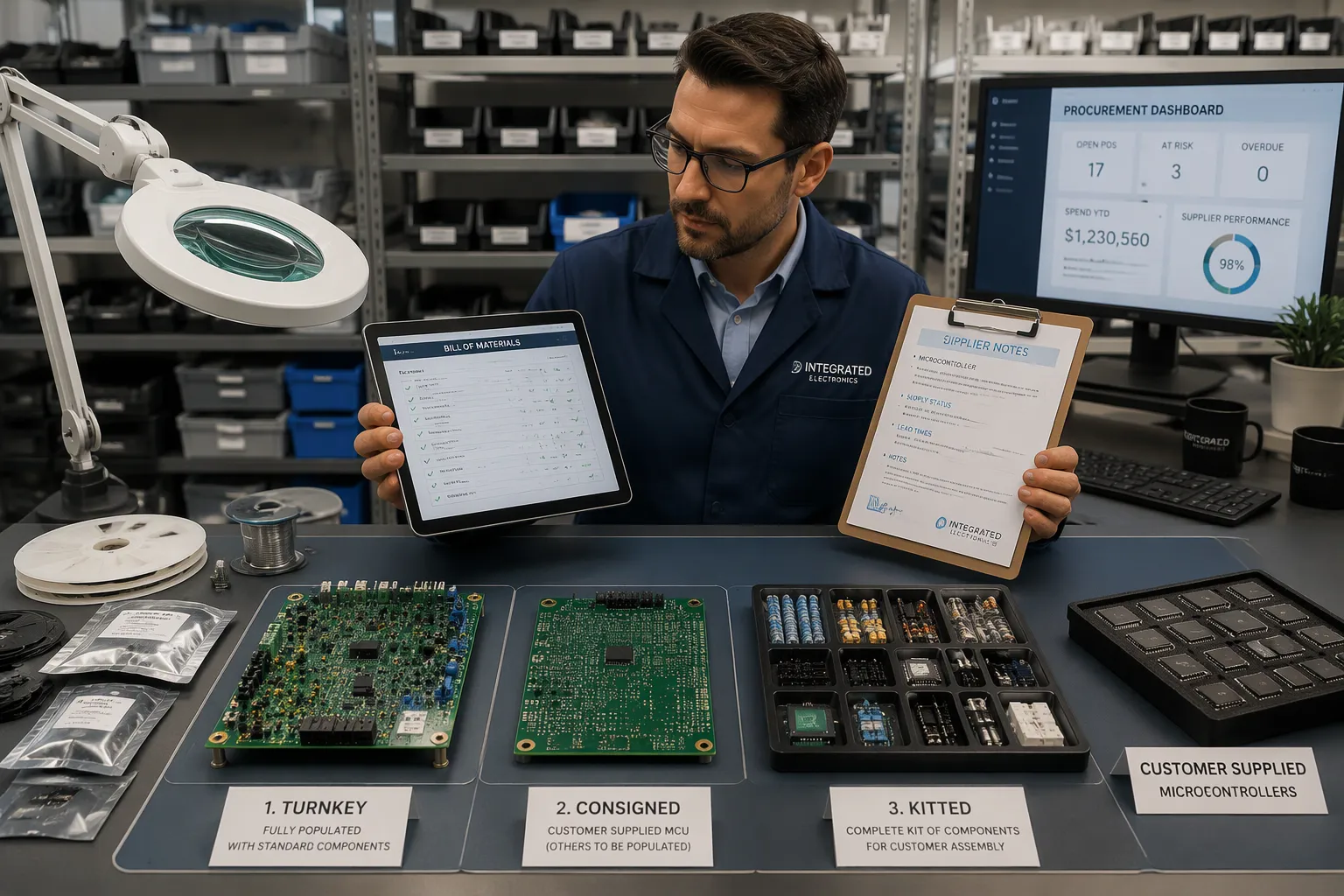
Fit depends on what the OEM already owns. Turnkey pcb assembly suits OEMs with no component inventory. These teams want standard parts sourced, shortages coordinated, and one partner accountable from quote to ship. A turnkey partner buys through franchised channels, inspects incoming material against IPC-A-610 workmanship criteria, and reports status without prompting. That model fits a high-mix, low-volume controller line where sourcing effort per build would otherwise swamp the engineering team.
Consigned pcb assembly fits a different profile. The OEM holds stock, carries locked supply agreements, or sources critical parts itself. A buyer with a warehouse of qualified microcontrollers gains little from paying an assembler to buy them again. Consignment lets that buyer use held inventory and keep direct leverage over its suppliers.
Kitting sits between the two. The OEM ships a complete component kit, and the assembler builds and tests. Kitting suits OEMs with full material on hand and a clear internal process for pulling kits. It demands more logistics work than either alternative, so it fits teams with the staff to run it.
Partial Consignment as a Hybrid
Partial consignment blends the models. The customer supplies selected parts, and the manufacturer sources the balance. This is the practical answer for industrial controllers with one locked microcontroller and dozens of standard passives. The OEM keeps control of the critical item and avoids buying the rest.
A partial-turnkey build also shortens the quote cycle. The assembler prices the standard parts it knows, and the OEM prices the locked items it already holds. Both sides see the true cost before release.
Turnkey vs. Consignment PCB Manufacturing Decision Framework
Questions to Ask First
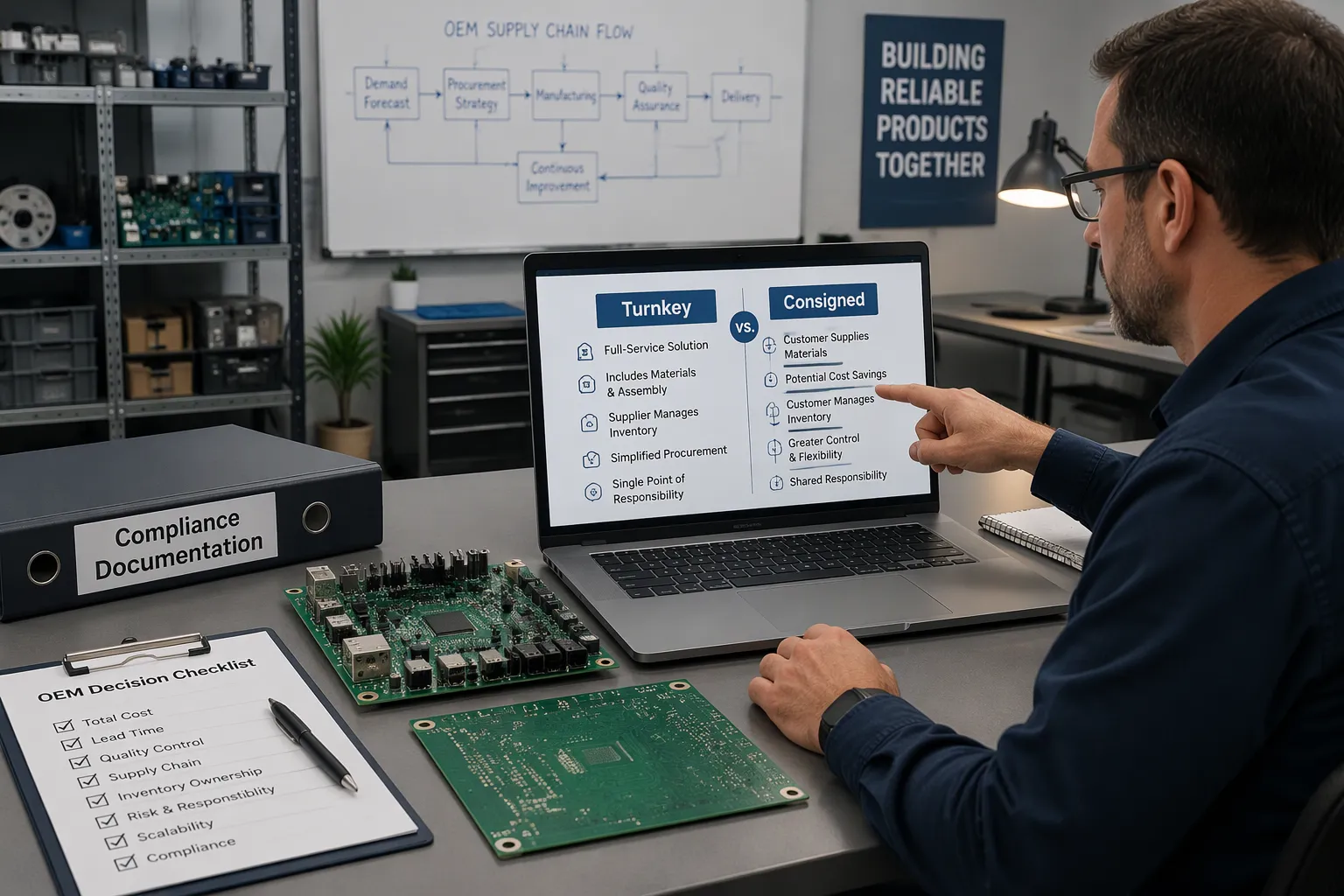
A clear decision starts with the OEM’s own position. Four questions settle most of the debate before pricing begins.
Does the team already hold the parts? An OEM with qualified stock on its shelves gains little from paying an assembler to buy the same material again. An OEM with empty shelves gains speed and simplicity from a partner that sources everything.
Are any components critical or long-lead? A locked microcontroller or a connector on extended lead time changes the calculus. The OEM may want direct control of that item while the assembler handles the rest.
What compliance documentation does the program require? Industrial controllers often ship with traceability records, certificates of conformance, and material declarations. One partner can compile that package under turnkey pcb manufacturing. Under consigned assembly, the OEM gathers the paper trail from its own suppliers.
How tight is the timeline? A short window favors the model with fewer handoffs. Material procurement responsibility sits at the center of this question. Unclear ownership of a late part is the most common source of schedule slips, so the OEM should name one owner for every line on the BOM before release.
Matching Model to Project Profile
High-mix, low-volume builds favor turnkey. A controller line with many variants and small batch sizes spreads sourcing effort across dozens of part numbers. A turnkey partner absorbs that work and inspects incoming material against IPC-A-610 workmanship criteria. The OEM keeps engineering focus on design.
Higher-volume builds open more options. An OEM with forecast visibility can buy in bulk and supply a complete component kit, then let the assembler build and test. This kitting route uses purchasing leverage and still leaves workmanship with the assembler.
The choice between consignment and turnkey pcb manufacturing rarely comes down to one factor. Inventory position, sourcing relationships, compliance needs, and timeline all pull on the answer. Teams that weigh turnkey vs consignment manufacturing against these four questions usually reach a defensible decision quickly. The same discipline applies to turnkey vs. consignment pcb manufacturing at any scale, and it keeps responsibility clear from quote to ship.
The central trade-off is control versus convenience. Turnkey pcb manufacturing trades some component control for lower risk and faster execution. Consigned builds trade convenience for leverage over sourcing and held inventory.
No single model wins everywhere. Existing inventory, sourcing relationships, compliance obligations, and timeline decide the fit. Partial consignment offers a practical middle path, letting an OEM lock critical parts while the partner sources the rest.
FAQ
Who owns material quality under each model?
The party that buys the part owns its quality. A turnkey assembler sources, inspects, and answers for incoming material. A consigned buyer supplies the parts and carries that responsibility. Industrial OEMs should name this owner on every BOM line before release, because unclear ownership is the most common source of disputes.
Why do industrial OEMs worry about unclear procurement responsibility?
Can an OEM supply only selected parts?
How does traceability differ between the models?
A turnkey partner compiles certificates of conformance, lot records, and material declarations in one package. A consigned build leaves the OEM to gather that paper trail from its own suppliers. Industrial programs that ship with documentation requirements should confirm the record owner early, since pcb manufacturing discipline rests on traceable material and documented inspection.
Which model fits a high-mix, low-volume controller line?
Turnkey fits best. Many variants and small batches spread sourcing effort across dozens of part numbers. A turnkey partner absorbs that work and inspects incoming material against IPC-A-610 workmanship criteria. The OEM keeps engineering focus on design and lets one partner own sourcing, shortage coordination, and delivery.
See Also
OEM AI PCBA Production Services for Electronics Factories in Poland
Turnkey AI PCBA Solutions for Irish MedTech and IoT Hardware Firms
Turnkey AI PCBA Services for Singapore MedTech and IoT Projects
Custom Edge AI PCBA Manufacturing for Hardware Startups in the US
Custom AI PCBA Production for Electronics Companies in Mexico