
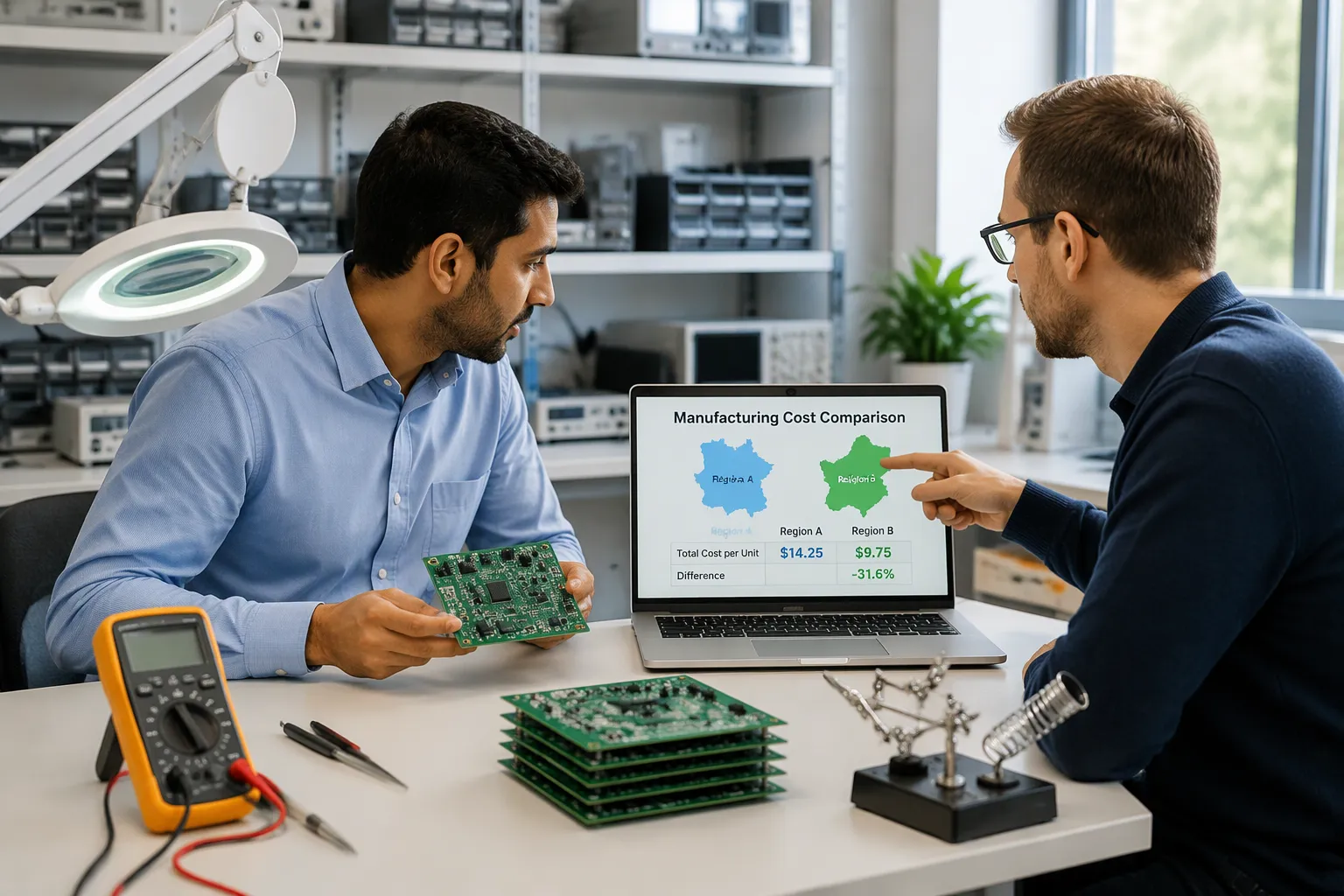
British OEMs see lower unit costs and broader capability from Chinese plants. A UK PCB manufacturer wins on lead time, compliance, and prototyping. Landed cost versus speed decides. A technical, cost-driven, and engineering-focused comparison clarifies each PCB manufacturing location. Overseas PCB manufacturing suits volume; this cost comparison weighs PCB manufacturing in China against China vs overseas options.
Key Takeaways
Compare total landed cost, not just unit price, to see the real savings between UK and China.
Choose China for high-volume and advanced boards; choose the UK for fast prototypes and easy compliance.
Use a hybrid approach: prototype in the UK, then move volume production to China for the best balance.
Cost Comparison: Unit Price to Landed Cost
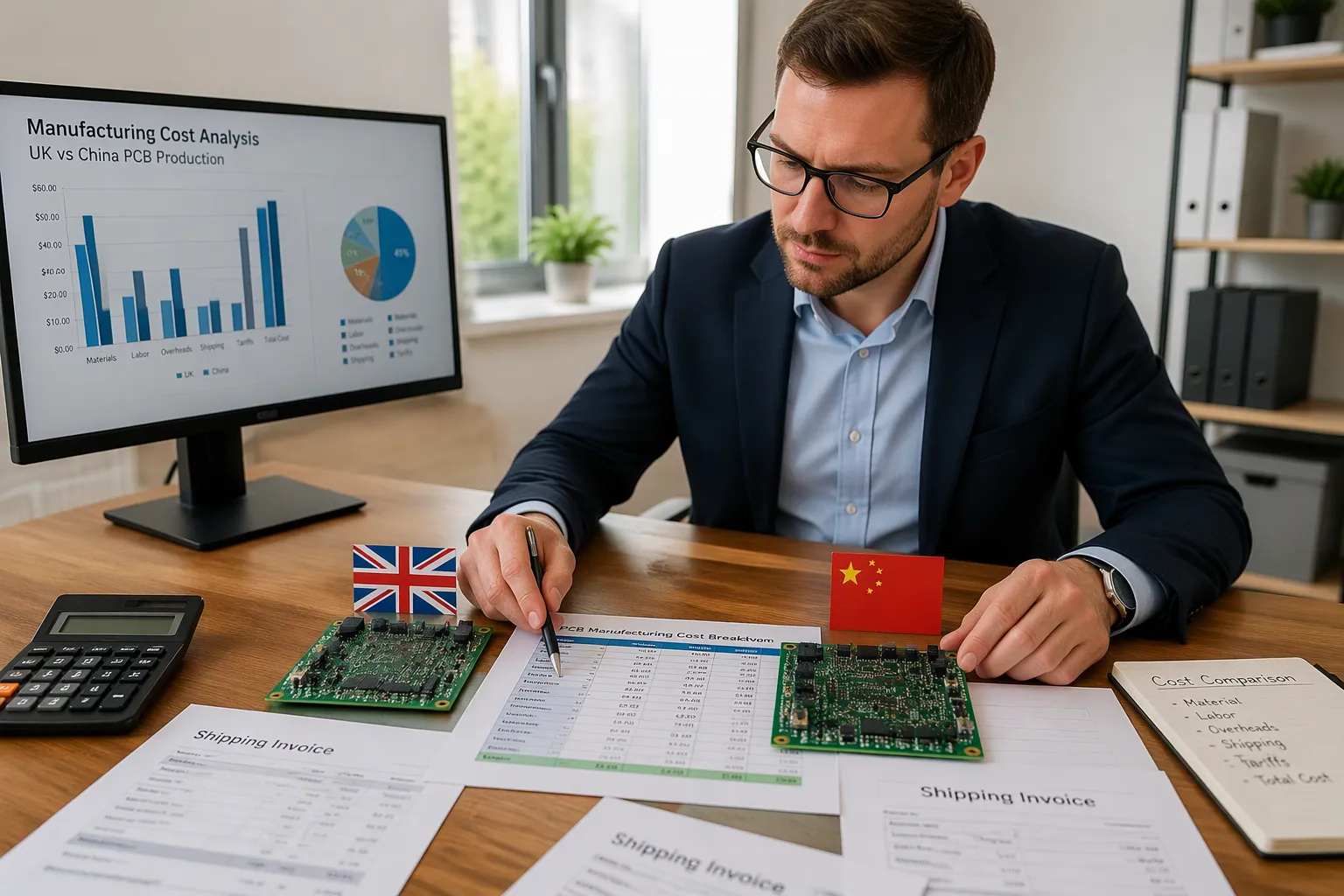
A fair cost comparison starts with the quotation and ends with the invoice. British OEMs often compare piece prices alone. That habit hides the real gap between a UK PCB manufacturer and a Chinese partner. Unit price, tooling and setup, freight, duties, and inventory carrying charges all shape the final number. Total landed cost captures every one of these elements.
Unit Price, Tooling, and Setup
Chinese cost efficiency comes from production at scale and dense, linked supply chains. Unit costs in China usually sit below Western levels, mainly because of supply chain density and volume. Chinese-owned PCB manufacturers generated $23.0 billion in revenue in 2023, and two companies accounted for over one-fifth of Chinese-owned production. That concentration supports aggressive pricing on standard boards.
Tooling and setup work differently on each side. A UK shop often absorbs simple setup into a modest batch charge. A Chinese plant may quote low tooling for a new design, then recover the difference across volume. Buyers should model both paths before they commit.
PCB, Flex & PCBA Cost Pressures in 2026
Several forces will shape PCB, flex & PCBA cost pressures in 2026. Laminate and prepreg repricing continues to move bare-board quotes. Copper and substrate availability adds volatility to PCB, flex, and PCBA costs. Overseas PCB manufacturing also carries freight and currency exposure that domestic work avoids.
Smart teams track PCB, flex & PCBA cost pressures across the full year, not just at quote time. They also separate PCB, flex, and PCBA costs by board type. A rigid multilayer board and a flex circuit respond to different inputs. Electronics manufacturing costs rise fastest where material content is high. Manufacturing costs for assembly depend more on component pricing and labor content.
Piece price is only one line. Total cost of ownership includes supplier oversight, engineering support, quality control, and coordination. For OEMs and industrial customers, technical communication, response speed, and long-term supply chain stability often matter as much as component cost. A cheap board with weak support creates hidden costs. A slightly higher quote with strong quality and fast answers can win on the balance sheet.
PCB, flex, and PCBA sourcing decisions should weigh these factors together. The China vs overseas debate rarely ends at the unit price. It ends at the landed cost and the support behind it. PCB manufacturing partners who explain their cost structure build more trust than those who simply undercut rivals. That transparency serves both sides of any PCB manufacturing agreement.
PCB Manufacturing in China: Scale and Cost
Volume Pricing and Supply Chain Density
China manufacturing clusters component makers, laminate suppliers, and board shops within short distances. That density lowers pcb manufacturing prices at every step. Chinese-owned PCB manufacturers generated $23.0 billion in revenue in 2023, and two companies accounted for over one-fifth of Chinese-owned production. Scale on this level lets plants quote aggressive volume prices for pcb manufacturing in China.
A British OEM ordering high volumes sees the gap clearly. Unit prices fall as order size grows, and the linked supply chain shortens material lead time. Buyers comparing china vs overseas quotes should model volume tiers, not single-piece prices. Volume tiers reward planning, and forecast accuracy protects the quoted price. Overseas pcb manufacturing carries freight and duty, and those charges shrink the headline advantage. Still, pcb manufacturing in China usually wins on landed cost at volume.
Advanced and Flexible Board Options
Leading Chinese plants handle complex multilayer boards, fine pitch, and flex circuits. Advanced capability supports pcb manufacturing for dense designs that smaller shops decline. China pcb manufacturing lines quote rigid, flex, and rigid-flex work under one roof. That breadth simplifies pcb manufacturing in China for OEMs with mixed board types.
Quality control matters as much as technology range. Buyers should audit certifications and request sample builds before committing volume. China pcb manufacturing offers strong options for advanced work, yet oversight protects the buyer. A hybrid plan pairs overseas pcb manufacturing for volume with domestic prototyping, and pcb manufacturing in China covers the ramp. Assembly manufacturing costs depend on component pricing. Buyers should also track pcb, flex, and pcba costs across the year. This approach balances cost and speed across the product life cycle.
PCB Manufacturing Capability: Technology and Quality
Layers, Materials, and Fine Pitch
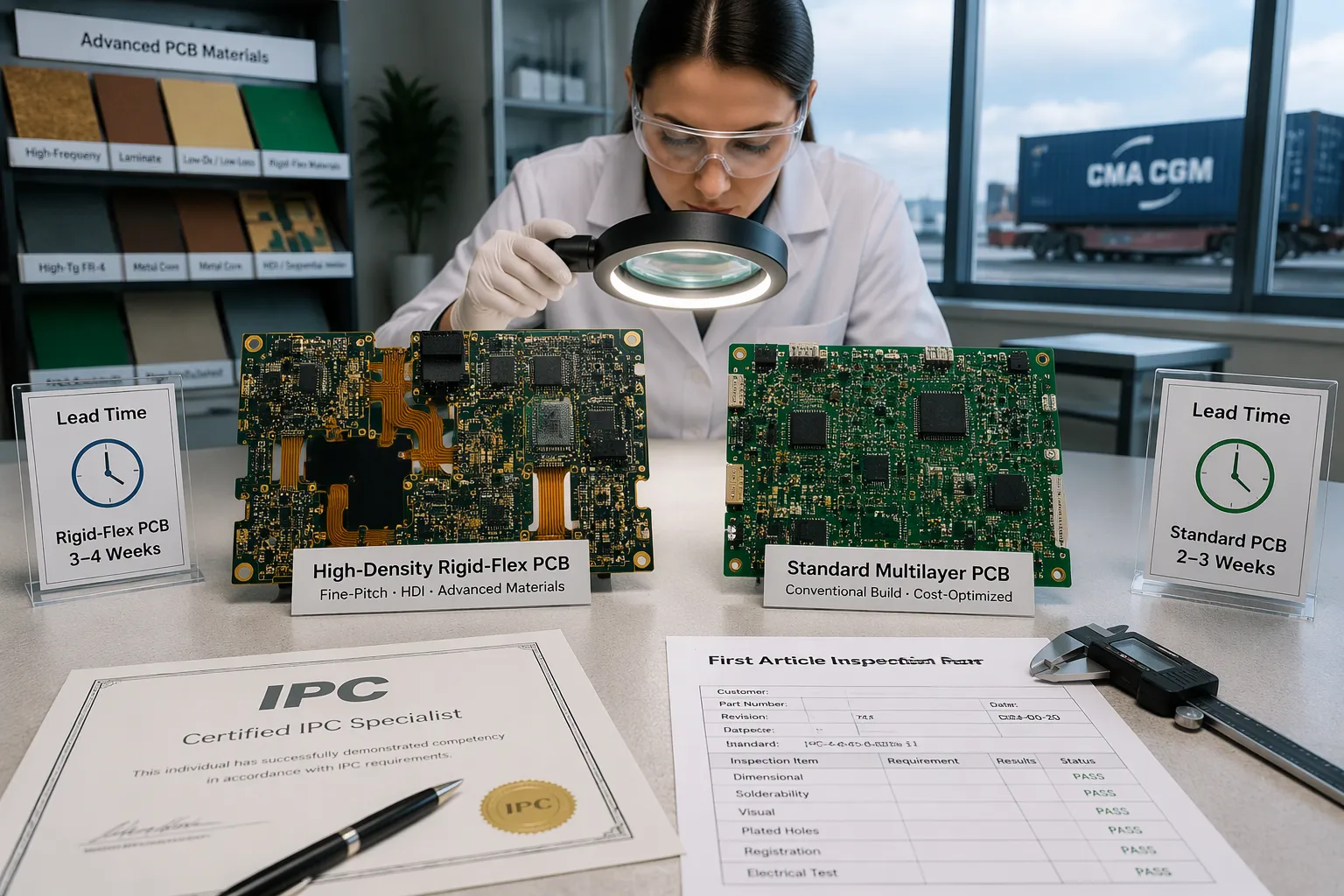
Technology range separates the two sourcing paths most sharply. Leading Chinese plants routinely build high layer-count multilayer boards, rigid-flex hybrids, and fine-pitch designs with tight trace and space rules. They stock advanced laminates, including high-frequency and high-temperature materials. A British OEM with a dense, complex design often finds more quoting options in China than at home.
UK shops concentrate on simpler multilayer work and quick-turn builds. They handle moderate layer counts well and deliver excellent pcb fabrication for standard designs. Fine pitch and exotic materials stretch their tooling and their schedules. Buyers should match board complexity to shop capability before comparing price.
Flexible electronics show the gap clearly. Leading Chinese manufacturers pair FPC production with sustainable flexible electronics programs, and they run pcb manufacturing for flex, rigid-flex, and rigid boards under one roof. That breadth supports full-service pcb fabrication and assembly for OEMs with mixed board types. China pcb manufacturing lines also scale from sample to volume without a supplier change.
Quality Standards and Lead Times
Quality systems travel with the supplier, not the country. Serious plants on both sides certify to IPC-A-610 and IPC-6012 and publish their audit results. Buyers should verify certification scope and request first-article reports. Robust quality control at the source protects the whole program.
Lead times diverge. A UK manufacturer typically turns prototypes in days and supports engineering changes mid-build. Chinese plants quote longer transit and production windows, yet they absorb volume ramps with stable quality. Prototyping fits the UK model; mass production fits the China model. Overseas pcb manufacturing adds freight time to every schedule, and planners must build that buffer into launch dates.
EMS comparisons deserve the same discipline. When buyers weigh EMS companies in Europe and the UK, they should compare pcb assembly capability, certifications, industries served, and production strengths. A UK EMS firm serves low-volume, regulated sectors with fast response. A Chinese partner serves high-volume consumer and industrial work with deep process control. Neither wins everywhere. The china vs overseas decision rests on program fit, and pcb manufacturing in China remains the stronger choice for advanced, high-volume boards. Total costs and quality records, not brochures, should settle the question.
UK PCB Manufacturer: Speed, Compliance, and Support
Prototyping and Low-Volume Specialist Work
A UK pcb manufacturer turns a prototype around in days, not weeks. Engineers can walk a design change into the shop and see a revised board on the bench shortly after. That loop suits specialist work, where a design may shift several times before it stabilizes. Low-volume runs of complex or unusual boards also fit the domestic model well.
A UK pcb manufacturer keeps technical staff close to the customer. Questions about stackup, impedance, or surface finish reach an engineer the same day. This proximity supports pcb manufacturing for regulated sectors, where documentation and traceability matter from the first article. Small batches of specialist boards rarely justify the freight and coordination overhead of overseas pcb manufacturing.
Faster Lead Times and Easier Compliance
Transit time disappears when the board ships from a domestic shop. A UK pcb manufacturer delivers finished boards without customs clearance, currency exposure, or port delays. Planners gain schedule certainty, and launch dates hold. The UK option also simplifies compliance, because the supplier works to the same regulatory framework as the buyer.
Domestic pcb manufacturing eases the paperwork behind UKCA and CE marking. The supplier understands RoHS and REACH obligations and can supply declarations without a time-zone gap. Quality audits happen on-site and in person. A buyer weighing china against the UK should count these support hours as real costs. The unit cost runs higher at home, yet the total cost often narrows once oversight and delay shrink.
Application Fit: Board Type and Volume
Simple vs. Complex Boards
Board complexity drives the choice of pcb manufacturing location. A simple two-layer or four-layer board with standard FR-4 material fits almost any shop. Domestic suppliers quote these boards quickly and build them well. Complex designs change the picture. High layer counts, fine pitch, and advanced laminates demand process depth. Chinese plants invest in that depth at scale, and they quote these boards with confidence.
A British OEM with a dense multilayer design should shortlist suppliers by capability first. Price comes second. A cheap quote from a shop that rarely builds fine-pitch work invites rework and delay. Buyers should request sample builds and review first-article reports before they commit. This step protects quality and keeps the program on schedule.
Low-Volume vs. High-Volume Production
Volume shapes the economics of every pcb manufacturing decision. Low-volume runs favor the UK, where setup is fast and engineering support sits close by. High-volume runs favor China, where scale lowers unit costs and the supply chain stays dense. Overseas pcb manufacturing adds freight and transit time, and planners must absorb both.
A mixed portfolio often needs both paths. A British OEM can prototype at home, then ramp volume abroad. This hybrid model balances speed against costs and keeps each pcb manufacturing stage with the supplier that serves it best. The china vs overseas question then becomes a question of stage, not of loyalty. Teams that map board type and volume to the right supplier avoid the worst of both models. They gain fast iteration early and low unit cost at scale. Overseas pcb manufacturing still carries coordination overhead, and pcb manufacturing in China rewards accurate forecasts. A clear volume plan keeps every quote honest.
Regulatory Compliance: UKCA, CE, RoHS, and REACH
Substance Control and Market Access
Compliance obligations follow the product, not the supplier’s address. A British OEM must meet UKCA and CE marking rules, RoHS substance limits, and REACH declaration duties whichever plant builds the board. The sourcing choice changes who gathers the evidence and how fast it arrives.
A UK supplier works inside the same regulatory framework as the buyer. Declarations of conformity, material statements, and test reports arrive without a time-zone gap. A Chinese partner can supply the same documents, yet the buyer must verify scope and currency. The United Kingdom’s Medium rating reflects Great Britain’s energy-performance condition. China’s Medium rating reflects multi-agency substance-control measures. Both ratings signal active oversight, and neither removes the buyer’s duty to check.
Export Control Considerations
Export control rules apply to certain board technologies and to end-use destinations. Dual-use classifications can cover high-layer-count boards and advanced materials. A British OEM should confirm classification before placing volume orders. Domestic pcb manufacturing keeps the transaction inside one jurisdiction and simplifies the paperwork trail.
Overseas pcb manufacturing adds a second layer of review. The Chinese plant may need an export license for controlled items, and the UK buyer may need an import authorization. Early classification avoids delay at the border. Buyers should also weigh the compliance cost against the unit savings. A clear audit trail protects quality claims and market access alike. Teams that map these costs early avoid surprises at launch.
Decision Framework: A Checklist for British OEMs
Priority-Based Selection Matrix
A structured matrix turns a vague debate into a clear decision. British OEMs should score each program against the priorities that matter most. The table below maps common priorities to the sourcing path that serves them best.
Priority | Stronger Fit | Reason |
|---|---|---|
Lowest unit price at volume | China | Scale and dense supply chains |
Fast prototype iteration | UK | Days-long turns and local engineers |
Advanced boards and fine pitch | China | Deep process capability |
Simple compliance paperwork | UK | Shared regulatory framework |
Schedule certainty | UK | No customs or transit delay |
Buyers should weight each row for their own product. A medical device program may rank compliance first. A consumer product may rank unit price first. The pcb manufacturing location then follows from the scores, not from habit.
When a Hybrid Approach Makes Sense
A hybrid model suits programs with mixed priorities. The OEM prototypes in the UK, validates the design, then moves volume production to China. This split captures fast iteration early and low unit costs at scale. It also keeps quality control close during the risky design phase.
The hybrid path carries coordination overhead. Teams must manage two suppliers, two document trails, and two schedules. Buyers should compare china and overseas pcb suppliers on responsiveness before they commit. A clear forecast protects the quoted price at the volume stage. Weigh total cost of ownership, not piece price alone, and the china vs overseas choice becomes a question of stage. Map pcb manufacturing and assembly steps to the right partner, and total program cost stays visible. Strong overseas pcb manufacturing partners reward that planning with stable quality and predictable costs.
China wins on cost and advanced, high-volume capability. A uk pcb manufacturer wins on speed, compliance ease, and prototyping. Weigh total landed costs and lead time against compliance burden, not unit price. Where priorities mix, hybrid pcb manufacturing works: prototype at home, then shift volume to overseas pcb manufacturing. The decision checklist guides that cost comparison.
FAQ
Sourcing questions recur across every program. The short answers below cover pcb manufacturing fit, china volume work, china pricing, and pcb manufacturing planning.
Which sourcing path fits a first production run?
A UK shop suits early runs and design changes. China fits stable designs at volume. Teams should match pcb manufacturing stage to risk. China pcb manufacturing rewards accurate forecasts.
How do buyers compare quotes fairly?
Compare total price, not piece price. China quotes often look lower before freight. Add oversight and quality checks to every pcb manufacturing quote. China pcb manufacturing partners should document pricing clearly.
What changes as volumes grow?
Volume shifts the math toward China. Scale lowers unit costs there. Overseas pcb manufacturing adds transit time. Planners should map pcb manufacturing stages early. China pcb manufacturing covers the ramp.
See Also
AI PCBA OEM Manufacturing Services for Electronics Factories in Poland
Manufacturing AI IoT PCBA Solutions for Hardware Companies in Malaysia
AI PCBA for Medical and Health Devices by UK Developers
Custom AI PCBA Manufacturing Services for Electronics Companies in Mexico
Turnkey AI PCBA Solutions for Irish MedTech and IoT Hardware Firms