
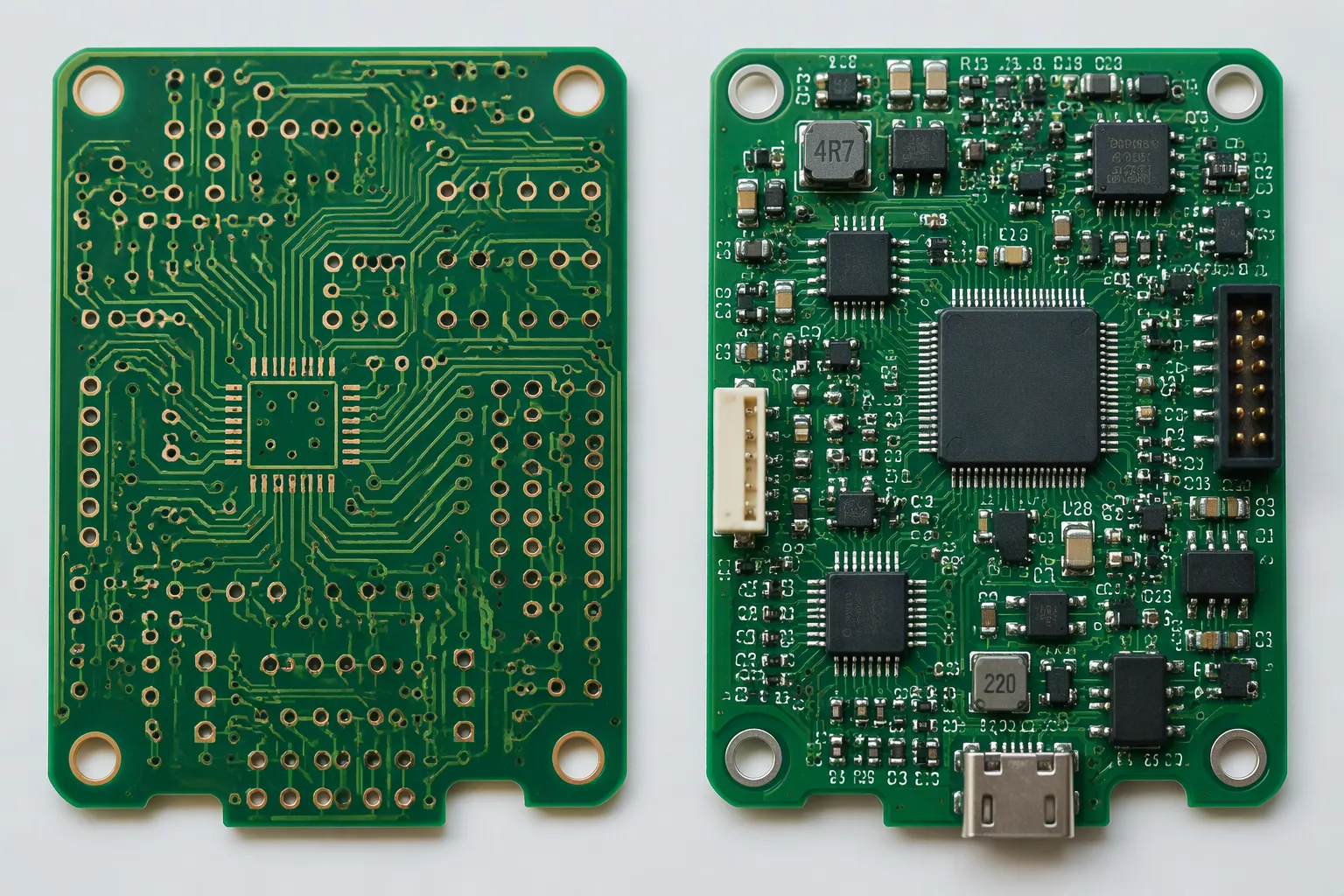
A printed circuit board is the bare board — substrate, copper traces, solder mask, finish — no components. A PCBA is that board once you mount, solder, and test components.
Rough versus finished shell: the PCB connects but does nothing; the PCBA works. Your pcb vs pcba choice is fabrication versus assembly; pcb and pcba orders differ in cost.
Key Takeaways
A PCB is a bare board with no components. A PCBA is the same board after parts are added and tested.
PCBA costs more because it includes parts, labor, and testing. PCB costs cover only the bare board.
Order bare PCBs if you can assemble boards yourself. Order assembled boards if you need a working unit right away.
PCB vs PCBA: The Core Difference
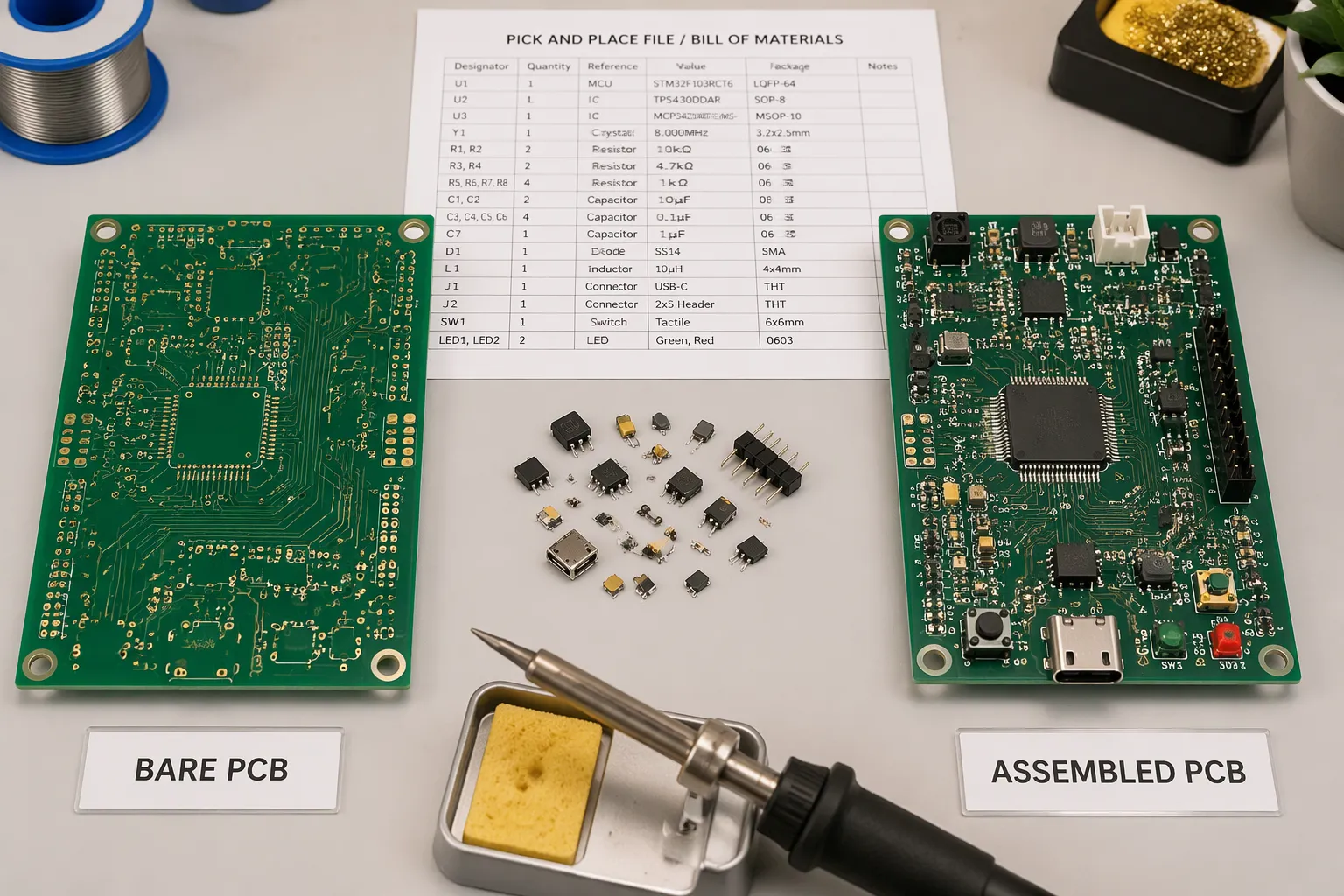
A PCB is a bare, unpopulated circuit board. It carries the substrate, copper traces, solder mask, and surface finish, and it holds no components. A PCBA is the same board after assembly: components mounted, soldered, and tested. That single step — assembly — separates the two deliverables, and it shapes everything you order, pay, and receive.
Bare Board vs. Assembled Board
The pcb vs pcba distinction becomes concrete at the order stage. When you place a PCB order, you buy fabrication only. The fab house drills, plates, etches, masks, and finishes your board, then ships it empty. When you place a PCBA order, you buy fabrication plus assembly. The assembler procures components, prints solder paste, places parts, reflows the board, and tests the result.
Think of the deliverable as the product you receive. A PCB order delivers a bare, unpopulated circuit board you can inspect, stock, and assemble later. A PCBA order delivers a fully assembled board you can power on and use. The pcb and pcba labels describe these two deliverables, not two unrelated products.
Why the Deliverable Matters
Your choice of deliverable changes five things at once. Specifications shift: a PCB order needs copper weight, layer stackup, and finish called out, while a PCBA order adds component values, package sizes, and placement data. Files change too. A bare board order runs on Gerber and fabrication drawings. A printed circuit board assembly order also needs a bill of materials and a pick-and-place file.
Cost and lead time follow the same split. Fabrication pricing covers board area, layers, and quantity. Assembly pricing stacks component cost, machine runtime, and test on top. Lead time stretches accordingly, because assembly adds procurement and reflow to the schedule. Inspection requirements differ as well. You might check a bare board for trace integrity and finish quality. You check an assembled PCB for solder joints, placement accuracy, and function, often against a named standard such as IPC-A-610.
These differences explain why the pcb vs. pcba question matters before you request a quote. The same design can travel two very different paths. One path ends with an empty board in a box. The other ends with a tested, working unit. Know which deliverable you need, and you avoid paying for assembly you do not want or discovering too late that you ordered a board nobody can populate.
The Difference Between PCB and PCBA
Side-by-Side Comparison
The table below gives you a quick reference for the difference between pcb and pcba across the points that matter at order time.
Attribute | Bare PCB | PCBA |
|---|---|---|
Structure | Substrate, copper, mask, finish | Same board plus mounted components |
Function | Connections only, no power-on | Performs its intended function |
Files | Gerber and fabrication data | Gerber plus BOM and pick-and-place |
Cost | Fabrication only | Fabrication plus parts, labor, test |
Lead time | Fabrication schedule | Longer, with procurement and reflow |
Inspection | Traces, plating, finish | Solder joints, placement, function |
Read the table as a checklist. Each row tells you what to prepare and what to expect. The pcb vs pcba difference shows up in every column, not just in cost.
Function and Readiness
A bare PCB does not conduct or function on its own. It offers copper paths and pads, and nothing more. You cannot power it on, and you cannot test its behavior as a circuit. It waits for components.
A tested PCBA is ready to perform its intended function. Assembly and test close the gap between a layout and a working unit. This is the practical heart of any pcb vs. pcba discussion. One deliverable is a platform. The other is a finished product.
Plan your order around readiness. If your team will populate the board, a bare printed circuit board fits. If you need a working unit out of the box, order the assembled board. Both pcb and pcba orders serve real needs, and the right pick depends on where assembly happens.
Core Differences Between PCB and PCBA
Materials, Layers, and Finish
A bare PCB starts as a substrate, often FR-4, clad with copper on one or both sides. The fabricator patterns that copper into traces and pads, laminates multiple layers together for denser designs, and applies a solder mask to protect the circuitry. A surface finish such as HASL or ENIG then covers the exposed pads to keep them solderable.
The fabrication process runs drilling, plating, etching, masking, and finishing in sequence. Each step adds capability and cost. More layers and tighter tolerances raise the price, and the finish you choose affects shelf life and solderability. A bare board suits you when you want to stock boards, control your own component supply, or iterate on layout before committing to parts.
Components, Soldering, and Testing
A PCBA adds the parts. Assembly houses source components against your BOM, then place them with surface-mount or through-hole methods. Reflow or wave soldering bonds the joints, and inspection follows — visual, X-ray, or functional — often against IPC-A-610.
The core differences between pcb and pcba sit in this second stage. PCBA manufacturing bundles pcb fabrication, component sourcing, smt / tht assembly, testing, and delivery into one flow. That flow moves from pcb fabrication → pcb assembly without a handoff on your side. A tested PCBA arrives ready to power on, while a bare board waits for your line. Neither path is better; each fits a different level of in-house capability and control.
PCB Cost Drivers
Fabrication and Volume
Board size sets the baseline for pcb cost. A larger board consumes more laminate and more copper, and it occupies more space in every process step. Layer count compounds this effect. Each added layer brings more drilling, plating, and lamination work, so a multilayer stackup costs more than a simple double-sided board.
Material choice and surface finish also move the price. Standard FR-4 keeps fabrication economical, while specialty laminates raise it. Finishes such as HASL cost less than ENIG, and tighter tolerances add inspection and process time. Quantity works in your favor. Fabricators spread setup charges across the whole run, so per-unit costs fall as order volume rises.
Panelization Effects
Fabricators build a printed circuit board inside a panel, not one at a time. Panelization packs multiple boards onto a single working panel with rails and spacing between them. A layout that fills the panel efficiently yields more boards per run and lowers the per-unit price.
Small boards benefit most from smart panelization. A compact design leaves unused panel area, and that waste still carries fabrication cost. Your fabricator can suggest panel dimensions and spacing that improve utilization. Ask about panelization early, because it shapes both pcb and pcba pricing and delivery schedules.
PCBA Cost Drivers
Components, Labor, and Runtime
Your pcba cost stacks several layers on top of fabrication. Component procurement comes first: the parts on your bill of materials carry their own price, and that price moves with market supply. Specialized labor adds the next layer. Technicians program machines, set up stencils, and inspect joints. High-speed placement machines consume runtime, and that runtime bills by the hour. Soldering consumables — paste, flux, and reflow energy — add a smaller but real share. Assembly handling and test close the stack.
Each layer scales with the job. A dense board with hundreds of placements takes longer to program and longer to run. Fine-pitch parts demand tighter machine settings and more inspection time. This is why pcba manufacturing quotes vary so widely between designs, even when the bare board price stays flat.
Why BOM Choices Matter
Two orders can share the same PCB and still land at very different pcba costs. The bill of materials drives that gap. A rare part with long lead times forces expedited sourcing. A part near end-of-life may need a substitute and a re-qualification step. Package choice matters too: a fine-pitch package slows placement and raises inspection effort.
Your total pcba cost reflects these choices before assembly even starts. Review the BOM with your assembler early. Ask which lines carry risk and where a drop-in alternative exists. Small substitutions often protect both schedule and budget.
A bare board and an assembled board simply buy different things. The pcb and pcba comparison is not a fairness question. One price covers fabrication; the other covers fabrication plus parts, labor, machines, and test. Both fit real needs, and the assembled option buys readiness you would otherwise build in-house.
PCB vs. PCBA: When to Order Which
Ordering Bare PCBs
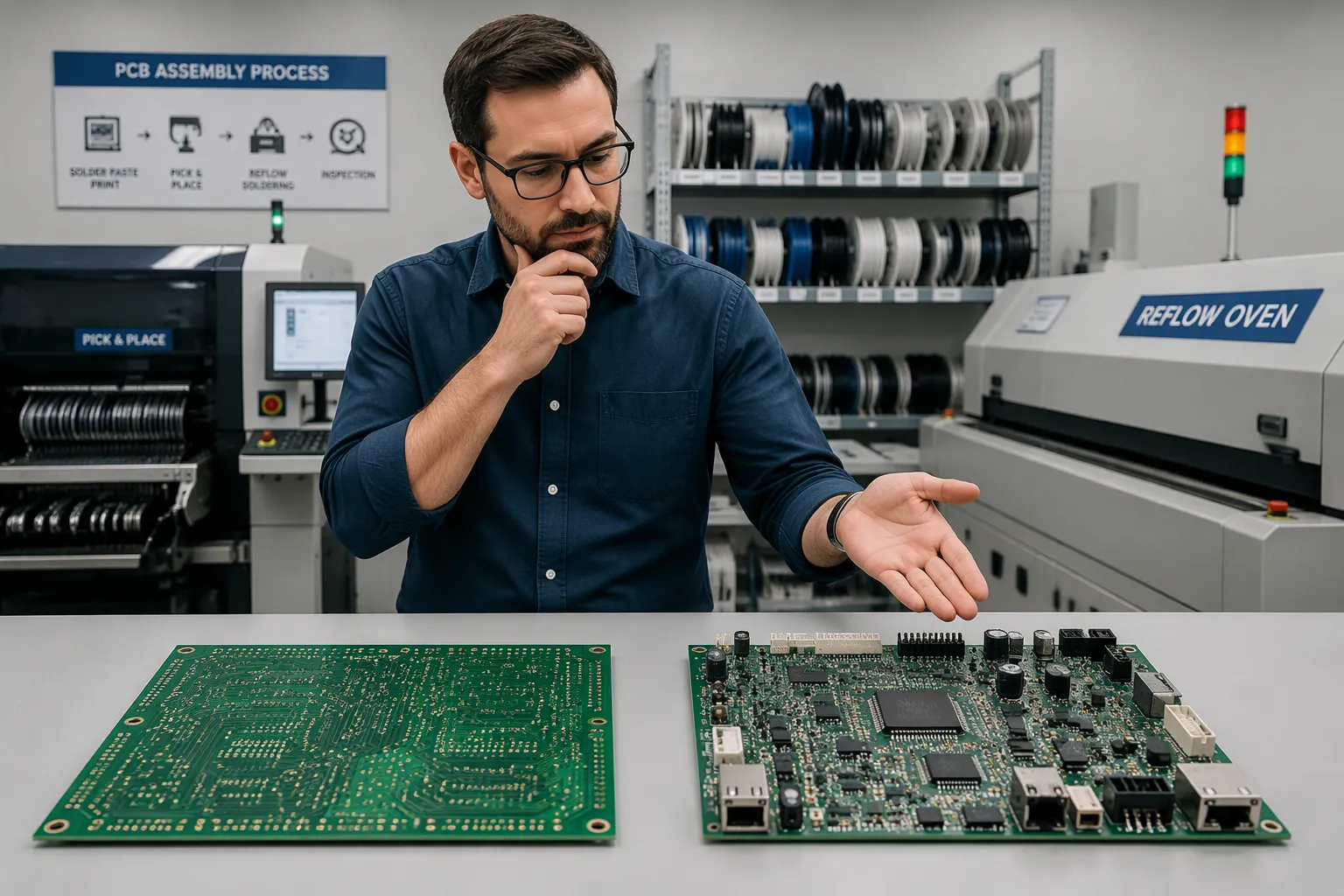
Order a bare board when your team can handle assembly in-house. You own the pick-and-place equipment, the reflow oven, and the inspection bench. A bare PCB order keeps that work on your floor and under your schedule.
Choose bare boards when you want control over components. You may hold preferred suppliers, negotiated pricing, or stock you trust. Buying the bare board lets you source every part yourself. This path also fits layout prototyping. You can check trace routing, fit, and finish before you commit to parts. A bare PCB quote covers fabrication alone, so early iterations stay affordable.
Ordering Assembled Boards
Order an assembled board when you need a tested, fully assembled, ready-to-use board. You lack assembly capability, or your line is full. The assembler handles procurement, placement, reflow, and test, and you receive a unit you can power on.
This path also fits low-volume runs and one-off builds. Setup effort for a small batch rarely pays off in-house. An assembled board shifts that burden to the assembler.
Sourcing models shape the pcba quotation you receive. Match the model to your volume and component availability.
Model | Who supplies parts | Best fit |
|---|---|---|
Turnkey | Assembler | Most builds; simplest workflow |
Consigned | You | You hold parts or locked pricing |
Partial | Both | Mixed availability or legacy parts |
Turnkey keeps one party accountable for the whole build. Consigned assembly suits teams with existing stock. Partial assembly covers the middle ground, where you supply critical parts and the assembler fills the rest.
Matching the Order to Your Situation
The pcb vs. pcba decision comes down to where assembly happens and who owns the parts. Compare pcb and pcba costs honestly. A bare board price excludes parts and labor, so it looks lower. A pcba quote bundles everything into one number.
Review pcb and pcba costs against your real capability. If you have a line and component control, bare boards win. If you need readiness, assembled boards win. Request a bare PCB quote or a pcba quote and compare the full picture. Both pcb and pcba orders serve clear purposes, and pcba manufacturing partners can scale with you as volume grows.
Files, Lead Time, and Common Mistakes
File Requirements for Each Order
A bare board order runs on fabrication data. You send Gerber files for every copper, mask, and silkscreen layer, plus a drill file and a fabrication drawing that states your stackup, finish, and tolerances. Check the Gerber output against your design before you submit it. A missing layer or a wrong drill file stalls the job at the fab house.
A pcba order needs everything above plus two more files. The bill of materials lists every part with its reference designator, value, and package. The pick-and-place file gives each component’s position and rotation. Both files must match the board exactly. A mismatch between the BOM and the placement data causes wrong parts or missing parts on the line.
Mistakes to Avoid
Lead time and inspection differ between the two stages. Fabrication follows a fixed schedule. Assembly adds procurement and reflow, so plan for a longer window. Inspection also shifts: you check a bare printed circuit board for traces and finish, and you check an assembled board for solder joints and function. Customs may also classify an assembled board under a different HS code than a bare board, so confirm the code before you ship.
Avoid these common errors. On a bare board order, do not skip the fabrication drawing, and do not assume the default finish fits your process. On a pcba order, do not send a BOM with unverified part numbers, and do not forget to confirm part availability before you commit. Review pcb and pcba files as one package. Small checks on pcb and pcba data protect both schedule and costs.
A PCB is fabrication; a PCBA adds assembly and test, the pcb vs pcba story. The pcb vs. pcba split: weigh pcb and pcba costs. Choose bare boards for in-house assembly or part control. Choose assembled boards for a tested, ready-to-use unit. Submit files for a bare pcb quote or turnkey pcba quote; a pcba quotation follows.
FAQ
Does a bare PCB work without components?
No. A bare pcb carries copper traces and pads, yet it holds no parts. It cannot power on or perform any function. You need assembly and test before the board works as a circuit.
What files do you need for a PCBA order?
Send your Gerber and fabrication data first. Add a bill of materials and a pick-and-place file for the pcba build. Both files must match the board exactly, or the line places wrong parts.
Does assembly always cost more than fabrication?
Yes, in most cases. A pcba quote stacks parts, labor, machine runtime, and test on top of fabrication. Compare pcb and pcba costs against your own capability before you decide.
See Also
Tailored AI PCBA Solutions for Czech Industrial Electronics Manufacturers
Bespoke AI PCBA Production Services for Electronics Firms in Mexico
Tailored Edge AI PCBA Development for American Hardware Startups
AI Server PCB Fabrication for United States GPU Hardware Businesses
AI Inference Server PCB Assembly for United Kingdom Edge Computing Initiatives