
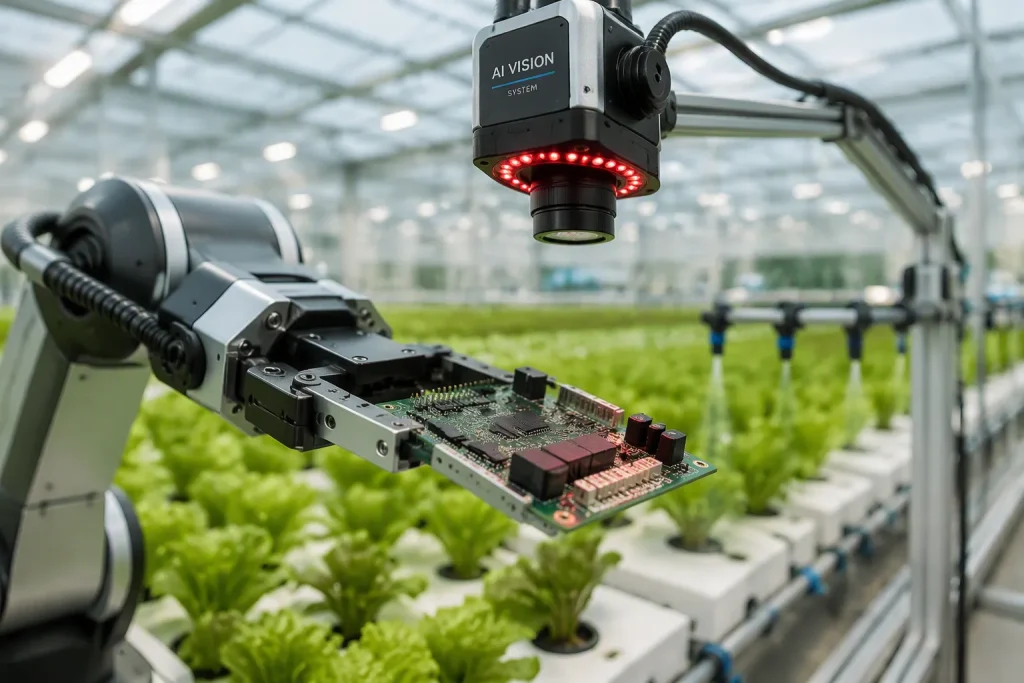
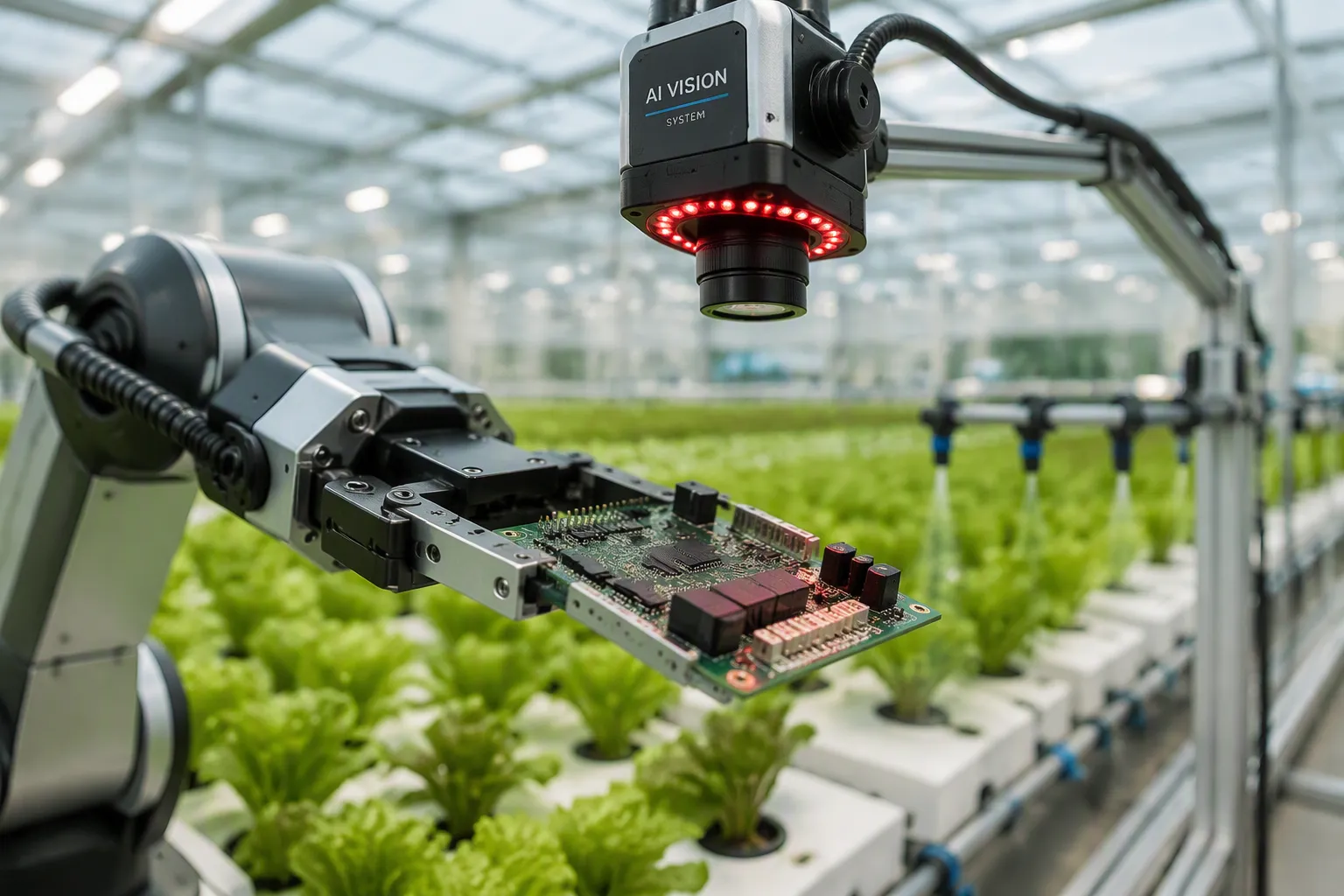
Greenhouse managers face three daily operational pain points. Manual scouting misses early pest outbreaks. High humidity corrodes standard electronics. Cloud-based vision systems add transmission and analysis delays, so time-critical control decisions arrive too late. Edge AI processing removes that cloud round-trip delay and enables immediate local responsiveness, while cloud processing cannot accommodate time-sensitive decisions.
AI vision PCBA assembly addresses these challenges through edge computing, moisture-proof durability, and seamless integration with existing greenhouse control systems. The hardware runs vision models locally, survives condensation and chemical exposure, and connects directly to crop recognition gateways and automatic irrigation controllers. This article examines how the hardware is built, how it endures harsh conditions, and what results it delivers for crop monitoring, pest detection, and automated control.
Key Takeaways
Edge AI processing enables real-time decisions without cloud delays.
Moisture-proof coatings and enclosures protect electronics in harsh greenhouses.
Multi-interface boards connect various sensors and cameras easily.
Early pest detection and precision irrigation save costs and increase yields.
Bonysn provides scalable solutions for different greenhouse sizes.
Core Components of an AI Vision PCBA
Greenhouse AI Cameras and iToF Depth Sensing
Camera modules form the front end of any AI vision PCBA. Standard RGB cameras capture color and texture, which helps identify leaf discoloration or visible pests. Indirect Time-of-Flight (iToF) sensors add a third dimension. These sensors emit modulated light and measure the phase shift of the returning signal. The phase shift translates directly into distance, so the module produces a depth map of the canopy. Growers then use that depth data for crop phenotyping, measuring plant height, leaf area, and fruit volume without touching the plant. Plant sorting systems rely on the same depth maps to grade seedlings by size and structure before transplanting.
Edge AI Processors and Industrial Coatings
The edge AI processor runs vision models directly on the board. It performs inference locally, so the system classifies an image and issues a control signal without a cloud round trip. Industrial-grade conformal coatings protect these processors and their surrounding circuitry. Acrylic, silicone, and polyurethane coatings each serve different chemical and thermal environments, and IPC-CC-830 defines the qualification requirements for these materials. The coating forms a thin barrier that blocks condensation and airborne chemicals from reaching solder joints and component leads.
Downstream devices depend on this board. Crop recognition gateways receive classification results and forward them to farm management software. Automatic irrigation controllers act on moisture and nutrient readings that share the same PCBA. Market demand now pushes toward multi-protocol communication design, because growers connect soil probes, nutrient sensors, and climate sensors from different vendors. Bonysn addresses this pain point with a multi-interface PCBA that accepts these varied sensor inputs on one board.
System Architecture and Sensor Integration
Camera, Soil, and Nutrient Sensor Interfaces
The PCBA gathers data from soil moisture sensors and nutrient-level sensors through multiple interface types. Analog voltage outputs, digital I2C buses, and RS-485 differential pairs each serve different sensor classes. The board routes these signals to the edge processor, which fuses them with camera data. High humidity threatens stable acquisition because condensation on connector pins changes contact resistance and corrupts analog readings. The system architecture therefore places signal conditioning and galvanic isolation close to the sensor inputs. This design keeps measurement accuracy stable even when relative humidity stays near saturation.
The vision processing pipeline moves through four stages. Camera modules capture raw frames. The image signal processor corrects exposure and white balance. The edge AI processor runs inference on the corrected frame. The output stage classifies the scene and issues a control signal. Each stage operates locally, so the pipeline avoids cloud round-trip latency.
Power Management for Continuous Greenhouse Operation
Greenhouses run 24/7, so the PCBA must manage power without interruption. A wide-input DC-DC converter accepts the 12 V or 24 V rails common in greenhouse control cabinets. Supercapacitors or small battery cells bridge brief power dips. The processor uses dynamic voltage and frequency scaling to cut consumption during idle periods. Sleep modes reduce draw when no camera frame is pending.
A comparison of interface options helps system designers choose the right sensor path:
Interface | Typical Use | Noise Immunity | Cable Length |
|---|---|---|---|
Analog voltage | Low-cost soil probes | Low | Short |
I2C | Nutrient sensors | Medium | Short |
RS-485 | Distributed sensor nodes | High | Long |
Bonysn sources industrial-grade components for these interfaces. The company’s procurement advantage ensures that connectors, isolation chips, and power regulators meet IPC-A-610 Class 2 assembly standards. This sourcing discipline supports reliable sensor integration in humid greenhouse environments.
Connectivity and Edge AI Processing
Ethernet, Wi-Fi, and LoRa Trade-Offs
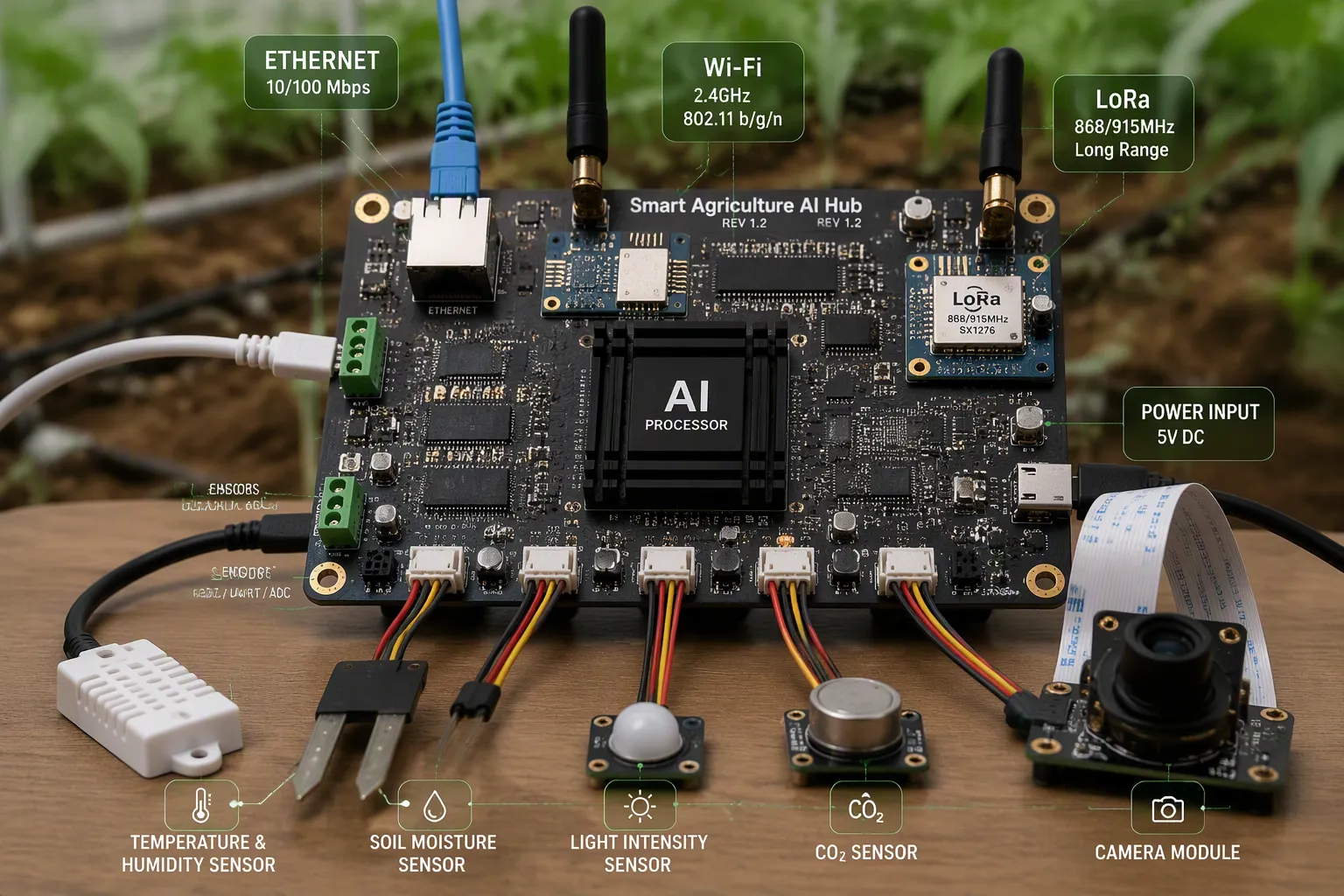
Greenhouse data flow demands different connectivity paths for different jobs. Ethernet delivers the highest bandwidth and the lowest latency. It suits fixed camera arrays that stream continuous video to a local edge server. Wi-Fi offers flexible placement without cabling. It works well for mobile scouting carts and temporary sensor clusters. LoRa trades bandwidth for range and power efficiency. It carries small packets from distant soil probes across a large greenhouse site.
The choice depends on the data type. Vision frames require high bandwidth. Soil moisture readings need only a few bytes. A single protocol cannot serve both needs efficiently. Market demand now pushes toward multi-protocol communication design. Growers connect cameras, soil probes, nutrient sensors, and climate sensors from different vendors. Large image files and frequent communication create a real customer pain point. Bonysn addresses this with a multi-interface PCBA that accepts Ethernet, Wi-Fi, and LoRa on one board. This design removes the need for separate gateways and simplifies deployment.
Latency | Internet Dependency | Main Advantage | |
|---|---|---|---|
Cloud Platform | Higher | High | Scalability and global access |
Local/Edge Server | Lower | Low | Real-time control and data privacy |
Low-Latency Inference and Anomaly Detection
Edge AI processing enables real-time inference without a cloud round trip. The AI vision PCBA runs vision models locally. It classifies an image and issues a control signal in the same operation cycle. This local processing reduces latency and dependence on constant internet access. The system works well even with poor or no internet connection. Remote or poorly connected farm environments benefit most from this reliability.
Edge AI processes data locally in the greenhouse, which reduces latency and dependence on constant internet access, making it more reliable for remote or poorly connected farm environments.
Anomaly detection follows the same local path. The processor compares each frame against learned patterns. A deviation triggers an alert immediately. No network delay slows the warning.
Aspect | Edge AI | Cloud-Based AI |
|---|---|---|
Where processing happens | On local greenhouse hardware | On remote cloud servers |
Response time | Immediate local inference with no network round-trip | Slower because data must travel over the network |
Reliability | Works well even with poor or no internet connection | Depends on continuous, high-bandwidth connectivity |
Best-suited use | Fast, on-site actions such as crop identification and treatment | Centralized storage and long-term analytics |
AI-based vision systems can provide pest and disease warnings several days in advance. Early detection gives growers time to act before an outbreak spreads. This lead time reduces pesticide use and protects crop yield. The edge processor handles this detection continuously. It never waits for a cloud server to respond.
Durability for Harsh Greenhouse Environments
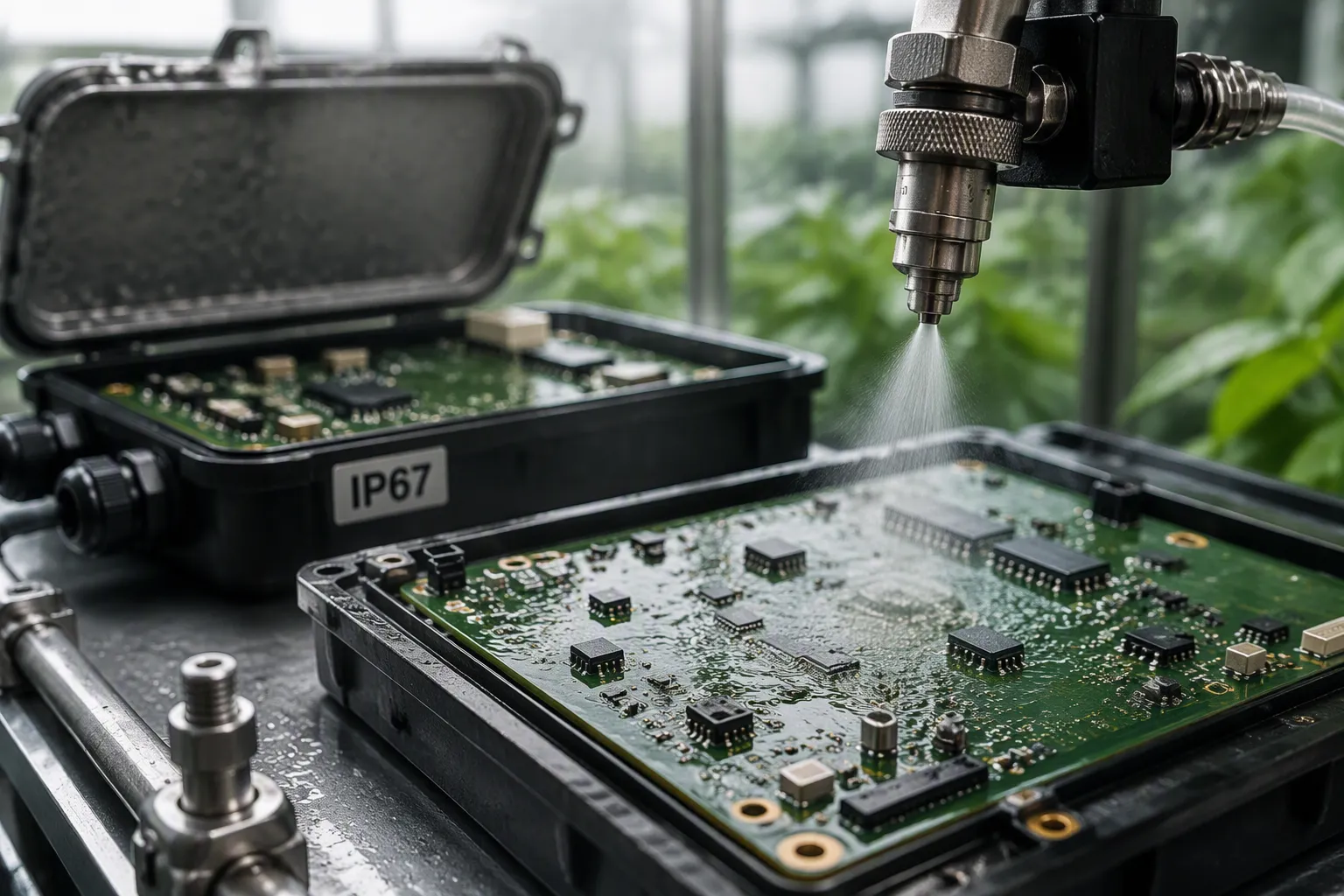
Greenhouse environments present severe challenges for electronics. Relative humidity often stays above 90% for extended periods. Condensation forms on surfaces during temperature swings. Chemical vapors from pesticides and fertilizers attack unprotected boards. Standard PCBA assemblies fail within months under these conditions. Greenhouse operators specifically demand moisture-resistant PCBA solutions. AI vision PCBA must withstand this environment to deliver years of reliable operation.
Conformal Coating and IP-Rated Enclosures
Conformal coating forms the first line of defense. These thin polymer films cover the entire board surface. They block moisture, dust, and chemicals from reaching component leads and solder joints. Three coating types dominate greenhouse applications. Acrylic coatings offer good moisture resistance and allow easy rework for repairs. Silicone coatings excel in high-humidity environments and withstand wide temperature swings. Polyurethane coatings provide the best chemical resistance, making them ideal for areas with frequent pesticide exposure. Each material must meet IPC-CC-830 or MIL-I-46058 standards. Bonysn selects coating materials based on the specific greenhouse environment. For installations with heavy pesticide use, polyurethane provides maximum protection. For general monitoring applications, acrylic offers cost-effective moisture resistance.
IP-rated enclosures add a second protective layer. IP65 enclosures protect against dust ingress and low-pressure water jets. IP67 enclosures withstand temporary immersion in water. Bonysn combines conformal coating with IP-rated enclosures to protect AI vision PCBA assemblies. This dual approach ensures protection against condensation, chemical spray, and physical contamination. The combination provides defense in depth against greenhouse moisture.
Coating Type | Standard | Key Advantage | Bonysn Application |
|---|---|---|---|
Acrylic | IPC-CC-830 | Moisture resistance and reworkability | General greenhouse electronics |
Silicone | IPC-CC-830 | High humidity and temperature tolerance | Edge processor boards near hot zones |
Polyurethane | MIL-I-46058 | Superior chemical resistance | Areas with pesticide exposure |
Long-Term Reliability and Moisture Testing
Manufacturers validate durability through standardized reliability tests. The 85/85 test exposes boards to 85°C temperature and 85% relative humidity. Test runs last 168, 500, or 1000 hours depending on the target application. These conditions simulate years of greenhouse exposure in a controlled setting. Passing these tests gives engineers confidence in long-term field performance.
Parameter | Value | Tolerance |
|---|---|---|
Temperature | 85°C | ±2°C |
Relative humidity | 85% RH | ±5% RH |
Duration | 168, 500, or 1000 hours | Per specification |
Several industry standards govern these procedures. JEDEC JESD22-A101 applies to integrated circuits and passive components. AEC-Q100 and Q200 require 85/85 bias testing for 1000 hours in automotive-grade electronics. IPC-TM-650 includes the 85/85 test for evaluating surface insulation resistance on PCBs and assemblies. IEC 61215 covers photovoltaic modules under damp heat conditions.
These tests detect four key failure mechanisms:
Electrochemical migration: Metal ions from silver, copper, or tin migrate between conductive tracks under electric field and humidity. This creates dendrites that cause short circuits.
Corrosion of bonding pads and wires: Moisture combined with residual process contaminants attacks connections.
Insulation degradation: Moisture absorption reduces resistance between PCB traces, allowing leakage currents that corrupt sensor measurements.
Delamination of encapsulants: The interface between mold compound and lead frame degrades, enabling further moisture ingress.
Each mechanism leads to specific system malfunctions that technicians struggle to diagnose in greenhouse installations.
Bonysn applies these test protocols during PCBA development. The results guide material selection and process adjustments. The moisture-proof design ensures years of unattended operation. Growers install the system once and rely on it season after season without maintenance interruptions.
Real-World Implementation Scenarios
Pest and Disease Detection
Greenhouse growers lose revenue when pests spread undetected. An AI vision PCBA changes this dynamic by running detection models directly on the camera board. The system compares each captured frame against learned patterns of healthy foliage. A deviation triggers an immediate alert to the grower’s dashboard. No cloud round trip delays the warning. This local processing gives growers a critical head start.
A commercial rose greenhouse in the Netherlands deployed this approach across its production area. The AI vision system flagged powdery mildew infections several days before visible symptoms appeared to human scouts. Early treatment reduced fungicide applications substantially compared to the previous season. The grower reported lower chemical costs and healthier crop cycles. This outcome demonstrates how edge-based detection translates directly into operational savings.
Precision Irrigation and Yield Prediction
Sensor fusion drives precision irrigation in modern greenhouses. The AI vision PCBA collects soil moisture readings, nutrient levels, and canopy images on a single board. The edge processor fuses these data streams and issues irrigation commands through automatic controllers. Water and nutrients reach each zone only when crops need them. This targeted delivery cuts waste and supports consistent growth.
Yield prediction accuracy depends on the prediction horizon. A system combining drone imagery, AI computer vision, greenhouse climate data, historical records, and weather forecasts achieved the following results for rose yield prediction:
Prediction Horizon | Accuracy Level |
|---|---|
Multi-day | 90% |
Multi-week | 85% |
Bonysn supports these deployments with small-to-medium batch delivery. Growers can scale from a single greenhouse bay to a full facility without redesigning the hardware platform.
AI vision PCBA assembly solves the core deployment challenges. Edge inference delivers real-time decisions. Moisture-proof construction endures harsh conditions. Flexible connectivity links cameras, sensors, and controllers on one platform.
Greenhouse managers gain measurable returns. Precision irrigation cuts water use by 20% to 60% and fertilizer costs by 20% or more. Earlier pest detection reduces chemical applications. Yield predictability improves with continuous local monitoring.
Metric | Observed Reduction |
|---|---|
Fertilizer input cost | 20% or more |
Water consumption (drip systems) | 20% to 60% |
Bonysn scales this platform across greenhouse sizes and crop types without redesign. Growers should evaluate AI vision PCBA assembly for their next automation project.
FAQ
How does Bonysn protect AI vision PCBA assemblies from greenhouse humidity?
Bonysn applies conformal coatings that meet IPC-CC-830 and MIL-I-46058 standards. Acrylic, silicone, and polyurethane options cover different chemical and thermal conditions. The company pairs each coating with an IP-rated enclosure. This dual approach blocks condensation, pesticide spray, and dust from reaching solder joints and component leads.
Which connectivity option suits a large greenhouse with mixed sensor types?
No single protocol serves every device well. Ethernet handles high-bandwidth camera streams. Wi-Fi supports mobile scouting carts. LoRa carries small packets from distant soil probes. Bonysn builds a multi-interface PCBA that accepts all three on one board. Growers avoid separate gateways and simplify deployment.
How does the PCBA handle large image files and frequent sensor communication?
Edge AI processing keeps vision inference local. The board classifies frames and issues control signals without a cloud round trip. This design reduces latency and dependence on constant internet access. Remote sites with poor connectivity still receive real-time pest and disease warnings.
What testing validates long-term reliability in humid conditions?
Bonysn runs the 85/85 test at 85°C and 85% relative humidity for 168, 500, or 1000 hours. JEDEC JESD22-A101 and IEC 61215 govern these procedures. The tests detect electrochemical migration, corrosion, insulation degradation, and encapsulant delamination. Passing results confirm years of unattended operation.
What delivery options does Bonysn offer for greenhouse automation projects?
Bonysn supports small-to-medium batch delivery. Growers scale from a single greenhouse bay to a full facility without redesigning the hardware platform. The same PCBA serves different crop types and greenhouse sizes.
Consideration | Bonysn Approach | Benefit |
|---|---|---|
— | – | — |
Moisture protection | Conformal coating plus IP-rated enclosure | Years of unattended operation |
Sensor interfaces | Multi-interface PCBA (analog, I2C, RS-485) | One board for mixed sensor types |
Connectivity | Ethernet, Wi-Fi, and LoRa on one board | No separate gateways needed |
Procurement | Industrial-grade components, IPC-A-610 Class 2 | Stable acquisition in high humidity |
Delivery | Small-to-medium batch | Scalable from one bay to full facility |
See Also
Smart Building AI PCBA Empowers Malaysian IoT Firms
AI Sensor PCBA Drives Dutch Greenhouse And Semiconductor Equipment
Edge AI PCB Assembly Enhances Canadian Vision Monitoring Systems
AI Vision PCBA Bolsters Israeli Security And Autonomous Devices