
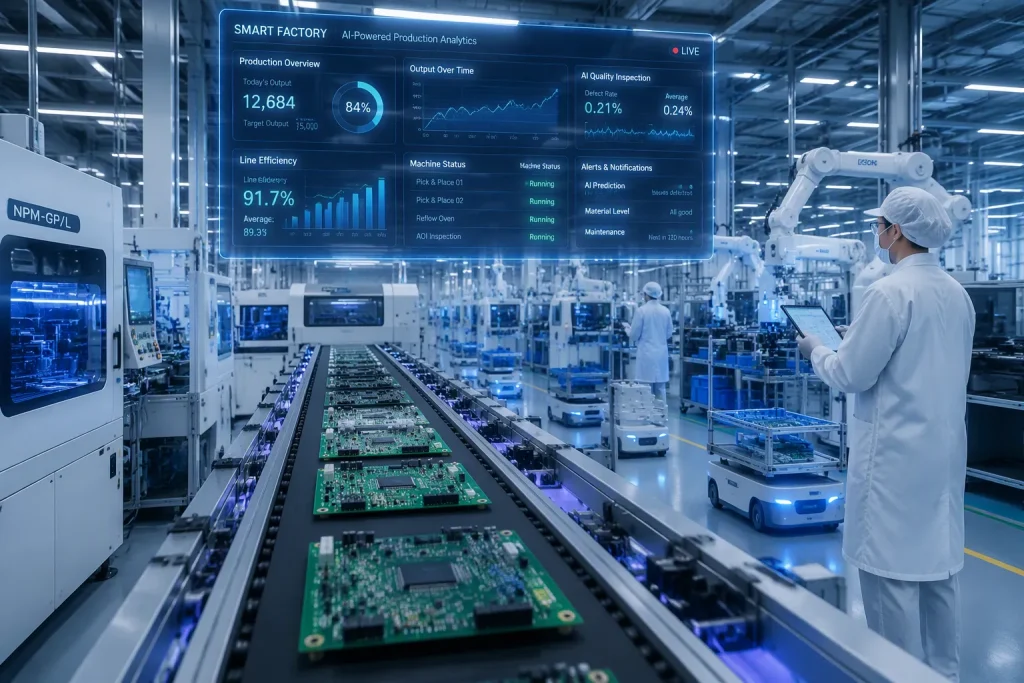
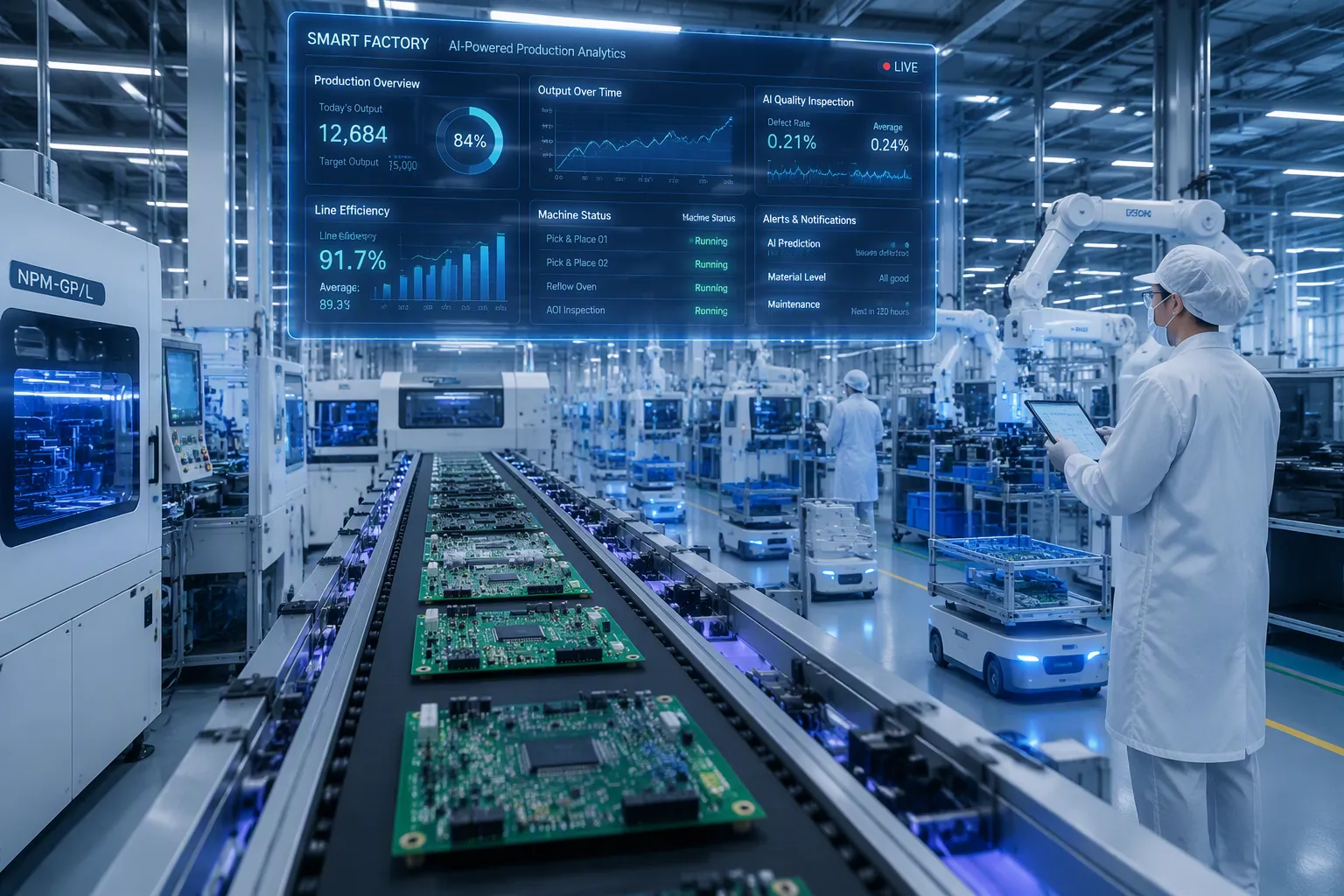
AI factory monitoring for PCBA assembly means embedding intelligent systems that detect defects at line speed, predict equipment failures, and integrate with MES/ERP to deliver end-to-end quality control for the industrial IoT and logistics hardware that powers modern manufacturing. Real-time sensor data, machine vision, and predictive analytics improve yield, reduce downtime, and ensure reliability. Industrial sites demand robust communication, sensor acquisition, and easy-to-maintain PCBA. They also face interference, vibration, and legacy device interfaces. Three hardware examples ground this concept: a predictive maintenance device, a logistics scanning terminal, and a factory AI gateway. Siemens Rastatt improved first pass yield by 42% using AI-driven monitoring. Egicon reduced repair rates from 30 ppm to 6 ppm with zero percent scrap in 2019. These results show how AI factory monitoring PCB assembly strengthens iot and ai technologies for printed circuit board production.
Key Takeaways
AI vision spots defects on every circuit board at full production speed, lowering rework and scrap by 15-30%.
Predictive maintenance uses sensor data to catch equipment failures before they stop your line, reducing downtime.
RFID traceability cuts material errors by 98% and shipment errors by 99.67%, making quality visible from start to finish.
Integrate AI as a smart layer above your existing MES and ERP systems to get real-time alerts and decisions without changing core operations.
AI Factory Monitoring for PCB Assembly
Modern PCB assembly lines generate enormous amounts of process data. AI factory monitoring PCB assembly transforms that raw data into actionable intelligence. Two core capabilities drive this transformation: real-time defect detection and predictive maintenance from equipment sensors. Together, they form the foundation of an ai-powered control system that keeps production stable and quality high.
Real-Time Defect Detection and Quality Control
Traditional automated inspection relies on hard-coded rules. These systems struggle with natural variation in lighting, component placement, and solder appearance. The result is high false-call rates that waste operator time and slow production. Artificial intelligence changes this equation entirely.
AI algorithms learn normal and abnormal patterns from production data. Deep learning models recognize spatial and texture patterns rather than simple edges. This capability distinguishes a legitimate solder fillet from a bridge caused by excess paste. High-speed AI vision at 100+ FPS inspects every PCB at full production speed without slowing the line. Defective boards are flagged or removed automatically, and operators receive instant notifications.
The table below compares rule-based automated optical inspection with AI visual inspection across key dimensions.
Dimension | Rule-based AOI limitation | AI visual inspection improvement |
|---|---|---|
Handling variation | Hard-coded rules struggle with real variation | Models keep learning and adapt to lighting, component, and layout variations |
False calls | High false-call rates waste time | Machine learning minimizes false calls and retests |
Reprogramming | Frequent reprogramming per product | Continuous learning improves with each batch |
Root cause | No built-in root-cause insights | Automatic Root Cause Analysis correlates visual failures with process parameters |
First-pass yield | Yield suffers from missed defects and rework | Catch issues earlier to lower rework and scrap |
Manufacturers typically report 15–30% lower rework and scrap with payback in 6–12 months. Bonysn’s deployment across SMT assembly lines demonstrated similar gains, with stable inspection quality across shifts. The system adapts quickly to new PCB designs with minimal reconfiguration, which suits high-mix pcba manufacturing environments.
Predictive Maintenance from Equipment Sensors
Equipment failures disrupt production and damage yield. Predictive maintenance uses sensor data from placement machines, reflow ovens, and conveyors to forecast problems before they stop the line. Vibration sensors detect bearing wear. Temperature sensors track thermal drift in reflow profiles. Current sensors identify motor degradation.
An ai factory monitoring pcb system collects this sensor data continuously. Machine learning models establish baseline behavior for each machine. When readings drift beyond normal ranges, the system alerts maintenance teams. This approach prevents unplanned downtime and extends equipment life. The same predictive analytics engine supports remote monitoring across multiple facilities, giving engineers visibility into every pcb control boards installation.
For PCB and PCBA manufacturing, these capabilities reduce field failures and accelerate time-to-market. The pcba process becomes more predictable, and the entire factory operates with greater confidence.
Industrial IoT Integration for Smart PCBA
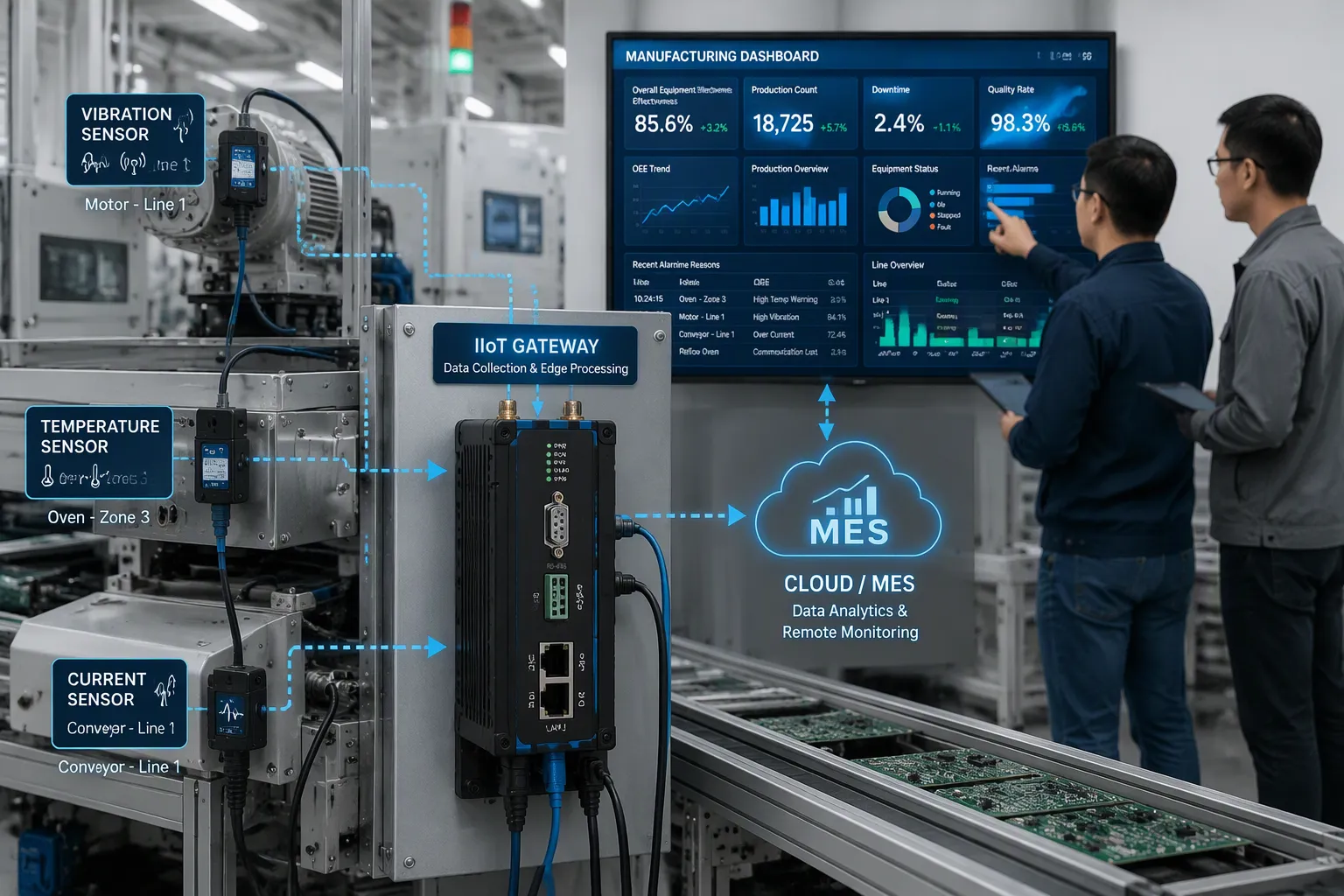
Industrial IoT integration turns a PCBA line into a connected system. Data flows from machines to dashboards, and engineers act on live information. This connectivity depends on robust sensor interfaces, standard communication protocols, and edge computing nodes. A factory AI gateway often serves as the central integration point, collecting data from every station and forwarding it to MES or cloud platforms.
Vibration, Temperature, and Communication Interfaces
PCBA manufacturing exposes equipment to constant vibration, thermal cycling, and electrical interference. Industrial-grade iot sensors capture temperature, pressure, vibration, current, and voltage across the line. These sensors connect through ruggedized interfaces that resist noise and mechanical stress. Legacy equipment often lacks modern ports, so gateways must support RS-232, RS-485, and Ethernet alongside newer standards.
Two protocols dominate industrial communication today. MQTT uses a lightweight publish/subscribe model with a broker. OPC UA provides platform-independent data models with built-in security. The table below compares them.
Protocol | Architecture | Key Features | Typical Use |
|---|---|---|---|
OPC UA | Platform-independent, TCP/HTTP transports | Encryption, authentication, vendor interoperability | Machine-to-machine data exchange, SCADA integration |
MQTT | Publish/subscribe with central broker | Low overhead, QoS support, high scalability | Remote monitoring, smart grids, industrial control |
MQTT is a lightweight protocol for data transmission. At best, data packets of just 2 bytes can be implemented, which is particularly advantageous for a large number of devices and messages. However, in contrast to OPC UA, MQTT is purely a transmission protocol and does not provide any enhanced framework with functions such as semantic data description or security mechanisms.
For smt assembly lines, OPC UA handles machine-level data exchange. MQTT suits remote monitoring across distributed sites. Both protocols feed the same ai analytics engine.
Edge Computing and RFID Traceability
Edge computing processes sensor data close to the source. This reduces latency and bandwidth costs. A factory AI gateway runs inference models locally, flagging anomalies before data reaches the cloud. The gateway also manages iot devices and ensures continuous operation during network outages.
RFID traceability closes the loop on quality control. Tags attached to PCB panels or carriers record every process step. The table below shows measured improvements from RFID deployment in PCBA manufacturing.
Metric | Before | After | Improvement |
|---|---|---|---|
Monthly material error accidents | 3-5 times | 0 | 100% reduction |
Material replacement time | 2 minutes | 30 seconds | 75% reduction, line efficiency +15% |
Assembly material error rate | 0.5% | 0.01% | 98% reduction |
Test data tracing time | 30 minutes (manual) | 1 second (tag reading) | Significant reduction |
Shipment error rate | 0.3% | 0.001% | 99.67% reduction |
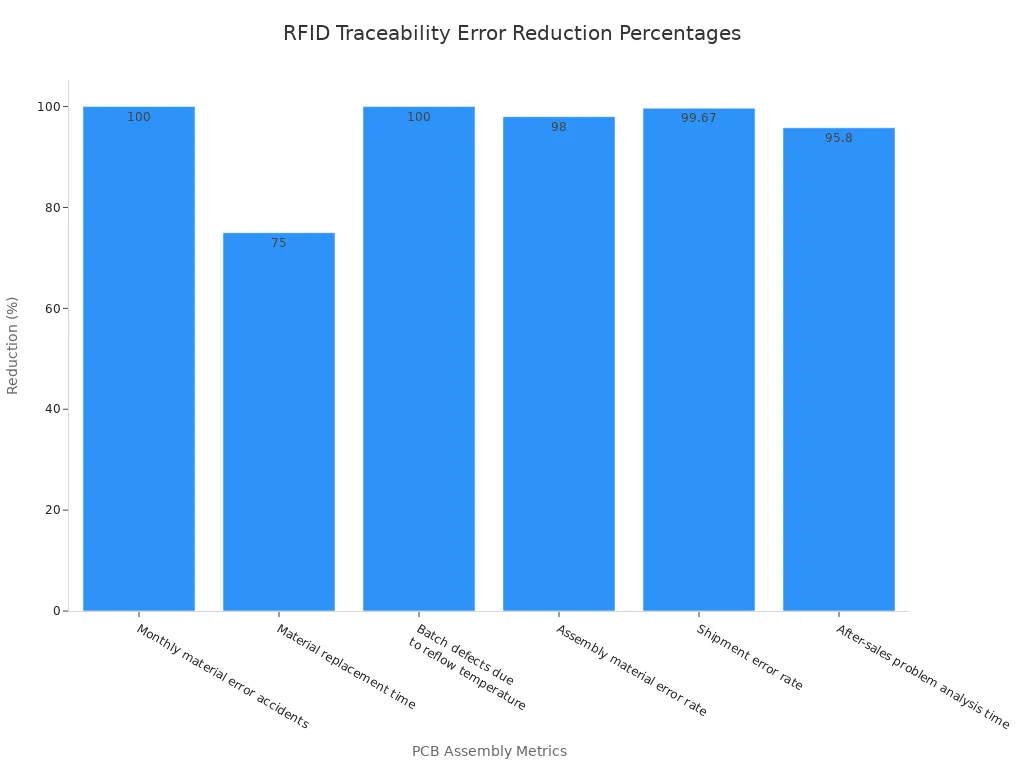
PCB RFID tags provide a reliable method for ensuring quality control and traceability in manufacturing processes. By tagging products at each stage of production, companies can track defects, identify the root cause of issues, and ensure that each item meets quality standards.
These results demonstrate how traceability reduces recalls and accelerates root-cause analysis. The pcba process becomes transparent from solder paste printing to final test. For iot products and logistics hardware, this transparency directly improves field reliability.
Reliability for Logistics AI Hardware
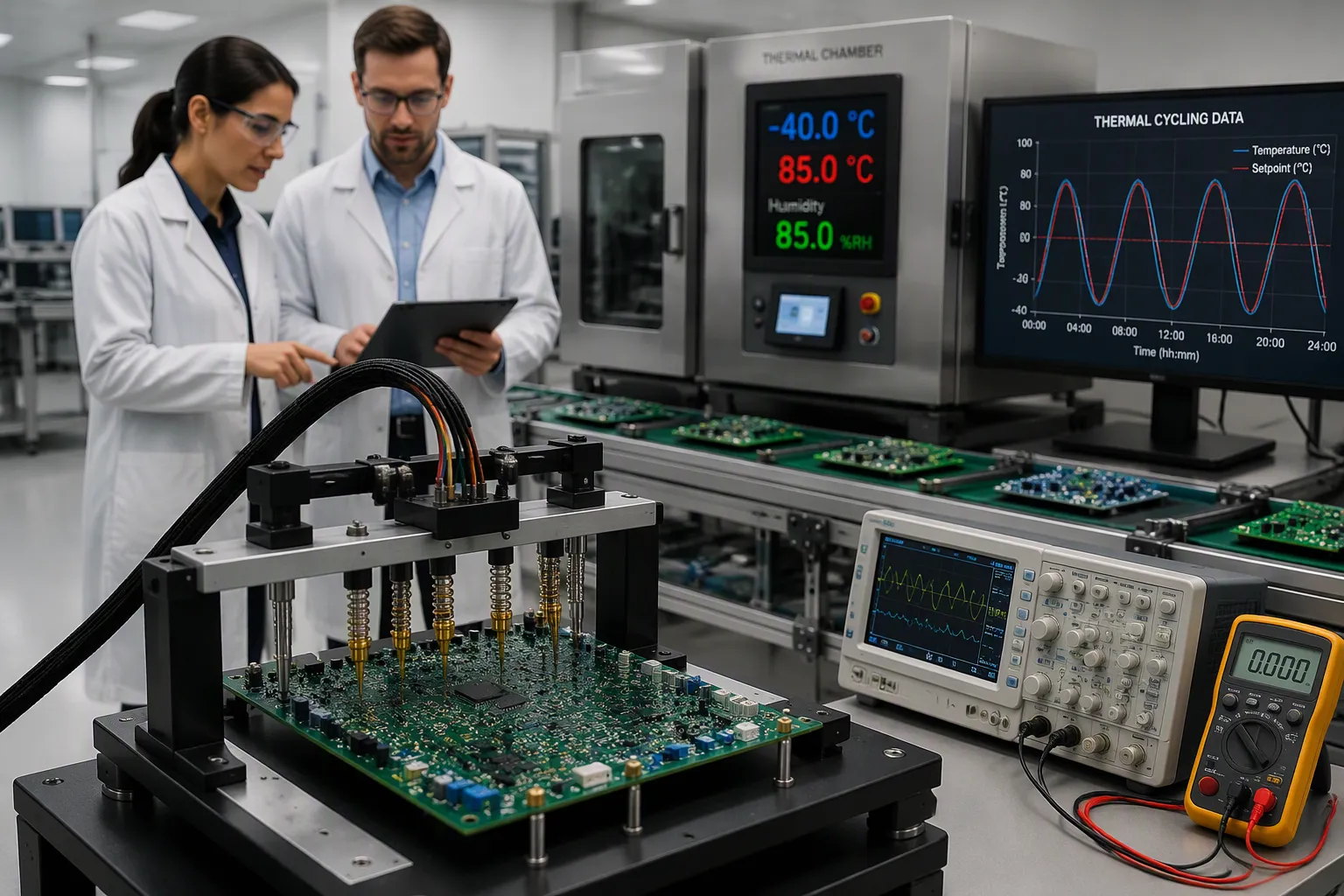
Logistics environments punish weak electronics. Vibration from conveyor belts, thermal swings inside delivery trucks, and humidity in warehouses all attack the same pcb control boards that keep scanning terminals and predictive maintenance devices running. Reliability starts before production begins.
Smart PCB Control Boards and Pre-Production Test Fixture Planning
Engineers who design smart pcb control boards for logistics hardware must plan test fixtures before the first board enters smt assembly. A test fixture validates every critical net, connector, and power rail on the pcb control boards. This step catches design errors early and prevents costly rework later.
Two test strategies expose weaknesses that field conditions would otherwise reveal. HALT (Highly Accelerated Life Test) stresses a product beyond its operational limits to find design margins. HASS (Highly Accelerated Stress Screen) screens manufacturing defects on the production line to eliminate infant mortality before shipment. MIL-STD-810H provides the recognized framework for validating robustness against vibration, thermal shock, humidity, and salt spray.
Test Strategy | Purpose | Relevance to Harsh Logistics PCBA Reliability |
|---|---|---|
HALT | Identifies design limits by stressing beyond operational limits | Reveals vulnerabilities like thermomechanical fatigue at solder joints |
HASS | Screens manufacturing defects on the production line | Eliminates latent defects before shipment |
MIL-STD-810H | Standardized environmental test methods | Validates robustness against mechanical and climatic stresses |
Two failure mechanisms matter most for logistics hardware. Thermomechanical fatigue occurs when the CTE mismatch between FR-4 pcb material and silicon components causes cyclic shear stress at solder joints. Electromigration happens when high current density displaces metal ions in traces, creating voids or shorts. HALT thermal cycling exposes both risks.
Bonysn supports industrial pcb manufacturing with plugin and SMT capabilities, program burning, functional testing, and batch production. This end-to-end approach ensures every intelligent pcb control boards unit meets reliability targets before deployment.
PCB Control Boards and Real-Time Device Monitoring
Once deployed, pcb control boards inside a logistics scanning terminal or predictive maintenance device must report their own health. Real-time monitoring captures vibration, temperature, and current data from each board. An ai engine analyzes that data and flags anomalies before they cause failures.
The table below compares monitored parameters across two device types.
Device | Primary Sensor Input | Monitored Risk | Response Trigger |
|---|---|---|---|
Logistics scanning terminal | Vibration, temperature | Solder joint fatigue, thermal drift | Alert when vibration exceeds baseline |
Predictive maintenance device | Current, temperature | Electromigration, component degradation | Alert when current density rises |
Each pcb control boards unit transmits data through iot devices to a central gateway. The gateway runs inference models locally and forwards only critical events to MES or ERP systems. This architecture reduces network load and keeps monitoring active during outages.
Field data from RFID traceability deployments shows measurable gains. Material error rates dropped from 0.5% to 0.01%, and shipment errors fell from 0.3% to 0.001%. These improvements directly extend the service life of pcb control boards in logistics hardware.
Bonysn applies the same discipline to every pcb control boards batch. Functional testing at temperature extremes, program burning verification, and batch-level traceability ensure that each pcb control boards meets the demands of intelligent hardware operating in uncontrolled environments. The result is fewer field failures and faster time-to-market for iot and logistics AI products.
Implementation and Integration Strategies
Integration with MES and ERP Systems
Connecting AI monitoring to existing MES and ERP platforms demands a structured approach. A successful rollout follows a clear sequence. First, teams conduct a data audit to assess production data quality and integration points. Second, they set clear objectives such as reducing downtime or improving quality. Third, they pilot the integration on a single line before scaling. Fourth, they invest in training so operators can interpret AI insights. Fifth, they monitor performance and iterate continuously.
AI integration works as an intelligence layer above existing MES and ERP systems. It reads data the systems already produce and returns decisions, alerts, and recommendations without touching core production logic. Connectivity to SAP, Oracle, and Siemens Opcenter relies on standard APIs and OPC-UA protocols. Bidirectional ERP sync means production actuals flow directly into business intelligence tools. ESTRA integrated Opcenter Execution with SAP ERP and reduced production cycle time to less than 1 minute.
True digital transformation requires full IT/OT convergence. We eliminate silos by connecting MES, OEE, Track & Trace, and ERP into a seamless, bi-directional data ecosystem — where a quality event on the shop floor instantly updates your business systems.
For pcba manufacturers, this convergence ensures that every pcb control boards unit carries traceable process data from solder printing to final test. The same data feeds ai algorithms that refine predictions over time.
ROI and Implementation Costs for Smart Factories
Smart factory projects deliver measurable returns when teams scope them correctly. Bonysn’s deployment across SMT lines showed 15–30% lower rework and scrap with payback in 6–12 months. RFID traceability cut material error rates from 0.5% to 0.01% and shipment errors from 0.3% to 0.001%. These gains offset upfront costs for sensors, gateways, and integration labor.
IPC standards lower adoption barriers. IPC-A-610 Class 2 and IPC-1791 provide recognized benchmarks for pcb assembly quality and trustworthiness. Predictive maintenance extends equipment life and reduces unplanned downtime. For pcb control boards in logistics hardware, real-time monitoring prevents field failures. A phased approach — pilot, train, scale — keeps costs predictable and risks contained. The table below summarizes typical cost and return drivers.
Cost Driver | Return Driver | Measured Impact |
|---|---|---|
Sensor and gateway hardware | Reduced unplanned downtime | Payback in 6–12 months |
Integration labor | Lower rework and scrap | 15–30% reduction |
Training programs | Faster root-cause analysis | Trace time cut to 1 second |
AI factory monitoring for PCBA assembly is a practical system, not an abstract concept. It directly improves predictive maintenance units, logistics scanning terminals, and factory AI gateways. Real-time defect detection, predictive maintenance, sensor integration, RFID traceability, and test fixture planning work together. Bonysn’s deployment across SMT lines showed 15–30% lower rework and scrap with payback in 6–12 months. These capabilities reduce field failures and accelerate time-to-market for industrial iot and logistics AI hardware. Every pcb control boards unit benefits from traceable process data. IPC standardization and edge computing will further lower adoption barriers. AI monitoring will become a standard requirement for competitive PCB assembly.
FAQ
What drives the demand for AI monitoring in PCBA assembly?
Manufacturers face pressure to reduce defects and downtime while handling complex, high-mix production. AI monitoring addresses these pain points by catching defects at line speed and predicting equipment failures. Bonysn’s deployment across SMT lines showed 15–30% lower rework and scrap with payback in 6–12 months.
How does AI monitoring improve logistics hardware reliability?
Logistics hardware endures vibration, thermal swings, and humidity. Real-time monitoring of pcb control boards captures anomalies before field failures occur. RFID traceability cut shipment errors from 0.3% to 0.001% in documented deployments. This transparency extends service life for scanning terminals and predictive maintenance devices.
What integration challenges do manufacturers face with MES and ERP systems?
Legacy equipment often lacks modern ports, requiring gateways that support RS-232, RS-485, and Ethernet. AI integration works as an intelligence layer above existing systems without touching core production logic. Standard APIs and OPC-UA protocols connect to SAP, Oracle, and Siemens Opcenter. ESTRA reduced production cycle time to less than 1 minute after integration.
How does Bonysn ensure quality for smart PCB control boards?
Bonysn supports industrial pcb manufacturing with plugin and SMT capabilities, program burning, functional testing, and batch production. Every intelligent pcb control boards unit undergoes HALT and HASS testing to expose design margins and screen manufacturing defects. This end-to-end approach ensures reliability before deployment in uncontrolled environments.
What cost and return factors should manufacturers consider?
Smart factory projects deliver measurable returns when scoped correctly. Sensor and gateway hardware costs offset by reduced unplanned downtime. Integration labor costs offset by 15–30% lower rework and scrap. Training programs enable faster root-cause analysis with trace time cut to 1 second. A phased approach keeps costs predictable.
See Also
Implementing AI PCBA Inspection In Mexican Manufacturing Plants
OEM AI PCBA Production For Polish Electronics Factories
Bespoke AI PCBA Manufacturing For Mexican Electronics Companies
AI And IoT PCBA Manufacturing For Malaysian Hardware Firms
Edge AI PCB Assembly For Canadian Vision And Monitoring Devices