
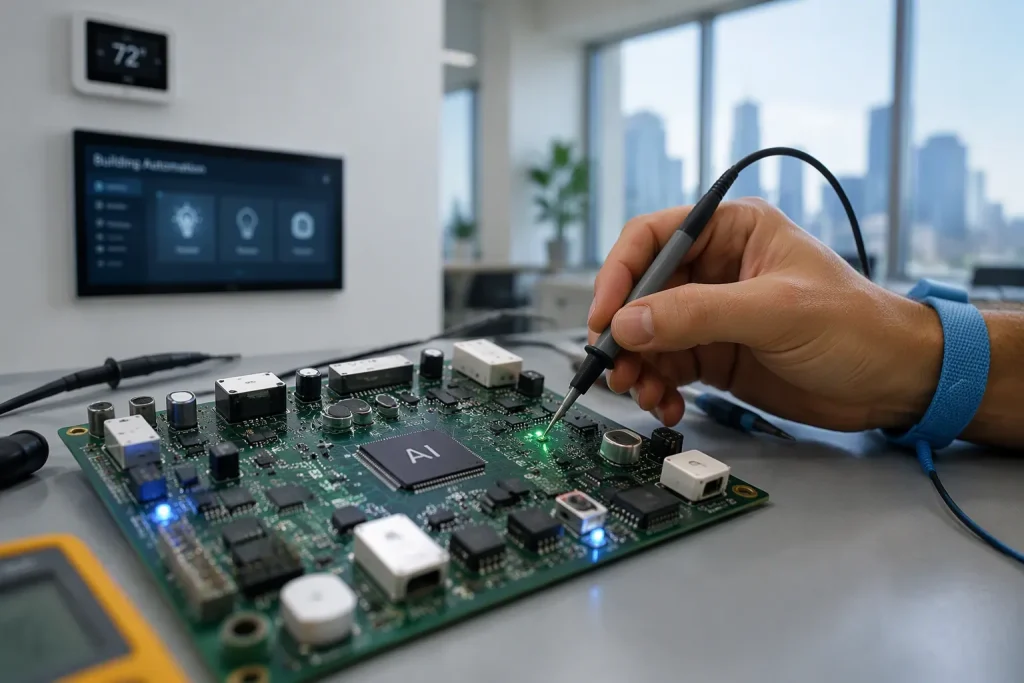
Low power AI PCBA assembly places machine learning and AI directly on sensors for smart building solutions. This real-time monitoring approach cuts cloud costs and latency while preserving privacy. Studies show facilities using real-time monitoring achieve 10% to 30% energy savings with payback under one year. Embedded systems in these PCBs require careful PCB design and microcontroller or FPGA selection. These embedded systems also need proper wireless protocol choices. This article covers low-power design, wireless protocols, and sensor mass production testing for AI sensor PCBA. Advanced sensors enable predictive maintenance, energy efficiency, and energy-efficient solutions through embedded product development.
Key Takeaways
On-device AI processing on sensor boards cuts cloud costs and protects privacy.
Sleep modes and duty cycling extend battery life for years in building sensors.
Choose wireless protocols like BLE, Zigbee, or Thread to match your building’s range and power needs.
Mass production testing with burn-in and calibration ensures sensors work reliably for years.
Smart buildings using these sensors save 10% to 45% on energy costs with faster payback.
What Is AI Sensor PCBA for Smart Buildings
Defining On-Device AI Sensor PCBA Assembly
An AI sensor PCBA integrates AI inference directly onto the sensor board. This design eliminates constant cloud connectivity. The board runs neural networks locally using a microcontroller or FPGA. A microcontroller handles simple classification tasks. An FPGA manages more complex inference workloads. Both options support real-time monitoring without sending raw data to the cloud.
This architecture differs from traditional designs. Traditional embedded systems stream all data to remote servers. On-device processing keeps sensitive information local. The board makes decisions in milliseconds. Latency drops significantly. Privacy improves because raw data never leaves the device.
A low power ai pcba combines several critical elements. The board includes advanced sensors, a processing unit, memory, and wireless communication. Each component must work within strict power budgets. Designers select parts that balance performance and consumption. Low power ai modules serve sensors, wearables, and embedded controllers. These modules need efficient on-device inference capabilities.
The assembly process requires precision. Manufacturers place components on a compact pcb. They solder fine-pitch parts using surface-mount technology. Testing verifies each board meets specifications. A well-built pcba delivers reliable performance across years of operation.
Why Low Power Matters for Building Sensors
Low power design extends battery life dramatically. A sensor running on a coin cell can operate for years instead of months. Reduced power consumption also lowers heat generation. Less heat means fewer thermal management problems. Buildings save on energy costs when thousands of sensors draw minimal power.
Consider a commercial building with hundreds of sensors. Each sensor consumes standby power continuously. Even small reductions multiply across the entire deployment. Facility managers track these savings closely. Energy efficiency becomes a measurable return on investment.
Typical building sensors fall into three categories. Environmental sensors track temperature, humidity, and air quality. AI people-flow detectors count occupants and analyze movement patterns. Energy management gateways aggregate data from multiple sources. All three types benefit from low-power operation.
Embedded systems in these devices face unique constraints. They must operate reliably for years without maintenance. They must handle varying environmental conditions. They must communicate over wireless networks. Embedded designers address these challenges through careful component selection.
Advanced sensors now include processing capabilities. These sensors perform inference at the edge. They reduce data transmission requirements. They enable faster response times. Embedded systems architects increasingly favor this approach.
The building sector demands long-term reliability. Maintenance costs for battery replacement add up quickly. Sensors mounted in ceilings or walls are hard to reach. Low power design directly addresses this pain point. It reduces the frequency of physical intervention.
Power consumption affects system design choices. A sensor with high standby draw needs larger batteries. Larger batteries increase size and cost. They also complicate installation. Low power components solve these problems at the source.
Embedded developers prioritize sleep modes and duty cycling. A sensor wakes briefly to take readings. It processes data locally. It transmits only relevant information. Then it returns to sleep. This pattern minimizes average power consumption.
The pcb design also influences power efficiency. Proper grounding reduces noise. Careful layout minimizes parasitic losses. Good pcb design practices extend battery life. They also improve signal integrity in compact modules.
Building owners increasingly demand sustainable solutions. Low power sensors align with green building certifications. They reduce operational carbon footprints. They support energy efficiency goals. The market rewards products that deliver these benefits.
Low Power AI PCBA Design and Signal Integrity
Low-Power Power Design for AI Sensor Boards
Engineers apply sleep modes and duty cycling to cut average current draw. A sensor wakes briefly, samples data, runs inference, then returns to sleep. Efficient voltage regulation keeps conversion losses low. A microcontroller handles simple classification tasks, while an fpga manages heavier inference workloads. Both parts support low power ai pcba architectures that extend battery life across thousands of deployed units.
Low power ai modules serve sensors, wearables, and embedded controllers. These modules need efficient on-device inference. Designers select components that balance performance against consumption. A low power ai pcba also reduces heat, which lowers thermal stress on nearby sensors and actuators. Facility managers benefit from fewer battery replacements and lower maintenance costs.
Signal Integrity in Compact Low Power AI Modules
Compact boards create signal integrity challenges. Fast switching digital lines couple noise into sensitive analog nets. Careful pcb design solves these problems. A solid ground plane under analog sections provides low-impedance return paths. Partitioned analog and digital grounds with a single bridge block digital noise ingress. Guard traces shunt stray fields around sensitive nets. Differential signaling rejects common-mode noise through subtraction at receivers.
Simulation tools such as Keysight PathWave and Cadence Sigrity model transmission lines, via effects, and differential pairs. Eye diagrams quantify timing and amplitude margins. S-parameters measure reflections and insertion loss. Verification uses TDR for impedance discontinuities and VNA for S-parameters. Engineers correlate simulation with prototype measurements under realistic industrial conditions.
These techniques matter for embedded systems in smart buildings. A building with hundreds of monitoring points demands reliable data. Advanced sensors feed real-time occupancy and energy data to embedded controllers. Good pcb design and grounding preserve accuracy across every node. Embedded systems architects who invest in simulation close the design loop before production. That discipline supports energy efficiency goals and keeps monitoring networks stable over years of operation.
Wireless Protocols and Cloud Cost Reduction
Choosing Wireless Protocols for Low-Power AI Sensors
Engineers compare BLE, Zigbee, Thread, and low-power mesh networking for building deployments. Each protocol trades range, data rate, and power draw differently. BLE suits short-range sensor links with low duty cycles. Zigbee and Thread both target mesh topologies for building automation. Thread adds native IP support for simpler cloud integration.
Protocol | Typical Range | Power Profile | Best Fit |
|---|---|---|---|
BLE | Short | Very low | Wearables, proximity sensors |
Zigbee | Medium | Low | Lighting, HVAC sensors |
Thread | Medium | Low | IP-based building networks |
Mesh | Extended | Low | Large sensor fleets |
Low-power mesh networking extends range across a building. Each node relays data for neighbors. This approach stretches battery life for sensors and smart switches. A microcontroller manages radio scheduling. An fpga handles protocol acceleration when needed.
How On-Device AI Cuts Cloud Costs
On-device AI reduces cloud computing costs by handling inference locally. The board processes raw data and transmits only results. This cuts bandwidth and storage expenses. A low power ai pcba performs classification without streaming video or audio. Low power ai modules deliver efficient on-device inference for embedded controllers.
Embedded systems architects measure savings across thousands of nodes. Embedded designs that filter data locally send fewer messages. Embedded processing lowers server loads. Embedded intelligence reduces network traffic. Embedded logic keeps sensitive data on site. Embedded platforms support real-time decisions. Embedded hardware cuts recurring cloud fees. Embedded solutions scale without proportional cost growth. Embedded teams deploy faster with less infrastructure. Embedded monitoring networks run leaner. Embedded sensor fleets report summaries instead of raw feeds. This architecture supports energy efficiency goals. It also improves monitoring reliability. A well-designed pcb and pcba enable these gains. Careful pcb layout preserves signal quality. Good pcb grounding supports stable radio performance. The pcb assembly process ensures consistent behavior across every unit.
AI Sensor Applications in Smart Buildings
Energy Monitoring and Environmental Sensing
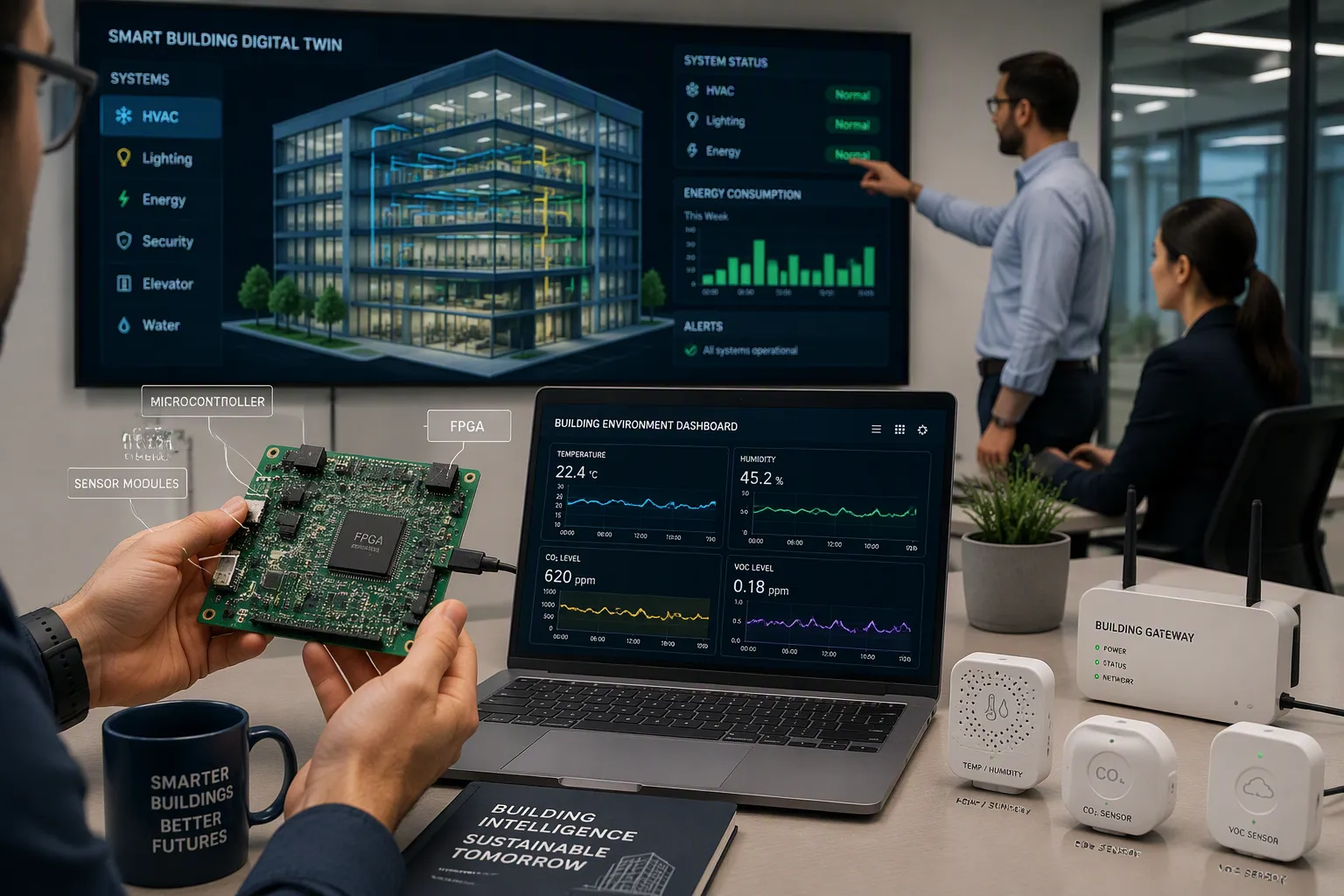
Energy management gateways collect data from environmental sensors to optimize building operations. These embedded systems monitor temperature, humidity, CO₂, and volatile organic compounds (VOCs) in occupied zones. A microcontroller on each sensor board processes local readings. An fpga handles heavier inference when required. The system adjusts HVAC output and lighting based on current conditions. This method reduces wasted energy while sustaining occupant comfort.
Location | Sensor Deployment | IAQ Metrics Monitored | Reported Improvements/Outcomes |
|---|---|---|---|
Hong Kong Polytechnic University | Milesight AM307 IAQ sensors + UG65 gateway, integrated with digital twin | Temperature, humidity, CO₂, VOCs | Real-time spatiotemporal IEQ data delivered to improve occupant health, wellbeing, and building sustainability |
Isle of Man schools | Milesight AM107 IAQ sensors (upgraded to AM307) | CO₂ and related IAQ metrics | Enabled effective review of school environments and informed future education infrastructure planning; supported COVID-19 spread prevention and student concentration |
Harford Community College (Maryland, USA) | Indoor air quality monitoring system across 24 buildings (~372,525 sq ft) | IAQ metrics (CO₂, VOCs, etc.) | Obtained verifiable data demonstrating IAQ maintained at safe levels for all stakeholders |
Abu Dhabi university (with ADEEB) | 100 VS121 AI Workplace Occupancy Sensors, 50 AM103 3-in-1 IAQ Sensors, multiple LoRaWAN gateways | Occupancy and IAQ (including CO₂ and VOCs) | Enabled facility managers to adjust HVAC systems efficiently, reduce energy waste, and ensure comfort for students and staff |
These deployments depend on embedded systems for reliable real-time monitoring. Each sensor performs processing locally before transmitting results. An embedded controller schedules communication timing. These embedded systems accelerate protocol tasks as needed. The pcba design guarantees consistent performance across many units. This structure supports energy efficiency goals without reducing data quality. Advanced sensors in these networks provide stable readings over years. Embedded engineers select components that balance power with accuracy. Good monitoring networks rely on proper pcb layout and grounding methods. All embedded systems in the network create the foundation for modern smart building solutions. Additional embedded systems handle data aggregation at each gateway point.
AI People-Flow Detection and Security
AI people-flow detectors analyze occupancy patterns across commercial buildings. These embedded systems count individuals and monitor movement without storing identifiable images. An fpga processes neural network models directly on the board. The system outputs anonymous counts for space utilization reports. Facility managers use this data to adjust cleaning schedules, desk allocations, and ventilation rates. Predictive maintenance algorithms detect equipment usage trends before failures occur.
These sensors run under strict power budgets. A sensor wakes briefly to capture data. It performs inference locally using machine learning and ai models. It transmits only the occupant count. Then it returns to sleep mode. This cycle extends battery life for years. This method reduces cloud costs by avoiding raw data streaming. Embedded controllers manage the entire process. An fpga handles the computational workload well. The board design supports stable wireless communication across mesh networks. Many embedded systems in this environment operate continuously for years without intervention.
Security stays essential for smart building solutions. A cybersecure framework guards against IoT-related cyberattacks. Each sensor authenticates before network access. Data encryption stops interception during transmission. Firmware updates travel over secured channels. Embedded systems architects integrate these protections at the board level. Monitoring networks that follow this framework maintain data integrity across all nodes. Sensors and actuators in the network benefit from layered security. These embedded systems maintain alignment with industry privacy standards.
The combination of people-flow detection and energy monitoring cuts overall energy use. Facilities adjust lighting and HVAC based on actual occupancy rather than fixed schedules. Maintenance teams receive warnings before equipment breaks. These smart building solutions provide measurable returns through lower bills and extended asset life. Embedded processing keeps all sensitive data on the device. No video or audio stream leaves the sensor. This design meets privacy rules while enabling intelligent automation.
Mass Production Testing and Real-World Deployment
Sensor Product Mass Production Testing Strategies
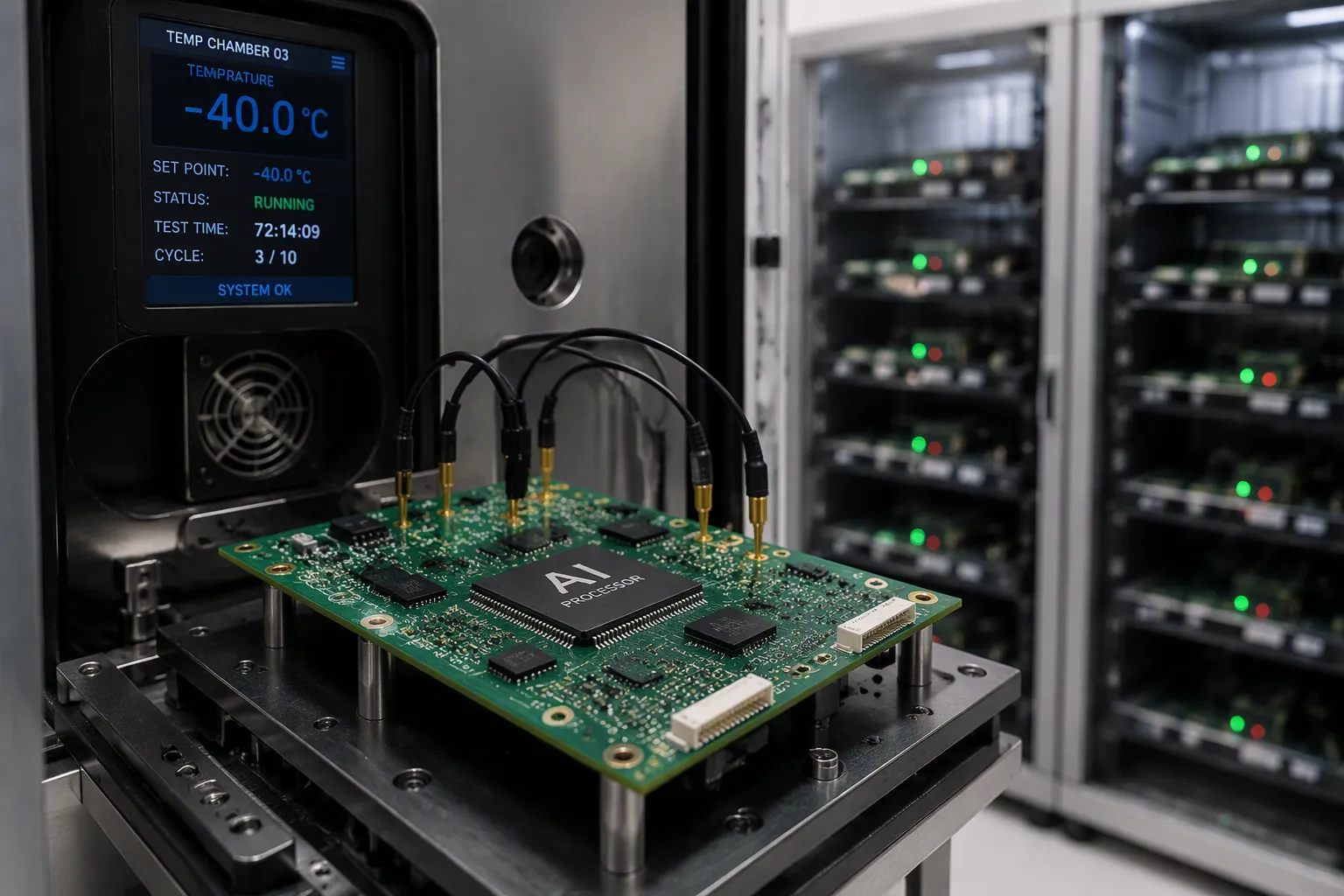
Mass production testing for an ai sensor pcba (ai sensor pcba: 1) involves three phases. Functional testing confirms each board operates correctly under standard conditions. Calibration adjusts sensor (sensor: 1) outputs to match known reference values. Burn-in stresses boards at elevated temperatures to expose latent defects before shipment. These steps prevent field failures and reduce costly returns.
Burn-in durations and conditions follow established industry standards across application domains. The following table summarizes recommended parameters:
Application | Temperature Range | Duration | Primary Defects Targeted |
|---|---|---|---|
Consumer Electronics | 90–125°C | 8–48 hours | Solder joints, capacitors, micro-cracks |
Industrial Equipment | 100–135°C | 24–48 hours | Thermal fatigue, insulation degradation |
Automotive | 125–150°C | 48–120 hours | Electromigration, delamination |
Aerospace / Defense | 125–150°C+ | 48–168 hours | All latent defects; highest safety margin |
These durations derive from Arrhenius-based acceleration factors that simulate 1,000 to 10,000 hours of field use. Key standards include JEDEC JESD22-A108 for temperature bias life, MIL-STD-883 for high-reliability microelectronics, and AEC-Q100 for automotive-grade stress testing.
Embedded systems (embedded systems: 1) on each board undergo dynamic burn-in. A microcontroller (microcontroller: 1) operates at full load while an fpga (fpga: 1) runs inference tasks continuously. This process reveals thermal or electrical overstress failures. Temperature cycling combined with burn-in tests resilience against repeated expansion and contraction. High-temperature operating life (HTOL) verifies long-term reliability for active components.
Proper pcb (pcb: 1) design supports testability directly. Designers place test points on every critical signal node. Fixtures contact these points rapidly during production, enabling fast verification. Careful pcb design (pcb design: 1) and grounding preserve signal integrity throughout the testing process.
Case Study: Deploying Low-Power Ai Sensors
A commercial building (building: 1) deployed low-power sensors (sensors: 1) across its facility. The installation covered meeting rooms, shared spaces, and open work areas. Each sensor board integrated a microcontroller (microcontroller: 2) for local processing and an fpga (fpga: 2) for neural network inference. The system collected occupancy data without transmitting raw video.
After one year, the results demonstrated clear returns. The following table summarizes the measured outcomes:
Metric | Value |
|---|---|
Annual energy (energy: 1) savings | 45% |
Yearly energy (energy: 2) cost savings | $46,000 |
Employee satisfaction increase | 83% |
Meeting/shared space utilization | Up to 100% |
These outcomes came from real-time monitoring (real-time monitoring: 1) of occupancy patterns. Facility managers used the data to adjust HVAC schedules and cleaning rotations. The building ran more efficiently (efficiency: 1) without sacrificing comfort.
Embedded systems (embedded systems: 2) in each sensor (sensor: 2) processed data locally. Boards transmitted only anonymous occupancy counts. This approach reduced cloud computing costs and preserved occupant privacy. Embedded (embedded: 1) controllers managed sleep and wake cycles to extend battery life. Embedded (embedded: 2) platforms supported low-power mesh networking across every floor. Embedded (embedded: 3) product development (embedded product development: 1) balanced inference performance with strict power budgets.
The deployment showed that edge ai (ai: 1) enables mission-critical applications for low-power IoT devices. Embedded systems (embedded systems: 3) architects who design for manufacturability ensure consistent quality at scale. Sensors (sensors: 2) and actuators (sensors and actuators: 1) across the network benefit from rigorous validation. This combination of testing and real-world deployment drives measurable, long-term returns for facility owners. Embedded (embedded: 4) systems (embedded systems: 4) engineers also apply these methods to improve reliability further. Embedded (embedded: 5) controllers handle communication timing precisely. Embedded (embedded: 6) platforms support firmware updates over secured channels. Embedded (embedded: 7) product teams iterate on designs based on field data. Embedded (embedded: 8) solutions scale without proportional cost growth. Embedded (embedded: 9) monitoring networks run leaner and last longer. Embedded (embedded: 10) processing keeps all sensitive data on the device.
Sensors (sensors: 3) in the network also support predictive maintenance (predictive maintenance: 1) alerts. Facility teams receive warnings before equipment fails. This reduces downtime and extends asset life. The system tracks energy (energy: 3) consumption across zones for ongoing optimization. Managers review energy (energy: 4) reports weekly to identify waste. Energy (energy: 5) efficiency (energy efficiency: 1) improves steadily through data-driven adjustments. Regular maintenance (maintenance: 1) checks ensure each sensor continues operating within specification. Efficiency (efficiency: 2) gains compound over time across hundreds of deployed units.
Sensors (sensors: 4) communicate through low-power mesh networking. Sensors (sensors: 5) relay data for neighbors to extend range. Sensors (sensors: 6) operate on coin cells for years without replacement. Sensors (sensors: 7) wake briefly, sample, infer, and return to sleep. Sensors (sensors: 8) transmit only relevant results, not raw feeds. Sensors (sensors: 9) support both environmental and occupancy tracking. Sensors (sensors: 10) form the backbone of modern smart building solutions.
The pcba (pcba: 1) design and assembly processes ensure consistent behavior across every unit. Each pcba (pcba: 2) undergoes the same rigorous burn-in and calibration before leaving the factory.
Embedded systems (embedded systems: 5) in this deployment handled data locally. Embedded systems (embedded systems: 6) managed power states to extend runtime. Embedded systems (embedded systems: 7) supported reliable wireless communication. Embedded systems (embedded systems: 8) processed inference at the edge. Embedded systems (embedded systems: 9) enabled real-time (real-time: 1) decisions without cloud dependency. Embedded systems (embedded systems: 10) delivered the reliability that mission-critical applications demand.
The pcb (pcb: 2) layout and grounding methods preserved signal quality across the network. Careful pcb (pcb: 3) design minimized parasitic losses. Good pcb (pcb: 4) practice extended battery life for every node. Each pcb (pcb: 5) assembly met the same high standard through automated optical inspection and functional testing. An fpga (fpga: 3) handled heavier inference workloads when needed. Another fpga (fpga: 4) managed protocol acceleration for mesh communication. The primary fpga (fpga: 5) processed neural network models directly on the sensor board.
Low-power on-device AI sensor PCBA assembly unlocks scalable, efficient smart buildings through real-time edge intelligence. Embedded sensors cut cloud costs, lower power consumption, and improve signal integrity. Embedded designers select flexible wireless protocols for each deployment. Embedded processing strengthens privacy and security. Embedded systems architects should consider on-device AI sensor PCBAs for their next project. Embedded solutions prove practical for mass production. Embedded teams achieve consistent quality across every PCB. Embedded monitoring networks run leaner and last longer. Embedded intelligence keeps sensitive data on the device. Each PCB assembly supports years of reliable operation. Energy efficiency improves through local inference. Energy costs drop as cloud dependency shrinks. A building gains measurable returns from edge AI. Sensors wake briefly, infer locally, and transmit only results. Sensors extend battery life across thousands of nodes. Sensors reduce maintenance costs over time. Sensors support predictive maintenance alerts. Sensors enable occupancy analytics without raw data streams. Sensors form the backbone of modern smart infrastructure. Sensors deliver the reliability that mission-critical applications demand.
FAQ
How does on-device AI reduce cloud costs for building operators?
The board runs inference locally and transmits only results. This cuts bandwidth and storage expenses across thousands of nodes. A commercial deployment reported 45% annual energy savings and $46,000 in yearly cost savings. Embedded processing keeps sensitive data on site and lowers recurring cloud fees.
Why does standby power consumption matter for large sensor fleets?
Hundreds of sensors draw standby power continuously. Even small reductions multiply across a deployment. Low power design extends battery life and lowers heat generation. Facility managers avoid frequent battery replacements in hard-to-reach ceiling or wall mounts. Embedded controllers manage sleep and wake cycles precisely.
Which wireless protocol suits a low-power AI sensor network?
Engineers compare BLE, Zigbee, Thread, and low-power mesh networking. BLE fits short-range links with low duty cycles. Zigbee and Thread target mesh topologies for building automation. Thread adds native IP support. Embedded platforms schedule radio timing to stretch battery life across smart switches and sensors.
How does Bonysn support stable mass delivery for AI sensor PCBAs?
Bonysn supports low-power component procurement, power PCB fabrication, SMT assembly, and testing. Each board undergoes functional testing, calibration, and burn-in per JEDEC JESD22-A108 and MIL-STD-883. Embedded systems architects gain continuous supply and consistent quality across every unit.
What testing proves reliability before field deployment?
Functional testing confirms standard operation. Calibration matches sensor outputs to reference values. Burn-in stresses boards at elevated temperatures to expose latent defects. Standards such as JEDEC JESD22-A108, MIL-STD-883, and AEC-Q100 guide these steps. Embedded designs that pass this regime deliver real-time decisions for years.
See Also
Intelligent Building PCBA Solutions For Malaysian Internet Of Things Firms
Artificial Intelligence Sensor PCBA For Swedish Industrial IoT And Power Equipment
OpenAI Style AI Companion Gadget PCB Design And Assembly Services
OpenAI Hardware Movement And Its Impact On Custom AI Device PCBA
AI Sensor PCBA For Netherlands Greenhouse And Semiconductor Manufacturing Equipment