
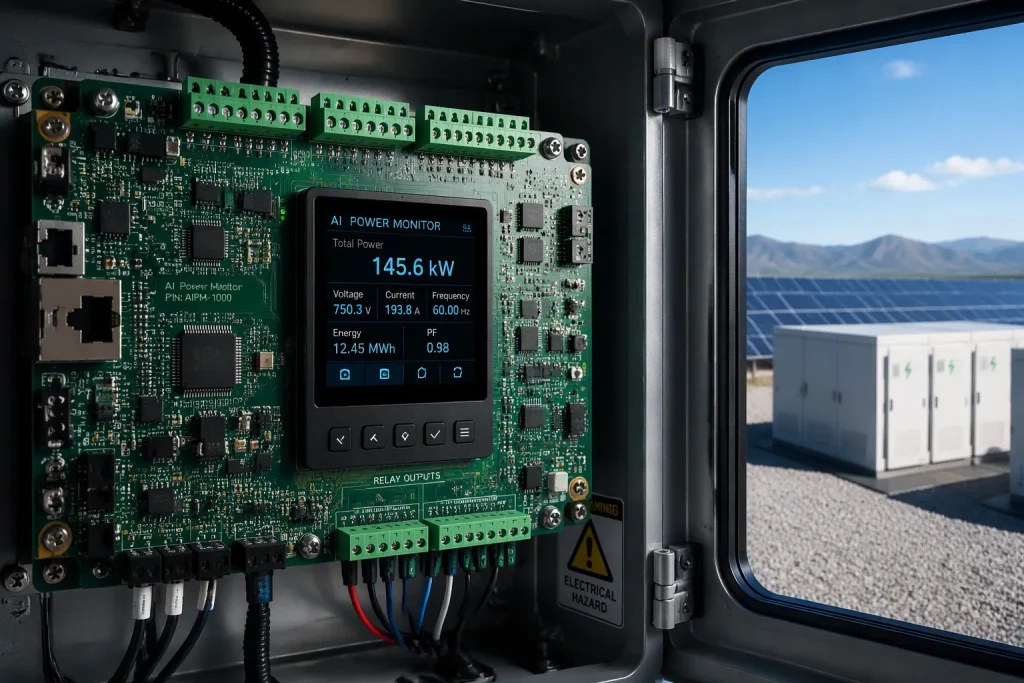
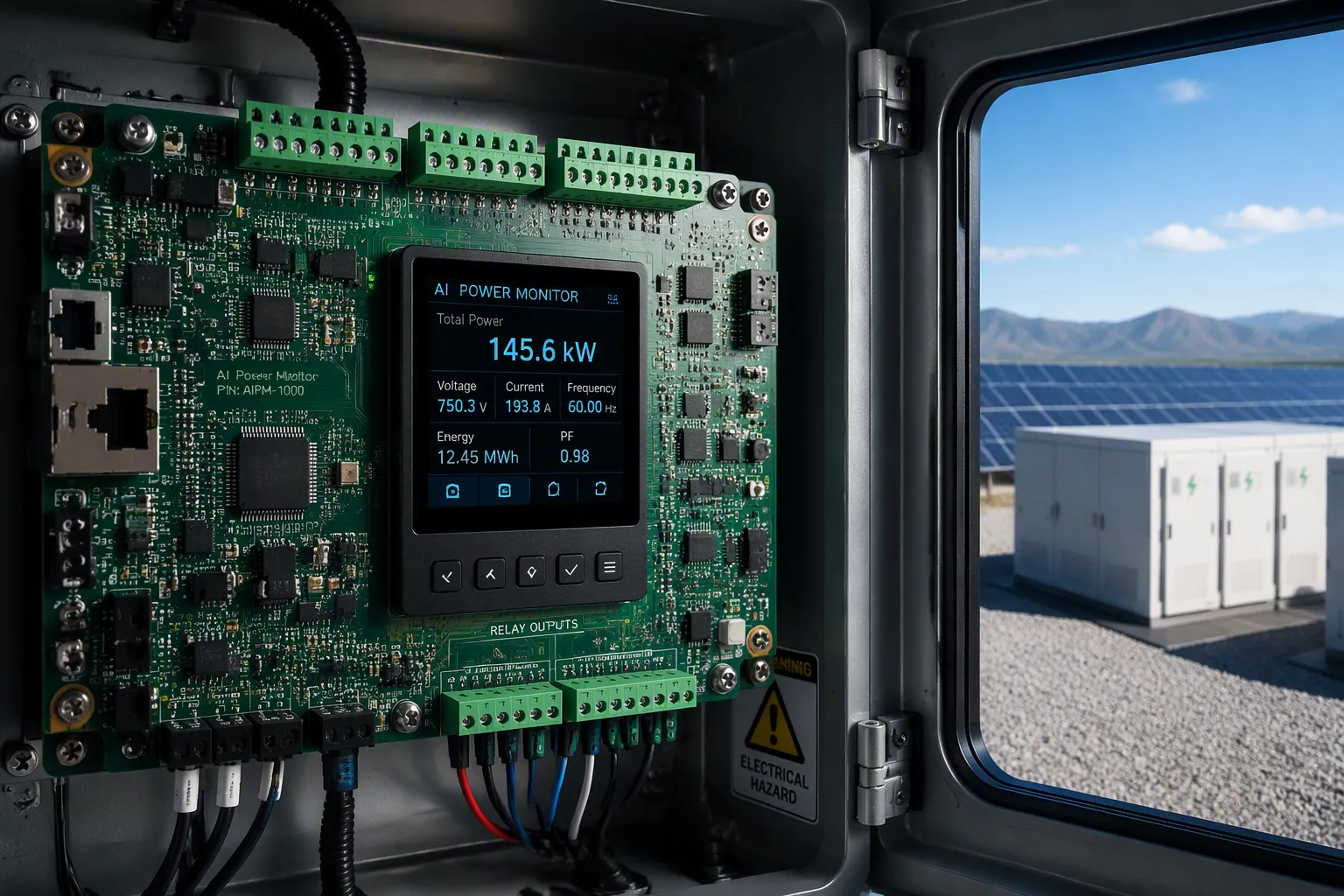
An AI energy monitoring PCBA is a printed circuit board assembly that uses artificial intelligence to track, analyse, and optimise power usage in real time. Remote AI hardware and energy storage systems often run off-grid. Poor power management there causes downtime and high maintenance costs. Three application types dominate this field: energy storage monitors, solar data collectors, and microgrid control boards. Consider a remote weather station on a mountain ridge. It harvests solar energy, stores charge in a battery, and reports data over a wireless link. An AI energy monitoring PCBA decides when to sample, transmit, and sleep. That decision protects the battery and keeps the station online through cloudy weeks.
Key Takeaways
AI energy monitoring PCBA tracks power use in real time. It keeps remote sites running without frequent maintenance.
The board predicts power needs and adjusts charging. This extends battery life and reduces downtime.
Thick copper and high TG materials handle high currents and heat. They make the board reliable in harsh conditions.
The board works with battery management systems. It balances cells and detects problems early.
One design scales from small sensors to microgrids. This saves money and supports future growth.
What Is an AI Energy Monitoring PCBA?
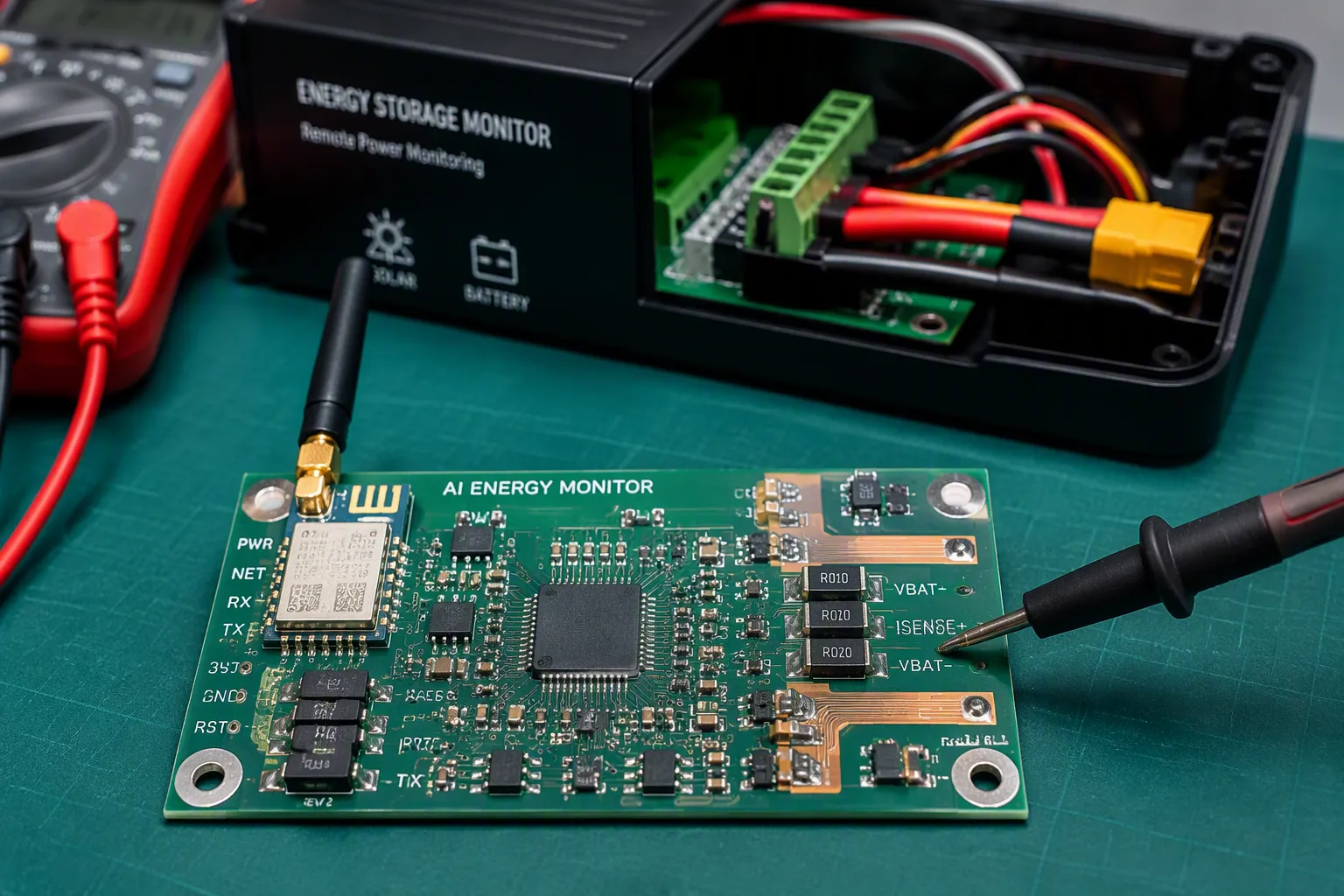
An AI energy monitoring PCBA integrates sensors, wireless modules, and AI processing units into a single assembly. This compact board does more than measure power. It interprets the data, predicts future demand, and adjusts operation without human input. Energy storage monitors and solar data collectors rely on this hardware to keep remote systems running.
Hardware Architecture and Core Components
The board combines several functional blocks on one substrate. Current shunts and voltage dividers form the sensing front end. A microcontroller or edge AI accelerator handles computation. Wireless modules provide connectivity through cellular, LoRa, or Wi-Fi links. Power conversion circuitry manages charging and distribution.
Bonysn builds these boards with thick copper PCB layers for high-current paths. Copper thickness reaches 3 oz or higher on power planes. This design reduces resistive heating and handles surge currents from motor loads or battery switching. High TG board material resists thermal degradation during soldering and long-term operation. The glass transition temperature exceeds 170 degrees Celsius, which keeps the laminate stable under repeated thermal cycling. High current soldering techniques ensure joints withstand continuous currents without fatigue cracking.
These manufacturing choices matter for energy storage monitors and solar data collectors. A remote installation may operate for years without service. The board must survive temperature swings, vibration, and humidity. IPC-A-610 Class 2 and IPC-6012 provide the acceptance criteria for such assemblies. Bonysn follows these standards to maintain consistent quality across production runs.
Current and Voltage Sampling
Real-time sampling forms the foundation of every power decision. The board measures current through shunt resistors or Hall-effect sensors. Voltage dividers or isolated amplifiers capture bus and battery voltages. An analogue-to-digital converter digitises these signals at rates from a few samples per second to several thousand, depending on the application.
AI algorithms then analyse the sampled data. They look for patterns that indicate battery degradation, panel soiling, or impending load spikes. A solar data collector might notice a gradual drop in panel output. The algorithm compares this trend against historical weather data. It then adjusts the charge controller settings or flags the anomaly for maintenance.
Predictive adjustments happen continuously. The AI energy monitoring PCBA can shift load between battery banks, reduce transmission power during low-charge periods, or trigger a safe shutdown before damage occurs. These actions extend battery life and reduce downtime at remote sites.
The combination of robust hardware and intelligent sampling creates a board that manages power autonomously. Energy storage monitors benefit from accurate state-of-charge estimation. Solar data collectors gain from maximum power point tracking that adapts to changing conditions. Microgrid control boards use the same architecture to balance multiple generation sources.
Powering Remote AI Hardware
Energy Harvesting and Distribution
Remote installations must gather, store, and deliver power without a technician on site. An AI energy monitoring PCBA coordinates this cycle automatically. Solar panels or small wind turbines feed a charge controller. The board tracks input voltage and current, then routes energy to a battery bank or directly to the load. When generation drops, the board reduces transmission power and puts idle circuits to sleep.
A remote weather station on a mountain ridge illustrates the process. The station wakes at intervals, samples its sensors, and transmits a data burst. The board decides the optimal moment for each action. It waits for sufficient charge and avoids deep discharge. A telecom tower follows a similar pattern on a larger scale. It balances rectifier output, battery reserve, and radio load through the day. Both sites operate for months with minimal human intervention.
Thick Copper PCB and Thermal Management
High-current paths demand conductors with a large cross-sectional area. Copper traces of this kind carry lower resistance, which reduces power loss and heat generation. For circuits above 10 amps, the industry recommends 3–4 oz/ft² copper. Heavy copper layers also spread heat laterally across the board. This lateral spreading prevents hotspots and protects sensitive components nearby.
The thermal benefit is measurable. A 3 oz/ft² copper layer reduces thermal resistance by roughly 15 per cent compared with a standard 1 oz/ft² layer. Thick copper in the 2–4 oz/ft² range increases thermal mass and conductivity. Designers combine these layers with thermal via arrays and copper pours. The result is a board that survives continuous high-current operation at a remote site. A telecom tower in a hot climate depends on this thermal design. The AI energy monitoring PCBA inside it manages rectifier load and battery charging through peak afternoon demand. Heat leaves the power stage efficiently, so the assembly avoids derating and keeps the site online.
Battery Management PCB Assembly Integration
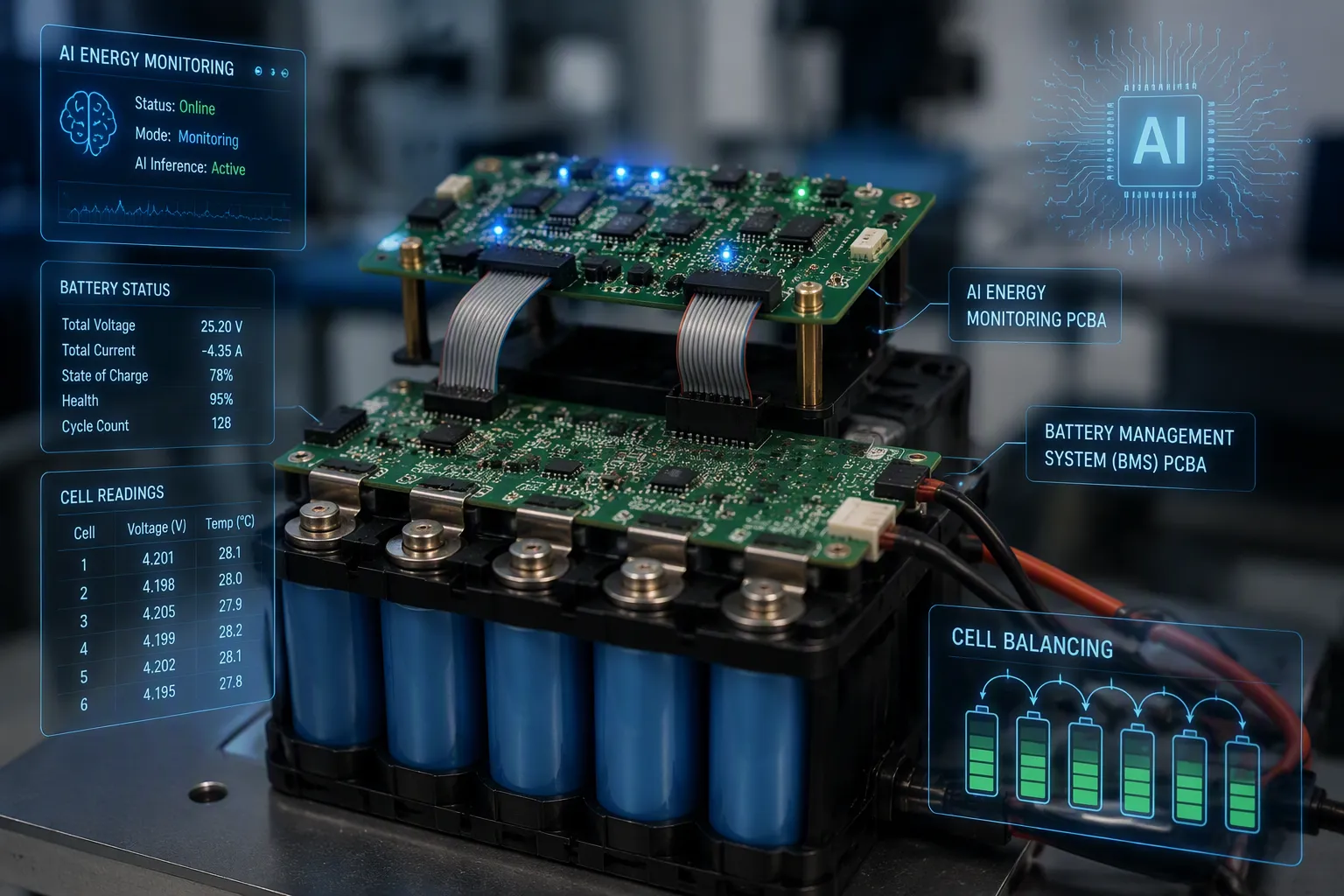
A battery pack alone cannot protect itself. The AI energy monitoring PCBA acts as the supervisory layer above the battery management PCB assembly. It reads cell voltages, temperatures, and current draw, then instructs the management board on how to charge and discharge each cell group. This division of labour keeps decisions fast and local.
Charge Balancing and Anomaly Detection
Multi-cell packs drift apart over time. One cell accepts charge faster than its neighbours. Without correction, the weakest cell limits the whole string. The AI energy monitoring PCBA applies balancing algorithms to correct this drift. Passive balancing burns excess charge through switched resistors. Active methods move charge between cells with capacitors, inductors, or transformers. The table below compares the common approaches.
Balancing Type | Algorithm / Method | Description |
|---|---|---|
Passive | Switched resistor | Dissipates excess charge as heat using resistors. |
Active | Capacitor-based (switched capacitor) | Alternately connects capacitor to cells to transfer charge; compact but slower. |
Active | Inductor/Transformer-based (buck-boost, Cuk, flyback) | Uses inductors/transformers to move charge between cells; high efficiency, scalable. |
Active | Topologies: direct cell-to-cell, adjacent cell-to-cell, multicell-to-multicell, hybrid cell-to-pack-to-cell | Various architectures for redistributing energy. |
Anomaly detection runs alongside balancing. The board watches for sudden voltage drops, rising internal resistance, and unusual temperature gradients. Edge AI executes machine learning inference directly on low-power hardware co-located with the battery pack. This approach eliminates round-trip cloud latency, which can reach hundreds of milliseconds, and removes the bandwidth demands of continuous sensor streaming. Edge AI therefore enables real-time decisions at sub-millisecond timescales, with full data privacy and operational resilience in connectivity-poor environments.
Communication between the two boards follows established interfaces and protocols. Battery management systems collect, process, and transmit performance data, diagnostic information, and status updates. Standardised protocols allow integration with charging infrastructure and cloud monitoring platforms. Bonysn applies conformal coating to these assemblies, which shields fine-pitch components from moisture and airborne contaminants at remote sites.
Surge Protection and Battery Life
Adaptive charging strategies extend battery life. The AI energy monitoring PCBA adjusts charge current and voltage according to cell age, temperature, and recent cycling history. A pack that has endured many partial cycles receives gentler charging than a fresh pack. This adaptive behaviour reduces stress on the weakest cells and slows capacity fade.
Surge protection guards the electronics against lightning-induced transients and load switching spikes. Metal oxide varistors, transient voltage suppression diodes, and series inductors divert or absorb these events before they reach sensitive circuitry. Thermal management works in parallel. Thick copper planes spread heat away from the power stage, and thermal vias carry heat to the opposite side of the board.
Microgrid control boards depend on this integration most heavily. They coordinate solar input, battery storage, and multiple loads. A single weak cell can destabilise the whole microgrid. Bonysn tests every assembly against IPC-A-610 Class 2 and IPC-6012 criteria before shipment, and IEC 62133 provides the safety framework for the battery packs these boards serve.
Benefits for Energy Storage and Remote Sites
Reduced Downtime and Costs
Remote sites pay dearly for every service visit. A telecom tower on a ridge or a weather station in a desert may sit hours from the nearest technician. An AI energy monitoring PCBA cuts those visits by keeping the power system inside safe limits. It samples current and voltage continuously, then acts before a fault becomes a failure. The board sheds non-critical loads when charge runs low. It restores them once generation recovers. This behaviour protects the battery and keeps the site online.
AI forecasting sharpens the same decisions. The board studies weather patterns and load history, then predicts how much solar energy the next day will deliver. It charges the battery fully before a forecast of heavy cloud. It delays non-urgent transmissions when generation looks weak. Where a site draws from a grid with time-of-use tariffs, the board shifts discharge into expensive peak hours and recharges during cheap ones. Operators report fewer emergency call-outs and longer intervals between battery replacements. The table below shows how copper weight, a Bonysn design choice, affects thermal performance.
Copper Weight | Relative Thermal Resistance | Suitability for High-Current Paths |
|---|---|---|
1 oz/ft² | Baseline | Light loads only |
3 oz/ft² | Roughly 15 per cent lower | Circuits above 10 amps |
Scalability for Off-Grid Sites
Off-grid deployments grow in steps. A single sensor becomes a cluster. A cluster becomes a microgrid. The same board architecture scales across all three. Low-power designs let wireless IIoT sensors run for years on a small cell, because the board sleeps between samples and wakes only to transmit. At the other end, microgrid control boards coordinate solar input, battery storage, and multiple loads from one platform.
Market demand pushes in the same direction. Buyers want high current handling, stable sampling, remote communication, and long-term supply. They also face real pain points: high-voltage input, outdoor heat, and maintenance that is hard to reach. Thick copper planes and high TG laminate address the thermal side. Surge protection and conformal coating address the environmental side. Bonysn builds every assembly to IPC-A-610 Class 2 and IPC-6012, and the battery packs these boards serve follow IEC 62133. A site that meets those standards today can add capacity tomorrow without redesigning its power stage.
An AI energy monitoring PCBA unites real-time sampling, thick copper PCB design, surge protection, and thermal management on one intelligent board. It powers remote AI hardware and works with battery management PCB assembly to extend battery life and cut downtime. This technology now forms the foundation for autonomous energy infrastructure. Self-managing power systems are becoming the norm for energy storage, solar data collection, and microgrid control. As demand grows, this architecture scales across off-grid deployments and delivers lasting resilience.
FAQ
What problems does an AI energy monitoring PCBA solve at remote sites?
Remote sites lose power without warning. Batteries fail early. Maintenance visits cost heavily. An AI energy monitoring PCBA samples current and voltage continuously. It predicts demand and adjusts charging before faults occur. This behaviour reduces downtime and extends battery life at off-grid installations.
Why does Bonysn use thick copper and high TG material?
High-current paths generate heat. Thick copper spreads that heat and lowers resistance. High TG laminate resists thermal degradation during soldering and long-term operation. Bonysn builds every board to IPC-A-610 Class 2 and IPC-6012. These choices keep remote power systems stable for years.
How does the board work with battery management PCB assembly?
The AI energy monitoring PCBA supervises the battery management board. It reads cell voltages and temperatures. It applies balancing algorithms and adaptive charging. It detects anomalies before they become failures. Microgrid control boards rely on this integration to coordinate solar input, storage, and multiple loads safely.
Does conformal coating matter for outdoor deployments?
Moisture and airborne contaminants damage fine-pitch components. Conformal coating shields these parts at remote sites. Bonysn applies coating to every assembly. This protection supports long-term reliability where humidity, dust, and temperature swings are constant. IEC 62133 provides the safety framework for the battery packs these boards serve.
Can one board design scale from a small sensor to a microgrid?
Yes. Low-power designs let wireless IIoT sensors run for years on a small cell. The same architecture scales to microgrid control boards. Buyers want high current handling, stable sampling, and remote communication. Thick copper planes and surge protection address these needs without redesigning the power stage.
See Also
AI Server Power PCBA for Australian Data Centre and Energy Schemes
High Amperage Power Distribution Board for Australian AI Server Initiatives
Cold Climate AI Server PCBA for Canadian Remote Mining Locations
Durable Artificial Intelligence PCBA for Australian Mining and Energy Systems
Robust AI PCBA for Norwegian Marine and Energy Monitoring Equipment