


Electronic systems now power patient monitors, laboratory controllers, and automated pharmaceutical tracking equipment. Each of these devices depends on the reliability of its internal printed circuit board assembly. A single point of failure on a pcba can lead to misdiagnosis, incorrect drug dosing, or costly operational downtime in a laboratory.
The journey from concept to compliant medical device technology is complex. You must navigate stringent requirements from regulatory bodies such as the FDA and ISO. You must design for safety and reliability amid increasing miniaturisation. You must also build a supply chain that manages component obsolescence and ensures long-term reliability.
This article serves as a practical guide. It outlines key considerations for successful medtech pcba assembly, covering medical pcb solutions, turnkey pcb assembly, and medical device pcb assembly. You will learn how to approach medical pcb assembly with confidence, ensuring your devices meet the highest standards of quality and performance.
Key Takeaways
Embed regulatory compliance into every stage of your medical device project, not just the final checklist.
Design for safety and miniaturisation by selecting high-reliability components and managing thermal and signal integrity challenges.
Choose the right assembly technology (SMT, THT, or hybrid) and enforce rigorous cleanliness and testing protocols to ensure reliability.
Build a resilient supply chain by diversifying suppliers, managing component obsolescence, and selecting an EMS partner with strong certifications and proactive lifecycle monitoring.
Navigating Regulatory Compliance for Medical Devices
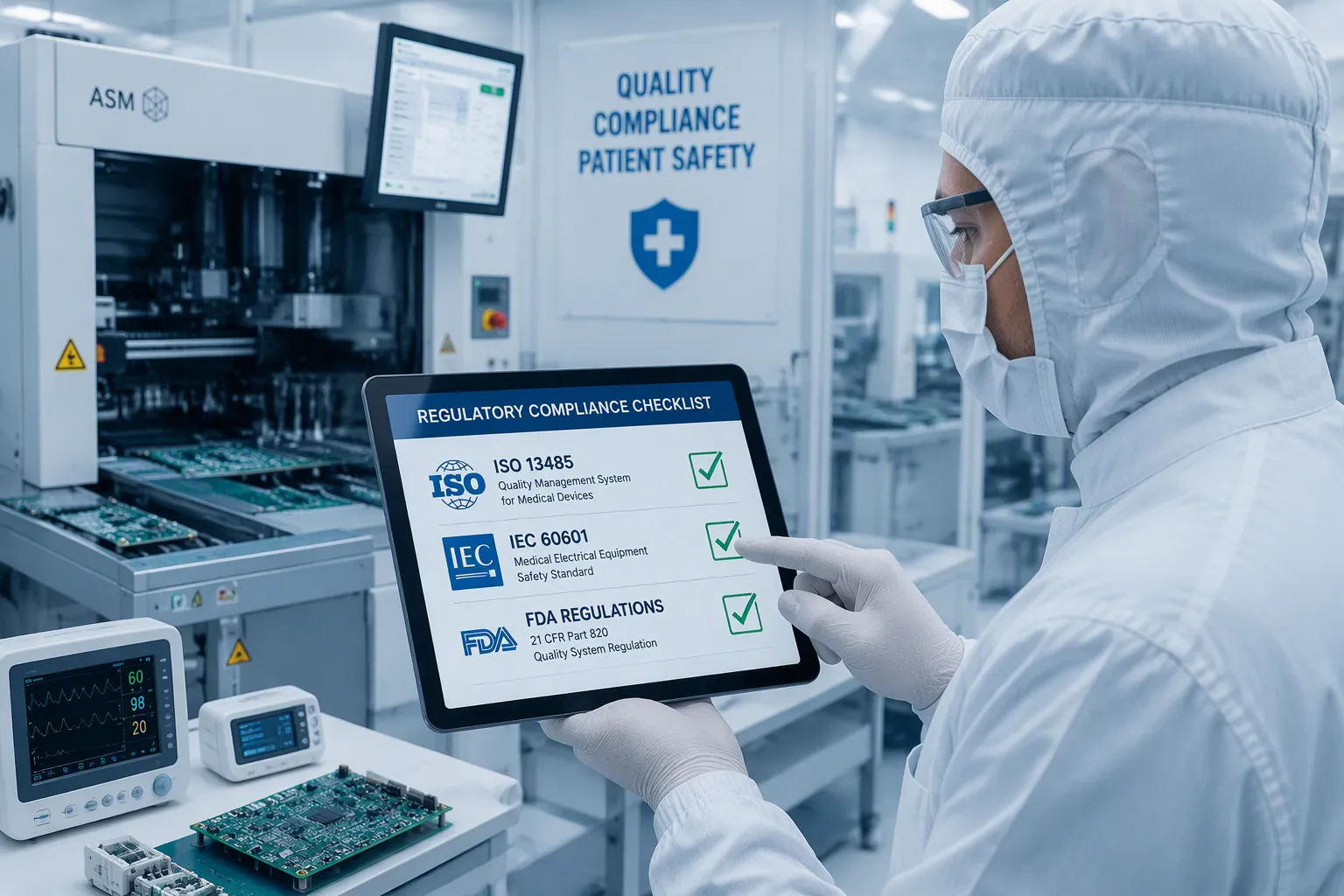
Regulatory compliance forms the backbone of every successful medtech pcba assembly project. You cannot treat it as an afterthought or a final checklist item. Instead, you must embed compliance into every stage of your product lifecycle, from initial concept through to post-market surveillance. The consequences of non-compliance extend beyond financial penalties. They include product recalls, reputational damage, and most critically, patient harm.
Key Standards and Regulatory Agency Requirements
Several core standards govern medical pcb assembly. ISO 13485 establishes the framework for your quality management system. This certification mandates strict risk management procedures and requires rigorous inspection and traceability protocols, particularly for implantable devices. Unlike ISO 9001, ISO 13485 demands validation processes that go far beyond general quality assurance. For PCB suppliers serving medical device manufacturers, this certification is not optional. It is a mandatory prerequisite for market access.
IEC 60601 addresses electrical safety for medical electrical equipment. This standard examines potential hazards such as leakage currents, electromagnetic interference, and protection against electric shock. Your pcb assembly must demonstrate compliance with these safety parameters through documented testing and design verification. FDA regulations add another layer of oversight for products sold in the United States. The FDA expects manufacturers to maintain comprehensive design history files and to follow current Good Manufacturing Practices throughout production.
Understanding regulatory agency requirements helps you anticipate what auditors will examine. They will review your component sourcing records, your assembly process controls, and your traceability documentation. They will verify that your medical pcb solutions meet the stated specifications for every batch produced. Market certification requirements vary by region, so you must research the specific regulations that apply to your target markets before you begin production.
ISO 13485 guarantees that PCB assembly manufacturers adhere to strict quality control and documentation procedures.
Implementing Risk Management per ISO 14971
ISO 14971 provides a systematic framework for managing risks throughout the life of your medical device. You must identify potential hazards, analyse their causes, and evaluate the probability of occurrence. This process informs your design decisions and your manufacturing controls. For example, if your device delivers medication, you must consider what happens if a component fails. You then implement safeguards to prevent that failure or to mitigate its consequences.
Your risk management activities must produce documented evidence. This documentation demonstrates to auditors that you have systematically addressed each identified hazard. You should maintain a risk management file that records every analysis, every mitigation measure, and every verification activity. This file becomes part of your submission for regulatory approval.
Compliance is not simply about passing a final test. It is a holistic approach that begins with design. You must consider regulatory standards during component selection, during layout planning, and during assembly process development. The DMAIC model—Define, Measure, Analyse, Improve, Control—offers a structured methodology for continuous process improvement. Applying this model helps you identify variations in your manufacturing process and implement corrective actions before they affect product quality.
Your medical device pcb assembly must also account for usability factors. Operators may use your equipment under stressful conditions. They may have varying levels of technical expertise. Your design should minimise the potential for operator error through clear labelling, intuitive interfaces, and fail-safe mechanisms. These considerations reduce overall risk and strengthen your compliance position.
Turnkey pcb assembly partners who understand these regulatory requirements can guide you through the complexities. They maintain the necessary certifications and documentation systems. They also stay current with evolving regulations, ensuring your products remain compliant as standards change. Choosing such a partner reduces your compliance burden and accelerates your path to market.
Design for Safety and Miniaturisation in PCBA
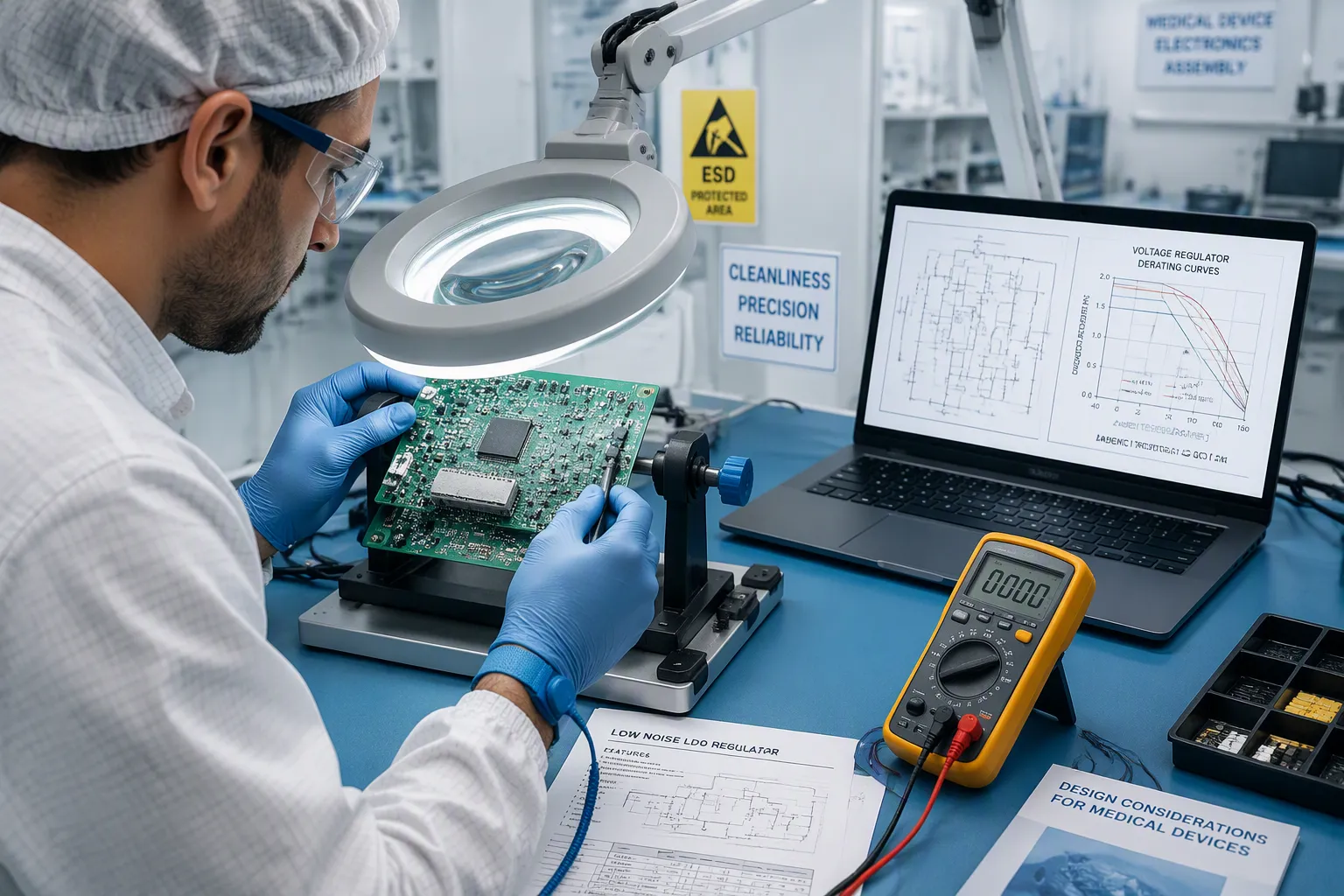
The design phase determines the safety of the product long before assembly begins. You must make deliberate choices about components, layout, and thermal behaviour. These decisions directly affect medical device safety and the long-term reliability of your equipment. A thoughtful design reduces risk and simplifies the path to regulatory compliance.
Component Selection for High-Reliability Applications
Component selection forms the foundation of high-reliability medical devices. You cannot rely on nominal ratings alone. Instead, you must base your choices on derating and thermal analysis. Derating means operating a component below its maximum rated stress to extend its service life. This practice protects against voltage spikes, current surges, and temperature excursions that might otherwise cause premature failure.
Your bill of materials must list approved manufacturer part numbers, critical characteristics, and allowed alternates. This documentation supports full traceability throughout production. Nominally similar parts can differ in tolerance, temperature grade, lifecycle, dielectric, firmware, noise, traceability, or qualification. Engineering and quality teams must approve any alternate part before placement. This approval process prevents subtle substitutions from compromising device performance.
Design margins must account for voltage, current, temperature, transients, contamination, and service life. Each factor contributes to the overall reliability equation. For implantable or wearable devices, miniaturisation intensifies these challenges. Smaller components generate more heat per unit area. Tighter spacing increases the risk of electrical interference. Your layout must address these constraints while maintaining signal integrity.
Every board is assembled under our ISO 9001:2015 quality system and inspected to IPC-A-610 workmanship standards. For medical and automotive customers we maintain the traceability and documentation your own quality system needs.
The following standards guide your design decisions for medical pcb assembly:
Standard | Relevance to Medical PCB Reliability |
|---|---|
IPC-2221 | Foundational design standard covering conductor spacing, trace width, via structures, and thermal management — critical for reliable medical device operation. |
IPC-6012 | Qualification and performance specification for rigid PCB fabrication, covering quality requirements by class (including Class 3 for high-reliability medical devices). |
IPC-A-610 | Most widely used inspection standard for assembled PCBs and solder joints, ensuring assembly quality. |
ISO 13485 | Quality management standard specifically for medical device supply chains with strict traceability requirements. |
These standards work together. IPC-2221 guides your initial layout. IPC-6012 defines fabrication quality. IPC-A-610 governs inspection of the finished assembly. ISO 13485 ensures your entire supply chain maintains the necessary documentation. Together, they form a comprehensive framework for medical pcb solutions.
Overcoming Thermal and Signal Integrity Challenges
Dense PCB layouts create significant thermal management problems. Heat must travel away from active components to prevent degradation. Passive techniques include heat sinks, heat pipes, and vapor chambers. Vapor chambers act as planar heat pipes. They spread heat in all directions and can measure less than 1mm thick. This makes them suitable for compact configurations. Phase change materials maintain a constant temperature during their transition, offering easy integration without requiring access to ambient air.
For high-performance medical equipment, passive solutions often prove insufficient. Active thermal management systems, such as custom fan and blower assemblies, pull cool air in and push heat away. These systems operate with programmable speed controls for smart operation. They remain compact and energy-efficient, integrating into equipment without adding excess weight. Diagnostic equipment like MRI machines and ultrasound systems benefit from this approach, as shrinking electronics generate more heat that must be actively managed.
Signal integrity presents another critical consideration. High-density layouts increase crosstalk between adjacent traces. Electromagnetic interference can corrupt sensitive measurement signals. Poor design can create electrical hazards or expose data security vulnerabilities. You must reference the risk categories from ISO 14971 when evaluating these threats. Proper grounding, shielding, and impedance control mitigate these risks.
Your layout should separate analogue and digital sections. Keep high-speed traces away from low-level sensor inputs. Use dedicated return paths to minimise ground loops. These practices preserve signal quality and reduce the likelihood of malfunction.
These design considerations directly influence the success of your medtech pcba assembly project. A partner offering turnkey pcb assembly can provide valuable guidance during this phase. They understand the requirements for medical device pcb assembly and can recommend proven strategies. Their experience helps you avoid common pitfalls and achieve a robust, manufacturable design. Ultimately, thoughtful design reduces risk, improves quality, and accelerates your journey to market.
Mastering Medical PCB Assembly and Testing Processes
The assembly and testing phase determines whether your design translates into a reliable medical device. Two fundamental decisions shape this stage: the assembly technology you choose and the cleanliness and testing protocols you enforce. Each choice directly affects the safety and longevity of your equipment.
SMT vs. THT: Choosing the Right Approach
Surface Mount Technology (SMT) and Through-Hole Technology (THT) serve different purposes in medical pcb assembly. SMT dominates high-volume production for miniaturised devices. Components mount directly onto the board surface, enabling dense layouts critical for wearable monitors and implantable sensors.
Our SMT technology is capable of testing SMT components while they are running, to ensure high quality and reliability. Full component traceability complies with the Unique Device Identifier (UDI) requirements set by the FDA.
THT remains essential for components that endure mechanical stress or high temperatures. Connectors, transformers, and large capacitors require through-hole mounting for secure attachment. Power supplies and electromechanical interfaces in medical equipment benefit from this approach. Many medical pcb solutions use a hybrid approach, combining both technologies for optimal performance. When evaluating turnkey pcb assembly options, these considerations help you select the right partner.
Ensuring Cleanliness and Implementing Rigorous Testing Protocols
Cleanliness directly affects biocompatibility and long-term reliability in medical device pcb assembly. Soldering residues, dust, and ionic contaminants can cause corrosion, leakage, and signal interference. Your assembly process must include specialised cleaning equipment to remove flux residues and debris after soldering. Controlled drying ensures the board is completely moisture-free.
Process Control Area | Critical Control | Verification |
|---|---|---|
NPI & Record Chain | Prove record chain before volume production | Traceability audit: retrieve complete history |
Containment for Failures | Define boundary review for failed results | Preserve unit state for failure analysis |
Cleanliness Verification | Use appropriate method (ionic extraction, leakage) | Define sampling, limits, temperature, humidity |
No-Clean Flux Decision | Decide with controlled material data | Evaluate compatibility with coating adhesion |
IPC-A-610 Class 3 sets the standard for high-reliability medical devices. The ionic contamination limit must not exceed 1.56 μg/cm² NaCl equivalent. Surface Insulation Resistance (SIR) must remain above 10⁸ ohms.
Testing protocols validate every assembly. Automated Optical Inspection (AOI) detects solder paste volume deviations within ±10% and height deviations within ±15%. It achieves 100% detection of bridging and ≥99.9% accuracy for misplacement. X-ray inspection examines hidden solder joints on BGA and multilayer boards, identifying voids, cold joints, and internal layer shorts. Functional testing confirms circuit integrity and electrical safety.
For successful medtech pcba assembly, custom test fixtures are essential for validation. They simulate the specific operating conditions of your device, ensuring every pcba performs as designed. These fixtures, combined with reliability testing such as thermal cycling and vibration, identify latent defects before the pcb assembly reaches clinical use.
Building a Resilient Supply Chain and Selecting an EMS Partner
Medical device manufacturing depends on a supply chain that can withstand disruption. Component shortages and geopolitical tensions can halt production without warning. You must build resilience into every layer of your procurement strategy. These considerations extend beyond simple inventory management into strategic planning.
Mitigating Risks and Managing Component Obsolescence
Diversify your supplier base across different regions. This approach reduces the impact of localised disruptions. Maintain buffer stock of essential components above typical monthly usage. This safety net keeps production moving during unexpected shortages.
Design flexibility supports substitution. Specify multiple compatible alternatives for critical components on your Approved Vendor List. Instead of relying solely on one manufacturer for a voltage regulator, include other suppliers who meet the same electrical and footprint requirements. This practice reduces single-supplier dependency.
Component obsolescence poses a particular challenge for long-life medical devices. Your design may remain in service for many years. The following framework guides your response:
Decision Point | Condition | Action Taken |
|---|---|---|
Identify critical components | Are any nearing end-of-life? | If yes → proactive management; if no → continue monitoring |
Proactive management | Can an alternative supplier source the component? | If yes → supplier diversification; if no → last-time buy |
Last-time buy | Is large inventory purchase feasible? | If yes → execute purchase; if no → redesign |
Redesign | Can the device use available components? | If yes → redesign and requalify; if no → explore alternatives |
Track part life cycles using specialised software. This tool identifies obsolescence early, allowing time for last-time buys or redesign. Your medical pcb assembly partner should offer BOM lifecycle monitoring as part of their service.
Key Criteria for Choosing Your Assembly Partner
Selecting an Electronics Manufacturing Services (EMS) partner requires careful evaluation. Verify their ISO 13485 certification first. This standard mandates risk management, record keeping, and regular audits. It provides assurance beyond general ISO 9001 quality systems.
Your partner must demonstrate experience with similar medical devices. Ask about their traceability systems. They should maintain detailed batch records for every pcb assembly they produce. This documentation supports your regulatory compliance and market certification requirements.
A capable turnkey pcb assembly partner manages complex supply chains proactively. They monitor component life cycles and suggest alternatives before shortages occur. They perform functional testing on every board. They also ensure multi-batch continuous supply for your production schedule.
Consider their commitment to quality beyond certification. Do they conduct regular internal audits? Do they provide full access to quality data? A partner who treats your medical pcb solutions as their own reputation will deliver the reliability you need. Their adherence to regulations and safety standards protects your patients and your brand.
Successful medtech pcba assembly demands a holistic approach. You must understand regulatory requirements and relevant regulations, design meticulously, and build robust manufacturing strategies. These elements work together to deliver reliable medical devices that improve patient care.
The challenges are significant but manageable. View compliance and risk management as integral parts of quality design, not burdens. This mindset improves patient outcomes and operational efficiency across your organisation. Every pcba you produce reflects these principles.
Take the next step. Audit your current processes against these considerations. Alternatively, consult a specialist turnkey pcb assembly partner about your specific project needs. Move from theory to practice. Ensure your next medical pcb solutions project succeeds with confidence. These medical devices depend on your commitment to medical excellence.
FAQ
How do you manage component obsolescence for long-life medical devices?
Monitor part life cycles using specialised software. Track end-of-life notices from manufacturers. Maintain an Approved Vendor List with multiple compatible alternatives. Execute last-time buys when necessary. Redesign only when substitution proves impossible. This proactive approach prevents production halts for medical devices.
What buffer stock levels should you maintain for critical components?
Your turnkey pcb assembly partner should recommend buffer stock at a level above typical monthly usage. This safety net keeps production moving during unexpected shortages. Diversify suppliers across different regions. These strategies protect your medical device production schedule.
How does proactive lifecycle monitoring differ from typical EMS providers?
Proactive, continuous BOM lifecycle monitoring with automated alerts flags components nearing end-of-life. Alternative component suggestions arrive before shortages occur. Typical competitors review manually and react periodically. This ensures uninterrupted supply for your medical pcb assembly projects.
What documentation does your assembly partner need for regulatory compliance?
Your turnkey pcb assembly partner must maintain detailed batch records for every assembly. ISO 13485 certification mandates strict traceability protocols for medical manufacturers. Full component traceability complies with FDA Unique Device Identifier requirements. Verify their quality management system before engagement. These records satisfy regulatory requirements and support audits.
See Also
Automated AI Circuit Assembly for Irish Medical Technology Firms
Accurate AI Boards for Swiss Healthcare and Measuring Instruments
Complete AI Circuit Solutions for Irish Medical and IoT Hardware Firms
Tailored AI Circuit Production for Mexican Electronics Enterprises
Bespoke AI Circuit Boards for Czech Industrial Electronics Sector