
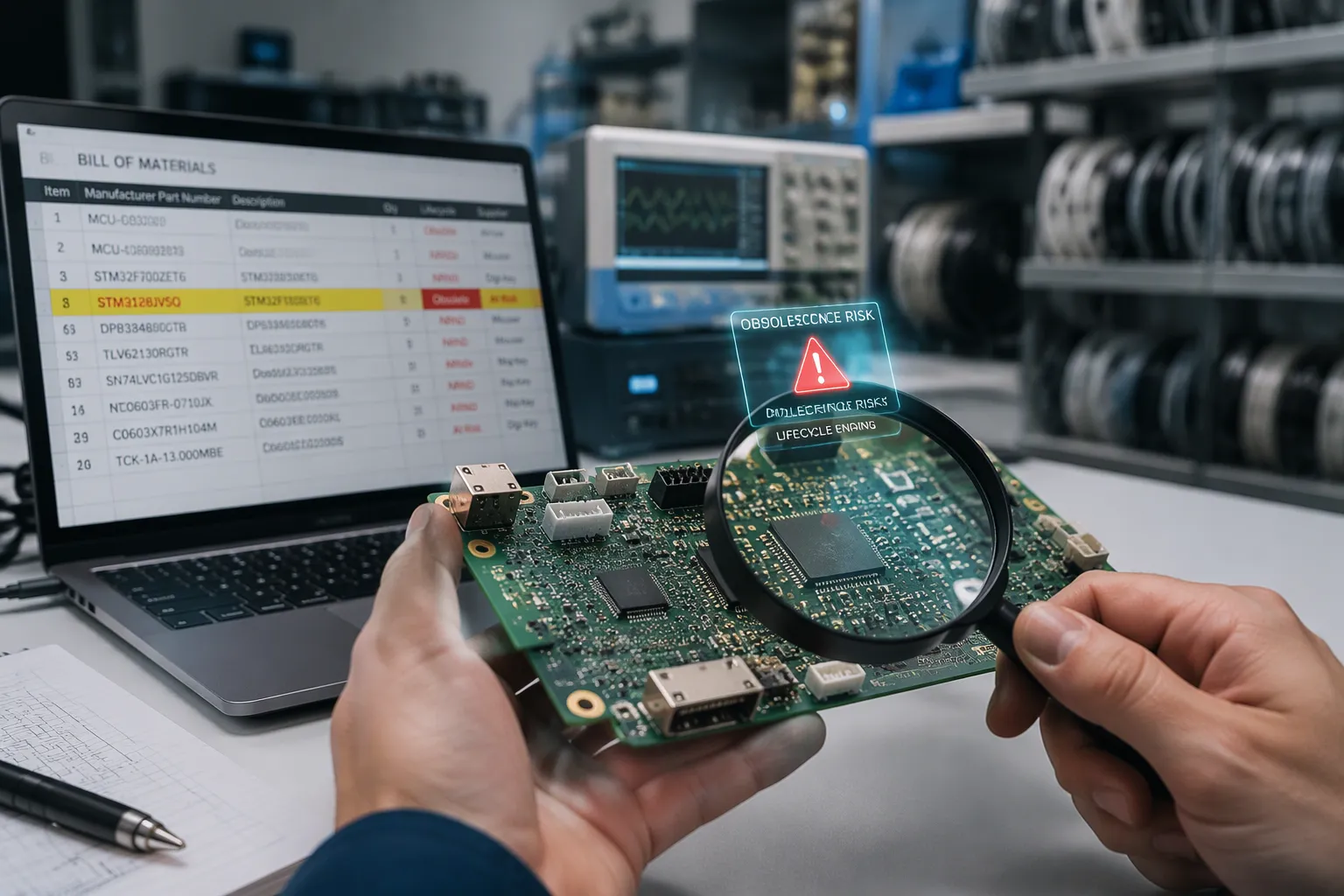
Your IoT product may stay in the field for a decade. The parts inside it will not. Long before your warranty window closes, original components will reach end-of-life, and your production line inherits the problem.
You already know the pain: a long product lifecycle pushes original parts into discontinuation, and the market then demands alternates and disciplined version management. Electronic component obsolescence is inevitable. Production disruption is optional, provided you run a structured process.
That process has four steps. Detect risk early, choose the right response, execute the fix precisely, and plan continuously. Engineers, product managers, and sourcing teams who own connected-device BOMs can apply this loop to BOM obsolescence, PCB assembly sourcing, component obsolescence, obsolescence management, BOM management, and everyday BOM decisions.
Key Takeaways
Monitor your BOM every month to catch obsolete parts early.
Choose the best response: last-time buy, alternate part, or redesign.
Calculate last-time buy quantities carefully to avoid shortages or waste.
Use version control to keep old and new parts from mixing on the line.
Make obsolescence planning a routine part of product strategy.
Spotting BOM Obsolescence in PCB Assembly Sourcing
End-of-life components: read the signals
You catch end-of-life components early through three channels. First, subscribe to product discontinuance notice and EOL notice feeds from your distributors and manufacturers. Second, ask your suppliers directly; a good account manager often warns you before the formal notice lands. Third, run lifecycle forecasting tools that predict when a part will likely go obsolete.
Treat every signal as urgent. A product discontinuance notice usually starts a countdown toward a final order date. Miss it, and an eol component becomes a line-down event. One sourcing team we worked with learned this the hard way: a single regulator went obsolete mid-build, and the search for a drop-in alternate delayed a shipment by weeks. The lesson is simple. Component sourcing and obsolescence risks belong on a watchlist, not in a folder.
Monthly BOM scans and lifecycle tools
Build a monthly scan routine. Export your bom for pcb assembly, check every line against lifecycle data, and flag parts marked obsolete, not recommended for new designs, or nearing end of life. Assign each flagged part an owner and a review date.
Fragmented data raises risk. Procurement spreadsheets, shop-floor MBOMs, and separate tracking files drift apart, and a part can disappear from one list while staying live in another. Consolidate these sources into one master BOM. Strong bom management gives you a single truth for component obsolescence decisions, and lifecycle monitoring then becomes a repeatable check rather than a scramble. Electronic component obsolescence rewards the team that looks monthly, not the team that reacts yearly.
Choosing a Response for Managing Component Obsolescence
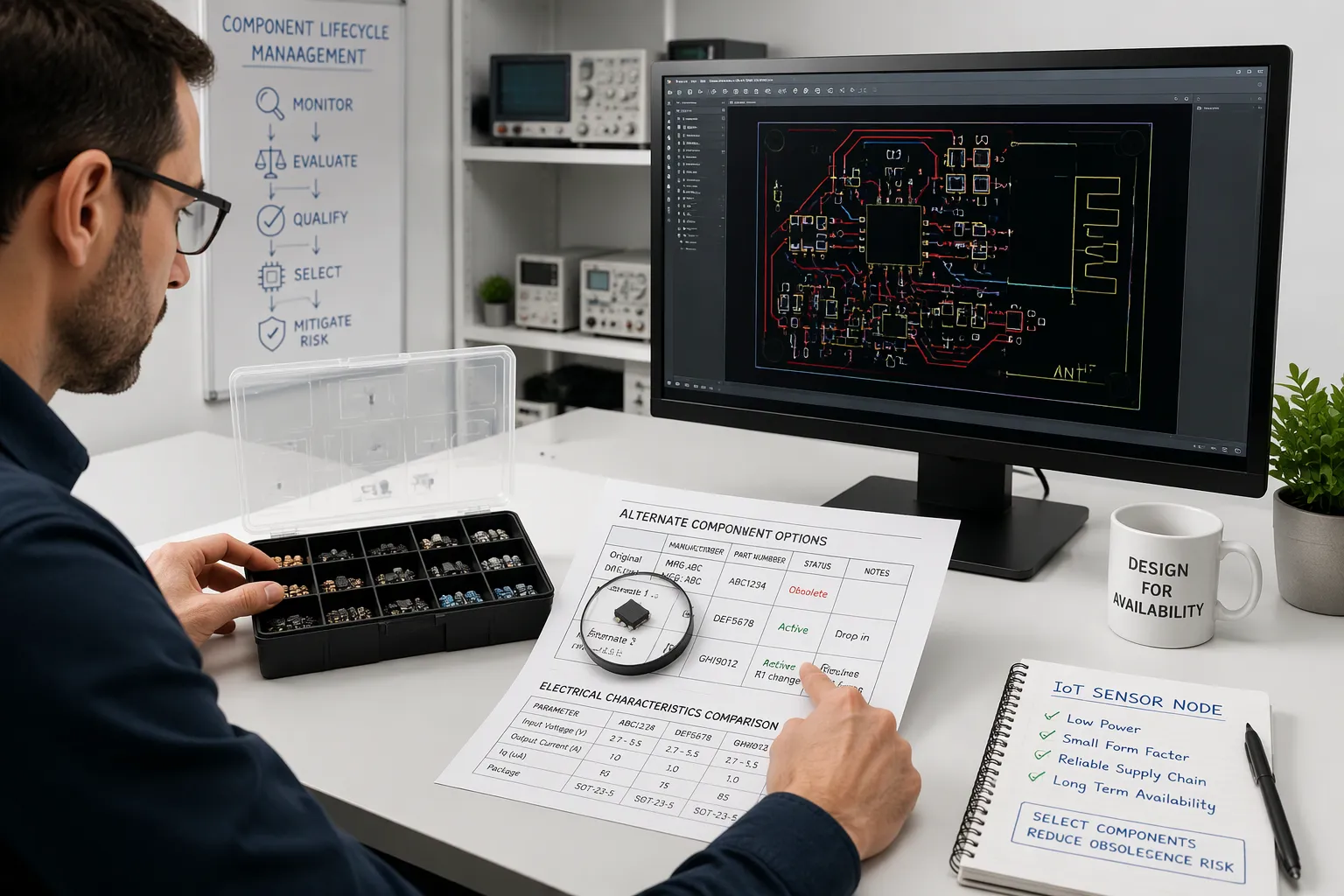
When a part goes obsolete, you face three paths: last-time buy, alternate qualification, or redesign. None is universally correct. Managing component obsolescence means matching the path to your demand volume, the part’s criticality, and your cost position. You will meet end-of-life components on every long-lived platform, so the goal is a repeatable choice, not a clever one-off.
Match the option to demand and criticality
A last-time buy suits high-volume parts with stable, long forecasts. You purchase the remaining lifetime supply and store it. This option fits when holding costs stay low and your demand signal is trustworthy. It also protects certification, because nothing on the board changes.
Alternate qualification fits moderate demand and non-critical parts. You qualify the alternate component against the original datasheet, then release it. This path delivers an alternate component without full redesign, which protects your schedule and your approval status. It demands engineering time for electrical, thermal, and firmware checks.
Redesign fits low remaining demand, or a part so central that no substitute exists. You revise the board and accept the engineering cost. Redesign also makes sense when the obsolete part sits on a platform you plan to refresh anyway. Component obsolescence then becomes a trigger for improvement rather than a setback.
Compare trade-offs at a glance
The table below compares the three responses on the dimensions that decide most programs. Ratings are relative, not absolute. Your volumes and certification scope set the real numbers.
Dimension | Last-time buy | Alternate part | Redesign |
|---|---|---|---|
Lead time | Short to procure, long to consume | Moderate, driven by test cycles | Longest, full design and validation |
Cost | Upfront inventory and storage | Qualification engineering and samples | NRE, tooling, and re-certification |
Firmware impact | None | Low to moderate, driver checks | Often substantial |
Certification impact | None | Usually none if form, fit, and function hold | Re-testing likely |
A medical-device team we worked with chose a last-time buy for a sensor with eight years of forecast demand. A consumer IoT team chose an alternate part for a power IC. Both decisions held. The difference was forecast confidence, not preference.
Treat these options as a portfolio, not a single bet. Good bom management lets you apply a different response to each line of the same bom. That flexibility is the practical core of electronic component obsolescence work in pcb assembly sourcing, and it keeps bom obsolescence from becoming a line-down event. Document each decision in your obsolescence management plan, and revisit it at every forecast update. IEC 62402 frames this discipline as policy, planning, mitigation, resolution, and improvement, and that structure keeps your choices auditable when a customer or auditor asks why a part changed.
Executing the Fix: Last-Time Buy and Alternates
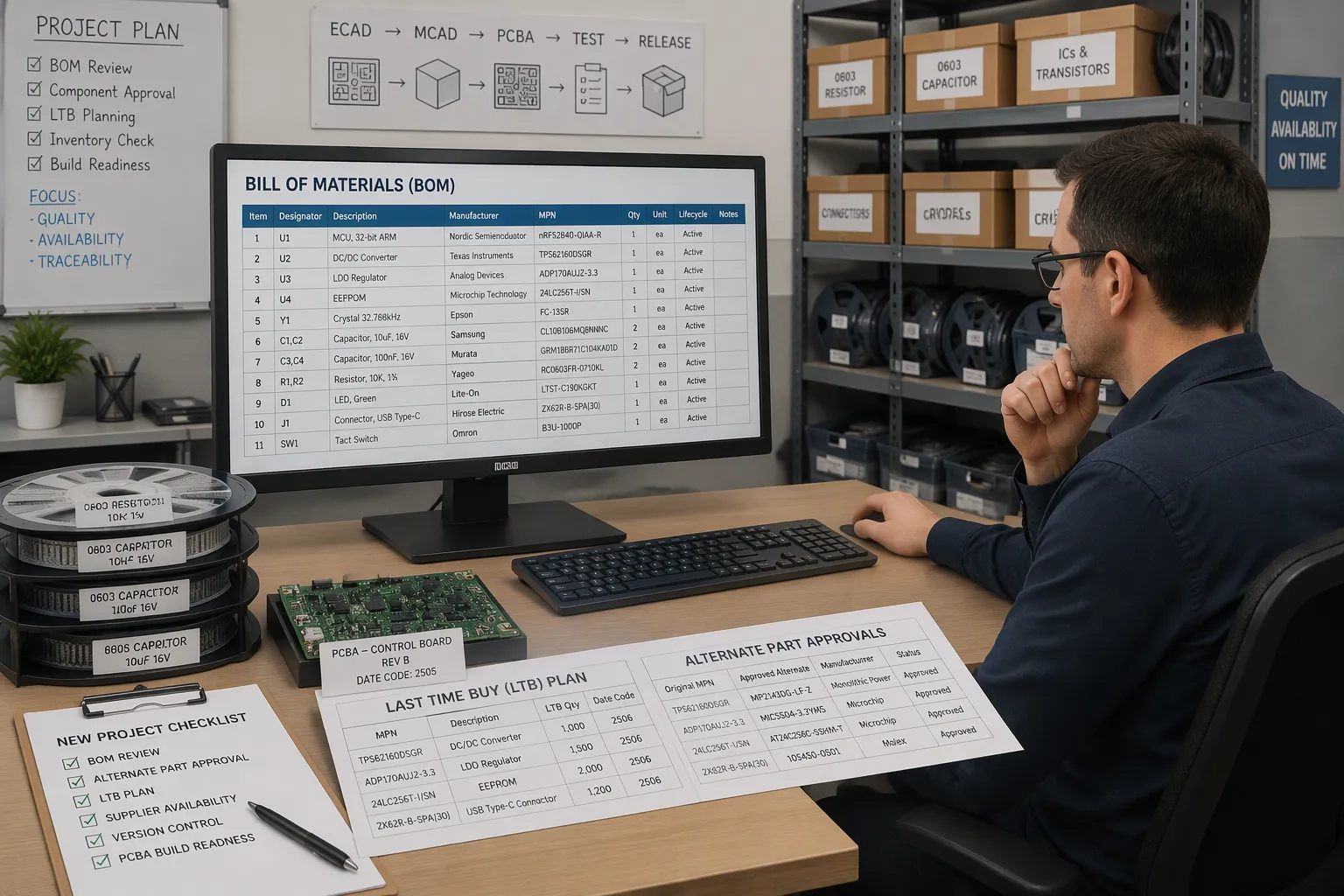
Calculate last-time buy quantities
A last-time buy only works when the quantity is right. Too little stock, and you face a second shortage. Too much, and you pay for inventory that expires on the shelf.
Start with remaining production demand. Multiply your planned build volume by the units of that part each board consumes. Add field spares for warranty and repair. Add a buffer for forecast error and scrap. Then check shelf life against your consumption rate. A part with a short shelf life needs a storage plan, or the last-time buy becomes waste.
One industrial gateway team we worked with sized a last-time buy on forecast alone. They ignored field spares and ran short within a year. The fix cost far more than the original buffer would have. Treat the last-order date as a hard deadline, and lock the quantity before it passes.
Approve alternates and isolate versions
An alternate component needs a disciplined approval workflow. Compare datasheets line by line. Run electrical and thermal checks against your operating conditions. Verify firmware compatibility, especially for parts with registers or timing behavior. Then qualify samples on real boards before you commit.
Version isolation protects you after approval. Create a separate BOM revision for the new part. Label boards, reels, and work orders clearly. Add line-level controls so mixed versions never ship. Your approved BOM and your released BOM must match the physical build at every station.
IEC 62402 gives you a lifecycle framework for this work: policy, planning, mitigation, resolution, and improvement. Use it to document why each part changed and who signed off.
The table below summarizes the execution controls for each path.
Control | Last-time buy | Approved alternates |
|---|---|---|
BOM revision | Unchanged | New revision required |
Line labeling | Stock lot tracking | Version tag on reels and boards |
Firmware check | None | Required before release |
Sign-off owner | Sourcing | Engineering and quality |
Strong BOM management ties these controls together. Managing component obsolescence at the execution stage means every end-of-life components decision lands in one approved substitute record. That record covers the alternate PCB component, the qualification evidence, and the version history. A clean alternate component without full redesign still needs this paper trail. Electronic component obsolescence rarely fails at the decision. It fails at execution, when an unlabeled reel reaches the line. Component obsolescence discipline lives in these small controls, and good BOM management keeps them visible.
Building Your Obsolescence Management Plan
Define contract manufacturer responsibilities
Your contract manufacturer should own more than placement and test. Write lifecycle monitoring into the agreement. The CM watches your active BOM against supplier feeds, routes PCN and EOL alerts to you within an agreed window, and supports alternate sourcing when a part flags. Add version control on the line: reel labels, work-order tags, and a hard stop when a build does not match the released revision.
Make monitoring a lifecycle discipline
Embed obsolescence planning into product strategy, not into firefighting. Connect your BOM to PLM so design changes and sourcing data share one record. Adopt a pcb assembly dual sourcing strategy at design time: qualify a second source for critical parts before you need it. Set a cross-functional review cadence where engineering, sourcing, and the CM examine risk together.
Proactive obsolescence management pays off across the product life. Teams that review quarterly catch component shortages or obsolescence while alternates remain available. Treat your obsolescence management plan as a living document. Component obsolescence management then becomes routine, and electronic component obsolescence stops dictating your schedule. Strong BOM management and disciplined managing component obsolescence keep every build on track.
Early detection and fast, structured decisions separate a minor part swap from a production stoppage. Run the loop: monitor your BOM monthly, decide between last-time buy, alternate, or redesign, execute with clean version control, then fold the lesson into your obsolescence management plan.
No single team carries this alone. Engineering, sourcing, and your contract manufacturer must share one channel and one record. That collaboration is the real safeguard for product continuity, and solid bom management makes it visible.
Treat component obsolescence as a lifecycle discipline, not a one-time fire drill. Electronic component obsolescence will return. Your process, not your luck, decides how bom obsolescence and pcb assembly sourcing affect the next build. Obsolescence management then becomes routine work.
FAQ
Why do long-lifecycle IoT products face component discontinuation?
Field life outlasts part availability. A connected device may serve customers for a decade, while suppliers retire components on much shorter cycles. You will meet end-of-life notices during production, not after it. Plan for discontinuation as a normal event, and the market supply of alternates becomes an advantage rather than a scramble.
When should you qualify an alternate instead of redesigning?
Qualify an alternate when demand is moderate and the part is not central to the design. A form, fit, and function match usually protects your certification. Reserve redesign for low remaining demand or parts with no viable substitute. Match the response to volume and criticality, and document the choice.
How do you keep old and new versions from mixing on the line?
Create a separate BOM revision for every approved alternate. Tag reels, boards, and work orders with the version. Add a line-level stop when a build does not match the released revision. Your contract manufacturer should enforce this check at every station. Clean bom management keeps the physical build aligned with the approved record.
What should a contract manufacturer own in obsolescence management?
How often should you review BOM risk?
Run a monthly scan of every BOM line against lifecycle data. Hold a cross-functional review each quarter with engineering, sourcing, and the CM. IEC 62402 frames this as a continuing cycle of policy, planning, mitigation, resolution, and improvement. Frequent review catches shortages while alternates remain available.
See Also
Malaysian Hardware Firms Get AI IoT PCBA Manufacturing Services
US Hardware Startups Receive Custom Edge AI PCBA Solutions
Danish Smart Healthcare and IoT Devices Use AI PCBA
Irish MedTech and IoT Hardware Firms Get Turnkey AI PCBA
Singapore IoT and MedTech Projects Get Turnkey AI PCBA Service