
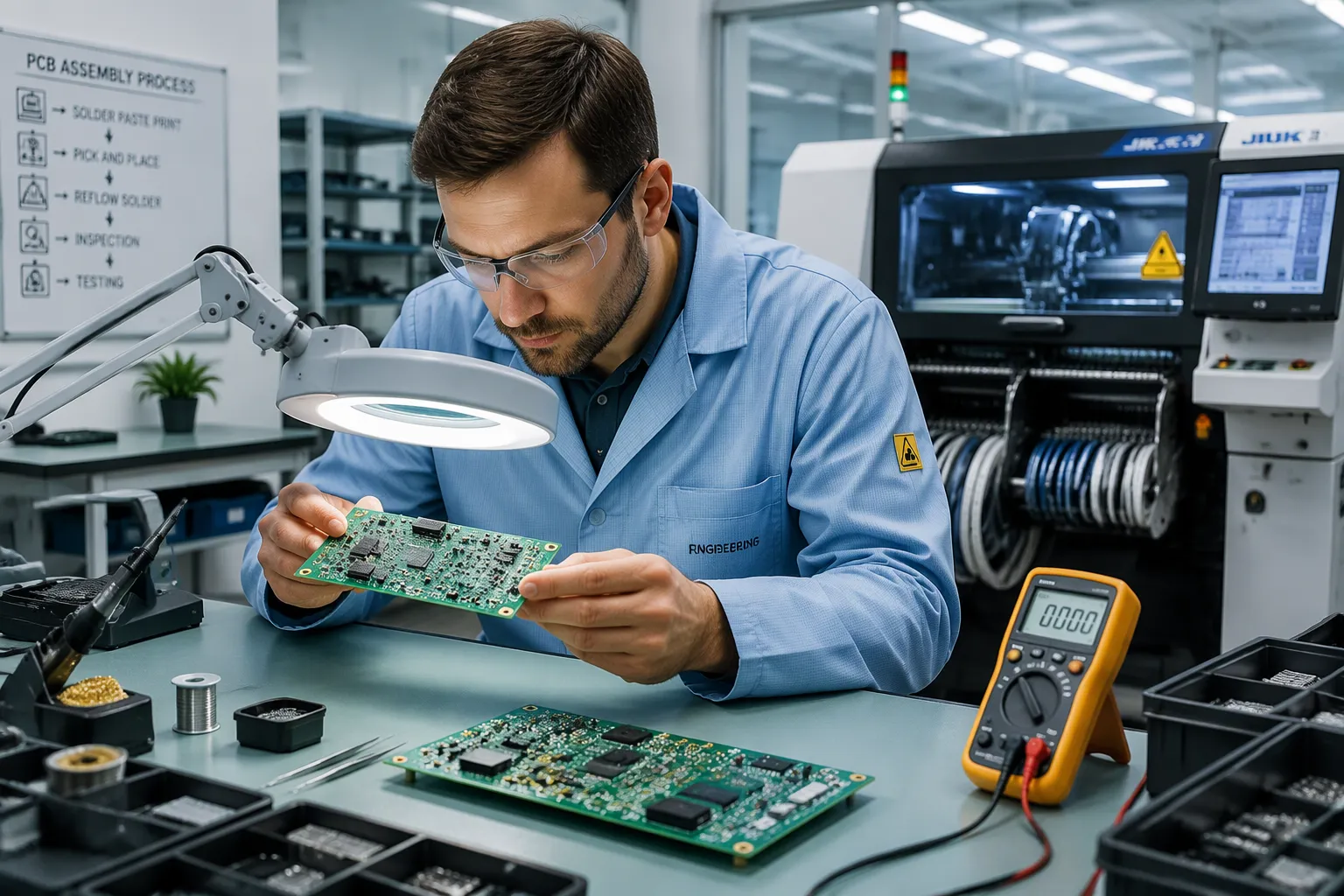
Your smart wearable or voice device is design-complete. Now you need boards built in small quantities, without committing to mass production. That step is low-volume pcb assembly: a defined batch of boards, typically far below high-volume runs, produced with the same process discipline. No universal quantity defines it, and providers set their own thresholds.
This stage carries real weight. You need validation builds, pilot runs, crowdfunding fulfillment, and market testing before scale. Yet small first batches often meet supplier hesitation or quotes that climb unexpectedly. Low volume PCB assembly; small batch PCBA solves this when you plan it well.
This guide follows your journey: preparation, process, supplier choice, cost, and pitfalls. After reading, you can plan a batch, brief suppliers confidently, and control cost.
Key Takeaways
Prepare complete files like Gerbers, BOM, and pick-and-place data before you request a quote.
Choose a supplier who reviews your prototype and batch plan together and provides a line-item quote.
Control costs by reusing tooling and approvals for repeat orders and freezing your design early.
Inspect the first article against IPC-A-610 standards and keep a signed report as your baseline.
Low Volume PCB Assembly and Small Batch PCBA Basics
Batch Sizes and Service Models
No single number separates low-volume pcb assembly from high-volume work. Providers set their own thresholds, and typical ranges shift with board complexity and line capacity. One shop may treat a few hundred boards as small-volume pcb assembly, while another reserves that label for runs in the low thousands. Ask each supplier where its cutoff sits before you compare quotes.
Service models matter just as much. Turnkey and consignment each fit different situations, and neither is inherently better.
Model | What the supplier handles | Best fit |
|---|---|---|
Turnkey | Components, kitting, and build | Teams with limited procurement bandwidth |
Consignment | Assembly only; you supply parts | Teams with existing stock or preferred vendors |
Turnkey pcb assembly suits a first pilot run, when speed matters most. Consignment pcb assembly fits later builds, when you already hold qualified components.
Where It Fits in a Launch
Small-batch pcb assembly supports several distinct launch stages. Validation builds prove the design works. Pilot runs confirm the line and the test plan. Crowdfunding fulfillment delivers to backers. Market testing gauges demand before you commit capital.
Each stage carries different priorities. A validation build tolerates slower delivery and rewards tight inspection. A fulfillment batch demands consistent output and clean documentation. Map your stage before you brief a supplier, and the quote will reflect the right trade-offs.
Small-volume pcb assembly also protects your budget. You fund tooling and setup once, then scale only after the data supports it. That discipline turns small batch pcb assembly into a repeatable step rather than a gamble. Many teams treat small-batch printed circuit board assembly as their bridge to mass production, and small volume pcb assembly gives them the evidence to cross it. A well-run low-volume pcb assembly program keeps every build documented, so each small batch pcb assembly order starts from a known baseline.
Smart Wearables and Voice Devices as Examples
Why These Products Suit Small Runs
Smart wearables and voice devices fit small-batch production naturally. Both categories move through frequent design revisions. A wearable may gain a new sensor. A voice device may shift its microphone layout. Each change calls for a fresh validation build, and a fresh validation build calls for low-volume pcb assembly.
Demand also arrives in stages. A crowdfunding campaign may fund a few hundred units. A retail pilot may need a few thousand. Neither stage justifies a mass-production commitment. Small runs let you ship real product, collect field data, and scale only when the numbers support it.
These products also carry high per-unit value. Buyers notice a loose connector or a noisy microphone immediately. Small batches give you room to inspect closely and correct issues before volume rises.
Board and Test Considerations
Wearable and voice boards pack dense circuitry into tight outlines. Expect fine-pitch components, mixed SMT placements, and limited real estate on both sides. Panelization needs care, because small boards waste panel area and raise handling risk. Discuss rail width and breakaway tabs with your supplier early.
Functional test deserves equal attention. A wearable must prove its sensors, radio, and battery path work together. A voice device must confirm microphone response and speaker output. Build a test plan into the pcb assembly quote rather than adding it later. Ask whether the supplier offers in-circuit test, functional test, or both.
Documentation keeps these builds repeatable. Reference IPC-A-610 for acceptability criteria and IPC-7351 for land pattern guidance. Share your test fixtures and pass criteria with the supplier. A clear first-article report then becomes your baseline for every repeat order.
Benefits and Trade-Offs of Low-Volume PCB Assembly
Speed, Flexibility, and Risk Control
Speed favors you at this stage. A small batch moves through quoting, setup, and build faster than a full production run, so your wearable or voice device reaches testers sooner. You also keep room to change the design between builds. A revised microphone layout or a new sensor needs only a fresh stencil and a new first article, not a full line changeover.
Risk control follows the same logic. You commit capital to a limited number of boards, inspect them closely, and correct problems before volume rises. Field data from a few hundred units tells you more than any simulation. That evidence supports a confident decision on the next order.
Flexibility has a limit, though. Small-batch pcb assembly still carries fixed setup work, and each new revision repeats part of it. Plan revisions in groups where you can.
Unit Cost and Setup Overhead
Per-board cost runs higher in small-volume pcb assembly than at scale. Setup, stencil fabrication, and programming spread across fewer units, so each board absorbs a larger share. Component minimums add pressure too, because you may buy more parts than the batch needs.
The trade-off is deliberate. You pay a higher unit price to avoid a large inventory commitment and the risk of obsolete stock. Compare suppliers on total cost, not unit price alone.
Cost factor | Effect on a small run | Where it fits best |
|---|---|---|
Setup and stencil | Fixed charge spread over few boards | Any first build |
Programming | One-time per design revision | Designs nearing freeze |
Component minimums | Extra stock beyond batch size | Parts reused in later builds |
Treat the higher unit cost of low-volume pcb assembly as the price of evidence. Once your design stabilizes, small batch pcb assembly orders reuse tooling and approvals, and the gap narrows. A disciplined pcb assembly plan keeps that path visible. Each pcb assembly quote should show setup, materials, and test as separate lines, so you can see where small volume pcb assembly costs sit and negotiate the right ones.
Design Readiness and DFM for Small Batches
DFM Checks That Matter Most
Design for manufacturability review protects a small batch more than a large one. A single avoidable defect wastes a larger share of a short run. Start with your fabrication data. Send complete gerber, bom and pick-and-place files to the supplier before quoting. Missing layers or mismatched reference designators stall the review.
A clean bom with manufacturer part numbers removes ambiguity. Include approved alternates for long-lead parts. Your supplier can then flag conflicts early instead of substituting at build time.
Automated dfm/dfa analysis catches spacing, solder mask, and component clearance issues quickly. Pair that software pass with a human review of the dense areas on your wearable or voice board. Fine-pitch parts and tight outlines deserve a second look. Reference IPC-7351 for land pattern guidance and IPC-A-610 for acceptability criteria. Document every accepted deviation, so the next low-volume pcb assembly order starts from the same baseline.
Panelization and Test Access
Panel design shapes both yield and testability. Small wearable boards waste panel area, so discuss rail width and breakaway tabs with your supplier early. Ask how the panel handles your mixed SMT placements. A panel that suits the line also protects delicate components during handling.
Test access needs the same early attention. Probe points must stay clear of tall parts and panel rails. Confirm that your fixture reaches every net you plan to test. Build functional test into the pcb assembly quote rather than adding it later.
Good documentation makes small-batch pcb assembly repeatable. Share your test plan and pass criteria with the supplier. A clear first-article report then anchors every repeat order. Treat design readiness as a checklist you close before pcb assembly begins. That habit keeps each low-volume pcb assembly run predictable and keeps your pcb assembly costs visible from the first quote.
Material Preparation Strategy for Small Runs
Turnkey vs. Consigned Components
Your material strategy shapes cost, lead time, and risk on every low-moq or small-batch build. A turnkey pcb assembly service buys, kits, and builds from your BOM. You send files, approve the quote, and receive finished boards. This model fits a first pilot, when your team has limited procurement bandwidth and speed matters most.
Consignment splits the work differently. You supply the components, and the shop performs pcb assembly only. This path suits teams that already hold qualified stock or prefer their own vendors. Neither model wins outright; each fits a different stage of your launch.
Model | You provide | Supplier provides | Best fit |
|---|---|---|---|
Turnkey | BOM and Gerbers | Parts, kitting, build | First pilot, tight timelines |
Consignment | Parts and BOM | Assembly only | Later builds, existing stock |
Low-MOQ Constraints and Buffer Stock
Component minimum order quantity rules trip up many small-volume pcb assembly projects. A part may carry a low moq at one distributor and a high moq at another. Check each line of your BOM before you commit. Some suppliers offer no moq for prototypes, and a few extend no moq terms to early production. Ask early, because a single high moq part can stall a small batch pcb assembly order.
Buffer stock protects you against attrition and rework. Order a modest surplus of fine-pitch parts and connectors, since handling losses hit short runs harder. Keep that surplus documented, so your next low-moq pcb assembly order reuses it. This habit supports small-batch pcb assembly across revisions and keeps your low moq strategy consistent. For a fuller checklist, see our low-moq and small-batch pcb assembly guide.
Prototype and Low-Volume PCB Assembly Process
From Quote and Stencil to SMT
The low-volume pcb assembly process follows a fixed sequence. You start with a quote. Send the files required for a pcba quotation: Gerbers, BOM, and pick-and-place data. A supplier that offers no moq for prototypes will quote your first boards without a minimum order penalty.
Next comes DFM review. Your supplier checks spacing, clearances, and part availability, then returns questions before tooling begins. Answer them in writing, so the record stays clean.
Stencil fabrication and machine programming follow. The stencil matches your paste pattern, and the programming file matches your placement data. Confirm both against your revision before the line starts.
SMT then runs in order: solder paste printing, component placement, reflow, and inspection. Mixed SMT boards on your wearable or voice device may need a second pass for the reverse side. Ask how the shop sequences those passes.
Testing closes the loop. In-circuit test checks connections, and functional test proves the board works as a system. Build both into the quote.
First-Article Confirmation and Approval
First-article confirmation is your formal gate. Inspect the first boards against IPC-A-610 acceptability criteria. Check component orientation, polarity, and solder joint quality under magnification. Verify that every reference designator matches your BOM.
Then run your functional test plan. A voice device should pass microphone and speaker checks. A wearable should prove its sensor and radio paths. Record the results.
Sign off only when the report matches your criteria. Keep that signed report as the baseline for every repeat order. This habit makes small-batch pcb assembly predictable and turns each low-volume pcb assembly run into a documented step. Teams that treat prototype and low-volume pcb assembly this way move faster into low-volume and quick-turn pcba programs, and a reliable quick-turn pcb assembly partner keeps that momentum. A disciplined pcb assembly workflow, backed by a clear low-volume pcb assembly process, protects every later build.
Selecting a Low-Volume PCB Assembly Manufacturer
Capability and Quality Signals
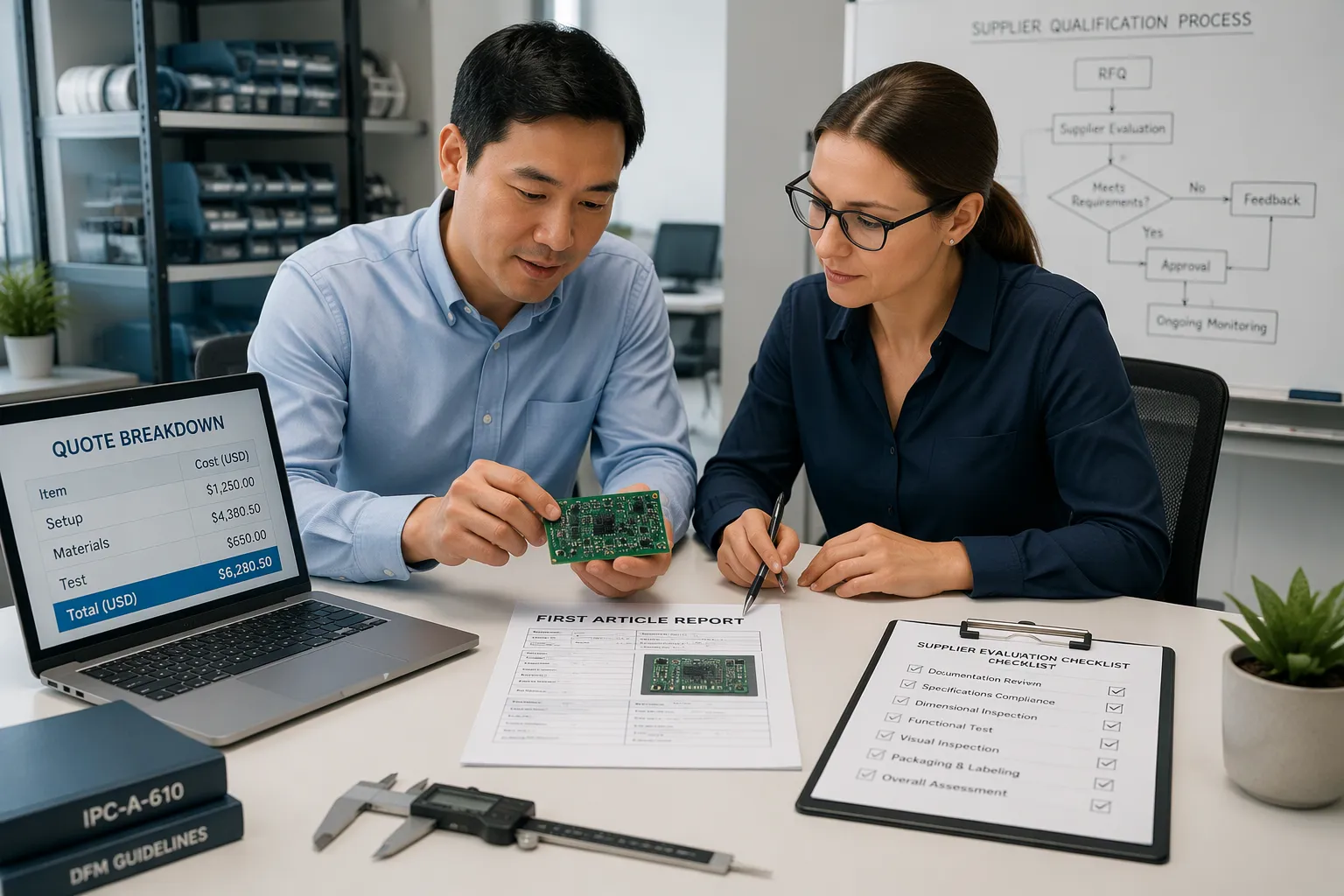
Start with capability. Ask whether the shop runs low volume pcb assembly; small batch pcba work should sit on a dedicated line, not fill gaps between large jobs. That arrangement keeps your wearable or voice board on the same equipment class as production work. Ask how the shop handles fine-pitch placement and double-sided reflow, since both appear on compact designs.
Quality signals deserve a close look. Request the shop’s registration to IPC-A-610 Class 2 or Class 3, and ask which class it applies to your build. Confirm a current quality management certification, such as ISO 9001. Ask for a sample first-article report from a comparable build, then read the deviation notes rather than the pass stamp alone.
Quotes, Lead Times, and Terms
Compare quotes on structure, not just the total. A useful small-batch quotation separates setup, stencil, programming, materials, and test. Ask each supplier to state its moq policy in writing. Some shops offer no moq for prototypes, and a few extend no moq terms into early production. Confirm the moq for each long-lead part as well. A clear moq statement protects your pcb assembly budget from surprise charges later.
Lead time needs the same scrutiny. Ask for the quoted lead time and the typical lead time on similar pcb assembly work. Confirm what triggers a delay: part shortages, panel changes, or test fixture gaps. Ask who contacts you when a schedule slips, and how quickly.
Terms close the loop. Confirm payment milestones, rework policy, and tooling ownership. Ask whether the shop keeps your stencil and programming file for repeat orders. A supplier built for low-volume and quick-turn pcba documents all three without prompting. Weigh each pcb assembly quote on total cost and documented process. That habit makes selecting a low-volume pcb assembly manufacturer a repeatable decision, and it keeps selecting a low-volume pcb assembly manufacturer grounded in evidence rather than sales talk.
Low-Volume PCB Assembly Cost Sources
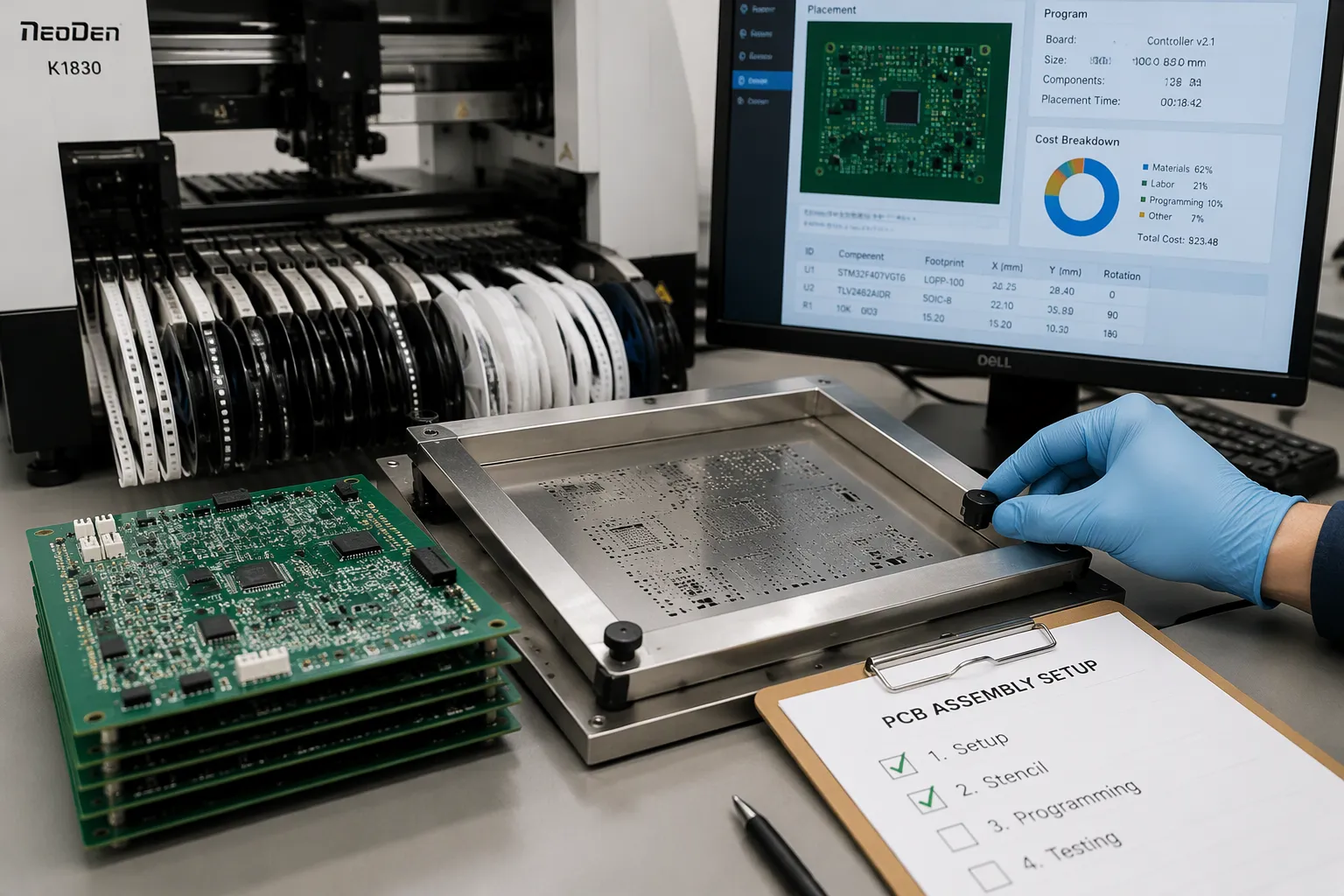
A small batch carries the same fixed work as a large run, spread across far fewer boards. That single fact explains most of your low-volume pcb assembly cost. Break the quote into its parts, and each line becomes a trade-off you can manage rather than a surprise.
Setup, Stencil, and Programming Fees
Setup covers line preparation: machine calibration, feeder loading, and the time your board occupies the line. You pay this once per build, whatever the quantity. A batch of a few hundred boards absorbs the same setup charge as a batch of a few thousand, so the per-board share falls as volume rises.
Stencil fabrication is a separate fixed cost. The stencil matches your paste pattern, and a new design revision needs a new stencil. Reusing the stencil across repeat orders is the simplest way to make small-volume pcb assembly more affordable.
Programming adds a third fixed charge. Placement data must load into the machine, and each revision repeats that work. Designs nearing freeze carry this cost once; designs still in flux repeat it.
Testing belongs in the same breakdown. In-circuit and functional test each need fixtures and time. Build both into the quote as separate lines, so you can see what each one adds.
Cost driver | Fixed or variable | How to manage it |
|---|---|---|
Setup | Fixed per build | Group revisions into fewer builds |
Stencil | Fixed per revision | Reuse across repeat orders |
Programming | Fixed per revision | Freeze placement data before build |
Component minimums | Variable, tied to MOQ | Share parts across builds |
Testing | Fixed plus per-board time | Confirm scope at quote stage |
Component Pricing and MOQ Effects
Component pricing follows its own logic. Distributors set a moq per part, and that moq may differ between suppliers. A single high moq line can outweigh every other saving on a small-batch pcb assembly order. Check each BOM line before you commit.
Some suppliers offer no moq for prototypes and extend favorable terms into early production. Ask for that policy in writing. A clear moq statement lets you plan a cost-effective low-volume pcb assembly run without hidden charges.
Buffer stock is a deliberate trade-off. A modest surplus of fine-pitch parts and connectors covers handling losses on a short run. You pay for extra parts, and you avoid a stalled build. Document that surplus, so your next low-moq order reuses it.
Turnkey and consignment each shift these costs. Turnkey bundles parts into one invoice and saves procurement time. Consignment lets you apply existing stock and preferred vendor pricing. Neither option is cheaper by default; each fits a different stage.
Treat every driver as a lever. Compare quotes line by line, confirm the moq for each long-lead part, and ask how the shop handles low-moq sourcing. That discipline keeps low volume pcb assembly; small batch pcba budgets predictable, and it turns each pcb assembly quote into a plan you can defend. A supplier that documents setup, materials, and test separately makes low-volume pcb assembly cost visible from the first order, and a well-structured pcb assembly program keeps small batch pcb assembly affordable across every revision.
Cost Optimization for Small Batches
Design and BOM Choices
Your design decisions lock in most of the low-volume pcb assembly cost before you request a single quote. Start with the BOM. Consolidate part values where the circuit allows, because every unique line adds a feeder change and a minimum order commitment. A wearable with three near-identical capacitors can often run on one value.
Choose parts with wide availability. A single-source connector can force a high moq on your whole build. List approved alternates for every long-lead line, and your supplier can source competitively instead of paying a premium.
Freeze placement data before the build starts. Each revision repeats programming and stencil work, and those fixed charges weigh heavily on a short run. Group your changes into one revision rather than three.
Order Timing and Quantity Trade-Offs
Quantity and timing interact. Setup, stencil, and programming charges stay fixed, so a slightly larger batch spreads them across more boards and lowers the per-board share. Ask your supplier to quote two or three quantities side by side, then weigh the savings against the inventory you must store.
Timing carries its own leverage. Order when your design has settled, and you pay programming once. Order during a revision cycle, and you pay it again. Some suppliers offer no moq for prototypes and extend that flexibility into early production, which lets you time a bridge batch without penalty.
A cost-effective low-volume pcb assembly plan pairs a stable design with a deliberate quantity. Compare suppliers on total cost, confirm the moq for each long-lead part, and document your buffer stock for reuse. That approach keeps small-volume pcb assembly affordable across revisions and turns each low-moq order into a step toward mass production.
Common Pitfalls and How to Avoid Them
BOM and Documentation Mistakes
Most small-batch problems start in the files, not on the line. A BOM with a missing manufacturer part number forces your supplier to guess, and a guess at build time costs a rework cycle. Send complete Gerbers, BOM, and pick-and-place data before you request a quote. Check that every reference designator matches across all three files.
Version control prevents the classic mix-up. Label each file set with a revision number and a date, and state which revision the quote covers. When you change a part, update the BOM and the placement file together. A supplier that reviews your prototype and batch plan together will flag these gaps early, while changes stay cheap.
Approval and Communication Gaps
A first-article report you never read is a pitfall in waiting. Inspect the first boards against IPC-A-610 acceptability criteria, verify polarity and orientation, and run your functional test plan. Sign off in writing, and keep that signed report as the baseline for every repeat order.
Communication gaps grow quietly. Name one contact on each side, and confirm how quickly that person responds when a schedule slips. Ask your supplier to state its moq policy in writing, including the moq for each long-lead part. Put test scope in the quote, not in a later email.
Document every accepted deviation. That record keeps your low-volume pcb assembly process repeatable and turns each pcb assembly order into a known quantity. A disciplined pcb assembly workflow protects both your budget and your schedule.
Reducing Cost on Repeat Orders
Reusing Tooling and Approvals
Your second order should cost less than your first. The stencil already exists, the programming file already matches your placement data, and the first-article report already sits signed in your records. Ask your supplier to confirm all three in writing before quoting the repeat. A shop that stores your tooling and files turns setup from a fresh charge into a quick verification step.
Approvals carry the same value. Your signed first-article report, checked against IPC-A-610 acceptability criteria, becomes the baseline for every later build. Reference it in the purchase order, and the supplier knows exactly which standard to meet. Keep your revision labels consistent, and nobody reopens settled questions. This discipline makes repeat pcb assembly faster and cheaper without cutting corners.
Bridge Batches Toward Mass Production
A bridge batch sits between your pilot and full production. Size it to cover demand until your next planned build, and you spread fixed charges across more boards while avoiding a large inventory commitment. Ask for quotes at two or three quantities, then weigh the per-board savings against storage and obsolescence risk.
Plan the bridge deliberately. Freeze your design first, so programming runs once. Confirm the MOQ for each long-lead part, and carry buffer stock forward from the previous run. Document each batch as a step on a known path, and your pcb assembly program moves toward volume with evidence behind every decision. A wearable shipping to backers today can become a retail product tomorrow, and each documented batch shortens that distance.
You now hold a clear path. Prepare the design and BOM, choose a material strategy, confirm the first article against IPC-A-610, compare suppliers on total cost, and plan repeat orders on purpose. Each step builds on the last.
Low-volume pcb assembly rewards documentation. A smart wearable or voice device moves through revisions, and a signed first-article report turns each build into a known baseline. Treat the work as repeatable, not as a gamble.
Gather your BOM and Gerbers today. Request comparable quotes, then open a conversation with a manufacturer using the checklist from this guide. Solid pcb assembly planning starts with that first message.
FAQ
Will a manufacturer accept my small first batch?
Why do small-order quotes sometimes climb after approval?
Fixed charges drive the total: setup, stencil, programming, and test fixtures. A quote that hides these lines invites later additions. Request a line-item quote with materials and test split out. Confirm the MOQ for each long-lead part. A written scope protects your pcb assembly budget from surprise charges.
Which checks should I confirm before I sign off?
Inspect the first boards against IPC-A-610 acceptability criteria. Verify polarity, orientation, and every reference designator against your BOM. Run your functional test plan and record the results. Sign the report in writing and keep it as the baseline for repeat orders. Ask whether the shop holds ISO 9001 certification.
Can a repeat order cost less than the first?
Yes, when you reuse tooling and approvals. The stencil already exists, the programming file matches your placement data, and the signed first-article report anchors the standard. Confirm all three in writing before you request the repeat quote. Documented pcb assembly turns setup into a quick verification step.
See Also
Tailored Edge AI PCBA Solutions for American Hardware Startups
PCB Design and Assembly for OpenAI-Style AI Companion Devices
AI IoT PCBA Production Services for Malaysian Hardware Businesses
Tailored AI PCBA Manufacturing for Electronics Firms in Mexico
OpenAI Hardware Trend and Its Impact on Custom AI Device PCBA