

Your pcb manufacturer’s dfm requirements trigger a dfm review before quoting. Dfm analysis covers design rules, copper, stackup, and drills; dfm analysis also covers manufacturability.
A dfm check follows, and dfm checks feed the dfm report: dfm issues, dfm limits, dfm feedback. The dfm process supports pcb design for manufacturing and avoids delays, re-quotes, and surprise costs.
Key Takeaways
Run a DFM check early to avoid delays and surprise costs.
Your manufacturer reviews design rules, stackup, drills, and placement before quoting.
Share complete files before quoting to get accurate pricing and a DFM report.
DFM Analysis for PCBs: Fabrication Checks

Your manufacturer runs dfm analysis on the Gerber files before anyone prices the job. Software checks trace and space, drill data, copper-to-edge clearance, solder mask, and silkscreen. An engineer then reviews the uploaded files by hand. This dfm check catches problems that automation misses.
Design Rules and Copper Features
Design rule compliance is the first gate. The dfm analysis compares your minimum trace width and spacing against the fabricator’s process capability. It also measures annular ring size, flags solder mask slivers, and tests clearance to board edges. Features below the specific fabricator’s process capability raise price and lead time, because the shop must slow down or rework panels. Check trace and space minimums against your supplier’s published rules before you release the layout. A quick dfm check at this stage protects your schedule.
Copper feature checks follow. The dfm analysis looks for acid traps, copper slivers, and antenna stubs that etch unreliably. It reviews solder bridging risk, starved thermals, and ground plane continuity. It also flags thermal conflicts between heavy copper and fine features. Each issue lowers yield, and low yield shows up in your quote. Fixing these items inside pcb design costs nothing. Fixing them after fabrication costs plenty.
Stackup, Materials, and Drills
Stackup review confirms layer count, symmetry, material, copper weight, and finished thickness. An asymmetric build can warp during reflow. Confirm the manufacturable stackup with your supplier before routing. This single step avoids engineering queries and layout revisions later.
Drill and via parameters complete the fabrication review. The dfm analysis sorts vias into through, blind, and buried types. It checks drill sizes against the tool list and verifies aspect ratios. Blind and buried vias need sequential lamination, so they add cost. Smaller drills wear tools faster and raise manufacturability risk. Keep vias on standard tool sizes where the design allows. A written dfm report lists every drill deviation, and that report feeds directly into quoting.
Treat dfm analysis before fabrication as a routine step in your pcb design for manufacturing workflow. The dfm process rewards early review with clean data and predictable pricing. Every dfm analysis you run early removes a manufacturability surprise later.
Assembly, Data, and Cost in PCB Design for Manufacturing
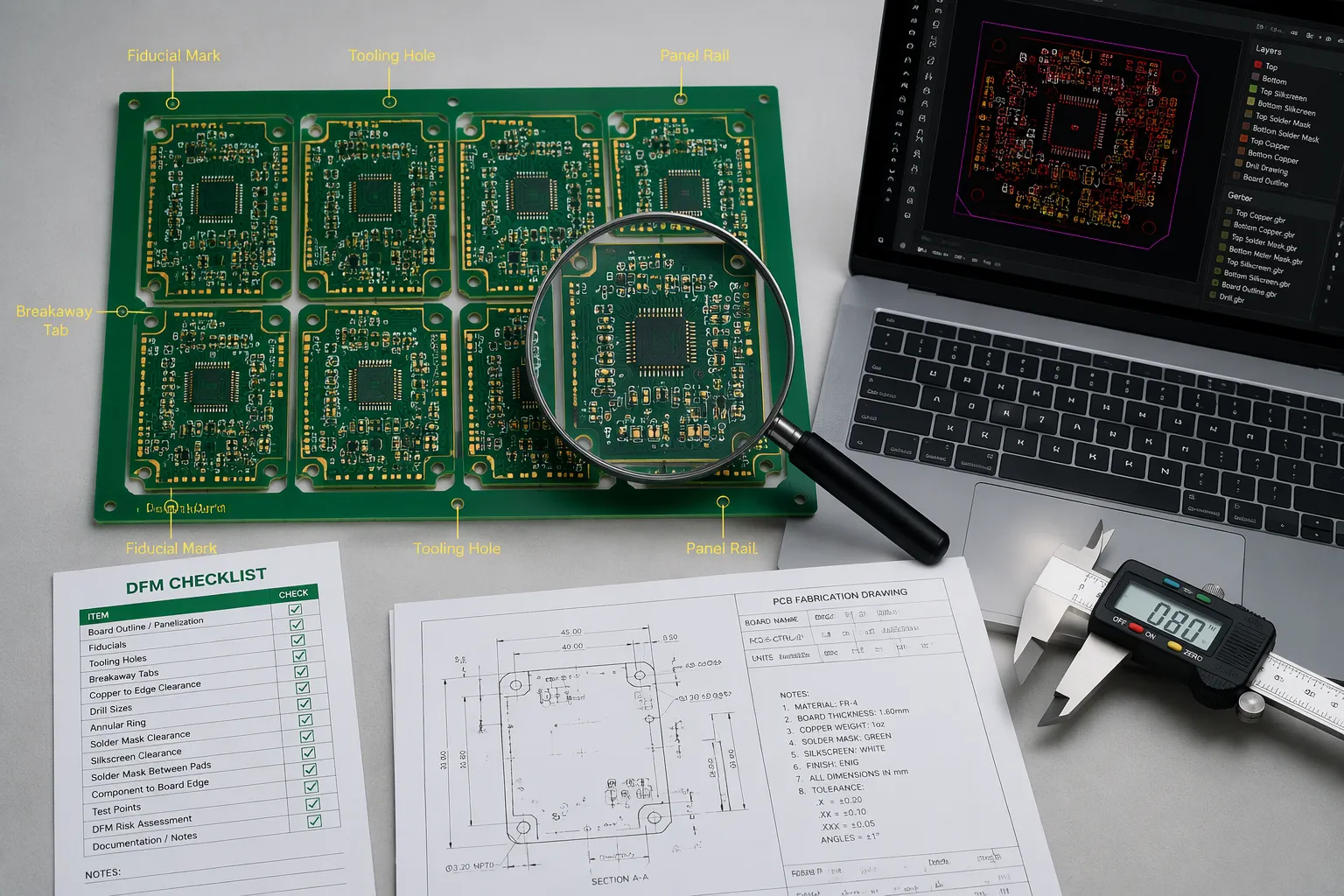
Placement, Silkscreen, and Panelization
Component placement drives assembly speed. Your dfm analysis checks orientation consistency, reference designator clarity, and silkscreen-to-pad clearance. Tight placement slows pick-and-place and blocks inspection access. Unclear silkscreen causes manual rework. Footprint-to-datasheet matching is another dfm check: a wrong land pattern fails at reflow, not at layout. Silkscreen-over-pad conflicts also trigger solder defects. Run a dfm analysis on placement before you release files, and the assembly house will thank you.
Panelization follows placement. Your pcb manufacturer’s dfm requirements cover rails, fiducials, and breakaway tabs. Poor array layout wastes material and raises per-board cost. A dfm check confirms fiducial placement and tab strength. Good panelization lowers manufacturability risk and keeps quoting predictable.
Files, Pre-Production Verification, and Cost
File completeness decides how fast you get a price. The dfm process reviews Gerber or fabrication data, drill files, NC drill alignment, layer naming, stackup drawings, and impedance requirements. Missing data triggers clarification cycles. Every query delays the quote. A written dfm report lists each gap, and you fix it once.
Cost drivers matter too. Board size, layer count, and tight tolerances are the biggest price levers. Your dfm analysis flags tolerances below standard capability. Pre-production verification is the final dfm check against manufacturing and assembly requirements. This step confirms the design for manufacturability before production begins. A design for manufacturing checklist should review fabrication rules, materials, stackup, component placement, and production files. Treat dfm analysis for pcbs as routine inside pcb design and manufacturing. Each dfm analysis before fabrication removes a surprise. The dfm report you receive should be flagged with written dfm report provided, so nothing hides. Strong pcb design for manufacturing practice means early dfm review. Your pcb design improves when dfm feedback arrives before quoting. The dfm process rewards clean data with stable pricing.
Your dfm review covers design rules and copper features, stackup and drills, placement and panelization, and file completeness. Run this dfm check early. Early dfm analysis saves time and money.
Share files with your manufacturer before quoting. Ask for a dfm analysis beside the price. That dfm process returns a dfm report, protects manufacturability, and strengthens pcb design for manufacturing. Good design for manufacturing starts with one dfm step in pcb design.
FAQ
How long does a dfm review take before quoting?
A dfm check runs fast with complete files. Missing data slows the dfm analysis. Ask for the report timeline up front. A second dfm analysis catches gaps.
Can you run a dfm analysis before you submit files?
Free dfm tools catch trace and space violations. They miss copper slivers and thermal conflicts. A dfm analysis needs an engineer. Run a dfm check, then request a dfm analysis.
What happens when files fail the dfm check?
The manufacturer sends a dfm report. Fix the layout, then resubmit. A second dfm analysis confirms it. Early pcb design fixes cost little. Each dfm finding improves your pcb design.
See Also
Artificial Intelligence PCBA Inspection Services for Manufacturing Facilities in Mexico
Original Equipment Manufacturer AI PCBA Production for Electronics Factories in Poland
Tailored AI PCBA Production Services for Electronics Businesses in Mexico
Bespoke AI PCBA Solutions for Industrial Electronics Sectors in Czech Republic
Artificial Intelligence IoT PCBA Production for Hardware Firms in Malaysia