

PCBA lead time equals PCB fabrication time plus component sourcing, assembly, and testing time. Simple builds ship in a few days. Complex builds take several weeks. Four stages set the schedule: bare board fabrication, part procurement, SMT assembly, and test. Buyers often count only SMT days. That habit hides the real critical path, where material and test time quietly stretch the turnkey assembly timeline. You need an executable schedule, not an optimistic quote. This guide gives typical ranges for each stage, the factors that extend them, and proven ways to compress your PCBA lead time and turnkey assembly timeline without cutting quality corners.
Key Takeaways
PCBA lead time includes four stages: PCB fabrication, component sourcing, assembly, and testing.
Ask for a written quote that breaks down each stage to see the full timeline.
Lock your bill of materials early and confirm part availability to avoid delays.
Component sourcing often causes the longest delays, so plan for it first.
You can speed up orders with fast-turn fabrication or priority assembly slots without cutting quality.
PCBA Lead Time and Turnkey Assembly Timeline
Four Stages, One Timeline
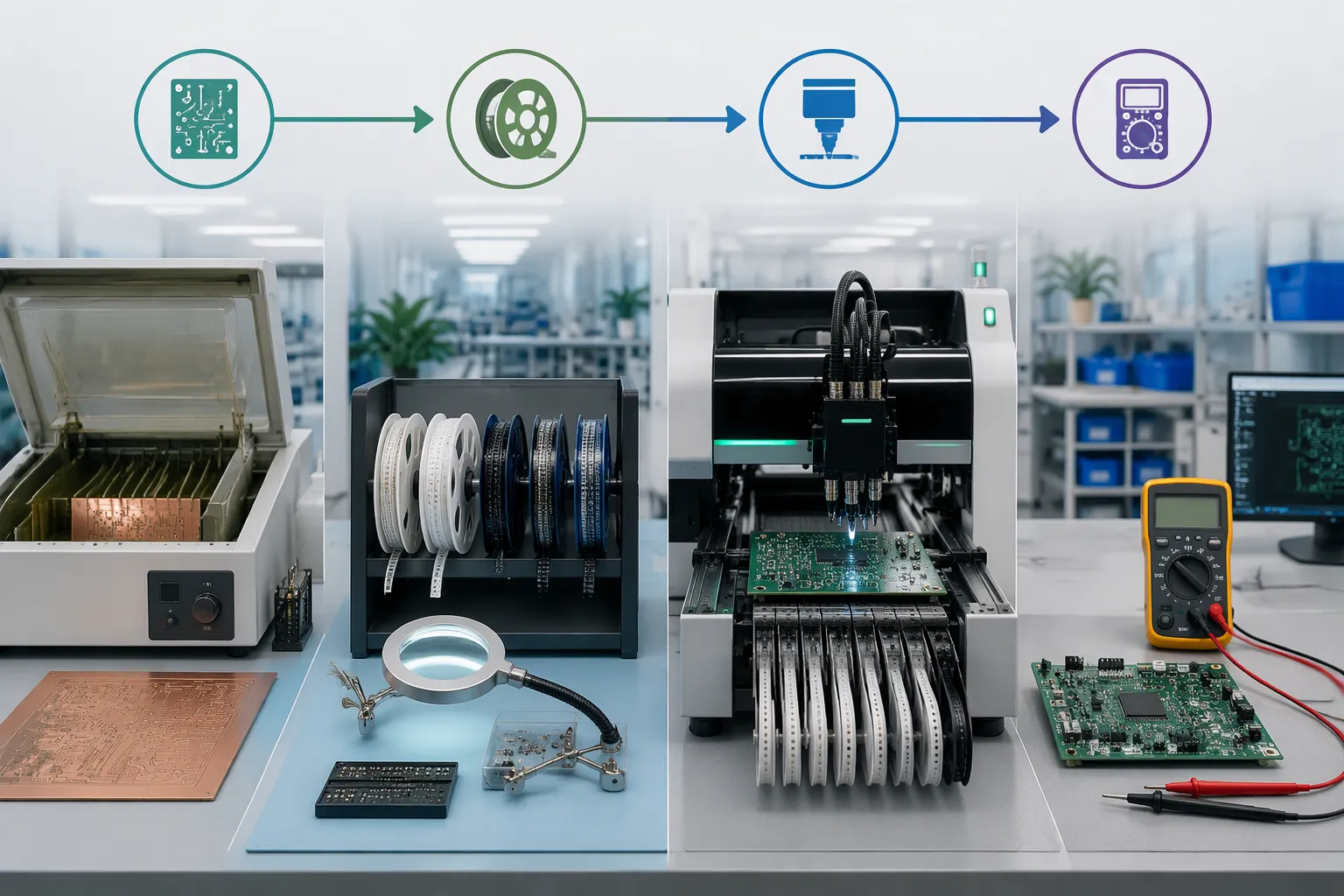
PCBA lead time runs from order confirmation to shipment. Treat it as a critical-path schedule, not a single factory speed. Four stages share that clock: PCB fabrication, component sourcing, assembly, and testing. Each stage waits on the one before it, so the slowest stage sets your ship date.
Consider a worked example. Fabrication takes five days, sourcing takes eight days for a long-lead connector, SMT assembly takes three days, and testing takes two days. Your total is eighteen days, even though the assembly line only touches the board for three. Buyers who count only line days miss this gap. Material and test time quietly stretch the turnkey assembly timeline, and that is the most common source of missed commitments.
Typical Ranges at a Glance
The table below shows common ranges. Your quote depends on board complexity, part availability, and queue position.
Build type | Typical range |
|---|---|
3–15 business days | |
First-time turnkey PCBA | 6–8 weeks |
Prototype | 24 hours–7 days |
Low-to-mid volume | 1–3 weeks |
Turnkey prototype | 3–5 days |
Urgent | 1–2 days |
A supplier may quote five days for the line while your total count runs longer. Ask for a stage-by-stage breakdown in writing. A quote that names PCB, procurement, and assembly scope in one document removes the guesswork.
That one-stop fabrication through assembly scope matters. You see the full critical path before you commit, and you can challenge any stage that looks optimistic. Work to IPC-A-610 Class 2 acceptance criteria, and confirm your supplier holds ISO 9001 certification, so the schedule you approve matches the quality standard you expect.
PCB Lead Time and Custom Fabrication
Custom PCB Manufacturing Lead Time Drivers
Standard fabrication for simple boards commonly runs several days to two weeks. That range covers most double-sided designs with conventional materials. Your custom pcb manufacturing lead time stretches from that baseline as design demands rise.
Five drivers set the schedule: layer count, board material, surface finish, panel size, and design complexity. Each adds process steps. A higher layer count means more lamination cycles and drilling passes. Exotic materials need specialized handling and cure profiles. Fine-line designs demand tighter imaging tolerances. Typical pcb fabrication lead times reflect these steps directly.
Enterprise gateway and edge computing box builds show this clearly. These products often need multilayer stacks for dense routing and thermal management. The added layers and thermal needs extend fabrication beyond a simple board’s window. That complexity fits these designs best. Fast-turn simple boards fit other applications equally well. Neither path is superior; each matches its use case.
Component Sourcing and Long-Lead Parts
Component sourcing often becomes the hidden driver of your pcb lead time. Your bill of materials may list parts with extended factory lead times. A single long-lead connector can push your pcba schedule past every other stage.
Start with your BOM and component placement list. Confirm availability before you release the order. Distributor stock changes daily, so verify again at purchase order release. One buyer we worked with locked a BOM early and reserved parts, cutting two weeks from their pcb assembly schedule.
Sourcing approach | Effect on lead time |
|---|---|
In-stock parts, locked BOM | Shortest path |
Long-lead parts, early reservation | Predictable, moderate |
Buyer-supplied parts arriving late | Extends schedule |
PCB Assembly Scheduling and Testing
SMT Production Scheduling
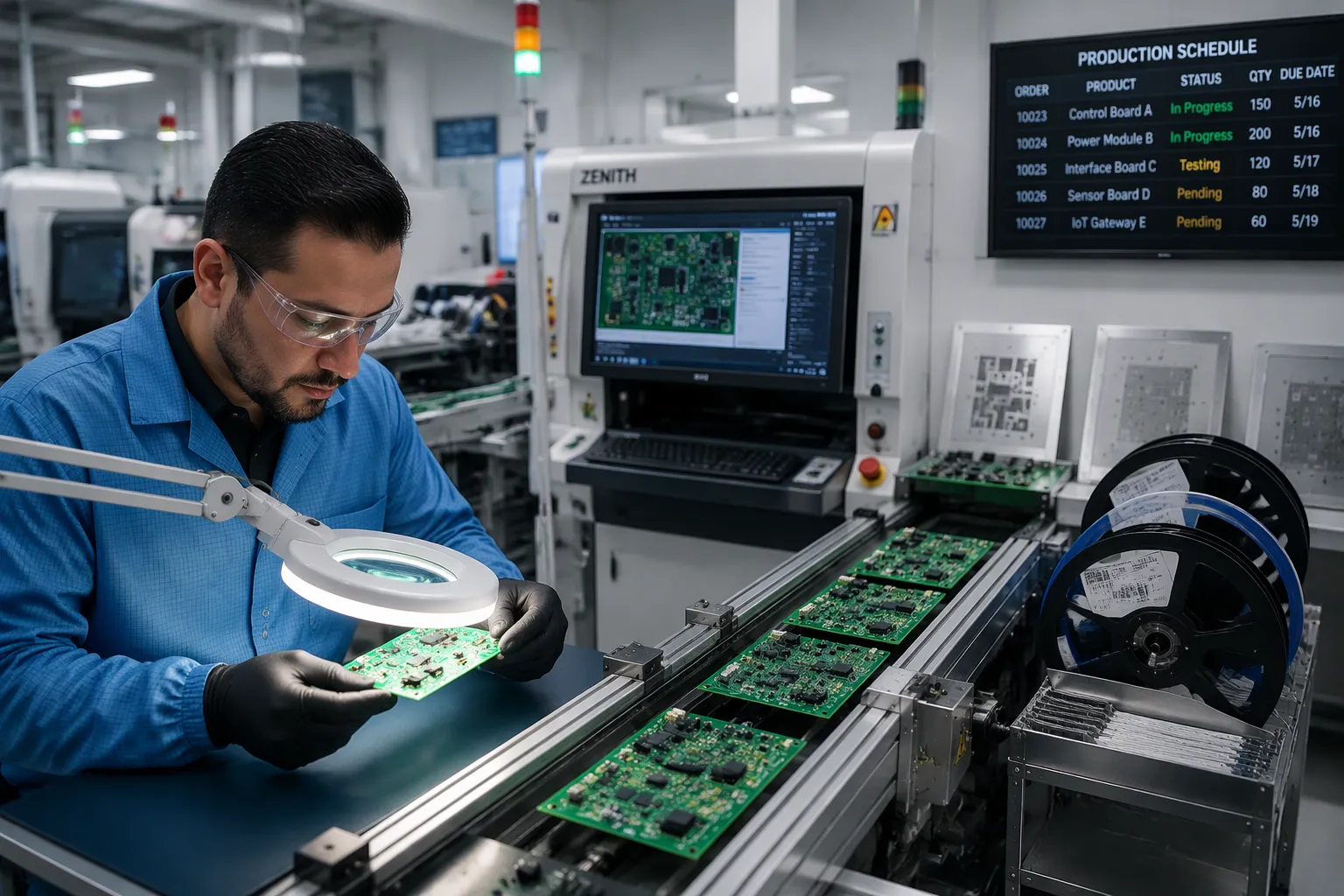
Your board now waits for a line slot. Queue position matters most. A busy shop may hold your job behind larger runs, and that wait can exceed the build itself. Line changeover adds time too. Each new product needs stencil mounting, feeder setup, and program verification. Stencil and fixture prep often starts before your slot opens, so confirm that work begins early. Panelization also shapes the schedule. A well-designed panel fills the line efficiently and reduces handling.
Assembly tiers give you a planning baseline. Prototype runs typically take 5–7 days. Small batches run 10–15 days. Full production runs 15–25 days. Rush service can compress a build to 24 hours when the line has capacity.
Place your turnkey smt assembly order early and reserve a slot. A confirmed slot protects your schedule better than a hopeful promise. The same rule applies to any smt assembly order with a fixed launch date.
Testing and Rework Buffer
Testing is a planned stage, not slack. Automated optical inspection catches placement and solder defects. X-ray checks hidden joints under area array packages. Functional test proves the board works as designed. Rework follows when a defect appears. Each step needs calendar time, and skipping the buffer invites a late shipment.
Plan test time into every pcb assembly order. A complete turnkey smt assembly order includes test planning from day one. Work to IPC-A-610 Class 2 acceptance criteria, and confirm ISO 9001 certification, so your test standard matches your quality expectation.
Sourcing model changes the schedule. Full turnkey means your supplier buys every part. Partial turnkey means you supply some parts, and a late delivery extends your pcb assembly time directly. One customer shipped connectors two weeks late and lost their slot. Lock your bill of materials and component placement list before release. Verify the bom against the component placement list twice. That habit shortens every smt pcb assembly cycle.
Testing and rework remain the most overlooked stage in any pcba quote. Buyers count line days and forget inspection. Build the buffer in, and your lead time holds.
Lead Time Delays and Expediting
Common Delay Causes
Four problems cause most late shipments. Long lead time components top the list. One part with an extended factory window stalls every downstream stage. BOM changes after PO release force re-quoting and re-sourcing. Missing Gerbers or test files stop fabrication cold. Late buyer-supplied parts also stretch your pcb lead time.
Prevention beats recovery. Lock the bill of materials early and confirm availability at PO release. Approve fab drawings before release. Reserve SMT slots in advance. Send complete pcb files for pcb assembly: Gerbers, a machine-readable bom, and a pick-and-place (pnp) file. A clean bill of materials (bom) file plus an accurate component placement list removes most questions. One customer sent an incomplete BOM and lost four days to clarification. A complete pcb assembly order package prevents that. Double-check your pcb files for pcb assembly, verify the component placement list against your Gerbers, and your pcb lead time holds.
Expedited Options Without Quality Trade-Offs
Each option fits a different situation. Fast-turn fabrication suits simple boards with confirmed designs. In-stock component selection works when your BOM allows alternates. Priority SMT slots help when parts arrive on time and the assembly line is the bottleneck. Parallel test planning fits builds with fixed launch dates.
Ask for price and lead time together, stage by stage. Compare options honestly. Your smt assembly order, smt assembly schedule, smt assembly plan, and smt assembly run all reward early commitment. Early commitment shortens lead time. Confirm the pcba quote covers assembly and test, and your pcba ships on time. Work to IPC-A-610 Class 2 and ISO 9001, and speed never costs quality.
Your pcba lead time is a sum, not a single number. Fabrication, sourcing, smt assembly, and testing each hold a place on the critical path, and the slowest stage sets your ship date. Front-end choices shape that path: layer count, board material, and part selection. Back-end buffers shape it too: reserved smt assembly slots, plus planned test and rework time.
Plan orders early and lock the bill of materials before release. Verify part availability at PO release, approve fab drawings, and confirm your bom against the placement list. Choose expediting options that preserve quality, such as fast-turn fabrication or priority line slots. Our team has seen early BOM locks protect pcb assembly schedules again and again. Hold IPC-A-610 Class 2 and ISO 9001 standards, and your turnkey assembly timeline stays both fast and sound.
FAQ
How long does a standard turnkey PCBA order take?
Standard turnkey builds typically ship in 3–15 business days. First-time turnkey PCBA commonly runs 6–8 weeks. Your actual count depends on board complexity, part availability, and queue position. Ask for a stage-by-stage breakdown in writing, so you see the full critical path before you commit.
Why does my quote look shorter than my actual ship date?
Suppliers often quote line days alone. Fabrication, sourcing, and test time sit outside that number. A five-day assembly quote can hide an eight-day part wait. Request one document that names PCB, procurement, assembly, and test scope together, and the gap disappears.
Which stage delays PCBA orders most often?
Component sourcing causes most late shipments. One long-lead connector can stall every downstream stage. BOM changes after PO release and missing Gerbers or test files rank close behind. Lock your bill of materials early, confirm availability at PO release, and reserve your SMT slot in advance.
Can I shorten lead time without lowering quality?
Yes. Fast-turn fabrication suits simple, confirmed designs. In-stock part selection works when your BOM allows alternates. Priority SMT slots help when the line is the bottleneck. Parallel test planning fits fixed launch dates. Each option preserves IPC-A-610 Class 2 acceptance and ISO 9001 certification.
PCB fabrication | Several days to two weeks | Quoted with assembly in one document |
|---|---|---|
Component sourcing | Separate quote, buyer follow-up | Included in the same quote |
Assembly | Quoted separately | Included in the same quote |
Testing | Often listed as an add-on | Planned into the schedule |
You see the full schedule before you commit. That visibility lets you challenge any optimistic stage early.
See Also
Tailored AI PCBA Production Services for Electronics Firms in Mexico
Original Equipment AI PCBA Production for Poland Electronics Manufacturing Plants
AI Server PCB Fabrication for American GPU Hardware Businesses
Bespoke Edge AI PCBA Solutions for American Hardware Startup Companies
AI-Based Inspection PCBA Services for Manufacturing Facilities in Mexico