
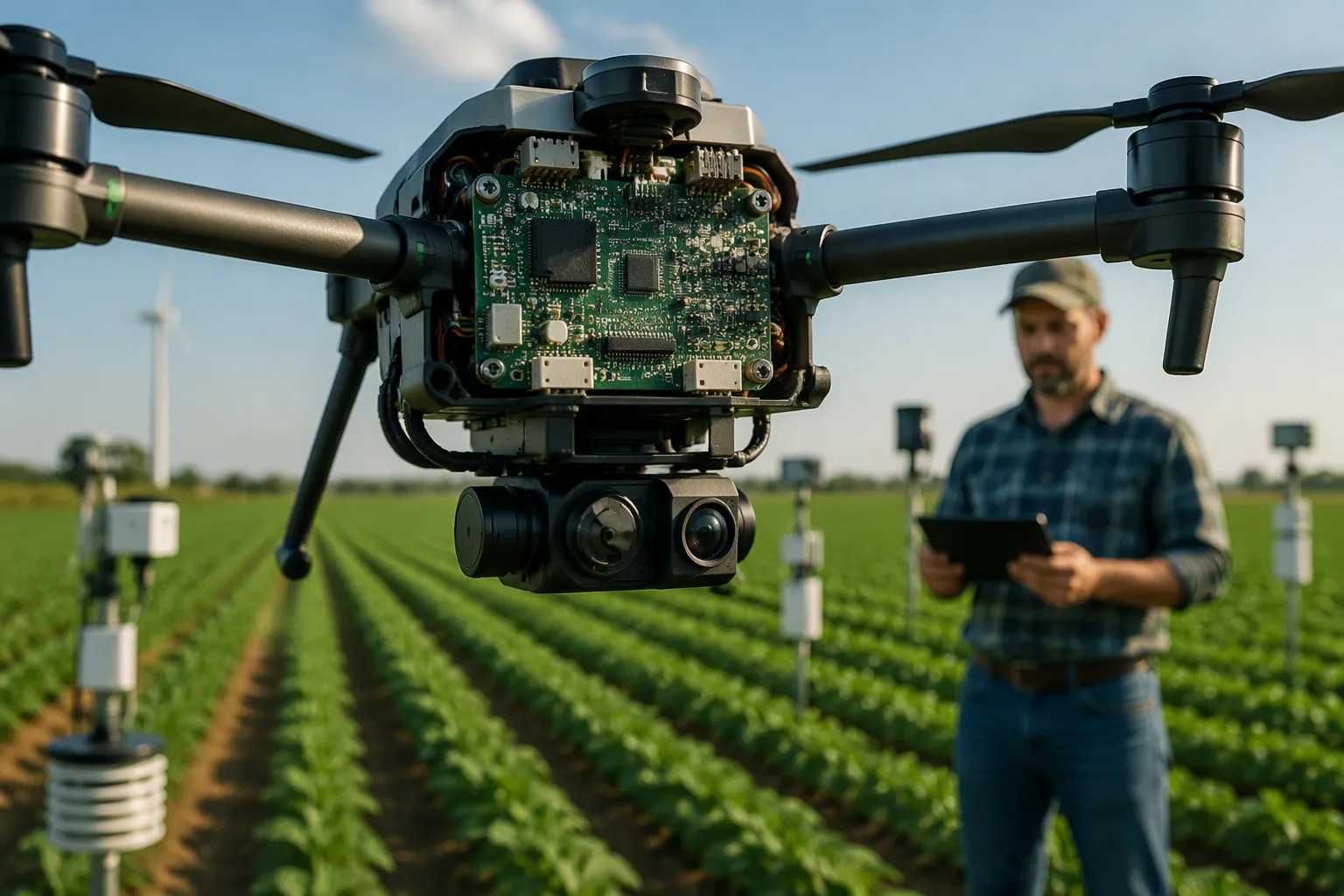
AI drone PCB assembly is the hardware foundation that turns UAVs into intelligent sensing platforms for smart agriculture and environmental monitoring. These aircraft no longer just fly and record. They identify crops, read sensor arrays, and act on what they detect.
The engineering challenge sits at board level. Vision drone controllers and agricultural drone PCBs must carry real-time video, sensor data, and AI inference at the same time. Latency and power budgets stay tight throughout each mission. Designers balance processing headroom against battery life and heat.
Board-level decisions shape real mission outcomes. Trace routing, component placement, and power architecture determine whether a drone detects a pest infestation in time or misses it. This article connects those engineering choices to field performance.
Key Takeaways
Custom PCBA assembly boosts drone performance for AI tasks like real-time video and sensor data processing.
AI drones use sensor fusion and edge computing to make quick decisions without relying on the cloud.
These drones help farmers monitor crops and detect pollution by collecting and analyzing data on the fly.
Future trends include neuromorphic chips and better regulations to make drones more autonomous and compliant.
Documenting assembly against standards like IPC-A-610 Class 2 ensures reliability and traceability.
Why AI Drone PCB Assembly Matters
A drone carries several electronic subsystems. Each one uses a PCB as both electrical interconnect and structural carrier. The flight control PCB manages motor control and sensor processing, and it sits at the center of every flight decision.
Limits of Off-the-Shelf Boards
Standard boards serve short development cycles well. They suit conventional FPV builds and light agricultural tasks, where the processing load stays predictable and the timeline stays short. Designers get a proven platform without a custom layout cycle.
High-throughput vision changes the picture. Real-time video feeds, multi-sensor fusion, and on-device inference push data rates and thermal loads past what a general-purpose board handles comfortably. AI drone PCB assembly addresses that gap through layout, stackup, and power design matched to the workload.
Matching PCBA to Mission Profiles
Mission profiles differ, and the board should follow the mission. Agricultural sensing demands robustness against dirt, ice, and difficult conditions, fast reaction to sudden obstacles, and diagnostic feedback on sensor status. Off-highway sensor designs often run on a 12/24V variable supply with J1939 CAN compatibility and support for up to 20 line or point objects in distance and localization modes.
Design Consideration | What It Supports |
|---|---|
Field nodes exposed to weather, vibration, and EMI | |
Thermal management and smart cooling | High-throughput vision and edge AI in sealed enclosures |
Sensor fusion and virtual sensors | Multi-sensor fusion mission profiles |
Edge AI analytics | Local decision-making without cloud dependency |
Advanced substrates and HDI | Dense multi-sensor and high-speed vision routing |
Custom boards let a drone carry the throughput that real-time video, sensor data, and AI inference demand. A dense fusion node shows why layout matters: keeping all sensors on top, clearing the RF section below, and tuning the matching network for nearby sensor ICs protects signal integrity. AI drone PCB assembly turns those choices into a repeatable build.
Core Technical Building Blocks
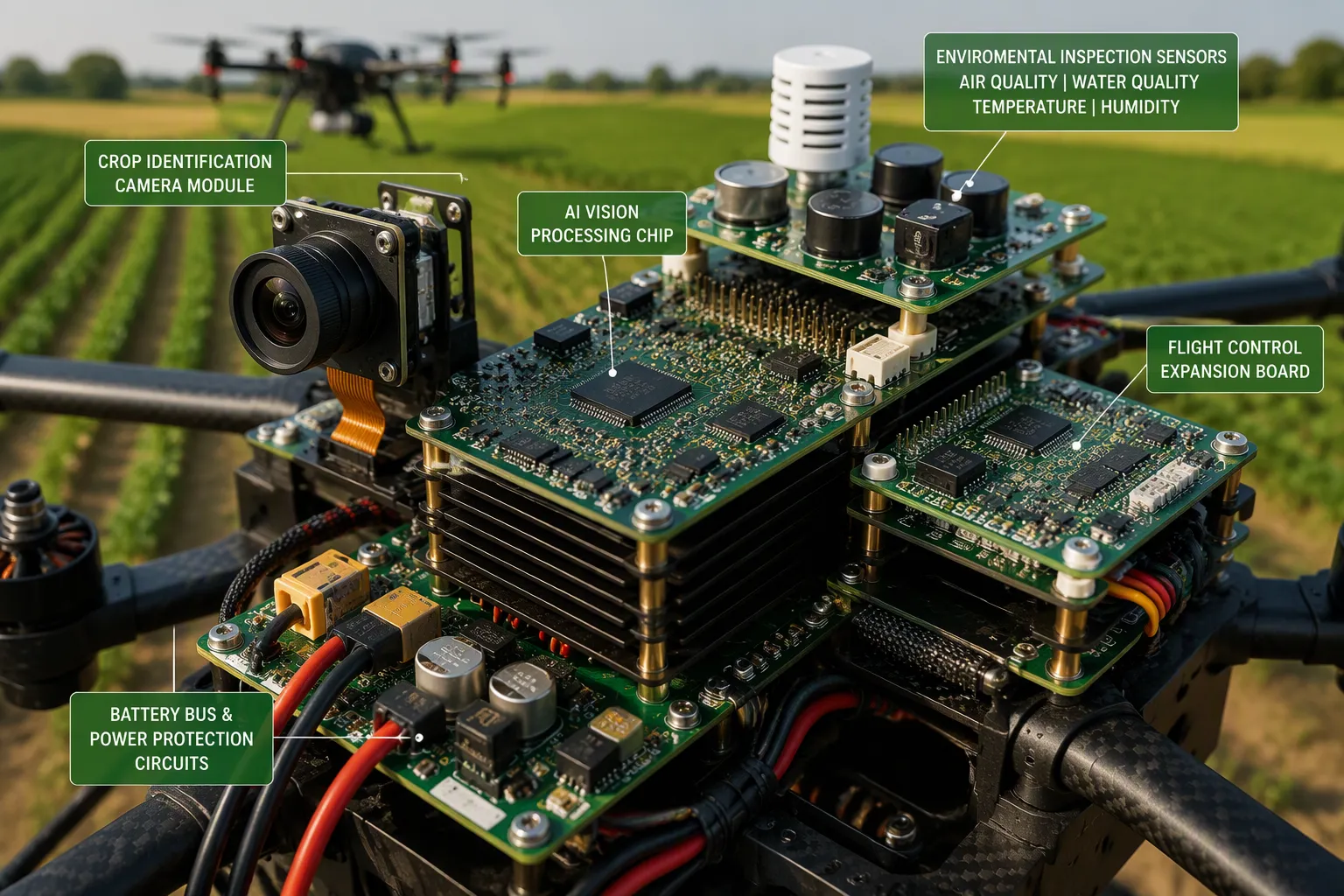
AI drone hardware breaks into modular building blocks. Crop identification cameras capture canopy imagery. Environmental inspection sensors sample air and water conditions. Flight control expansion boards add processing and I/O without a full redesign. Each block needs a board that carries it mechanically and connects it electrically.
Sensor Fusion and AI Processing
The flight controller PCB and the AI vision path divide the work. The flight controller handles direction, altitude, and speed. The vision path processes frames for obstacle avoidance and target identification. Both paths share power and data buses, so layout discipline matters.
Technical Challenge | Solution in Drone PCBA Assembly |
|---|---|
High data throughput from video, sensors, and inference | Custom PCBs built for high throughput without compromising flight performance |
Millisecond-level collision avoidance | FPGA/ASIC hardware acceleration, cutting latency by over 90% |
Power efficiency across many sensors | Dynamic voltage scaling and low-power sleep modes |
Sensor synchronization across LiDAR, radar, vision, and IMUs | ARM Cortex-M processors or FPGA solutions handling simultaneous data |
Signal integrity for high-frequency LiDAR/radar | Impedance-controlled routing to prevent noise and degradation |
Real-time CNN inference | Onboard NPUs reaching about 3ms object detection with YOLOv7 |
Thermal load under AI workloads | Multi-layer heatsink PCBs for extreme conditions |
Power, Battery Protection, and Rugged Design
Power distribution feeds every block from one battery bus. Protection circuits guard against overcurrent and reverse polarity. Vibration resistance comes from staked components and reinforced mounting. Connectors use locking hardware that holds under rotor vibration.
Parameter | Off-the-Shelf PCB | Custom AI-Optimized PCB |
|---|---|---|
Power Efficiency | 8-12W | 3-5W (dynamic voltage scaling) |
Processing Bandwidth | 4 TOPS | 28+ TOPS (tensor cores) |
Thermal Management | Passive cooling | Multi-layer heatsink PCBs |
Update Cycle | 6-12 months | OTA firmware upgrades |
These figures come from NVIDIA Jetson performance benchmarks, Q2 2024. The trade-off is objective. Off-the-shelf boards shorten development, and custom assemblies buy throughput and efficiency for vision-heavy missions.
Performance Benchmarks
AI Drone PCB Assembly vs. Off-the-Shelf
Throughput, latency, and power efficiency separate the two approaches most clearly. Published NVIDIA Jetson benchmarks from Q2 2024 put off-the-shelf boards near 4 TOPS of processing bandwidth and 8-12W of power draw. Custom AI-optimized assemblies reach 28+ TOPS with tensor cores and hold power to 3-5W through dynamic voltage scaling.
Metric | Off-the-Shelf PCB | Custom AI-Optimized PCB |
|---|---|---|
Processing bandwidth | 4 TOPS | 28+ TOPS |
Power draw | 8-12W | 3-5W |
Collision-avoidance latency | Baseline | Over 90% lower with FPGA/ASIC acceleration |
Cloud response time | Baseline | 92% faster with edge inference |
Latency tells a similar story. IEEE Robotics 2024 reports that edge AI on custom assemblies cuts cloud response times by 92%. Onboard NPUs reach about 3ms object detection with YOLOv7. These are trade-offs, not a verdict. Off-the-shelf boards win on time-to-market, and AI drone PCB assembly wins on sustained vision workloads.
Vibration and Thermal Reliability
Field reliability depends on test conditions that mirror the mission. Vibration tables shake assembled boards across the rotor frequency band while fixtures monitor solder joint integrity. Thermal chambers cycle units between cold soak and elevated operating temperatures under full AI load. Inspectors then check assemblies against IPC-A-610 Class 2 acceptance criteria.
In-house assembly of custom drone FPV PCB circuit boards shortens this loop. Engineers adjust staking, connector locking, and heatsink contact, then retest within days rather than weeks. Agricultural and FPV drone programs benefit most, because their airframes and payloads change often. Rapid iteration keeps vibration and thermal margins current with each design revision.
Applications in Agriculture and Environmental Monitoring
Precision Agriculture and Crop Health
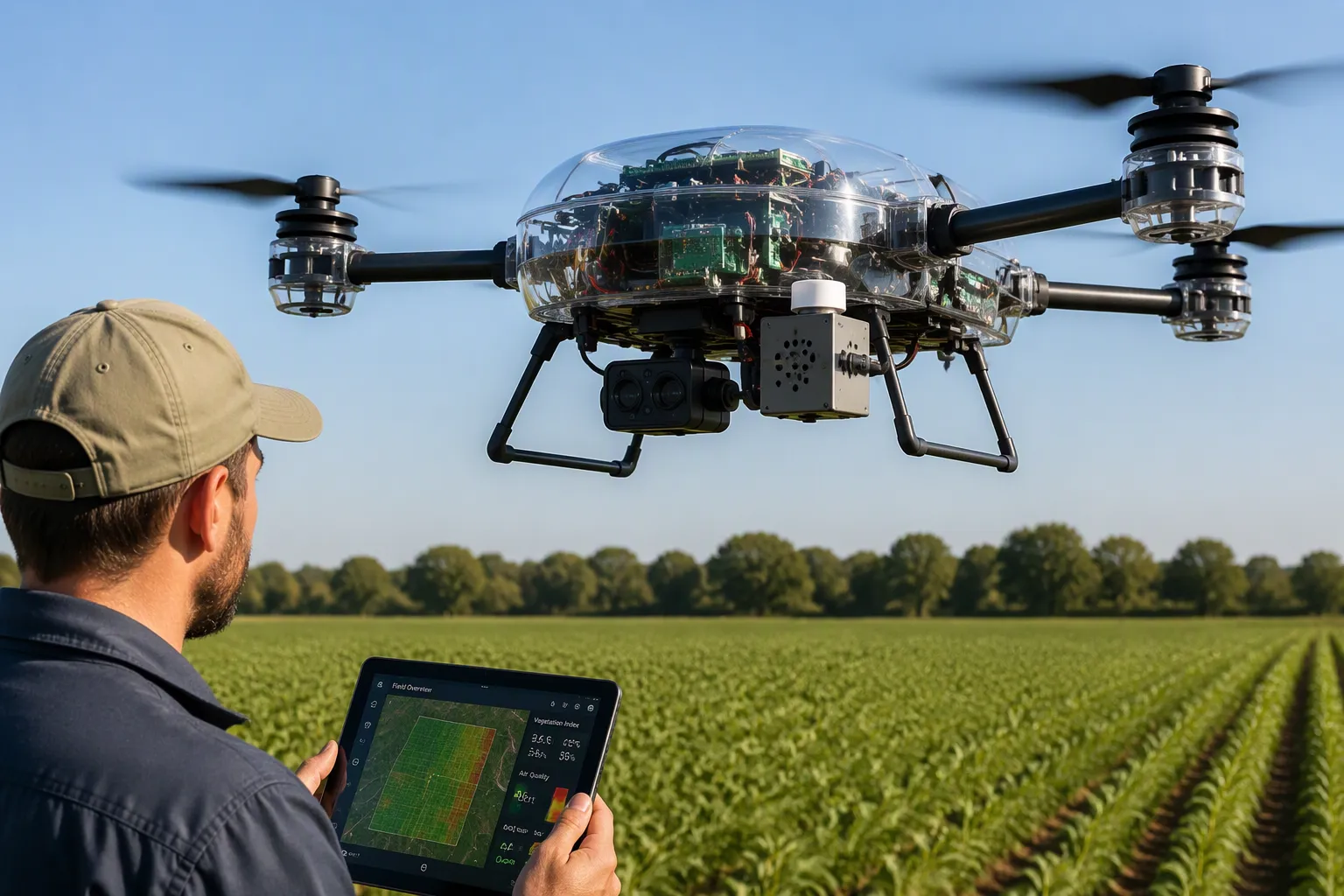
Crop identification cameras give growers a view of canopy health that ground surveys cannot match. These cameras capture imagery across visible and near-infrared bands, and the agricultural drone PCB processes each frame on board. AI algorithms then flag stress patterns, discoloration, and pest damage while the drone is still over the field.
Soil conditions follow the same logic. Moisture sensors and water level sensors feed readings into the flight control expansion board, and the drone maps variation across a field rather than reporting a single average. A grower can then direct irrigation and inputs to the zones that need them. Insect infestations show up as spectral anomalies, and the vision path isolates those patches for closer inspection on a later pass.
Pollution Detection and Ecosystem Sensing
Environmental inspection equipment turns the same airframe into a mobile laboratory. Air quality payloads measure particulate matter, VOCs, oxidizing gases, humidity, and temperature, and they stamp each reading with GPS location and time. Live data links over cellular move results to the ground while the drone is still flying.
Environmental Domain | Drone-Mounted Equipment / Sensors |
|---|---|
Air quality | Plug-and-play payload for particulate matter, VOCs, oxidizing gases, humidity, and temperature, with GPS and time stamp |
Water and soil | Soil moisture sensors, water level sensors, flow and leak detection |
Ecosystem and acoustic sensing | Acoustic nodes that classify sound sources and ultrasonic detection of bat echolocation calls |
Mapping and terrain | LiDAR, photogrammetry, point clouds, 3D models, orthophotos, GIS-ready datasets |
Inspection | Imaging and video cameras for power networks, pipelines, and structures |
Autonomy keeps these missions running without constant human input. Multi-modal SLAM provides situational awareness and obstacle avoidance. AI-based sensor fusion across GNSS, magnetometer, radar, LiDAR, and cameras builds a real-time picture of the surroundings, so the drone localizes and adapts to changing conditions. Edge-near-sensor compute processes data locally, and a redundant sensor architecture maintains safe navigation when one sensor is compromised. Imaging modules stream low-latency data over MIPI CSI-2 or GMSL into edge platforms such as NVIDIA Jetson or NXP i.MX 8, where segmentation and anomaly-detection models run on board.
Task-allocation research strengthens this further. An enhanced ant colony optimization adds an obstacle-avoidance factor to the state-transition probability and uses a Gaussian-distribution-based adaptive pheromone coefficient. Drones share raw data directly with one another, so a mission continues even if one unit fails. Climate monitoring, water quality control, emissions tracking, and biodiversity surveillance all benefit from this coordinated, self-directed operation.
Future Trends and Compliance
Neuromorphic Computing and Edge AI
Neuromorphic processors mark a promising direction for drone PCBAs. These chips mimic the event-driven signaling of biological neurons. They fire only when input changes, so idle pixels and steady sensor readings consume almost no power. A vision drone controller built on this architecture could hold inference within a smaller power budget and shed less heat inside a sealed airframe.
Regulatory Pathways for Autonomous UAVs
Autonomy raises the compliance bar, and operators must clear it before flight. Most countries regulate drone registration, pilot certification, airspace restrictions, flight altitude limits, and privacy. Regulators classify operations into categories that set the applicable requirements, and operators obtain flight authorization before conducting a mission.
EASA regulations build a more consistent EU-wide framework for commercial operations and support cross-border activity.
Pilot certification requirements reward investment in training.
No-fly zones and airspace restrictions apply to every mission.
Beyond-visual-line-of-sight missions carry additional regulatory complexity.
GDPR obligations cover privacy, cybersecurity, and data governance, especially for surveillance work.
Divergent national rules complicate cross-border operations.
Regulatory clarity encourages investment in testing facilities, drone corridors, and autonomous navigation. Design teams should document assembly against named standards such as IPC-A-610 Class 2, because certification bodies increasingly ask for traceable process records alongside the airframe approval.
AI drone PCB assembly changes what a UAV is. Onboard vision, sensor fusion, and edge inference let the aircraft identify targets and avoid obstacles without a pilot watching every frame. The platform shifts from remote-controlled camera to autonomous decision-maker.
Board-level engineering carries that shift. Custom layouts deliver 28+ TOPS at 3–5W, and edge inference responds 92% faster than cloud paths. Ruggedization holds those gains through vibration and heat. Teams that document builds against IPC-A-610 Class 2 keep reliability traceable across revisions.
Capabilities will keep expanding. Denser routing and lower-power accelerators will let future UAVs sense more, decide faster, and fly longer missions over farms and ecosystems.
FAQ
What drives demand for custom AI drone PCB assembly?
Growers and environmental teams want aircraft that identify targets and avoid obstacles on their own. Off-the-shelf boards suit short development cycles and light tasks. Vision-heavy missions need more throughput, and custom assemblies deliver 28+ TOPS at 3–5W.
Which pain points does a custom assembly solve?
Designers struggle with latency, heat, and power drain when video, sensors, and inference share one board. Custom layouts cut collision-avoidance latency by over 90% through FPGA/ASIC acceleration. Multi-layer heatsink PCBs spread thermal load, and dynamic voltage scaling holds power near 3–5W.
Do custom boards cost more time to develop?
A custom layout adds an initial design cycle. Off-the-shelf boards reach the field faster for standard FPV and light agricultural work. Custom assemblies repay that time on vision-heavy missions, where 28+ TOPS and 3–5W operation sustain real-time inference across a full flight.
Which board features matter most for field reliability?
Power protection, vibration resistance, and thermal design decide field uptime. Locking connectors hold under rotor vibration, and staked components survive sustained shaking. Demanding flight control systems use 6-layer boards that separate power and ground planes from high-speed traces. Documented builds keep certification traceable.
See Also
Durable Edge AI Circuit Board for Canada Outdoor Surveillance Systems
Smart Sensor Circuit Board for Netherlands Greenhouse and Semiconductor Machinery
Tough AI Circuit Board for Norway Marine and Energy Tracking Systems
Precision AI Circuit Board for Switzerland Medical and Measurement Instruments
AI Circuit Board for Denmark Smart Healthcare and Connected IoT Devices