
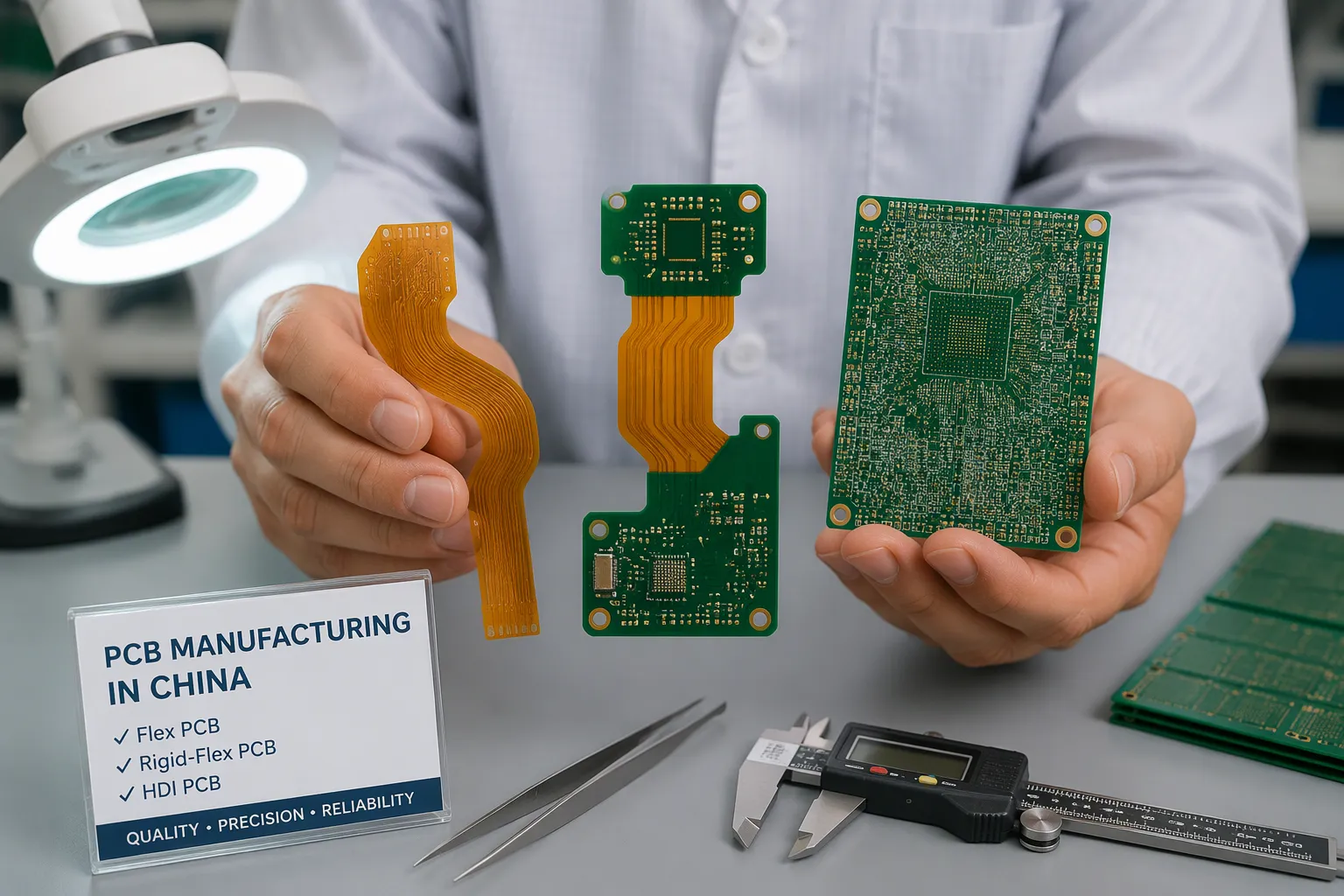
Flex, Rigid-Flex, and HDI PCBs differ in construction, flexibility, and routing density. The best china pcb manufacturer for a given project therefore depends on technical requirements, order volume, and budget. A supplier that excels at high-density interconnect mass production may not suit a dynamic bending application, and the reverse holds true as well. This comparison examines each PCB type, the factors that matter when evaluating a pcb manufacturer in china, and the way to match supplier strengths to a specific project. Buyers who understand these distinctions can shortlist candidates with confidence and avoid costly mismatches between design intent and manufacturing capability.
Key Takeaways
Match PCB type to project needs: flex and rigid-flex for bending, HDI for high-density routing.
Check supplier certifications and process control for bend zones and microvias.
Order a pilot build to test bend life and stack-up accuracy before production.
Compare total cost, not just unit price, including tooling and test charges.
Shortlist three to five manufacturers and verify their capabilities with documentation.
Flex, Rigid-Flex, and HDI Defined
Flex and Rigid-Flex Construction
A flex circuit starts with a thin dielectric film. Polyimide is the common choice for demanding work because it tolerates soldering heat and repeated bending far better than polyester. Polyester suits simple, low-cost static designs. Single-layer flex carries one conductor layer; multilayer flex stacks several layers with plated through-holes. Polyimide material quality drives bend life, so buyers should confirm the film grade and adhesive system with the supplier.
A rigid-flex circuit board bonds rigid FR-4 sections to flexible cores during lamination. The flexible sections act as built-in cables, and the rigid sections hold connectors and dense circuitry. This hybrid removes connectors and solder joints from the bend path. Designers choose rigid-flex pcbs when an assembly must fold into a tight enclosure yet still support component mounting. The rigid and flexible substrates share one continuous lamination, so the transition zones demand careful design review.
HDI Density and Microvias
High-density interconnect boards raise routing density through sequential build-up layers. Each build-up layer adds fine-line traces and microvias, which are small laser-drilled holes that connect adjacent layers. Blind/buried vias link inner layers without passing through the full board thickness. This architecture packs fine-pitch components, such as high pin-count BGAs, into a compact footprint.
The right choice depends on mechanical duty. Flex and rigid-flex shine in dynamic bending applications, where the board must survive repeated flexing. Rigid HDI boards cost less for stable designs that never move. HDI manufacturing also demands tighter process control than standard rigid boards, so buyers should verify a supplier’s build-up experience before committing.
Evaluating a China PCB Manufacturer
Technical Capabilities and Tolerances
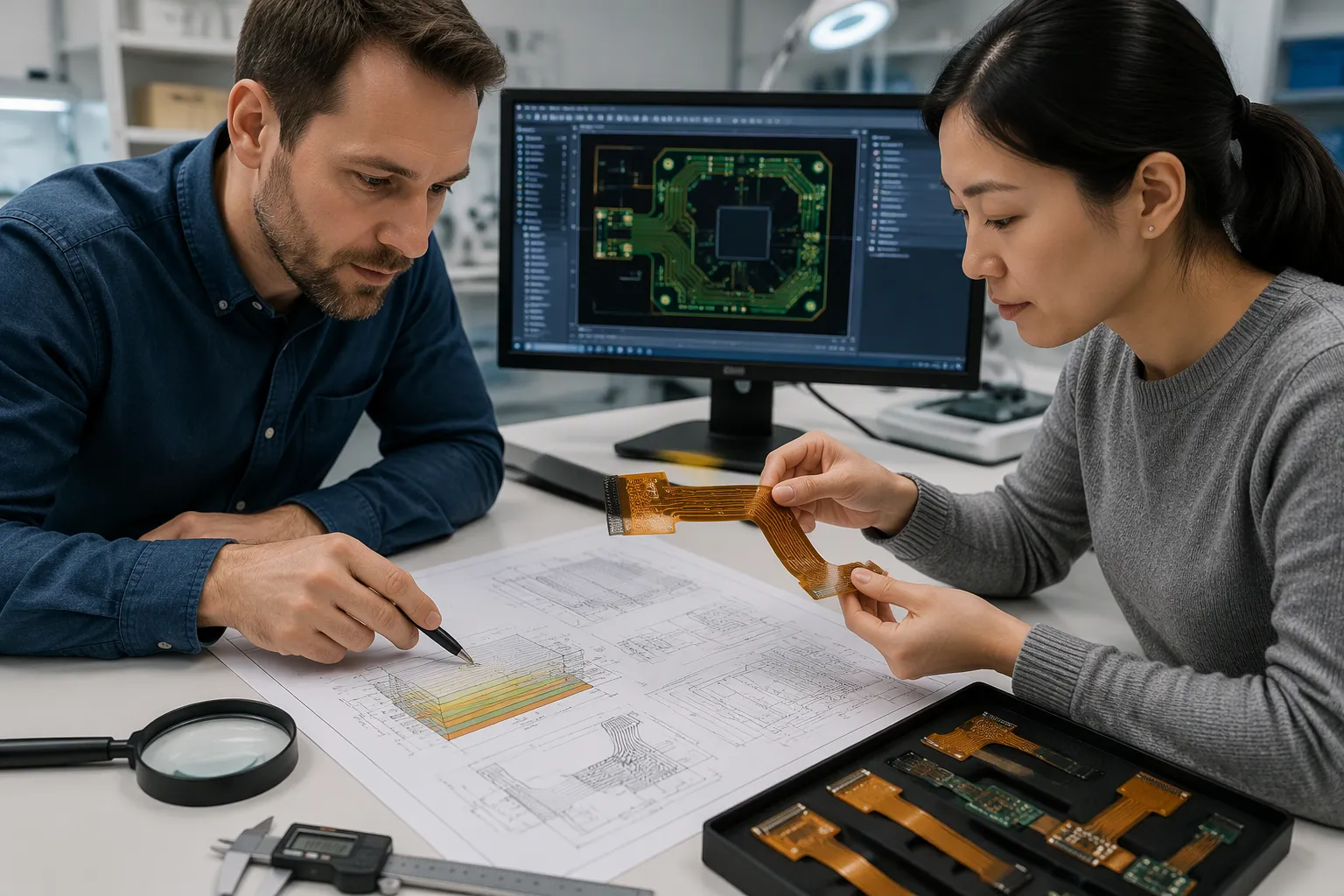
A capable supplier reviews the construction before quoting. The buyer should confirm the polyimide grade, the adhesive system, and the layer stack for every flex and rigid-flex order. Connector fit deserves equal attention. Stiffener placement, bond-ply thickness, and coverlay openings all affect how a connector seats, and a small mismatch can scrap an entire lot. Ask the supplier to walk through these details on a drawing rather than accept a verbal assurance.
Bend duty requirements separate serious rigid-flex pcb manufacturers from general board shops. A static bend needs far less process control than a dynamic bend that flexes thousands of times in service. The supplier should state how it controls bend radius, trace orientation, and plating quality in the flexible zones. Handling processes matter too. Flex circuits are thin and fragile, so the factory needs tray-based transport, controlled cleaning, and trained operators to prevent creases and scratches.
Certifications, Capacity, and Lead Time
Quality systems provide the first filter. A china pcb manufacturer with current ISO 9001 registration and IPC-A-600 or IPC-6013 familiarity has documented process control. IPC-6013 covers flex and rigid-flex acceptance, so it is the relevant standard for these builds. Capacity claims need scrutiny as well. Ask how many lamination cycles the line runs per week and whether the quoted lead time holds during peak season.
DFM support reveals how much engineering support a supplier offers. Strong design for manufacturability review catches trace-to-edge clearance problems, missing teardrops, and impossible bend zones before tooling starts. Sourcing risk rises when a pcb manufacturer in china subcontracts lamination or plating to unknown partners. Request the actual production site and confirm which steps stay in-house.
Evidence beats promises. A representative pilot build shows real capability. Order a small lot, inspect the flex zones under magnification, and test bend life against the design target. Compare the delivered stack-up to the approved drawing. This single step exposes more about a supplier than any brochure. Buyers who run this check on several pcb manufacturers in china quickly separate reliable partners from optimistic sales teams.
PCB Manufacturers in China by Specialty
Rigid-Flex PCB Manufacturers
Flex and rigid-flex specialists build their business around thin-film lamination and bend reliability. These rigid-flex pcb manufacturers invest in coverlay alignment, controlled depth routing, and stiffener bonding. Their engineers understand how trace orientation and bend radius affect fatigue life. A dedicated rigid-flex pcb manufacturer typically accepts lower layer counts but delivers tighter process control in the flexible zones. Buyers with dynamic bending requirements should start their search here.
Many of these shops also run rigid-flex pcb manufacturing for medical, aerospace, and wearable products. That focus shapes their tooling and inspection routines. One china pcb manufacturer in this group may handle advanced hdi rigid-flex pcbs as a niche offering, yet volume capacity stays modest. Buyers should confirm capacity before placing a large order. A specialist suits prototype and mid-volume work, where engineering support matters more than raw throughput.
HDI and Combined-Capability Suppliers
HDI mass-production leaders build sequential lamination lines and laser drilling at scale. Proven high-end hdi capability shows in fine-line resolution and microvia reliability across many build-up layers. These factories excel at high-volume manufacturing for consumer electronics and mobile devices. Their fabrication teams tune process windows for repeatability, and their quotes reflect that scale advantage.
Some pcb manufacturers in china handle flex, rigid-flex, and hdi under one roof. Combined-capability suppliers reduce sourcing risk and simplify communication for mixed-technology assemblies. Buyers should still match order volume and complexity to the right group. A high-end hdi leader may treat a small rigid-flex order as low priority. Conversely, a flex specialist may lack the build-up experience for dense designs. The keyword rigid-flex pcb manufacturers appears again here because specialty fit drives outcomes. Buyers who map project needs to supplier strengths avoid both traps.
Manufacturer Comparison at a Glance
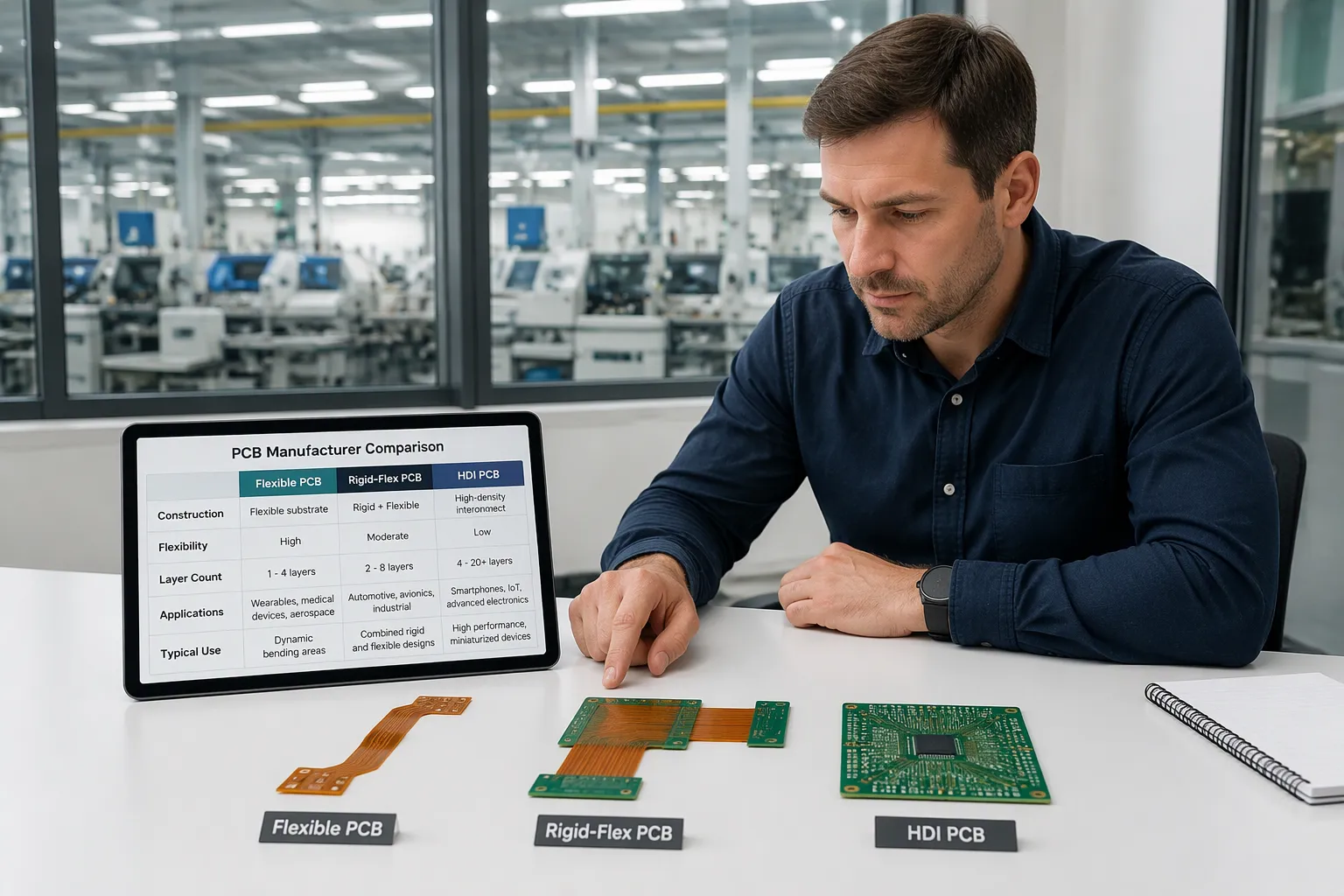
The table below summarizes how the three supplier groups typically differ across the factors that matter most during selection. Entries describe general tendencies, not guarantees. Buyers should confirm every claim against a supplier’s own documentation and a pilot build.
Factor | Flex and Rigid-Flex Specialists | HDI Mass-Production Leaders | Combined-Capability Suppliers |
|---|---|---|---|
PCB type focus | Flex and rigid-flex, including dynamic bend designs | Rigid HDI, high layer counts, fine-pitch work | Flex, rigid-flex, and HDI under one roof |
HDI capability | Limited; often a niche offering | Proven high-order build-up experience | Moderate to strong, varies by line |
DFM support | Strong on bend zones, coverlay, and stiffeners | Strong on microvia and fine-line rules | Broad but sometimes less deep per technology |
Quality systems | ISO 9001 with IPC-6013 familiarity | ISO 9001 with tight process-window control | ISO 9001 across multiple product lines |
Lead times | Longer on complex rigid-flex, shorter on prototypes | Competitive at volume, slower on small lots | Mixed; depends on which line runs the order |
Sourcing risk | Low for bend-critical work, capacity limits at scale | Low at volume, low priority for small flex orders | Reduced coordination risk, diluted focus risk |
Read the table by column first. A project with dynamic bending duty points to the first column, where rigid-flex pcb manufacturers concentrate their process control. A dense, high-volume design points to the second column. Mixed-technology assemblies often fit the third column, which simplifies communication across board types.
Then weigh the rows by project priority. Technical fit outranks price when bend life or microvia reliability decides whether the product works. Quality systems act as a baseline filter for every project. Lead time and sourcing risk carry more weight during ramp-up than during prototyping. A rigid-flex pcb manufacturer with modest capacity may still win a prototype order on engineering depth. The same shop may lose a production order to a larger pcb manufacturers in china rival with spare lamination cycles.
One caution applies to every cell. Table entries compress real differences, and a single strong capability can outweigh several weak ones. Buyers should treat the comparison as a shortlisting tool, then verify the shortlisted suppliers through documentation and sample builds. This approach keeps the rigid-flex decision grounded in evidence rather than reputation.
Cost Drivers and Price Ranges
Cost Factors by PCB Type
Material choice sets the first cost tier. Polyimide film costs more than polyester, and buyers who specify polyimide for a static design pay for bend life they never use. Layer count compounds the effect. Each added conductor layer in a flex stack requires another lamination cycle, more coverlay alignment, and tighter registration. A multilayer flex therefore costs substantially more than a single-layer part of the same outline.
Bend requirements push rigid-flex pcbs into a higher price band. Dynamic bend zones demand premium film grades, rolled annealed copper, and careful trace routing. Rigid-flex pcb fabrication also bonds FR-4 sections to flexible cores, and that hybrid lamination adds process steps and yield risk. A static rigid-flex design costs less than a dynamic one with the same layer count. HDI pricing follows a different curve. Microvia count and build-up layer number drive cost more than panel area, because each sequential lamination pass adds laser drilling and plating steps.
Volume, Tooling, and Total Cost
Tooling spreads across the order quantity. Flex and rigid-flex fabrication often needs custom fixtures for coverlay pressing and stiffener bonding, and those one-time charges weigh heavily on small lots. HDI tooling includes laser drill programs and test fixtures that carry high upfront cost. At low volume, tooling can dominate the quote. At high volume, the per-unit tooling share shrinks and material and process time take over.
Test requirements shape total cost across all three types. Flying probe test suits prototypes and low volume. A dedicated test fixture adds expense but cuts test time at volume. Buyers should request quotes at two or three quantities and compare the total, not the unit price alone. A supplier with strong manufacturing discipline may quote higher per unit yet deliver fewer scrap lots. That difference often outweighs a small price gap.
Common Challenges and Fixes
Quality and Communication Pitfalls
Bend-fatigue failure ranks among the most common field failures in flex and rigid-flex assemblies. Traces routed across a bend zone at the wrong angle crack after repeated flexing. Plating quality in the flexible region also drives fatigue life. A supplier that lacks bend-zone discipline may pass a first-article inspection yet fail in the field.
Connector mismatch creates another frequent problem. Stiffener placement, coverlay openings, and bond-ply thickness all shift how a connector seats. A small dimensional error can prevent assembly or weaken the solder joint. Spec miscommunication compounds these risks. Buyers send a drawing, suppliers interpret it differently, and the finished board misses the design intent. Clear written specifications prevent most of these disputes.
Verification Steps
Mitigation starts with design for manufacturability review. A capable rigid-flex pcb manufacturer flags impossible bend zones, missing teardrops, and trace-to-edge clearance problems before tooling begins. Buyers should treat this review as a gate, not a formality.
Pilot builds provide the strongest evidence. Order rigid-flex pcb prototypes in a small lot and test bend life against the design target. Compare the delivered stack-up to the approved drawing. Quick-turn prototypes let teams validate construction early, before committing to production volume. Incoming inspection closes the loop. Check flex zones under magnification, verify connector fit, and confirm material grades against the purchase order. Buyers who pair DFM review with pilot validation and incoming inspection catch most defects before they reach the assembly line. This disciplined approach protects both schedule and budget.
Applications by PCB Type
Flex and Rigid-Flex Use Cases
Dynamic bending duty defines the first application group. Products that flex repeatedly in service — folding wearables, hinged handheld devices, articulated camera modules — rely on flex circuits with rolled annealed copper and carefully oriented traces. Space-constrained designs form the second group. A flex circuit folds into gaps that no rigid board can fill, and it routes around obstructions inside compact enclosures. Weight-sensitive products form the third group. Thin polyimide film replaces heavier cable harnesses and connectors, which trims mass from drones, portable medical devices, and aerospace assemblies.
Rigid-flex pcbs serve applications that combine all three demands. A rigid-flex assembly folds into a tight housing yet still supports mounted components on its stiff sections. Medical catheters, implantable device interconnects, and compact instrument clusters use this hybrid construction. Buyers in industrial and automotive pcb applications also adopt rigid-flex for vibration-prone mounts, where removing connector joints improves reliability. Each of these use cases rewards a supplier with proven bend-zone process control.
HDI Use Cases
High-density interconnect boards serve designs that pack many connections into a small area. Smartphones, tablets, and wearables use hdi build-up layers to route fine-pitch processors and memory without enlarging the board. Microvias and blind/buried vias free routing space on outer layers, which lets designers place dense component clusters. Medical imaging modules and high-resolution sensor packages follow the same logic.
The common thread is pin density. Fine-pitch BGAs and chip-scale packages demand trace widths and via sizes that standard rigid boards cannot hold. HDI manufacturing answers that need through sequential lamination. These boards suit stable, high-volume products rather than dynamic bending duty. A design team should match the routing challenge to the technology, then confirm the supplier’s build-up experience before release.
Choosing a Rigid-Flex PCB Manufacturer
Define Requirements and Shortlist
Selection begins with a written requirements package. The electrical side covers layer count, impedance targets, current loads, and connector pinouts. The mechanical side covers outline dimensions, bend radius, bend duty (static or dynamic), and stiffener locations. Volume matters too. Buyers should state prototype quantity, expected annual volume, and ramp schedule. A clear package lets rigid-flex pcb manufacturers respond with meaningful quotes instead of generic estimates.
Shortlisting follows naturally. Buyers filter candidates by proven experience with rigid-flex pcbs of similar complexity. They check whether the shop runs custom rigid-flex pcb manufacturing in-house or subcontracts lamination. They also confirm capacity for the expected volume. A shortlist of three to five rigid-flex pcb manufacturers keeps competition healthy without spreading the evaluation too thin.
Audit, Quote, and Validate
A capability audit comes next. Buyers review process documentation, quality records, and sample builds from past projects. They ask how the supplier controls bend zones, coverlay alignment, and plating quality. Engineering support deserves scrutiny as well. A strong partner reviews the stack-up and flags risks before tooling starts.
Quote comparison should weigh total cost, not unit price alone. Buyers request pricing at two or three quantities and check what tooling, test, and custom rigid-flex pcb fabrication steps each quote includes. Lead time claims need confirmation against current load. The final gate is a pilot build. A small lot of rigid-flex prototypes reveals real capability in rigid-flex pcb manufacturing, from stack-up accuracy to bend life. Buyers who validate a rigid-flex pcb manufacturer this way commit with evidence rather than hope.
Each PCB type serves a distinct technical and commercial need. Flex and rigid-flex boards suit dynamic bending and space-constrained designs. HDI boards fit dense, fine-pitch routing at volume. No single supplier type wins every project. A capable china pcb manufacturer may still lack the bend-zone discipline a folding assembly demands.
Buyers should match supplier strengths to their requirements. Capability, certifications, capacity, and engineering support all carry weight. Volume and budget decide how much each matters. A pcb manufacturer in china with proven hybrid experience may beat a larger rival on a prototype order.
A practical next step is a shortlist of three to five candidates. Request capability documentation and pilot quotes from each.
FAQ
How can a buyer tell a true flex specialist from a general board shop?
Ask how the supplier controls bend radius, trace orientation, and plating quality in flexible zones. A true specialist explains coverlay alignment and stiffener bonding in detail. General shops often answer vaguely. Request sample builds from past bend-critical projects as supporting evidence.
Can one manufacturer handle flex, rigid-flex, and HDI orders together?
Some combined-capability suppliers run all three technologies under one roof. This arrangement simplifies communication for mixed-technology assemblies. Buyers should still confirm which production line runs each order. A high-volume HDI leader may treat a small rigid-flex lot as low priority, so capacity fit matters as much as capability.
What documents should a buyer request before committing to a supplier?
Request current ISO 9001 registration, IPC-6013 familiarity for flex and rigid-flex work, and process documentation for bend zones and microvias. Ask for the actual production site and confirm which steps stay in-house. A representative pilot build report adds stronger evidence than any certificate alone.
Does order volume change which supplier group fits best?
Yes. Flex and rigid-flex specialists suit prototypes and mid-volume work, where engineering depth outweighs throughput. HDI mass-production leaders excel at high volume. Buyers should state prototype quantity, expected annual volume, and ramp schedule in the requirements package so each candidate quotes realistically.
How does a buyer validate bend reliability before production?
Order a small pilot lot and test bend life against the design target. Inspect flex zones under magnification and compare the delivered stack-up to the approved drawing. Pair this validation with a design for manufacturability review and incoming inspection. This sequence catches most defects before they reach the assembly line.
See Also
Tailored AI PCBA Production Services for Electronics Firms in Mexico
Artificial Intelligence PCBA Inspection Solutions for Mexico Manufacturing Facilities
Original Equipment AI PCBA Production for Electronics Factories in Poland
AI Hardware Prototype PCBA Solutions for Israeli Vision Security Equipment
Tailored Edge AI PCBA Manufacturing for Hardware Startups in the US