
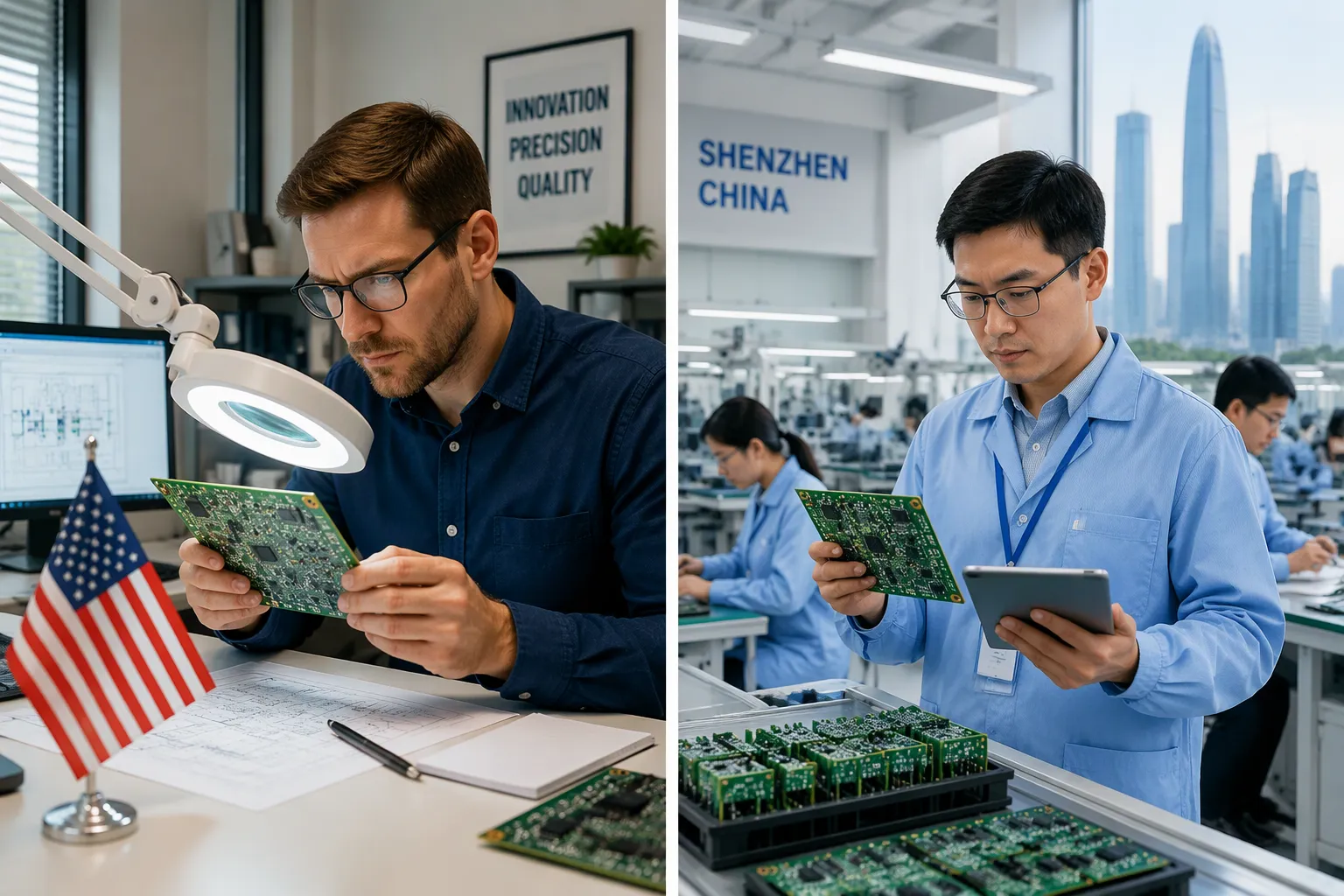
US pcb assembly usa services usually cost more, yet they deliver shorter lead times for small volumes. Offshore assembly in Shenzhen costs less at volume, but it adds shipping time and logistical complexity. Buyers weigh three drivers: cost, lead time, and fit for purpose. This comparison offers a practical checklist, and it favors neither option.
Key Takeaways
Compare total landed cost, not just unit price, to see the real savings.
Choose US assembly for fast prototypes and sensitive designs.
Use offshore assembly for high-volume, mature products to save money.
PCB Production Costs: USA vs Shenzhen
What Drives PCB Production Cost
Labor rates set the base of any pcb cost model. Lower labor costs are the primary reason China cost less than the USA for board fabrication and assembly. US fabricators counter with stronger quality control and better IP protection. Buyers should not treat price as the only factor. A board that needs rework delays the entire assembly process and erases the savings.
Several inputs shape pcb manufacturing costs beyond labor. Board complexity, layer count, component mix, and order size all move the per-unit cost. A simple two-layer board and a dense multi-layer design follow very different cost curves. Buyers who compare quotes without matching these variables rarely see real cost differences.
Volume Thresholds and Total Landed Cost
Volume changes the math. Offshore suppliers offer lower unit prices at high quantities. Small runs often lose that advantage once setup, freight, and handling spread across few boards. The landed variable cost per board captures this shift better than a unit quote.
Total landed cost adds duties, freight, and compliance to the invoice price. Section 301 tariffs already apply a 50 percent rate to semiconductors from China under the forced technology transfer investigation, per the Federal Register. A new action sets an initial 0 percent tariff that rises in 18 months, on June 23, 2027. A Section 232 proclamation also imposes a 25 percent duty on certain advanced computing chips, per Gibson Dunn. China’s export controls on tungsten, bismuth, and molybdenum have pushed ammonium paratungstate prices sharply higher, per Reuters reporting. Tungsten carbide micro drill bits drill PCB holes, so these controls feed directly into manufacturing costs. The EU’s upcoming CBAM adds another layer for exports to Europe.
CircuitHub’s automated Massachusetts factory now offers prices comparable to China. This development changes the traditional cost calculus and gives pcb manufacturers in the USA a stronger position on total cost.
Lead Time: USA vs Offshore
Production and Turnaround Timelines
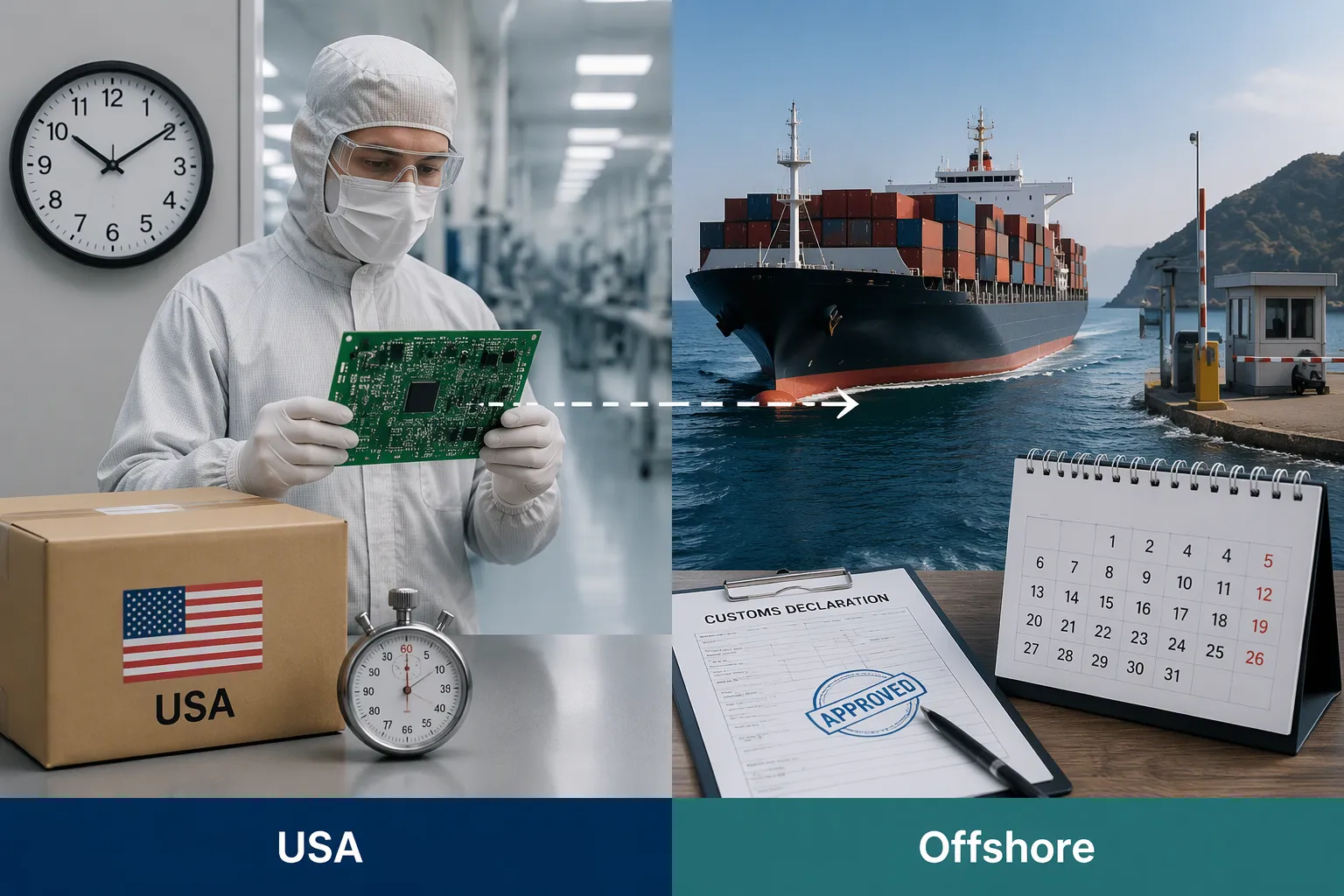
Build speed separates the two sourcing models. CircuitHub averages four days to build and ship a board, while a typical Shenzhen-based supplier averages nine days. That gap matters most during prototype iteration, when each revision restarts the clock.
US-based quick-turnaround services attract buyers who want faster turnaround than offshore options like JLCPCB can provide, even with its advertised 24-hour turnaround. The domestic advantage compounds across a project. HT Global Circuits reports that a 6-layer rigid prototype ships in 3 to 5 days, with production running 10 to 15 days. An 8-layer multilayer board prototypes in 7 to 10 days, with production at 20 to 30 days. Buyers gain shorter lead times on domestic orders because no border sits between the fab and the dock.
Lead Time | Faster turnaround. No international shipping or customs. Prototypes in days; faster time-to-market. | Longer lead times. Overseas shipping and customs can stretch delivery to several weeks.
Shipping and Customs Impact
Freight and clearance add days that no production schedule can absorb. Fenix Manufacturing lists standard ocean freight from Asia at 35 to 45 days, with emergency air freight at 5 to 7 days and a high cost attached. The table below sets the two paths side by side.
Metric | Offshore Manufacturing (Asia / China) | Nearshore Manufacturing (Dominican Republic) |
|---|---|---|
Standard Shipping Time | 35 to 45 Days (Ocean Freight) | 2 to 5 Days (Sea / Direct Port) |
Emergency Logistics | 5 to 7 Days (High Air Freight Cost) | 24 to 48 Hours |
Customs Duties & Tariffs | Section 301 Tariffs (Up to 25%+) | 0% Duty-Free under DR-CAFTA |
Working Capital Needs | 2–3 months of buffer stock locked in transit | 1–2 weeks of buffer stock required |
Customs paperwork carries its own risk. Belitechnologies notes that import clearance stays with the buyer and the customs broker, the only parties able to decide tariff classification and duty treatment. Import taxes often use a customs value that includes freight and insurance, so faster shipping raises the tax base as well as the freight bill. OurPCB warns that a wrong HTS code, a missing Chapter 99 code, or a PCBA filed as a bare PCB can trigger delays, corrections, or unexpected duty bills. EMS shipping from China to the USA typically takes several days to two weeks, depending on service level, customs clearance speed, and destination. These variables push total costs and delivery dates beyond the control of the assembly supplier.
When Offshore Assembly Makes Sense
High-Volume and Cost-Sensitive Projects
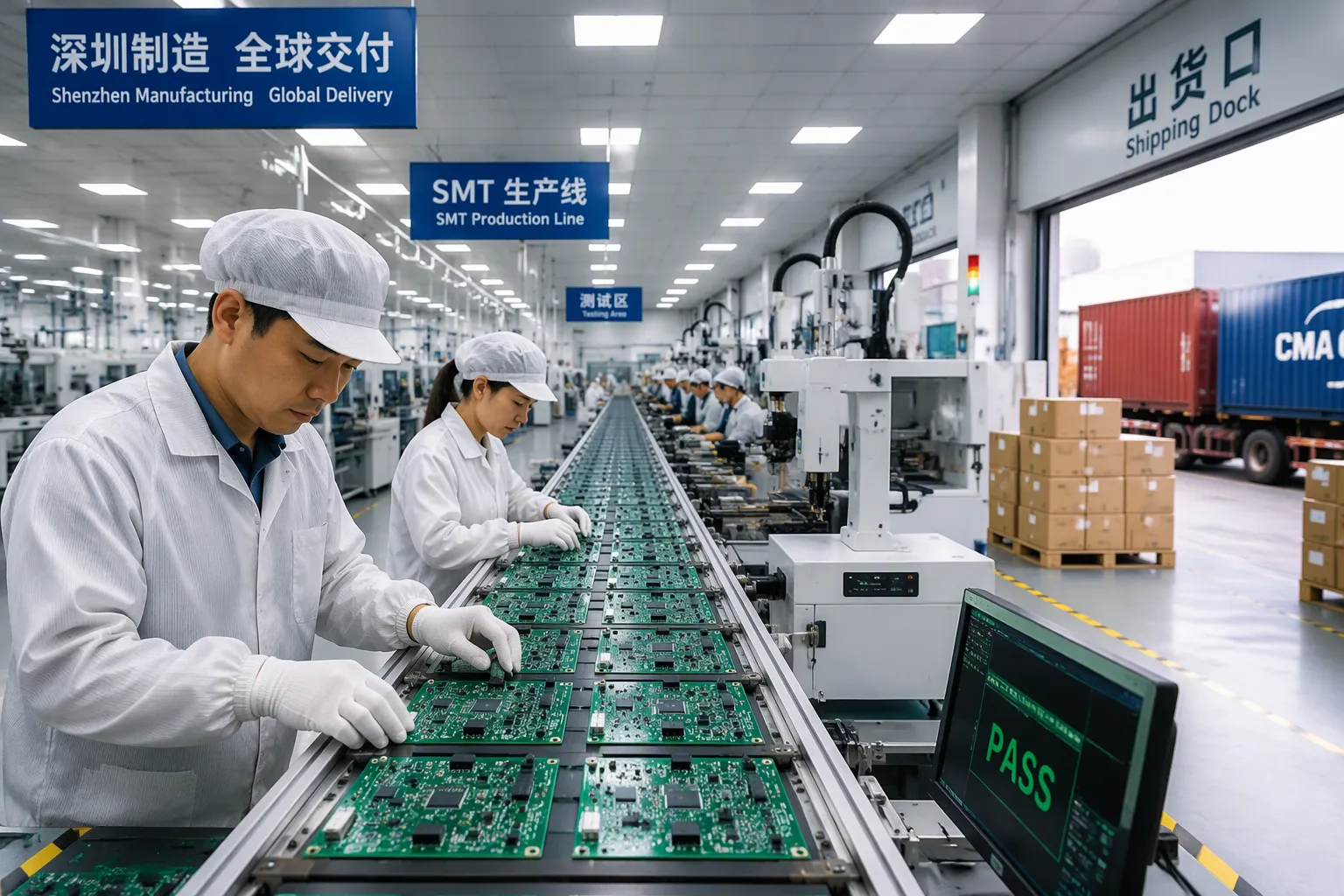
Offshore assembly delivers its clearest cost advantage at high volume. Shenzhen-based manufacturers such as Fscircuits offer global PCB manufacturing services that rival the quality of US circuit board manufacturers. Large overseas facilities spread expenses across much larger orders, and labor costs remain substantially lower in major manufacturing regions, per PCBnet. Stable demand and predictable quantities let buyers lock in a lower per-unit cost.
Volume alone does not settle the question. PCBnet notes that the quoted unit price does not always reflect what a buyer ultimately pays. Heavy or bulky products can lose the savings to ocean freight and long transit times. Localization near the assembly factory supports just-in-time delivery and reduces warehousing pressure.
Localization: While overseas labor may be cheaper, for heavy or bulky products, the ocean freight and/or long transit times offset the labor savings. Priority to suppliers around the assembly factory provides for “Just-in-Time” delivery and reduces warehousing pressure.
Mature Designs and Flexible Sourcing
Offshore manufacturing suits mature, high-volume products best. PCBnet explains that large overseas facilities offer lower per-board pricing when designs are stable, order quantities are predictable, and the production schedule can absorb longer shipping and communication cycles. Buyers who still revise layouts every week should look elsewhere.
Long-term sourcing partnerships with Chinese suppliers depend on lessons learned around quality and trust. A 17-year sourcing relationship with China shows how accumulated experience turns a transactional order into a reliable supply channel. Buyers who treat the first order as a test build build that trust gradually.
Offshore assembly fits when designs are mature and volume justifies the added logistics. Prototypes and low-to-mid-volume orders rarely clear that bar, because domestic automation and shorter supply chains have closed much of the gap, per PCBnet. Buyers weighing pcb manufacturers in the usa against Chinese partners should compare total landed costs, not headline quotes.
When PCB Assembly USA Makes Sense
Speed, Low Volume, and Prototype Iteration
Buyers choosing pcb assembly usa for speed find quick-turnaround services that beat offshore delivery. A team that must prototype and validate domestically gains days on every revision, and those days compound across a project. Domestic assembly also shortens the design-revision loop, per Hallmark Nameplate, which simplifies compliance documentation at the same time.
Low volume strengthens the case. Setup, freight, and customs charges spread across few boards, so offshore unit prices lose their edge. Buyers shortlisting pcb manufacturers in the usa should weigh them against China on costs, IP protection, and lead time rather than unit price alone.
IP Protection and Regulatory Needs
Stronger quality control and better intellectual property protection stand as key US advantages. Domestic manufacturing keeps proprietary designs under U.S. legal jurisdiction, which reduces the risk of unauthorized copying or technology transfer.
Intellectual Property Protection: Keeping production domestic ensures proprietary designs remain under U.S. legal jurisdiction. This reduces risks of unauthorized copying or technology transfer, which is a critical advantage for defense, aerospace, and emerging technology companies.
— The Strategic Benefits of Bringing PCB Assembly Back to the U.S., Suntronic Incorporated (LinkedIn)
Regulated programs often remove offshore options entirely. Sending Gerber files, stack-up details, or BOMs to a foreign company may count as an export under ITAR, per PCBnet. Under 22 CFR 122.1, manufacturers of defense articles in the United States must register with the Directorate of Defense Trade Controls, Hallmark Nameplate notes. Domestic fabricators also more often hold AS9100 and ISO 9001 with fully auditable, on-site quality systems. For medical work, ISO 13485:2016 flows down through supplier controls. These obligations make us manufacturing the practical choice for sensitive builds, and pcb assembly usa buyers gain faster turnaround with no export licensing delay.
A Practical Decision Framework
Supplier Vetting Checklist
Supplier vetting goes far beyond checking for ISO certificates. Buyers must look for risk signals in operations, environmental compliance, and quality systems. The Shenzhen environmental regulator recently penalized firms for poor environmental impact report quality, per reporting on the agency’s enforcement actions. That case shows how compliance risk can hide behind a polished brochure. A site audit should trace how a supplier handles waste, documentation, and corrective actions.
A strong checklist also covers process controls and traceability. Buyers should confirm that the supplier documents rework loops, maintains calibrated equipment, and tracks lot-level material history. These checks protect pcb manufacturing costs from hidden rework and scrap. A supplier that cannot show these records adds risk to every order.
Hybrid Sourcing and Risk Balancing
A hybrid sourcing model spreads cost, lead time, and risk across US and offshore partners. KTTS outlines practical tactics in the table below.
Strategy | Primary action | Intended benefit |
|---|---|---|
Material right-sizing | Specify generic IPC performance classes instead of a single brand | Reduces the risk that one material shortage stops production |
Hybrid layer stack-up | Combine qualified ultra-low-loss layers with conventional FR-4 cores | Reduces high-end material demand and may lower cost |
Laminate pre-ordering | Authorize raw-material purchases during early design | Helps reduce fabrication delays from long-lead inputs |
Buyers can pair domestic manufacturing for prototypes with offshore partners for volume runs. This split keeps pcb assembly usa speed for iteration and lowers unit costs at scale. Layout optimization ties the plan together. AdvancedPCB recommends involving the fabricator early, selecting the minimum layer count, and designing with fabrication and assembly constraints in mind. Nortech adds that standardizing components and aligning tolerances with process capability improve yield and field reliability. Buyers shortlisting pcb manufacturers in the usa should apply the same DFM review to every partner.
Cost favors Shenzhen at volume. Speed and simplicity favor US work for small or sensitive builds. Prototypes and low-volume runs suit pcb assembly usa. High-volume, mature designs fit offshore partners. IP-sensitive work stays domestic. Readers should weigh total landed cost and timeline, not unit price alone.
FAQ
Does offshore assembly always cost less than US assembly?
No. Offshore unit prices drop at high volume, yet freight, duties, and customs charges raise the landed cost. Small orders often lose the savings entirely. Buyers should compare total landed cost, not the invoice quote.
How do tariffs change the Shenzhen versus USA decision?
Section 301 tariffs apply a 50 percent rate to semiconductors from China. These duties raise the landed cost of offshore builds. Buyers must add tariff exposure to every quote before comparing suppliers.
Can a buyer combine US and offshore partners?
Yes. A hybrid model pairs domestic assembly for prototypes and low-volume runs with offshore partners for mature, high-volume production. This split keeps fast iteration at home and lowers unit costs at scale.
See Also
AI PCBA OEM Manufacturing Services for Electronics Factories in Poland
Tailored AI PCBA Manufacturing Solutions for Electronics Companies in Mexico
Bespoke Edge AI PCBA Services for Hardware Startups in the US
Manufacturing AI Server PCBs for GPU Hardware Companies in America