

OpenAI Stargate hardware represents a significant leap in the evolution of AI data centers. This cutting-edge hardware boosts operational efficiency by providing a staggering compute capacity of 2 × 10^21 FLOP/s, which is over 250 times that of the previous models. Additionally, the expansion to five new AI data center sites enhances scalability, enabling faster deployment and improved cost efficiency. With an investment of $500 billion, the Stargate initiative reshapes the data center landscape, positioning the Midwest as a new hub for AI infrastructure.
Key Takeaways
OpenAI Stargate hardware offers unprecedented compute power, boosting AI processing capabilities by over 250 times compared to previous models.
The expansion to five new AI data center sites enhances scalability, allowing for faster deployment and improved cost efficiency in AI applications.
Advanced cooling and power management systems in Stargate hardware reduce energy consumption, leading to lower operational costs for data centers.
The integration of GPU server backplanes enables high-speed data transfer, essential for meeting the growing demands of AI workloads.
Collaborating with manufacturers and developing robust testing strategies are crucial for the successful deployment of Stargate hardware.
Stargate Hardware Overview
Key Features
The OpenAI Stargate hardware stands out due to its remarkable capabilities. Here are some of the key features that make it a game-changer in the AI landscape:
Unprecedented Compute Power: With a compute capacity of 2 × 10^21 FLOP/s, Stargate delivers over 250 times the performance of previous models. This immense power allows for faster processing of complex AI algorithms.
Scalability: The expansion to five new AI data center sites enables you to scale operations quickly. This flexibility supports growing demands in AI applications without compromising performance.
Energy Efficiency: Stargate incorporates advanced power management systems, reducing energy consumption while maximizing output. This efficiency translates into lower operational costs for data centers.
Technological Innovations
The technological innovations behind OpenAI Stargate hardware are pivotal in enhancing AI data center operations. These innovations include:
Advanced Cooling Solutions: Stargate employs cutting-edge liquid cooling technology, which maintains optimal temperatures for hardware components. This innovation prevents overheating and prolongs the lifespan of the equipment.
Power Distribution Boards: The design includes specialized power distribution boards that ensure stable and efficient power delivery to all components. This feature minimizes downtime and enhances reliability.
Integrated GPU Server Backplanes: The hardware integrates GPU server backplanes, allowing for seamless connectivity and communication between GPUs. This integration boosts overall system performance and responsiveness.
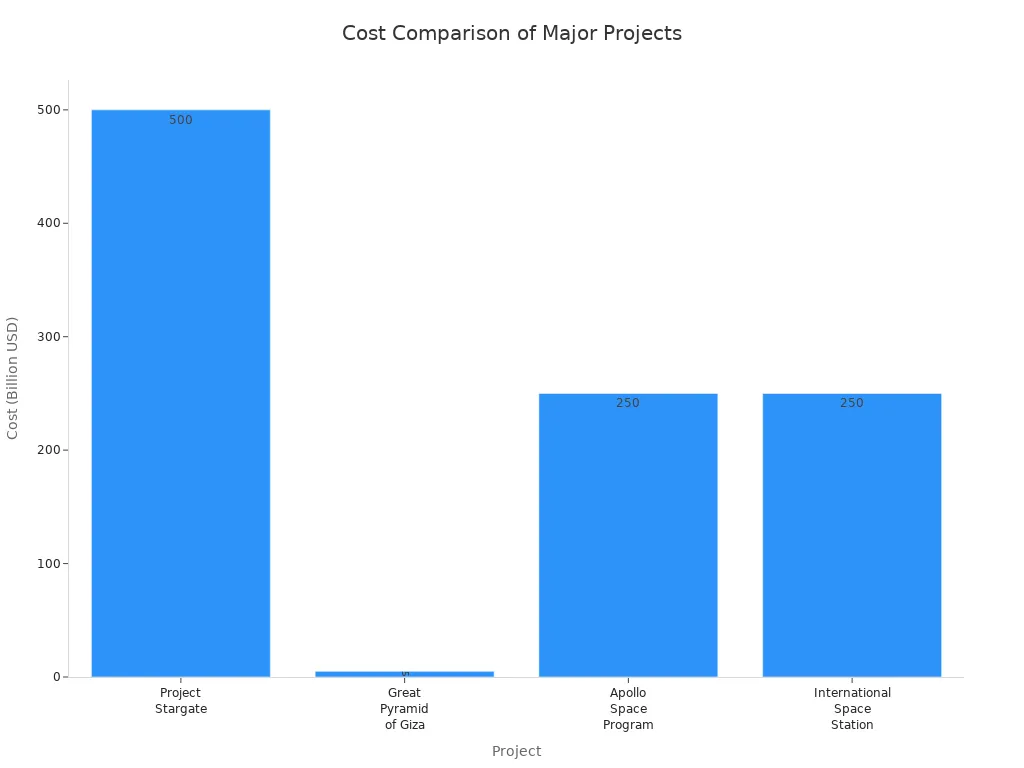
To illustrate the efficiency gains achieved through Stargate’s technological innovations, consider the following comparison of costs associated with major historical projects:
Comparison | Cost (in today’s dollars) | Notes |
|---|---|---|
Project Stargate | $500 billion | Largest AI initiative in history |
Great Pyramid of Giza | $5 billion | 100 times less than Stargate |
Apollo Space Program | $250 billion | Twice less than Stargate |
International Space Station | $250 billion | Double less than Stargate |
These features and innovations position OpenAI Stargate hardware as a leader in the AI data center market, paving the way for future advancements in technology.
Applications in Data Centers
Enhancing Server Performance
The integration of OpenAI Stargate hardware significantly enhances server performance in AI data centers. You can expect improvements in various aspects of computing, which directly address common challenges faced by data center operators. Here are some key enhancements:
Improvement Type | Description |
|---|---|
Specialized Chips | Stargate utilizes NVIDIA’s latest Blackwell chips designed for AI workloads, enhancing parallel computing. |
Advanced Cooling Systems | The hardware incorporates closed-loop water cooling to maintain optimal temperatures and reduce water waste. |
Energy Management Systems | Stargate explores renewable energy sources like solar and wind to lower environmental impact and costs. |
These advancements lead to measurable performance metrics that you can rely on. For instance, the following metrics are crucial in assessing server performance enhancements resulting from Stargate hardware:
Metric | Description |
|---|---|
Per-core performance | Higher clock speeds and/or higher IPC benefit both reasoning and action workloads. |
Core count | More cores enhance multi-threading capabilities, which is advantageous for action workloads. |
CPU-xPU interconnect bandwidth | This is important for long-context reasoning workloads, facilitating quick token exchanges. |
Memory bandwidth and capacity | Increased memory aids in task execution for both reasoning and action workloads. |
Cache size | Larger cache sizes reduce latency for action workloads by keeping small data on-chip. |
Power and Cooling Solutions
Power and cooling solutions are critical components of the Stargate project, especially given the high demands of hyperscale data centers. You will find that the design prioritizes energy efficiency, which is essential for sustainable operations. Here are some notable features:
The Stargate Project involves the construction of 20 hyperscale data centers, known for their high power demands. This indicates a significant focus on energy efficiency in their design.
Initial investments exceed KRW 30 trillion, highlighting the scale and potential energy efficiency improvements expected from such large-scale power and cooling solutions.
By implementing these advanced power and cooling solutions, you can effectively manage the challenges of high server power consumption and complex cooling needs. The Stargate initiative not only addresses these pain points but also sets a new standard for energy-efficient operations in AI data centers.
Data Center Hardware Demand
GPU Server Backplanes
The demand for GPU server backplanes is surging as AI applications become more prevalent. These backplanes play a crucial role in connecting multiple GPUs, enabling high-speed data transfer and efficient processing. The technical specifications of these backplanes are impressive:
Specification | Details |
|---|---|
Number of Connector Housings | 72 (4 × 18) |
Pins per Housing | 152 (19 rows, 4 columns, 2 pins per position) |
Total Pins per Midplane | 10,000 pins per midplane, per side |
Total NVLink Pins per Rack | Over 87,000 NVLink pins |
NVLink Switches | 6x NVLink switches connecting midplanes and compute trays |
With the projected demand reaching 900,000 DRAM wafers per month, this hardware represents up to 40% of the total global DRAM output. As you can see, the market for GPU server backplanes is not only growing but also evolving to meet the needs of advanced AI workloads.
Power Distribution and Liquid Cooling Boards
Power distribution and liquid cooling boards are essential for maintaining the performance and reliability of Stargate hardware. These components ensure that power is efficiently distributed while managing heat generated by high-performance processors. Here are some key requirements:
Requirement | Description |
|---|---|
Cooling Distribution Unit | Takes up an entire rack and requires space for tubes with water. |
Plumbing for Coolant Distribution | Significant plumbing is needed to distribute coolant to every liquid-cooled device on each rack. |
Infrastructure for AI Processors | Current infrastructure primarily supports air-cooled devices, limiting the use of AI processors. |
Type of Coolant | Distilled water is used, posing risks in case of leaks. |
Environmental Impact | Liquid cooling reduces mechanical cooling needs and lowers carbon and water footprints. |
These innovations lead to substantial benefits, including 40% power savings and a 60% smaller data center footprint. As you consider the future of data center hardware, the integration of these advanced components will be vital for optimizing performance and sustainability.
Challenges and Strategies
Technical Barriers
Implementing the OpenAI Stargate project presents several technical barriers that you must navigate. These challenges can hinder the integration of advanced hardware into existing systems. Here are some key barriers and proposed solutions:
Fragmented GNSS Networks: You may face difficulties due to fragmented Global Navigation Satellite System (GNSS) networks. To overcome this, consider unifying these networks and reference stations. This approach simplifies cross-border operations and enhances coverage.
Memory Wall Bottleneck: The integration of processing and memory is crucial. Collaborating with companies like SK Hynix can help develop new AI-specific hardware architectures. This collaboration focuses on overcoming the ‘memory wall’ bottleneck, which limits performance.
Sustainable Development Goals: Supporting sustainable development through improved positioning accuracy is essential. You can achieve this by utilizing existing GNSS correction services and partnering with trusted Real-Time Kinematic (RTK) providers.
Collaborating with Manufacturers
Successful deployment of Stargate hardware relies heavily on effective collaboration with manufacturers. Here are strategies to ensure a smooth partnership:
Develop Manufacturing Test Strategies: Create robust manufacturing test strategies and tools. This ensures that hardware is reliable and production-ready at scale.
Engage with Hardware Engineering Teams: Work closely with hardware engineering, manufacturing partners, and deployment teams. This collaboration helps translate product requirements into actionable manufacturing test coverage.
Design Automation for Testing: Design test stations and automation to streamline the testing process. This will enhance efficiency and reduce the likelihood of errors during production.
By addressing these challenges and employing effective strategies, you can facilitate the successful implementation of the Stargate project. Collaborations with industry leaders, such as Oracle and NVIDIA, can further enhance your efforts. These partnerships not only expand compute capacity but also create job opportunities nationwide.
OpenAI Stargate is set to transform AI data centers significantly. You can expect a cohesive system that integrates compute, power, and capital, paving the way for advanced hardware manufacturing. The establishment of five new centers across the U.S. demonstrates a scalable model for AI infrastructure. This initiative not only enhances operational efficiency but also creates thousands of jobs, linking local economies to technological advancements.
As you look to the future, consider how the focus on energy self-sufficiency and renewable sources will shape the landscape of AI data centers. The shift towards vertically coordinated ‘AI industrial parks’ reflects a new paradigm in data center development, promising a more sustainable and efficient approach.
FAQ
What is the Stargate project?
The Stargate project is an initiative by OpenAI aimed at revolutionizing AI data centers. It focuses on creating advanced data centers that enhance operational efficiency and scalability for AI applications.
How does Stargate improve AI applications?
Stargate enhances AI applications by providing next-generation AI hardware. This hardware delivers unprecedented compute power, enabling faster processing and improved performance for various AI workloads.
What are the benefits of the new centers?
The new centers offer significant benefits, including increased scalability, energy efficiency, and reduced operational costs. They also support the development of AI-focused infrastructure, which is crucial for future advancements.
How does Stargate address cooling and power needs?
The Stargate project incorporates advanced cooling solutions and power distribution boards. These innovations ensure efficient power delivery and optimal temperature management, crucial for maintaining high-performance hardware.
What role do custom silicon solutions play in Stargate?
Custom silicon solutions are integral to the Stargate project. They optimize performance for specific AI workloads, enhancing the overall quality and efficiency of the data centers.
See Also
Comprehensive AI Server PCBA Solutions for Singapore Facilities
Impact of OpenAI Hardware Trends on Custom AI PCBA
Complete AI Server Board Assembly for Singapore Data Centers