
Custom GPU server PCBA plays a vital role in enhancing your AI training infrastructure. These tailored solutions offer significant improvements in design, performance, and scalability. You can expect enhanced performance and efficiency with custom GPU servers, as they leverage advanced technologies like NVIDIA’s HGX™ B300/B200 and NVLink® & NVSwitch® interconnects. This integration allows your infrastructure to handle billions of AI model parameters and massive datasets, optimizing training for large language models. Moreover, these systems support high bandwidth of up to 1.8TB/s, enabling you to manage large-scale AI workloads effectively.
Key Takeaways
Custom GPU server PCBA enhances AI training by improving performance, scalability, and efficiency.
The demand for GPU servers is growing rapidly, driven by the increasing use of AI across various industries.
High computational power and substantial memory capacity are essential for effective AI model training.
Effective thermal management is crucial to prevent overheating and ensure optimal performance in GPU servers.
Implementing rigorous testing methods during production ensures the reliability and quality of custom GPU server PCBA.
GPU Server Demand for AI
Growth of AI Applications
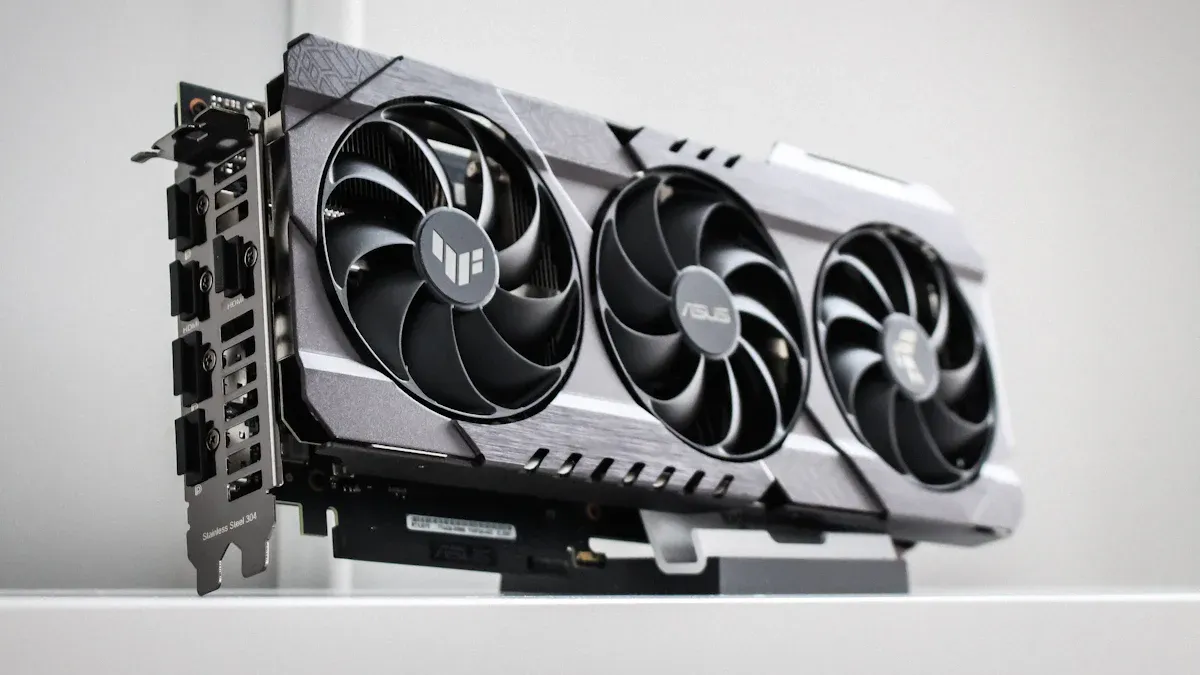
The demand for GPU servers has surged dramatically due to the rapid growth of AI applications. In the United States, the projected growth rate of AI applications stands at an impressive 30 percent annually over the next five years. This expansion reflects the increasing reliance on AI technologies across various sectors, including healthcare, finance, and automotive. As organizations seek to leverage AI for data analysis, predictive modeling, and automation, the need for efficient GPU servers becomes paramount.
The rise of AI applications drives the demand for high-performance computing solutions.
Organizations require robust infrastructure to support complex algorithms and large datasets.
The market sees significant investments from major IT firms and cloud providers in AI infrastructure.
Performance and Scalability Needs
To effectively train AI models, GPU servers must meet specific performance and scalability requirements. High computational power is essential for processing vast amounts of data efficiently. The following table outlines the primary performance requirements for GPU servers used in AI training workloads:
Performance Requirement | Description |
|---|---|
High computational power | Necessary for processing large datasets efficiently. |
Substantial memory capacity | Required to hold model parameters during training. |
Efficient data pipeline management | Ensures smooth data flow for training processes. |
Distributed computing capabilities | Essential for handling large-scale AI models. |
Training deep learning models involves billions of calculations across multiple layers of a network. GPUs excel in this area by executing numerous computations simultaneously, significantly accelerating the training process.
Scalability is another critical factor influencing the design of GPU servers. As AI models grow in complexity, the need for higher GPU densities arises. This trend necessitates advanced cooling and power management solutions to maintain optimal performance. Additionally, innovative data center layouts and hardware configurations become essential to meet memory and communication requirements.
The trend towards GPU-dense nodes reduces latency and costs associated with scaling models across multiple GPUs.
Organizations must adapt their infrastructure to accommodate the increasing demands of AI applications.
Custom GPU Server Hardware Structure
Mainboard and Backplane
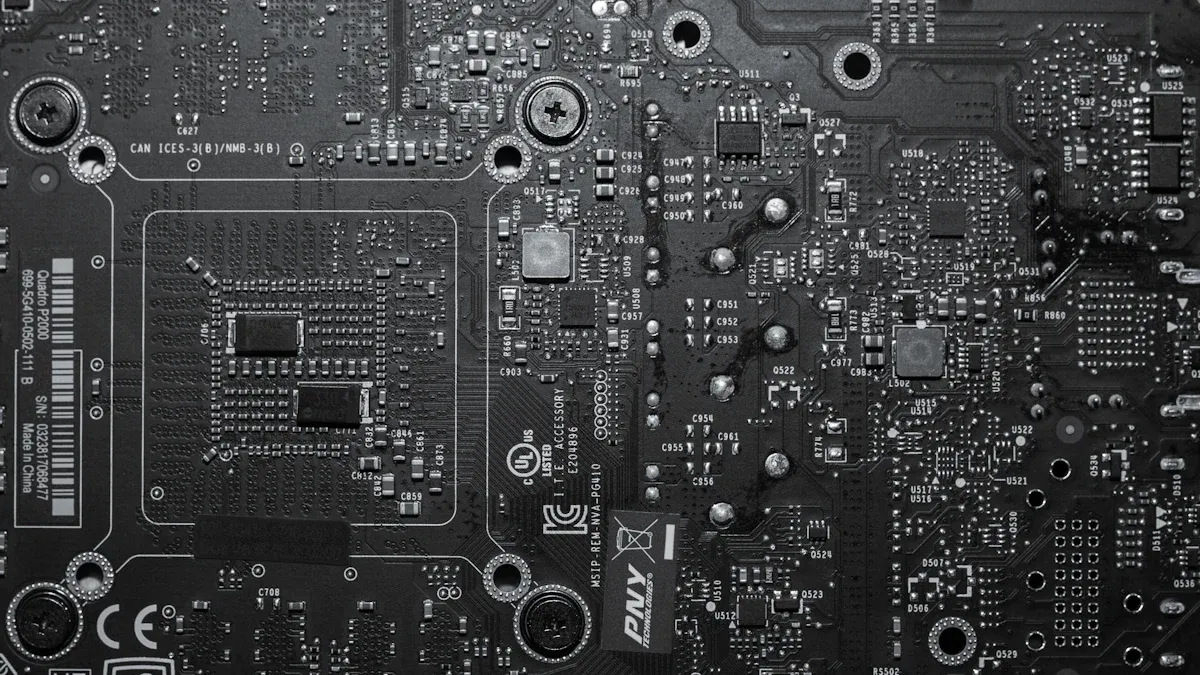
The mainboard and backplane form the backbone of your custom GPU server PCBA, playing a crucial role in its overall performance and functionality. The mainboard features a high-layer and high-speed design, essential for managing fast signals and high power requirements. This design allows for efficient routing of data and power across the server, ensuring that all components operate seamlessly.
The backplane acts as the primary hub for data and power distribution, connecting critical elements such as CPUs, GPUs, memory, and storage. This centralized architecture simplifies the integration of various components, allowing for modular daughterboards to be added easily. These daughterboards enhance functionality and enable upgrades without the need to replace the entire motherboard.
Board Type | Main Function | Typical Use Case |
|---|---|---|
Backplane | Main data and power distribution | Server motherboard, AI server PCB |
Daughterboard | Adds features or upgrades | Networking, storage, AI accelerators |
Modern AI server PCBs typically require between 24 to 40 layers to accommodate the increased connections and data density necessary for efficient operation. This layered design supports high data rates, which are vital for AI training and inference tasks. The design of the mainboard is crucial as it requires high-layer stackups to facilitate dense routing for components like GPUs and CPUs. This approach enhances signal integrity and minimizes crosstalk, which is vital for maintaining performance in high-speed applications.
Advanced HDI manufacturing techniques enable the use of fine-pitch BGA breakout and various via structures. These innovations maintain short signal paths and high routing density, particularly important in AI applications where performance heavily relies on efficient signal transmission.
Power Distribution Board
The power distribution board is another critical component of your custom GPU server PCBA. It ensures that all components receive the necessary power while maintaining signal integrity. The specifications of power distribution boards used in AI training servers include:
Specification | Details |
|---|---|
Signal Integrity | Tight signal integrity margins |
Power Delivery | High-current power delivery |
Thermal Management | Effective thermal management under continuous load |
Impedance Control | Controlled impedance across complex multilayer stackups |
Manufacturing Reliability | Reliable domestic manufacturing |
The power distribution board must handle high-current demands while ensuring thermal management. This capability is essential for maintaining optimal performance during intensive AI training tasks. The design must also consider impedance control to prevent signal degradation, which can impact the overall performance of the GPU server.
Manufacturing Challenges for AI Server PCB
High-Speed Signal Integrity
High-speed signal integrity poses significant challenges in the manufacturing of AI server PCBs. As you design your GPU server, you must address several common issues that can affect performance. The following table outlines these challenges:
Challenge | Description |
|---|---|
Insertion Loss | High-speed signals lose energy during transmission, especially over long distances and through connectors. Using low-loss PCB materials is essential to mitigate this issue. |
Impedance Control | Maintaining a strict impedance of differential pairs is crucial. Any discontinuity can lead to signal reflections and increased error rates. |
Crosstalk | Electromagnetic interference between adjacent signal lines can degrade performance. Proper routing and spacing are necessary to minimize this effect. |
Timing & Jitter | Jitter can compress the eye diagram, affecting data sampling. Minimizing jitter sources is critical throughout the design process. |
To ensure high-speed signal integrity, you should implement several key strategies. These include using high-speed digital PCBs, which typically have 24 or more layers, and focusing on signal integrity, power integrity, and electromagnetic compatibility. Additionally, you must control impedance, crosstalk, reflection, and timing skew effectively.
Thermal Management Considerations
As AI workloads intensify, effective thermal management becomes crucial for server PCBs. High power densities generate significant heat, which can impair performance and reduce component lifespan if not managed properly. Here are some leading thermal management solutions you should consider:
Board-Level Techniques: Incorporate thermal vias, copper coin inserts, and heavy copper layers to enhance heat dissipation.
Mechanical Cooling Aids: Utilize vapor chambers, heat pipes, and cold plates with liquid coolant for efficient cooling.
Simulation & Validation: Run CFD simulations and IR thermography tests to validate thermal performance.
The following table compares the thermal management features of AI server PCBs with traditional server PCBs:
Feature | AI Server PCBs | Traditional Server PCBs |
|---|---|---|
Power Density | 1000W to 3000W+ per board | 200W–800W |
Thermal Management | Heavy copper layers, embedded copper coins | Standard aluminum heatsinks and air fans |
By addressing these manufacturing challenges, you can enhance the performance and reliability of your custom GPU server PCB, ensuring it meets the demands of AI training workloads.
Production Process from Prototype to Small Batch
Prototyping and Testing
The journey from prototype to small batch production involves several critical steps. You begin with preparation, gathering all necessary components and tools. A clean and organized workspace is essential for efficiency. Next, you proceed to component placement, arranging the components on the PCB according to the schematic. Pay close attention to the orientation of polarized components like capacitors and diodes.
After placement, you move on to soldering. Start with smaller components, such as resistors, and gradually work up to larger ones like GPUs and CPUs. Following soldering, conduct a thorough inspection of all connections. Look for solder bridges or cold joints that could affect performance. Use a multimeter for testing to check for continuity and ensure there are no short circuits. This step is crucial for the reliability of your AI inference server.
Once the PCB passes inspection, you install the necessary firmware. This software is vital for the operation of your AI inference server. Finally, assemble the server case, ensuring all components fit securely, and connect any necessary cables and peripherals. Run a series of performance tests to evaluate the server’s capabilities and monitor for any issues during operation.
To ensure high quality in your custom GPU server PCBA, adhere to IPC Class 3 standards. Employ comprehensive testing methods such as Automated Optical Inspection (AOI), X-ray, In-Circuit Testing (ICT), and Functional Testing. These measures guarantee long-term reliability in data center environments.
Transition to Small Batch Production
Transitioning from prototyping to small batch production presents unique challenges. You may face imbalanced capacity distribution, as the average lead time for samples and small-batch production of high-end HDI PCBs has extended to eight weeks, while the standard lead time should be two to four weeks. Additionally, cost and economic barriers arise, as small-batch trial production often requires production line reconfiguration, increasing costs by up to 60%.
Technical thresholds also pose challenges. Approximately 40% of PCB factories lack the capabilities needed for manufacturing server boards due to insufficient lamination control and microvia technology. Furthermore, regional concentration issues complicate matters, with 70% of production capacity concentrated in Taiwan and South Korea, leading to tariff risks and increased costs.
In small batch production, implement quality assurance measures such as Solder Paste Inspection (SPI) to verify paste volume, AOI for component placement and solder-joint quality, and ICT for electrical connectivity. Conduct 100% X-Ray inspection and functional testing to ensure reliability. By addressing these challenges and maintaining rigorous quality standards, you can successfully navigate the transition to small batch production of custom GPU server PCBA.
Custom GPU server PCBA significantly enhances your AI training capabilities. These systems offer advantages such as scalability, allowing you to connect multiple DGX servers for increased compute power. Customization options enable tailored configurations, optimizing performance for specific applications. High-speed data transfer is crucial, with each training node achieving up to 3200 GB/s, ensuring efficient processing of large datasets.
Looking ahead, the industry will likely see a shift towards high-density designs and innovations in thermal management. The rise of generative AI will accelerate the adoption of advanced interconnect standards like PCIe 5.0 and CXL 3.0. Additionally, sustainability will drive the development of eco-friendly materials and energy-efficient processes, aligning with the evolving demands of AI workloads.
FAQ
What is a GPU server PCBA?
A GPU server PCBA is a printed circuit board assembly designed specifically for GPU servers. It integrates components like GPUs, CPUs, and memory to optimize performance for AI training workloads.
How does custom GPU server PCBA improve AI training?
Custom GPU server PCBA enhances AI training by providing tailored configurations, high-speed data transfer, and improved thermal management. This optimization allows for efficient processing of large datasets and complex models.
What are the key components of a GPU server?
Key components of a GPU server include the mainboard, backplane, power distribution board, and cooling solutions. Each component plays a vital role in ensuring high performance and reliability during AI training.
Why is thermal management important in GPU servers?
Thermal management is crucial in GPU servers because high power densities generate significant heat. Effective thermal solutions prevent overheating, ensuring optimal performance and extending the lifespan of components.
How can I ensure quality in small batch production?
To ensure quality in small batch production, implement rigorous testing methods such as Automated Optical Inspection (AOI), In-Circuit Testing (ICT), and functional testing. These measures help maintain reliability and performance standards.
See Also
PCB Production for AI Servers in American GPU Firms
Prototype PCBA Services for Israeli AI Server Startups
Complete PCBA Solutions for AI Servers in Singapore