
The emergence of OpenAI hardware marks a significant milestone in the realm of custom AI device manufacturing. This innovation enhances the efficiency of PCBA processes by streamlining production and reducing costs. You can expect a surge in innovation as OpenAI continues to advance artificial intelligence technology. As a result, the integration of AI capabilities into devices becomes more accessible, enabling you to create smarter, more capable products that meet the demands of today’s market.
Key Takeaways
OpenAI hardware boosts efficiency in custom AI device manufacturing, streamlining production and reducing costs.
Custom AI chips, like the Jalapeño chip, enhance performance and lower reliance on third-party suppliers, making AI applications more affordable.
Collaboration with companies like TSMC and Foxconn strengthens the AI hardware ecosystem, leading to faster and more efficient manufacturing processes.
In-house hardware production allows for specialized AI devices, improving design cycles and reducing operational costs.
The future of AI hardware focuses on custom processors, driving innovation and enhancing the capabilities of AI applications.
OpenAI Hardware Overview
Custom AI Chips
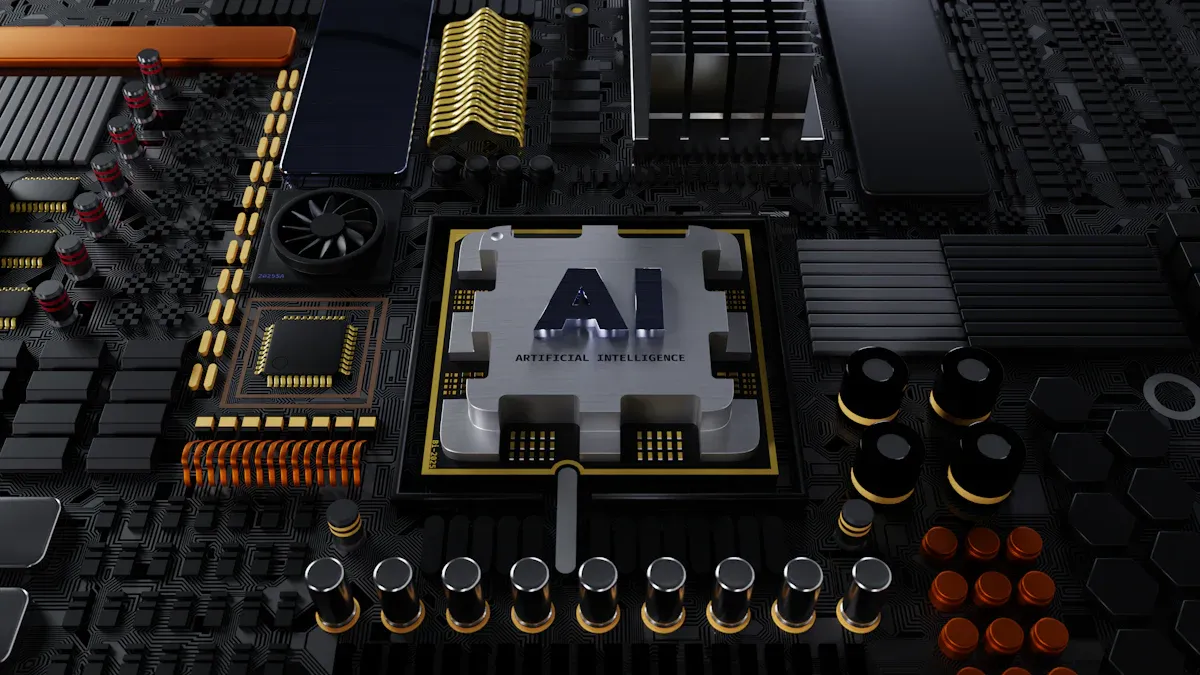
OpenAI has made significant strides in developing custom AI chips that cater to various applications. These chips are designed to optimize performance and efficiency in AI tasks. Here are some key types of OpenAI hardware relevant to AI applications:
Hardware Type | Description |
|---|---|
Central Processing Unit (CPU) | General-purpose processor for data processing and small-scale inference. |
Graphics Processing Unit (GPU) | Optimized for parallel processing, widely used in deep learning applications. |
Tensor Processing Unit (TPU) | Custom-built AI accelerator by Google for efficient deep learning. |
Field Programmable Gate Array (FPGA) | Reconfigurable hardware for custom accelerations in specific AI tasks. |
Application-Specific Integrated Circuit (ASIC) | Custom AI chips tailored for specialized tasks, offering high-speed processing. |
Edge AI Devices | Designed for real-time AI inference on local devices, reducing latency. |
Neuromorphic Computing Chips | Brain-inspired chips mimicking neural networks for low-power cognitive processing. |
The proprietary Jalapeño chip exemplifies the significance of custom AI chip development. This chip enhances efficiency and reduces costs, allowing OpenAI to minimize reliance on third-party suppliers. Such optimization leads to lower inference costs, making complex AI applications more financially viable. Organizations can leverage this technology to optimize their infrastructure, fostering a competitive edge.
Collaboration with TSMC and Foxconn
OpenAI’s collaboration with TSMC and Foxconn plays a crucial role in the AI hardware ecosystem. TSMC focuses on advanced semiconductor manufacturing, while Foxconn has transitioned from a component supplier to a major player in full server manufacturing. By 2024, Foxconn’s AI server production was growing at over 200% year-over-year, showcasing their significant market presence.
Foxconn is recognized as NVIDIA’s largest server assembler, capable of executing complex builds like the H100 and GB200 systems. This partnership emphasizes Taiwan’s expanded role in supplying not just chips but complete AI systems, further enhancing the capabilities of custom AI device manufacturing.
Impact on Custom AI Device Manufacturing
Efficiency in PCBA
OpenAI hardware significantly enhances the efficiency of the printed circuit board assembly (PCBA) process. By utilizing advanced AI chips, you can streamline production workflows and reduce the time required for assembly. The integration of AI capabilities allows for real-time monitoring and adjustments during the manufacturing process. This leads to fewer errors and higher quality outputs.
Here are some ways OpenAI hardware contributes to efficiency:
Real-Time Data Processing: AI chips process data at high speeds, enabling immediate feedback during assembly.
Automated Quality Control: AI-driven systems can identify defects and anomalies, ensuring that only high-quality products reach the market.
Optimized Resource Allocation: With AI, you can predict demand more accurately, allowing for better inventory management and reduced waste.
The collaboration between OpenAI and manufacturers like Foxconn further enhances these efficiencies. By co-designing hardware and systems, they create solutions that are specifically tailored for AI applications, which simplifies integration into existing manufacturing processes.
Cost-Effectiveness of OpenAI Solutions
The cost-effectiveness of OpenAI solutions is another critical factor in custom AI device manufacturing. By reducing reliance on third-party suppliers through in-house AI chip production, OpenAI lowers overall costs. This shift allows you to allocate resources more effectively, driving innovation in design and functionality.
Consider the following contributions to cost-effectiveness:
Contribution to Innovation | Description |
|---|---|
Co-designing Hardware | OpenAI collaborates with software and research partners to create hardware that integrates seamlessly with AI models. |
The hardware is specifically optimized for advanced AI workloads, enhancing performance and efficiency. | |
Custom Design Tools | OpenAI develops custom design tools that facilitate faster innovation in AI device design. |
By investing in AI hardware architecture, you can expect to see a reduction in operational costs while improving the performance of your devices. The shift towards physical AI devices reflects a broader trend in the industry, emphasizing the importance of integrating hardware and software for optimal results.
AI Companion Device Use Cases
AI Voice Devices
AI voice devices have transformed how you interact with technology. These devices leverage OpenAI hardware to enhance user experience and functionality. Here are some common applications of AI voice devices:
Portable ChatGPT companion device
Built-in voice conversations
Bluetooth connection to smartphones
Rechargeable battery
Push-to-talk button and optional wake word
LED light ring for interaction feedback
Speaker designed for natural conversation
Privacy mute switch
Portable dock for various settings
Different voice and personality modes
Optional offline basic functions
OpenAI hardware plays a crucial role in these devices by optimizing performance and ensuring seamless interaction. The energy-efficient architecture of OpenAI hardware extends battery life, allowing you to use these devices longer without frequent recharging. Additionally, the lightweight design enhances portability, making it easy to carry your AI voice device wherever you go.
AI Wearable Technology
AI wearable technology is another exciting area where OpenAI hardware shines. These devices enhance your daily life by providing real-time feedback and context-aware information. Some examples of AI wearable technology include:
Headsets utilizing bone-conduction technology, allowing users to hear ambient sounds while receiving feedback.
Wearable pins designed to capture and prioritize spontaneous ideas.
Smart glasses that provide real-time translation and contextual information based on your location.
AI-powered earbuds expected to be released in 2026.
OpenAI hardware enhances the functionality of these wearables by enabling multitasking capabilities. This allows you to operate multiple AI features simultaneously, improving your experience in real-time applications. The integration of OpenAI hardware ensures that these devices not only perform efficiently but also provide a seamless interaction that enriches your daily activities.
The focus on optimizing power consumption and thermal behavior is vital for enhancing the usability and reliability of AI companion devices. This directly influences your experience by ensuring that devices operate effectively, providing a smooth interaction.
Future Trends in OpenAI Hardware
Custom Processors for AI
The future of OpenAI hardware lies in the development of custom processors tailored for AI applications. Industry analysts predict a shift towards specialized silicon architectures, such as GPUs, NPUs, TPUs, and custom ASICs. This transition is essential due to the increasing complexity of AI models and the need for efficient hardware-software co-design. Major companies like NVIDIA, AMD, and Intel are already adjusting their strategies to focus on AI-dedicated silicon, indicating a significant change in the competitive landscape.
The edge AI processor segment is rapidly expanding, driven by advancements in autonomous systems and mobile AI workloads. Companies such as Qualcomm and Apple are responding to the demand for low-latency, energy-efficient AI inference. This trend will likely lead to further innovations in custom processors, enhancing performance and efficiency in AI applications.
In-House Hardware Production
OpenAI’s commitment to in-house hardware production marks a pivotal shift in the industry. The company is focusing on developing proprietary devices that integrate AI capabilities directly into consumer hardware. This strategy includes reshoring manufacturing to the U.S. and Vietnam, establishing a partnership with Foxconn for production. Such moves aim to create a physical interface for AI that transcends traditional smartphone applications.
The implications for the PCBA industry are profound. In-house production can lead to faster chip design cycles, lower inference costs, and greater energy efficiency. You will notice a reduced dependence on off-the-shelf hardware, allowing for more specialized AI infrastructure built for specific workloads. This shift could fundamentally change how AI companies engage with consumer markets, emphasizing the importance of owning the physical interface layer between users and AI.
As OpenAI continues to innovate, you can expect to see advancements in industry standards and certifications that will further enhance the reliability and performance of custom AI devices. The focus on efficiency and context-aware interaction will drive the next generation of smart devices, making them more capable and user-friendly.
OpenAI hardware is revolutionizing custom AI device manufacturing. This technology enhances your PCBA processes by enabling the use of custom AI chips, which lead to significant performance improvements and cost reductions. Industry leaders, like Dr. Isil Berkun, note that the shift from generic chips to custom silicon allows for direct optimization between chips and algorithms. This transformation results in massive cost savings and operational efficiency. As you embrace these advancements, expect to drive innovation and create smarter AI devices that meet evolving market demands.
FAQ
What is an AI companion device?
An AI companion device is a smart gadget designed to enhance your daily life through interaction. These devices use AI technology to provide personalized assistance, making tasks easier and more efficient.
How do screenless AI devices work?
Screenless AI devices rely on voice recognition and audio feedback for interaction. They process your commands and respond verbally, allowing you to engage without needing a visual display.
What are the benefits of using AI in companion devices?
AI enhances companion devices by improving their responsiveness and adaptability. You can enjoy a more intuitive interaction, as these devices learn from your preferences and behaviors over time.
Can AI companion devices be used for various applications?
Yes, AI companion devices serve multiple purposes, including home automation, personal assistance, and entertainment. Their versatility makes them valuable tools for enhancing your lifestyle.
How does OpenAI hardware improve AI device performance?
OpenAI hardware optimizes processing power and efficiency, enabling faster response times and better interaction quality. This advancement allows you to experience seamless functionality in your AI companion devices.
See Also
Tailored AI PCBA Solutions for American Hardware Innovators
Complete AI PCBA Services for Irish MedTech and IoT Firms
Bespoke GPU Server PCBA for US AI Training Systems
Prototype AI PCBA Solutions for Israeli Vision and Security Tech
Original Equipment Manufacturer AI PCBA for Belgian Tech Firms