
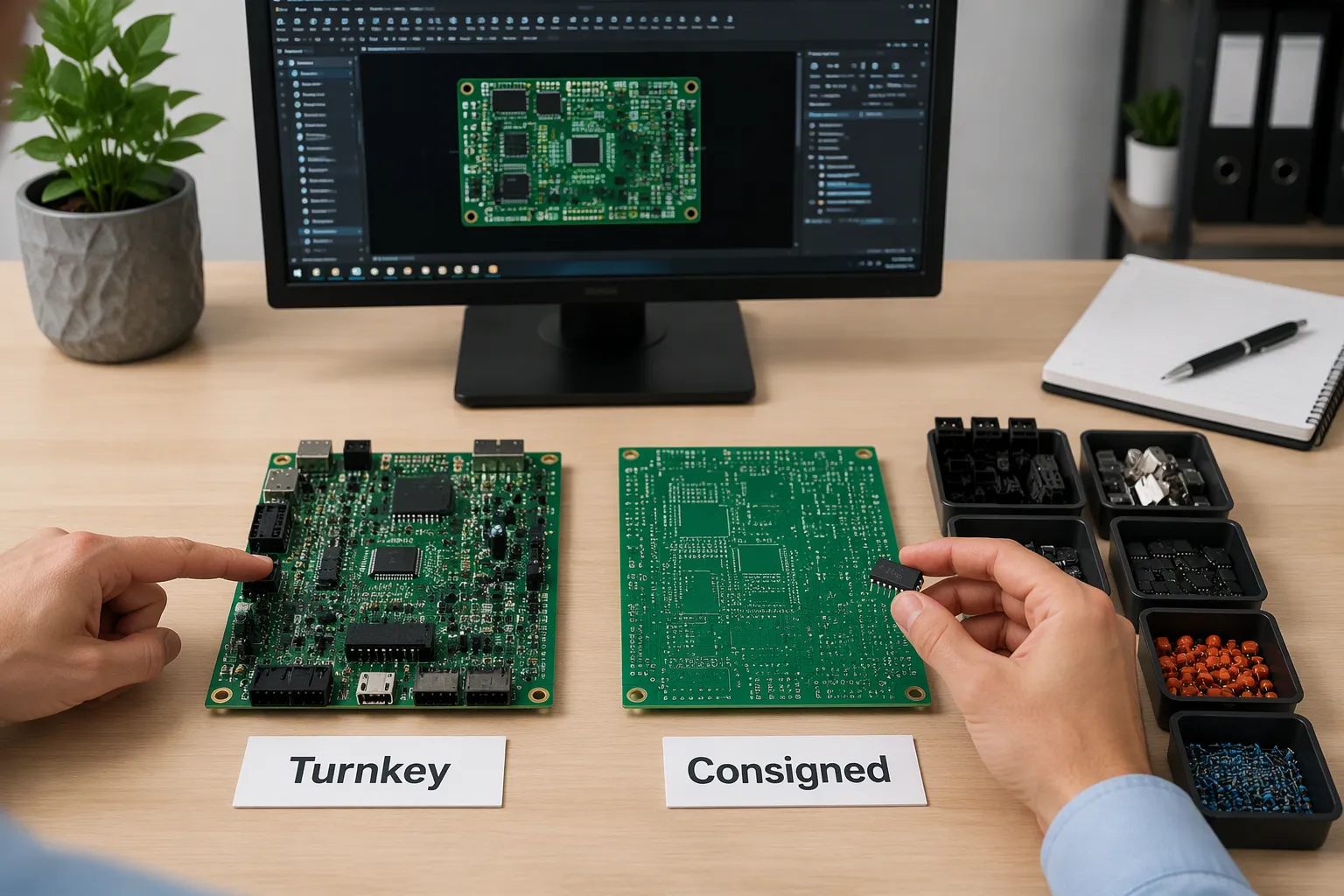
Turnkey pcb assembly means your supplier buys components and builds the boards. Consigned pcb assembly means you supply parts and the supplier handles labor. This guide explains the key differences between turnkey and consignment in included services, true costs, and project fit. You will compare full, partial, and consigned models and get a practical decision framework.
Key Takeaways
Turnkey assembly means your supplier buys all parts and builds the boards. Consigned assembly means you supply the parts and the supplier does the labor.
Compare total project cost, not just the quote. Consigned quotes look cheaper but hide extra work like buying parts and managing inventory.
Choose based on your team’s readiness. New products often fit turnkey, while teams with established supply chains may benefit from consigned or partial turnkey.
Turnkey PCB Assembly: What’s Included
Component Sourcing and PCB Fabrication
A turnkey quote bundles two things: the bare boards and the parts that go on them. Your supplier handles component sourcing, checks part availability, and orders the bill of materials. The same quote covers PCB fabrication. This bundling explains why the initial number looks higher than a labor-only quote. You see one price for the whole build instead of separate invoices for parts and boards.
Full turnkey pcb assembly also puts bom management in your supplier’s hands. They track approved parts, watch for obsolescence, and flag alternates before production starts. This model suits new products and teams without an established parts purchasing process. You avoid building a component procurement pipeline from scratch.
Assembly, Testing, and Inventory Management
The bundled scope continues past sourcing. Your supplier runs smt / tht assembly, performs the agreed tests, and manages component inventory for the build. Assembly, testing, and delivery sit under one point of accountability. If a part fails incoming inspection, the supplier resolves it. You do not chase a separate vendor.
Turnkey pricing reflects this full scope, so compare it against your total project cost rather than a labor rate. Full turnkey assembly works well when you want one partner to own the build from bare board to shipped unit. For many teams, that single-owner model removes coordination work and shortens the path to first articles.
Consigned PCB Assembly: What’s Included
Customer-Supplied Components
In a consigned pcb assembly order, you own the parts before the build starts. You buy the components from your distributors, take delivery, and ship them to the assembler. The supplier inspects what arrives and confirms the count against your bill of materials. Any shortage or damage becomes your responsibility to resolve.
This arrangement gives you direct control over part selection and pricing. You can lock in volume discounts, use approved vendors, and keep consigned inventory at your own facility. The trade-off is that you carry the purchasing work and the risk of late or short shipments.
Labor, Assembly, and Testing Scope
A consigned quote prices labor only. You see charges for setup, smt and tht assembly, and the agreed test steps. Component costs sit outside that number, so you absorb them separately through your own purchase orders. Compare the two figures side by side before you judge which route is cheaper.
The supplier still owns process quality. They run the assembly, perform inspection, and report defects. Testing scope depends on what you specify in the contract. Clarify incoming inspection, functional test, and rework terms in writing.
When consigned pcb assembly makes sense, you already hold approved parts on hand. Teams with an established supply chain often fit this model well. If you lack that pipeline, the labor-only quote hides real work you must do yourself.
Full vs Partial vs Consigned: Three Models
Where Partial Turnkey Fits
Partial turnkey pcb assembly sits between the two extremes. You supply some approved components at better pricing, and your supplier sources the rest. This model works well when you already hold certain parts on hand. You keep control of those parts and let the supplier handle the remainder of the bill of materials.
The full turnkey vs partial turnkey split comes down to who buys which parts. In a full build, the supplier buys everything. In a partial build, you split the sourcing list. Partial turnkey pcb assembly gives you a flexible middle path. You gain savings on the parts you already own without taking on the whole purchasing load.
Matching the Model to Build Readiness
Real cost must include logistics and coordination, not just unit price. A low part price means little if you pay for shipping, kitting labor, and schedule delays. Count the time your team spends tracking shipments and reconciling counts. Add the risk of a line stoppage when a part arrives late.
Build readiness decides the fit. Teams with approved parts and a working supply chain can weigh partial turnkey or consigned routes. New products with no parts pipeline usually fit full turnkey better. Compare full vs partial vs consigned options against your total project cost. Partial turnkey pcb assembly often balances control and convenience for teams with some parts in hand.
Consignment vs. Turnkey PCB Assembly: Cost Analysis
Visible Costs in Each Quote
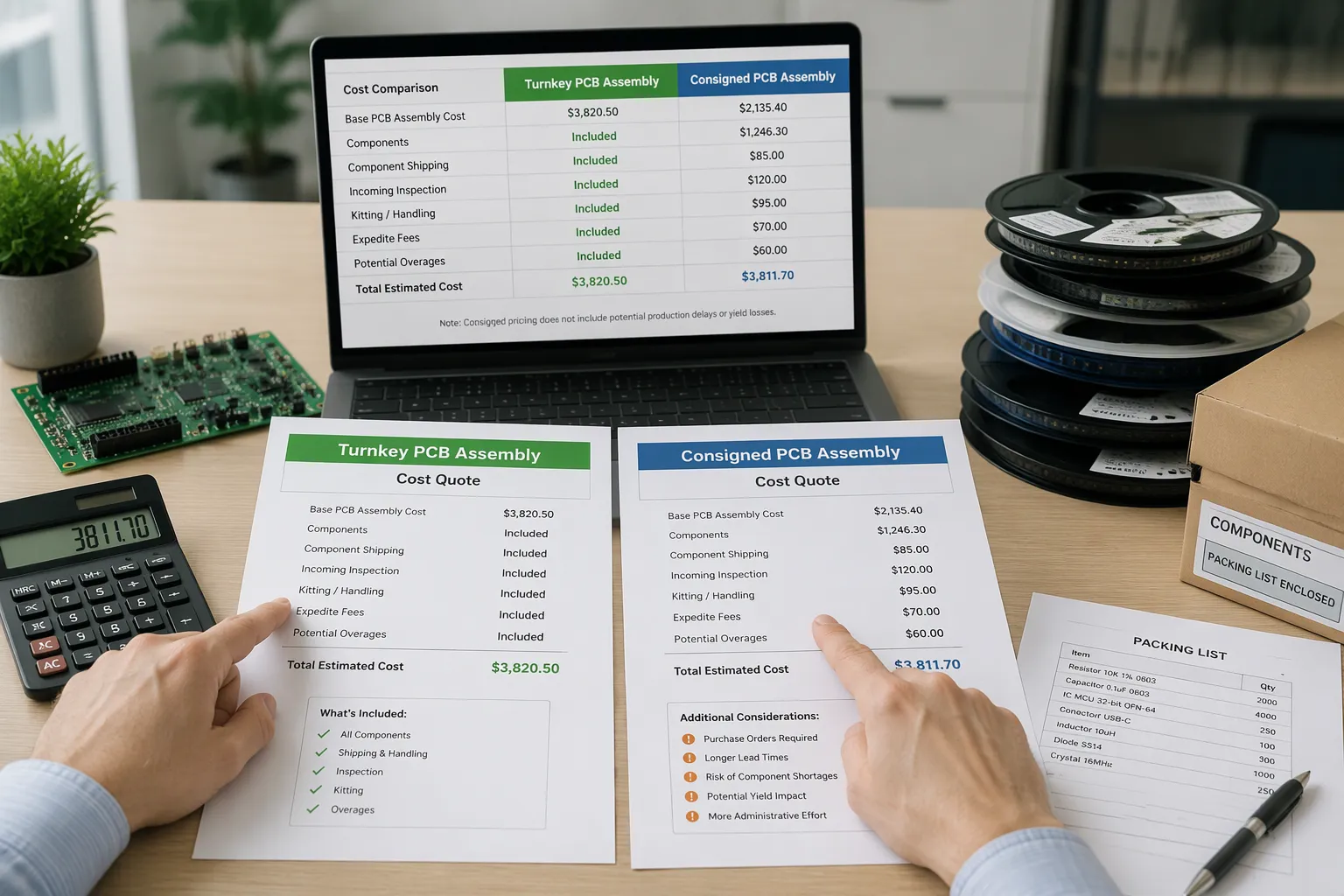
Start with what each quote shows you on paper. A turnkey pcb assembly quote lists bare boards, components, assembly labor, testing, and often inventory handling as one bundled figure. A consigned pcb assembly quote lists setup, assembly labor, and test steps only. The parts line disappears because you buy those yourself.
This difference shapes the first impression. A labor-only number looks smaller, so buyers often ask does turnkey cost more. The answer depends on what you count. Pull an itemized quote from each supplier and place the lines side by side. Add your own component purchase orders to the consigned column. Now you see the full cost of each route rather than two numbers that measure different things.
Cost line | Turnkey quote | Consigned quote |
|---|---|---|
Bare boards | Included | Included or separate |
Components | Included | Your purchase orders |
Assembly labor | Included | Included |
Testing | Included | Included per contract |
Hidden Costs and Total Project Cost
The visible lines rarely tell the whole story. Consignment shifts work onto your team, and that work carries a price. Count internal kitting labor: receiving parts, counting them, labeling reels, and packing them for shipment. Add outbound freight and insurance on the parts you send. Add coordination time spent reconciling counts and chasing shortages.
Production downtime deserves its own line. A short or damaged reel can stall a build while you source a replacement. Reassembly and rework after a component issue also land on your side of the ledger. None of these items appear on the consigned invoice, yet each one raises your total cost.
This is where how cost changes between the two models becomes clear. For high-mix, low-volume builds, turnkey often costs less overall and reaches first articles sooner. Small part quantities rarely earn deep discounts, and the coordination burden grows with every changeover. One supplier owning sourcing, kitting, and build removes that overhead. Weigh the full cost of each route before you decide, and treat the labor rate as one input rather than the verdict.
How to Choose: Criteria and Scenarios

Prototypes, Low-Volume, and High-Reliability Builds
Four criteria drive the decision: component availability, sourcing responsibility, total cost, and build readiness. Score your project against each one before you request quotes. A project with approved parts in stock and a working purchasing team can handle more sourcing work. A new design with no parts pipeline needs a partner who owns that task.
For prototypes, the decision hinges on component availability and build readiness. Ask which model fits quick-turn prototypes best when your design uses long-lead parts. A full turnkey pcba supplier can often start sooner because they already hold distributor relationships and stock. If you hold every approved part on hand, a consigned build may move faster. If you hold only some parts, partial turnkey pcb assembly lets the supplier fill the gaps.
Low-volume builds reward simplicity. High-mix schedules multiply the coordination work on your side, so weigh partial turnkey or full turnkey pcb assembly against your team’s capacity. High-reliability builds add another factor: traceability. Confirm who records lot codes and test data, and make that duty explicit in the contract.
How to Evaluate a Turnkey PCBA Supplier
Knowing how to evaluate a turnkey pcba supplier starts with quote transparency. Ask for an itemized breakdown of boards, components, labor, and testing. A supplier who hides the parts line makes cost comparison impossible. Request the component sourcing policy in writing, including approved vendor lists and alternate part rules.
Then probe testing scope. Ask which tests run on every unit and which run on samples only. Confirm how the supplier handles incoming inspection and rework. Ask about inventory handling: who stores excess parts, and how do they report shortages?
A strong turnkey pcba supplier answers these questions with documents, not assurances. Check their process for flagging obsolescence before production. Ask for a sample report from a past build. These steps apply to any pcb assembly partner, whether you choose full turnkey, partial turnkey, or consigned work. Use the same questions for each route, then compare answers side by side.
Choosing a Turnkey PCBA Supplier: Decision Checklist
Questions to Ask Before You Commit
A good checklist protects you at any point in the sourcing decision. Ask these questions of every pcb assembly partner, whether you plan a full turnkey build, a partial turnkey pcb assembly order, or a consigned job. The answers tell you where responsibility sits and where risk hides.
Sourcing responsibility: Who buys each part on the bill of materials? Ask the supplier to mark every line as their purchase or yours. A full turnkey pcba supplier buys all lines. A partial turnkey partner splits the list with you. Get that split in writing before you sign.
Quote transparency: Request a transparent, itemized quote that separates bare boards, components, labor, and testing. A single lump sum hides the parts cost and blocks any fair comparison. Ask how the supplier handles price changes on components between quote and build.
Testing scope: Confirm which tests run on every unit and which run on samples only. Ask who performs incoming inspection and who pays for rework when a part fails.
Inventory handling: Ask who stores excess parts, how the supplier reports shortages, and how they flag obsolescence before production starts.
Use the same list when you learn how to evaluate a turnkey pcba supplier against a consigned shop. Score each answer, then compare the scores side by side. A turnkey pcba supplier who answers with documents earns more trust than one who answers with assurances. This checklist keeps your pcb assembly decision grounded in facts, not sales talk.
Turnkey pcb assembly offers convenience and single-point accountability. Consigned work offers component control and potential savings for established supply chains. Partial turnkey bridges both.
Your choice depends on component availability, sourcing capability, total project cost, and build readiness. Compare the full cost of each route. Use the checklist to match your pcb assembly model to the project.
FAQ
Is a consigned quote always cheaper than a turnkey quote?
No. A labor-only quote hides your component purchases, freight, and kitting time. Add those lines before you judge. That is why does turnkey cost more rarely has a simple answer. Compare total project cost for each pcb assembly route.
Can you switch models between builds?
Yes. Many teams start with turnkey pcb assembly for a new design, then move to partial or consigned work once they hold approved parts. Confirm the change with your supplier before the next order.
What happens when your supplied parts arrive short or damaged?
You own that risk in a consigned build. The supplier inspects incoming parts and reports the count. You then source replacements. Build schedules can slip while you resolve the shortage. Ask about incoming inspection terms in your pcb assembly contract.
See Also
Complete AI PCBA Solutions for Irish MedTech and IoT Hardware Firms
Full Turnkey AI PCBA Service for Singapore IoT and MedTech Initiatives
Tailored Edge AI PCBA Built for American Hardware Startup Companies
AI Server PCB Production Serving US GPU Hardware Manufacturers
PCB Assembly for AI Inference Servers in UK Edge Computing Projects