
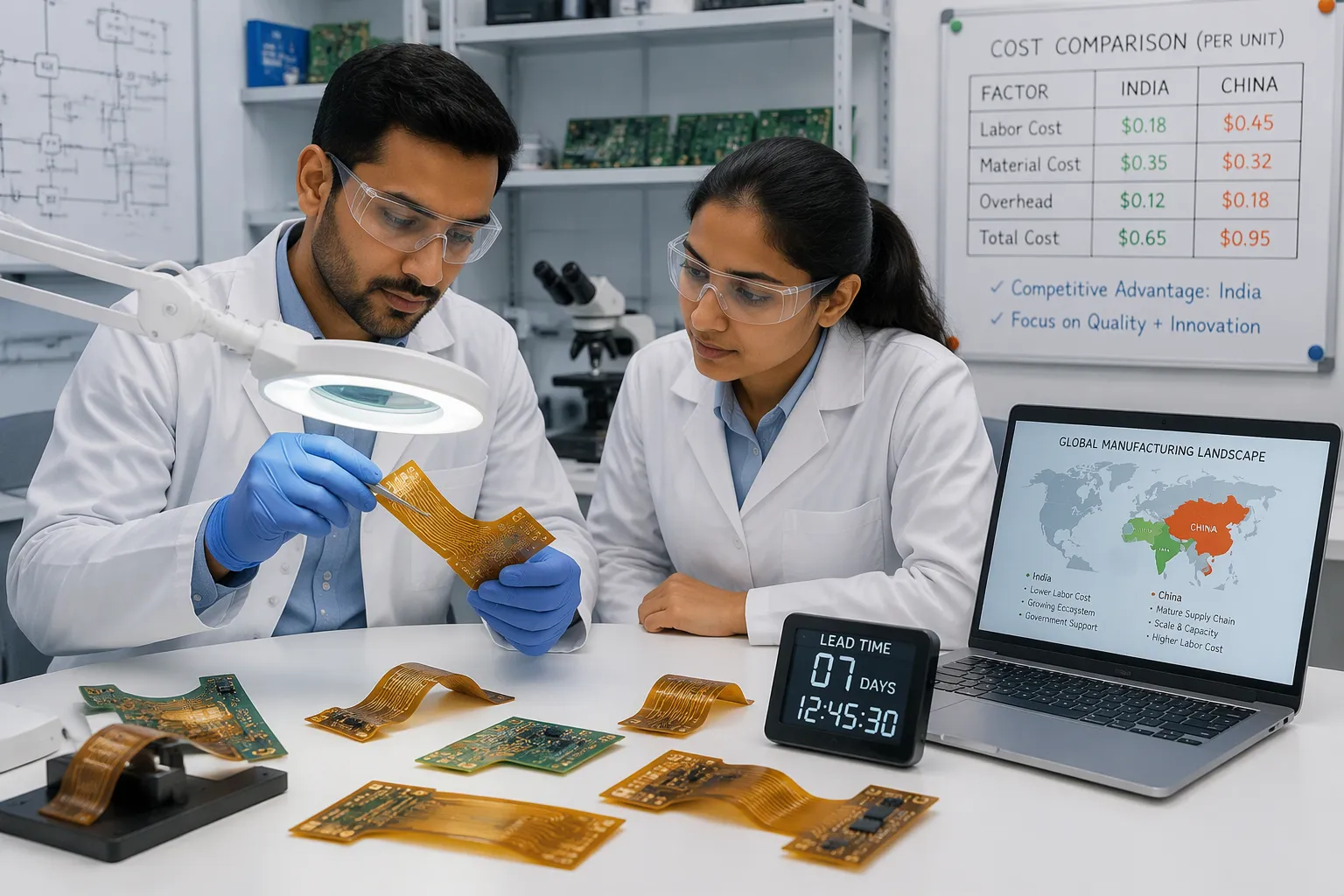
China generally leads on advanced capability and predictable scheduling. India is increasingly compelling on cost, local support, and lower IP risk for Western buyers. Neither country wins everywhere. Three dimensions matter most: capability, cost, and lead time. The right choice depends on reader priorities. This comparison gives buyers a side-by-side view, a decision framework, and a summary table. Flexible PCB manufacturers in India now compete seriously, and flexible sourcing decisions deserve fresh scrutiny. Let us examine the trade-offs.
Key Takeaways
China leads in advanced flexible PCB technology and reliable schedules.
India offers lower costs and strong local support for Western buyers.
Match your project needs to each country’s strengths for the best results.
Capability of Flexible PCB Manufacturers in India vs China
Technology, Materials, and Scale
China sets the benchmark for scale and ecosystem depth. Its factories handle high-volume runs of flexible PCBs and advanced rigid-flex builds with mature process control. Component sourcing is close at hand, so a flex PCB program can move from fabrication to pcb assembly without long-distance coordination. Buyers of complex, dense designs usually find more proven capacity among pcb manufacturers in china than anywhere else.
India is closing the gap at a steady pace. Bengaluru-based Lion Circuits is building a 100-acre integrated mega campus in Vijayapura, a clear signal of India’s expanding capacity. Still, India depends on China for roughly 70% of its PCB supply. That dependency limits India’s technology ambitions at the high end today. Flexible pcb manufacturers in india serve mid-range and standard builds well, while the most advanced flexible pcb fabrication still concentrates in China.
Certifications and Supply-Chain Depth
Certification coverage shapes supplier shortlists. Many Chinese plants hold broad international approvals and support diverse compliance needs across markets. Indian suppliers increasingly carry the certifications Western buyers expect, and their local support teams simplify audits and communication.
Supply-chain depth favors China for now. A deep bench of material vendors and equipment makers shortens problem-solving cycles there. India offers a shorter, more transparent chain for regional programs. Each country fits a different program profile, and neither wins on every measure.
Cost Comparison: Unit Price and Landed Cost

Unit Pricing and Tooling/NRE
India’s cost structure has become compelling enough that China, the world’s manufacturing giant, now sources some PCBs from India. Indian manufacturing wages average below $3 per hour across most states. China’s coastal hubs pay $5.80 to $9 per hour. That gap shapes quoted unit prices, especially on labor-heavy steps such as manual inspection and assembly. Buyers often find pcb assembly cheaper in china on highly automated, high-volume lines, where scale spreads tooling and setup cost across millions of units. India competes hardest on mid-volume work and on programs where local engineering support reduces rework cost.
Tooling and non-recurring engineering (NRE) follow a similar pattern. Chinese suppliers amortize stencil and fixture cost across dense supplier networks. Indian suppliers quote NRE that is competitive for standard flexible designs, and they often bundle design support into the fee. A buyer comparing quotes should separate one-time charges from recurring cost. This step makes the cost comparison honest.
Total Landed Cost Factors
Unit price is only part of the picture. Tooling and NRE, tariffs, freight, inventory carrying cost, and import hassle all feed into total landed cost. A low unit quote can lose its edge once customs clearance, duties, and safety stock sit in the calculation. Freight mode matters too. Air freight shortens lead time but adds cost per kilogram. Sea freight lowers freight cost but stretches the cash cycle.
Inventory carrying cost deserves attention. Longer transit times force larger buffer stocks. Those buffers tie up working capital and add storage cost. Import hassle carries a hidden cost as well, including documentation, broker fees, and delay risk. Buyers who source domestically in India avoid these layers entirely.
Compliance adds another line. Certification testing, audit support, and documentation vary by supplier and by destination market. Each item feeds total assembly costs in ways a unit price sheet never shows. The table below summarizes the main cost drivers.
Cost driver | India | China |
|---|---|---|
Labor rate | Below $3/hour in most states | $5.80–$9/hour in coastal hubs |
Tooling/NRE | Competitive on standard flex designs | Spread across high volume |
Freight and duties | Lower for domestic Indian buyers | Adds to cross-border landed cost |
Inventory buffer | Smaller for regional programs | Larger for distant buyers |
A disciplined buyer builds a full landed cost model before choosing a source. That model turns a simple quote into a real cost comparison. It also protects the program from surprises after the purchase order.
Lead Time: Prototyping, Production, and Logistics
Prototype and Sample Turnaround
Prototype schedules differ sharply between the two countries. Electronics manufacturing lead times from India typically run 45–75 days. China typically runs 30–60 days. China also offers more predictable end-to-end scheduling, so buyers can plan launch dates with greater confidence.
Overseas quick-turn services often win on price and quality for prototypes. Indian manufacturers can win on turnaround for buyers sourcing within India. Domestic sourcing also removes import hassle and simplifies compliance checks. A team that needs a small batch and fast prototype should compare both routes before committing. The fastest quote does not always produce the earliest working board.
Mass Production and Shipping
Volume orders widen the gap in scheduling certainty. Chinese factories absorb large flexible orders into mature production lines. Their total lead time stays stable across repeat builds. Indian suppliers handle growing volumes well, yet capacity swings can stretch the total lead time on very large programs.
Logistics shape the final schedule. Air freight shortens transit but raises cost per kilogram. Sea freight lowers freight cost and extends the cash cycle. Customs clearance adds variable days at each border. Buyers who plan pcb assembly and pcba work in one region avoid double clearance. That single-region approach trims days from the schedule and reduces delay risk. A realistic plan builds buffer time into every cross-border shipment.
Decision Framework: India, China, or China vs USA PCB Assembly
Matching Priorities to a Source Country
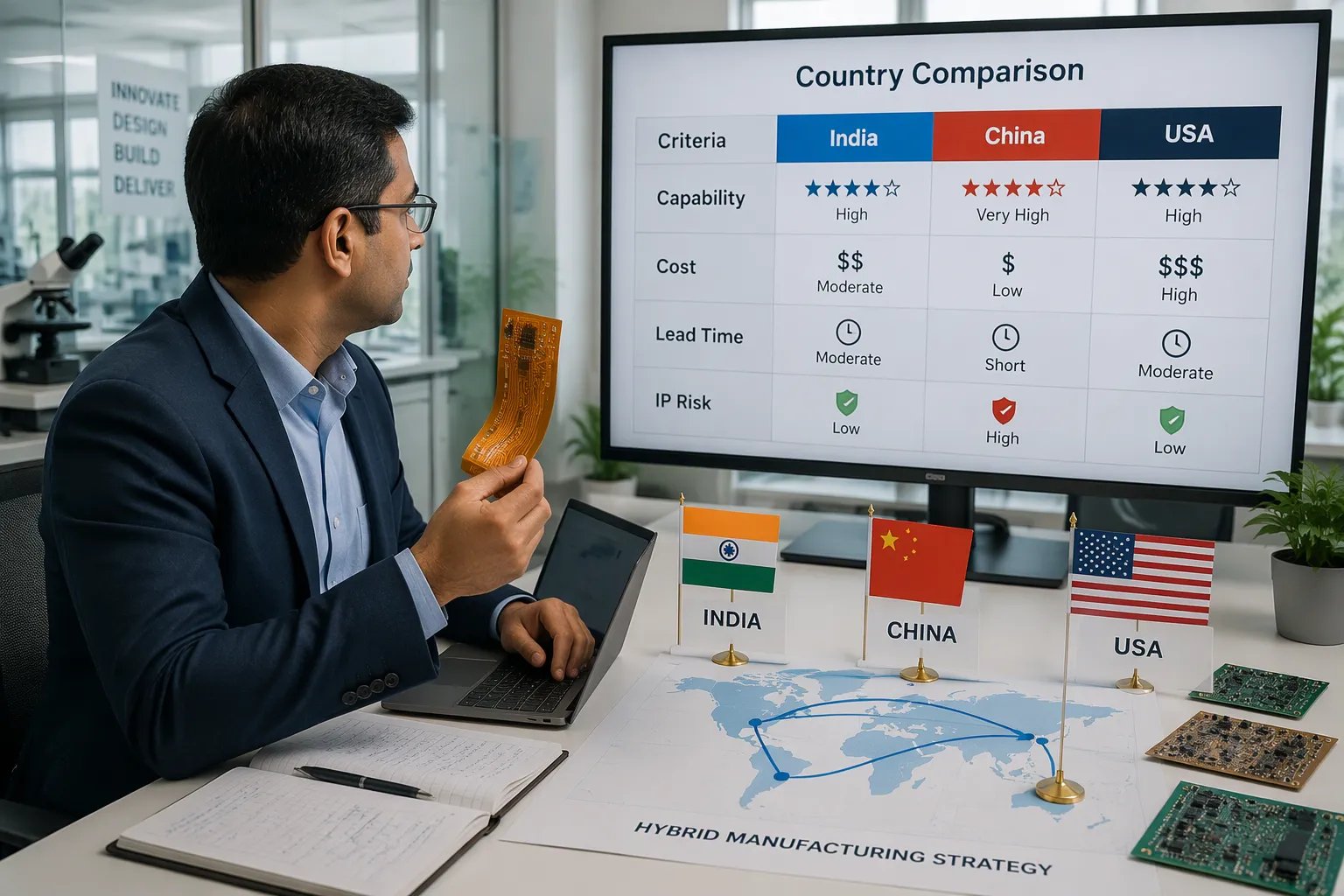
A short framework helps buyers map priorities to a source country. Advanced technology needs point to China, where dense flexible and rigid-flex builds have proven process control. Volume scale also favors China, since large factories absorb big orders without schedule drift. Budget sensitivity cuts both ways. India wins on labor-driven cost for mid-volume work, while China wins on highly automated high-volume lines. IP risk tolerance matters too. IP risk is lower in India than in China for Western buyers, and that fact belongs in the sourcing decision as a practical consideration, not a judgment about either country. Schedule predictability favors China. Local support favors India for regional programs.
Some buyers also weigh china vs usa pcb assembly options. That comparison is a related question, and each route has a legitimate fit. US pcb assembly suits programs that value domestic oversight and short domestic transit. A US pcb assembly partner can simplify compliance, ip protection and supply chain security for defense-adjacent or highly sensitive work. Buyers comparing offshore vs domestic manufacturing should treat all three routes as valid, then match each to program needs.
Many teams now run a hybrid manufacturing strategy. They place prototypes and advanced builds with one country and volume production with another. A well-chosen pcb assembly partner supports that split and keeps cost, lead time, and compliance visible across sites.
Summary Comparison Table
The table below compares capability, cost, and lead time side by side. Its purpose is to make trade-offs concrete at a glance. Buyers can scan it, then weigh cost, quality, lead time, compliance, and scalability against their own priorities.
Dimension | India | China |
|---|---|---|
Capability | Strong on standard and mid-range flexible builds; expanding capacity | Deep ecosystem for advanced flexible and rigid-flex, high volume |
Cost | Lower labor rates; competitive tooling on standard designs | Scale spreads tooling; strong on automated volume |
Lead time | 45–75 days typical | 30–60 days typical, more predictable |
The table does not declare a winner. It shows where each country fits. A buyer who needs advanced flexible capability and stable scheduling leans toward China. A buyer who needs lower cost and local support leans toward India. A buyer who needs domestic oversight may add US pcb assembly or PCBA quotes to the shortlist. PCBA programs with mixed volumes often benefit from splitting work across countries. Flexible sourcing works best when the framework drives the choice, not habit.
China fits programs that need advanced capability, scale, and predictable scheduling. India fits cost-driven, volume, or locally supported programs. Neither country is universally better. Buyers should weigh technology needs, budget, IP considerations, and schedule against the comparison table.
A practical next step: request quotes from flexible pcb manufacturers in india and from flexible pcb manufacturers in india partners abroad, then compare total cost, lead time, and compliance. Ask each supplier about flexible pcbs, flex pcb, flex pcbs, and flexible builds. Confirm pcb assembly, pcba, and us pcb assembly options. US buyers can also test us pcb assembly quotes. Let us validate assumptions with real quotes.
FAQ
Which country suits advanced flexible PCB builds?
China offers deeper capacity for advanced and rigid-flex builds. India handles standard and mid-range work well. Buyers with dense designs usually find more proven options in China.
How do lead times compare between the two countries?
Indian electronics manufacturing typically runs 45–75 days. Chinese suppliers typically run 30–60 days with more predictable scheduling. US buyers should build buffer time into cross-border shipments.
What drives total cost beyond the unit price?
Tooling, tariffs, freight, and inventory buffers all raise total cost. US buyers sourcing domestically avoid import hassle. A full landed cost model helps US teams compare pcb assembly and pcba quotes fairly.
See Also
Tailored AI PCBA Production Services for Electronics Firms in Mexico
Original Equipment AI PCBA Fabrication for Poland Electronics Manufacturing Plants
Bespoke Edge AI PCBA Solutions for American Hardware Startup Companies
Artificial Intelligence Inspection PCBA Services for Mexico Production Facilities
AI Server PCB Production for United States GPU Hardware Manufacturers