

Companies in Bangalore, Pune, and Hyderabad source Flex/HDI PCBA from China through specialized sourcing agents, direct supplier contracts, or online B2B platforms. Many pcb assembly companies in bangalore weigh three pillars before committing: technical fit, regulatory compliance, and landed cost. This post walks through each step of that process in practical detail.
Key Takeaways
Check suppliers for ISO 9001 certification and proven Flex/HDI experience before you commit.
Evaluate technical fit, compliance, and landed cost together to choose the best supplier.
Start with a pilot order and document inspection criteria to ensure quality and reduce risks.
Why Source Flex/HDI PCBA from China
Technical Capabilities for Flex and HDI
Chinese fabricators support fine-pitch routing, rigid-flex builds, and high layer counts. These capabilities matter for dense designs that pack many connections into a small area. Avary Holding, Benchuang Electronics, OurPCB, and TTM Technologies stand as examples of suppliers active in this space. The list serves illustration only, not endorsement.
Flex and HDI work demands tight registration and controlled impedance. Many Chinese plants run dedicated lines for these builds. Buyers gain access to mature process control for complex stackups. Rigid-flex combines flexible and rigid sections in one board. This construction suits products that fold or bend during use. Suppliers with rigid-flex experience can review stackup choices early and flag risk. High layer counts let designers route more signals through a compact board. Fine-pitch routing supports components with tight lead spacing. These process skills reduce the chance of rework later.
Cost and Application Fit
India depends on China for roughly 70% of its PCB supply. That figure frames the market context. Domestic capacity is expanding too. Lion Circuits’ Vijayapura campus represents a complementary trend. Both options can coexist in a sourcing strategy.
Cost and application fit vary by design. High-volume flex orders often benefit from China’s scale. Simpler boards may suit regional suppliers. Buyers should match each design to the right source. A dense HDI board with fine-pitch routing usually needs a supplier with proven process control. A basic two-layer flex may not. Volume, design complexity, and timeline shape the decision. Each factor deserves a separate review before a buyer commits. A pilot order tests both quality and communication before volume production begins. Buyers should document inspection criteria for each order.
Step-by-Step Sourcing Process
Supplier Identification and Qualification
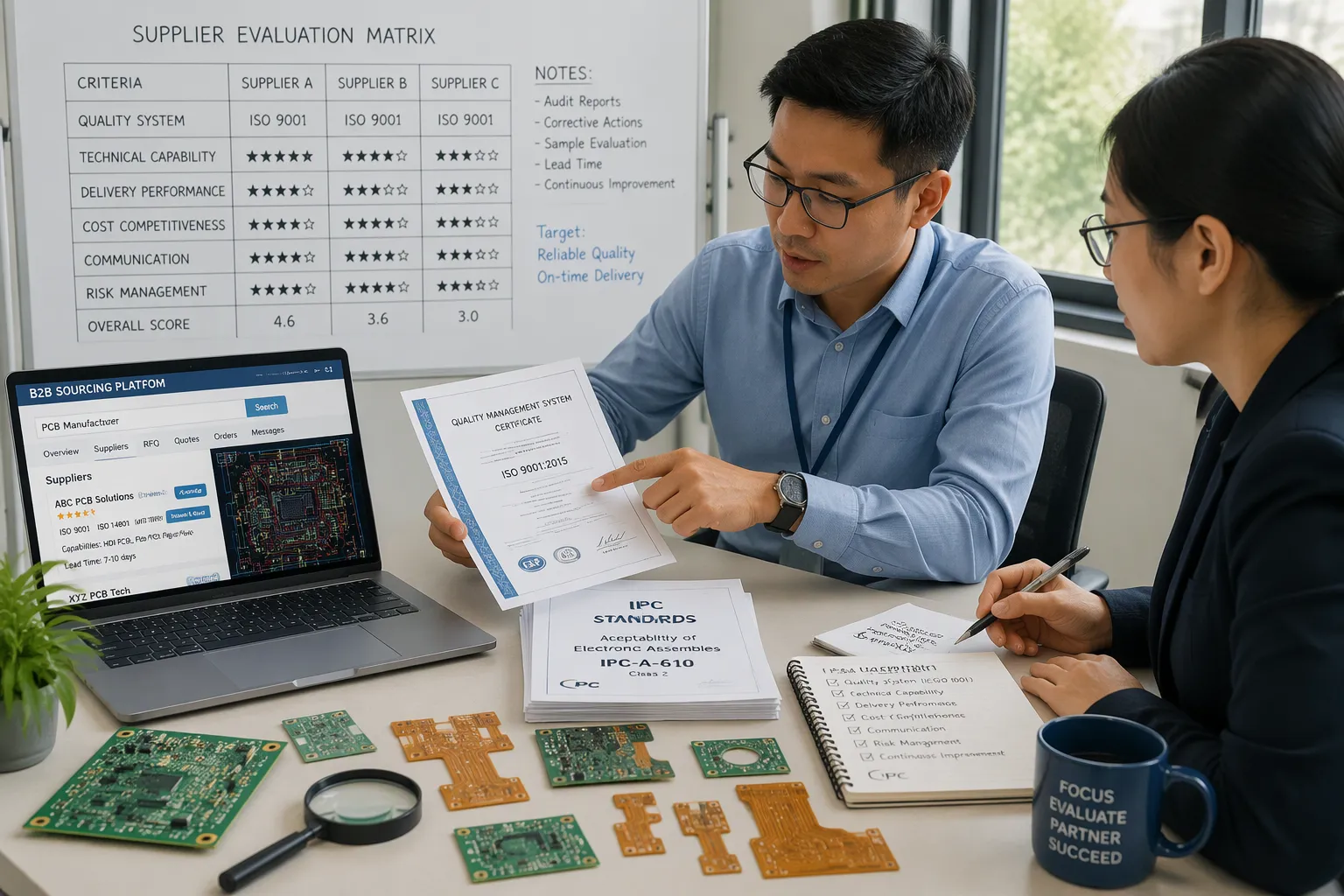
Buyers in Bangalore, Pune, and Hyderabad typically find Chinese Flex/HDI suppliers through three channels. Specialized sourcing agents bring vetted factory lists and handle communication. Direct supplier contracts suit firms with existing relationships or referrals. Online B2B platforms such as Alibaba offer the widest reach and the least upfront screening.
Each channel demands the same qualification discipline. A buyer should confirm ISO 9001 certification first. This standard shows a supplier runs a documented quality management system. Next, the buyer checks for proven flex and HDI experience. Factory photos, customer references, and sample boards reveal more than a catalog page. A supplier with dedicated flex lines and rigid-flex builds deserves closer attention. Buyers should also verify business licenses and export records. Agents can shorten this step, yet the buyer still owns the final decision. Platforms work best as a starting point, not a finish line.
Technical Evaluation and Compliance
Technical evaluation begins with the stackup. The buyer shares the design files and asks the supplier to propose a layer structure. A good supplier returns a design-for-manufacture review. This review flags tight spacing, thin dielectric layers, and impedance risks before tooling starts. Samples come next. A pilot build tests the supplier’s process control on fine-pitch routing and controlled impedance traces. The buyer should inspect the samples against agreed criteria and document every result.
Compliance checks run alongside the technical review. ISO 9001 covers quality systems. IPC standards, such as IPC-A-600 for bare boards and IPC-A-610 for assemblies, give the buyer a shared acceptance language. The buyer should name the IPC class in the purchase order. Import documentation matters too. Indian customs requires accurate invoices, HS codes, and certificates of origin. Missing paperwork delays clearance and raises landed cost.
Buyers should compare candidate suppliers on three axes only: technical fit, compliance, and cost. A supplier with strong flex experience but weak documentation creates risk at the border. A low-cost quote with no IPC alignment invites disputes later. The best choice balances all three. Pune and Hyderabad buyers can apply this same checklist without modification.
Logistics and Quality Control
Shipping, Customs, and Lead Times
Freight choice shapes both transit time and landed cost. Flex and HDI boards are thin, light, and sensitive to moisture, so air freight suits urgent pilot builds and small volumes. Sea freight lowers cost per kilogram for larger orders, yet it adds weeks to the schedule. Buyers should plan lead time as three blocks: production, transit, and customs clearance. Each block carries its own risk, and a delay in one pushes the others.
Customs paperwork decides how fast goods move. The buyer needs an accurate commercial invoice, the correct HS code, and a certificate of origin. A mismatch between the invoice and the packing list invites inspection and storage fees. Buyers should confirm the HS code with a customs broker before the first shipment. Flex boards also need moisture-barrier packaging. A supplier who ships without desiccant and a humidity indicator card hands the buyer a quality problem at the dock.
Incoming Inspection and Quality Management
Incoming inspection turns a supplier’s promise into verified fact. The buyer should check board dimensions, layer count, and surface finish against the purchase order. Visual review looks for scratches, delamination, and plating defects. For flex boards, a bend test on a sample coupon reveals cracking at the bend radius. The buyer should record every result on a written checklist and keep photographs with the lot number.
IPC-A-600 gives the acceptance criteria for bare boards, and IPC-A-610 covers assembly work. Naming the IPC class in the purchase order removes ambiguity at inspection.
Quality management continues after acceptance. The buyer should track defect rates by supplier and by lot. A rising trend signals a process drift worth a conversation. Feedback loops work best when the buyer shares inspection data and photos with the supplier. Repeat orders then start from a documented baseline instead of a fresh guess.
How PCB Assembly Companies in Bangalore Evaluate China Suppliers
Local Support and Regulatory Alignment
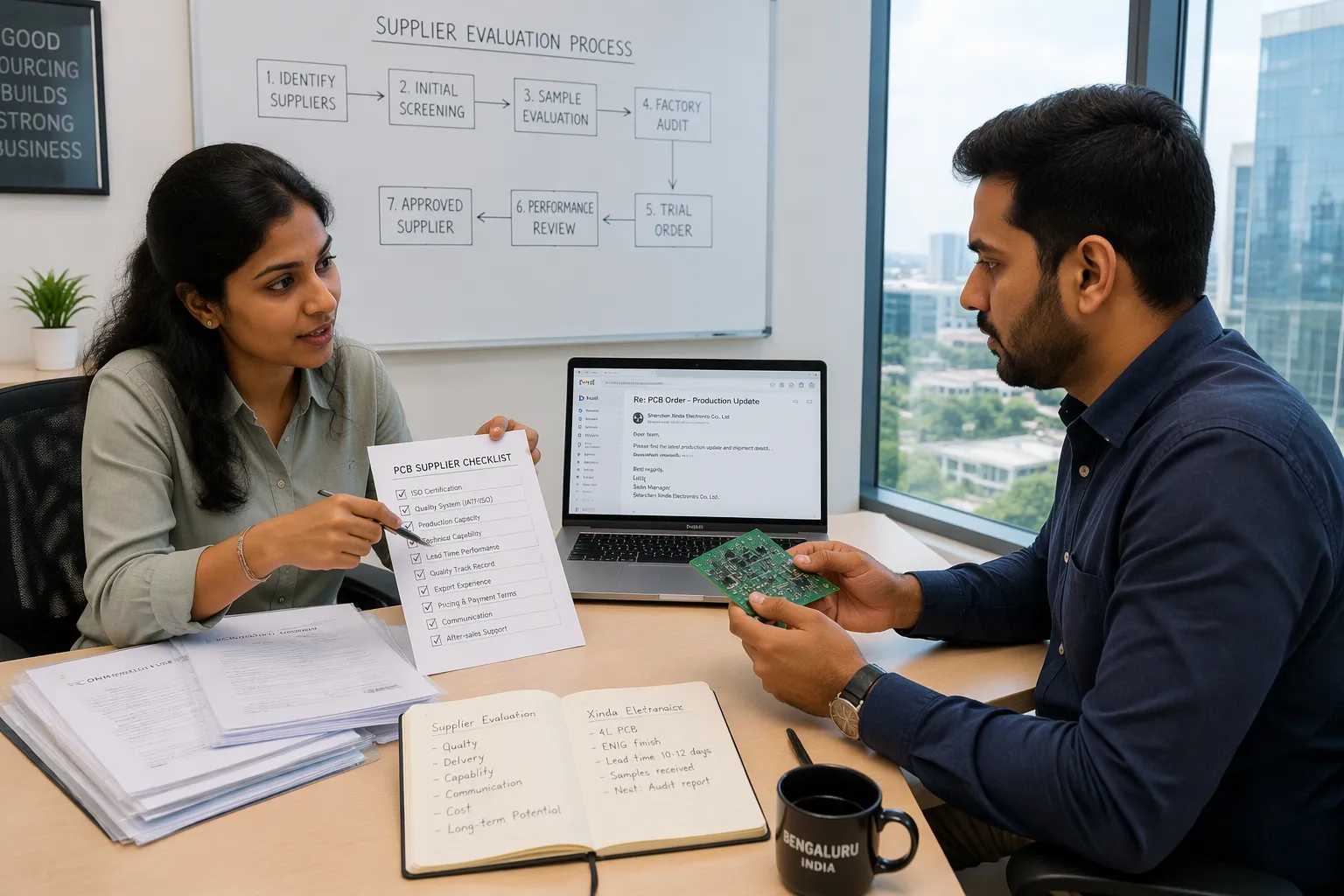
Bangalore hosts a cluster of design-to-sourcing firms. Zettaone Technologies, Alica Technologies, Aaviza Electronics, and MicroLOGIX serve as examples of local players active in this space. These firms bridge the gap between Indian design teams and overseas factories. They review stackups, translate specifications, and manage supplier communication. Many pcb assembly companies in bangalore rely on this local layer for faster issue resolution.
Local support matters most when problems surface. A time-zone gap slows a defect query. A local partner visits the buyer’s facility, inspects boards, and relays findings to the Chinese supplier. This arrangement shortens the feedback loop. Buyers should confirm that their chosen partner holds direct contacts at the factory, not just a sales desk.
Regulatory alignment with Indian import rules deserves equal weight. The buyer must secure a valid Import Export Code, classify goods under the correct HS code, and keep invoices consistent with the packing list. The Directorate General of Foreign Trade governs these rules. A supplier unfamiliar with Indian paperwork creates clearance delays. Buyers should ask the supplier for prior India shipments and review the documents from those runs.
Pune and Hyderabad buyers can apply this same checklist without change. Both cities host design houses with similar sourcing needs. The evaluation criteria do not shift by geography. A partner with proven India import experience serves all three hubs equally well.
Cost Management Across the Three Hubs
Landed cost drives the final supplier choice. The calculation combines unit price, freight, customs duty, and inspection overhead. Each hub weighs these factors differently.
Cost Factor | Bangalore | Pune | Hyderabad |
|---|---|---|---|
Freight routing | Strong air cargo links | Road feeder to Mumbai | Air cargo via Hyderabad |
Buyer profile | Design-heavy, low volume | Automotive, mid volume | Mixed, growing volume |
Cost lever | Consolidate pilot shipments | Batch orders for scale | Balance air and sea freight |
Bangalore buyers often run low-volume, high-mix orders. Consolidating several designs into one shipment lowers freight per board. Pune buyers lean toward automotive work with steadier volumes. Batch orders spread tooling cost across more units. Hyderabad buyers face a growing mix and should balance air freight for urgent builds against sea freight for volume runs.
Many pcb assembly companies in bangalore track defect rates and freight spend side by side. This habit reveals the true cost of a supplier. A cheap quote with high defect rates costs more over a year. Pune and Hyderabad buyers benefit from the same discipline. A shared cost model keeps all three hubs honest about supplier performance.
The Import Export Code and HS classification fall under Directorate General of Foreign Trade rules. Buyers should verify both before the first shipment.
Firms that treat local support, regulatory alignment, and cost as one package make better supplier choices. The checklist travels well across all three cities.
The sourcing path repeats well. Buyers qualify suppliers on technical fit first, verify compliance next, then optimize logistics and cost. Teams should start with a pilot order, build a dual-supplier strategy, and document inspection criteria. Many pcb assembly companies in bangalore follow this sequence. China sourcing works best when matched to each company’s volume, design complexity, and timeline needs.
FAQ
How do buyers in Bangalore, Pune, and Hyderabad find reliable Flex/HDI suppliers in China?
They use sourcing agents, direct contracts, or B2B platforms. Each channel needs the same checks: ISO 9001 certification, proven flex and HDI experience, and verified export records.
Which documents should accompany a Flex/HDI shipment from China?
Buyers need an accurate commercial invoice, the correct HS code, and a certificate of origin. An Import Export Code supports Indian clearance. Moisture-barrier packaging protects the boards in transit.
How do buyers compare Chinese suppliers on cost and quality?
They weigh unit price, freight, duty, and inspection overhead together. A cheap quote with high defect rates costs more over a year. Technical fit and compliance come first.
See Also
Tailored AI PCBA Production Services for Electronics Firms in Mexico
Artificial Intelligence PCBA Inspection Solutions for Mexico Manufacturing Facilities
Original Equipment AI PCBA Production for Electronics Plants in Poland
AI and IoT PCBA Production Services for Hardware Businesses in Malaysia
Bespoke Edge AI PCBA Manufacturing for American Hardware Startup Companies